12 SO-101 robot arms for my robotics class 🤖
Last year, students built their SO-101s from scratch. This year, with help from our TA @ZQ_fantastic, we handed out 12 pre-built arms so they can jump straight into arm calibration!
More time for robots!
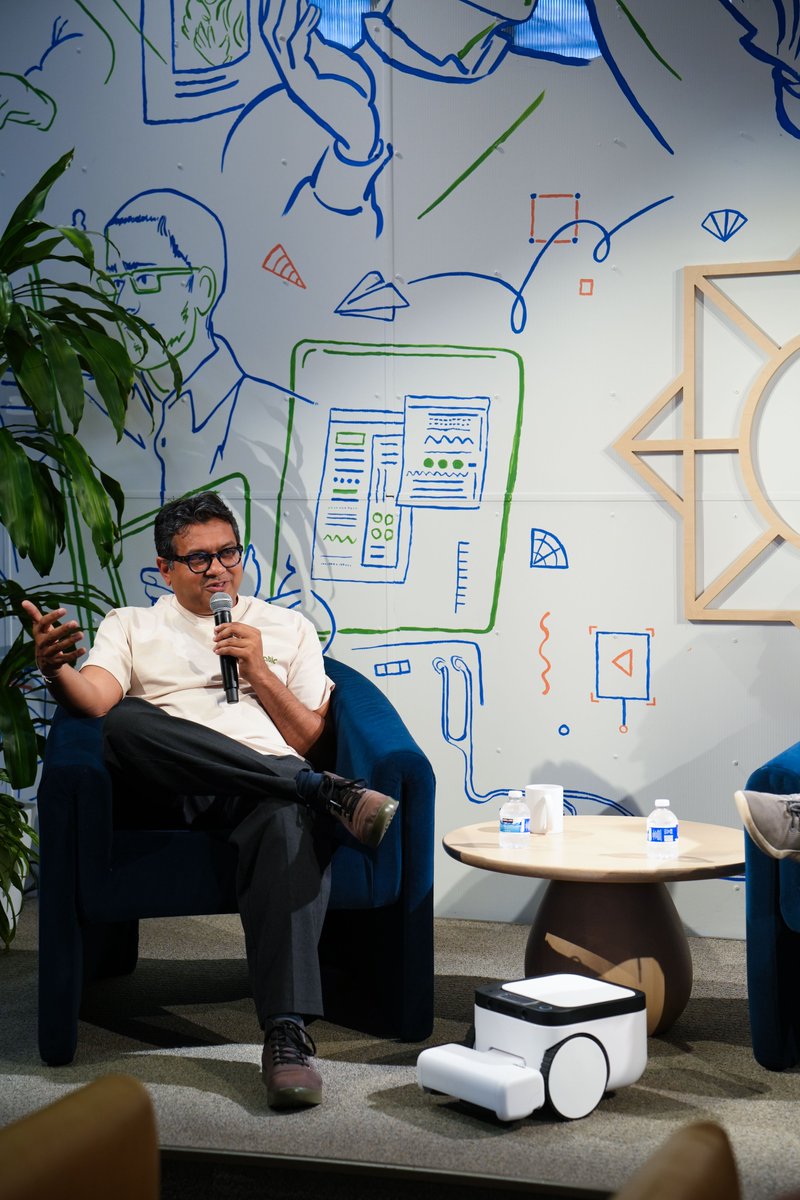
There's a graveyard of robotics companies that have chased what's cool. @maticrobots built a cleaning bot people love and need. @mehul shared his insights at @spc .
After chasing cool at Flutter, @navneetdalal and @mehul decided to deeply understand the problem before the solution. A 21 page problem deck before the pitch deck.
Start with the customer. What does a family with kids and pets want? A home whose entropy perpetually collapses to zero. So a robot that sees intelligently and cleans well: 5 RGB cameras set at a high vantage point to understand your home and a rectilinear cleaning head shaped for its straight lines, unlike circular bots.
How should the robot feel? Like a family member. So the unboxing feels like greeting a guest at the door instead of lifting an object out of a box. Nobody wants a noisy family member, so they ditched the loud dock. The interface is human: natural language and pointing.
Decisions that came from obsessing over the problem, making hard tradeoffs, iterating and shipping ruthlessly against real feedback. Their bar for what's useful is the microwave test: if it breaks, you replace it immediately because you can't fathom your life without it.
@willsentance and I enjoyed moderating this one
After so many demos, models, pilots, robots are still struggling to land real deployments with real customers. Until now.
Today we’re excited to share that our robots have successfully crossed the ROI threshold, and Din Tai Fung, one of the highest revenue per location restaurant chain in the US, is rolling out Dyna robots across its extensive restaurant network.
This brings our rollouts across hotels, logistics, data centers, and many other use cases to a fleet that reaches hundreds of robots by the first half of 2027. And we’re just getting started.
It’s been a wild year, and today we’re double clicking on the battlefield stories and sharing a few learnings about scaling robot deployments. We are just scratching the surface.
Read the full blog post: https://t.co/8QVEoQuzBY
AI for science is the most exciting area of exploration at @SPC right now.
Next week, we're bringing together leading life sciences leaders for a deep dive on AI and the wet lab. The first of many deep dives into AI x science.
Spots are limited.
Cassidy, that's a great question... not a hater at all.
The best way to say it is that Matic is Robotics 2.0 a robot with actual intelligence vs. disc robots which are really automation w/o intelligence.
The first Roombas (without cameras) were like wearing a blindfold, folding hands, and then bouncing from wall to wall to cover a room. Roombas with cameras or Disc bots with LIDAR (single-pixel laser sensors) are still wearing a blindfold but now they have a hand extended as a single laser to see if something in their path. However, if the obstacle is higher or lower than the laser, they still bump into it. They also don't really know if the obstacle is a wall or counter or table a door, etc. They neither truly detects or recognizes obstacles. Their flat, ant-like vantage point prevents any real understanding, that's why they can't see wires and get stuck no matter how many sensors they keep adding to the device.
Matic is a completely redesigned, reengineered, and reinvented robot with Vision-Only AI robot that sees like human, so it can clean like us. The vantage point of the robot is the same as crawling human child, so it see our floors top the down the way we do. This is why it:
**** deftly navigates around any surface/obstacles using visual intelligence
****quieter than dishwashers at 55dBA
****recognizes floor types auto-toggles between vacuuming and mopping - knowns it can't mop a rug
****outperforms any vacuuming and mopping robot (in our own homes and tests -- I have 3 kids and a golden retriever)
****Convenience of HEPA bags that keep the air clean and eliminate the hassle of changing filters
Air coming out of vacuums is cleaner than air going in which is not the case with disc bots
****private — keeps your data within 4 walls of your home with all edge device processing (no cloud at all)
In addition, We wanted to solve problems that disc robots struggle with:
**** Disc robots struggle with thresholds or shag rugs or thick pile rugs -- for that big wheels of matic help.
**** Actuated cleaning head adjusts to different thickness of the rugs and dynamically changes suction/brush roll speed to clean rugs that even manual vacuums cannot clean.
**** Designed to deal with pet hair in a way tha it doesn't get clogged and don't have to flip the robot and cut hair - so easily accessible brush roll.
**** Cleaning head is littler over 2" tall so it can easily fit under space below kitchen cabines and visible dirt under the couches and furniture. Those don't get dirty as frequently as visible area.
**** And one the things we cared about and have heard from any customers is that it doesn't scare pets and kids.
**** as mentioned above, higher vantage point of cameras (instead ant-like vantage point of disc robots) allows us to see floors the same way we do at 45 degree angle -- this means it can truly see what obstacles are and avoid it. No more wire chewing.
**** In addition, just like the bottom of the cars get dirtier faster, flat robot sensors get dirtier much faster too, and then they make all kinds of mistakes. Higher camera position allows robot to see like humans at 45 degree angle to the floor and doesn’t get dirty. So, the trade-off is also intelligence.
We talked to many users and felt that cleaning obviously accessible area thoroughly, effectively, w/o needing to babysit around obstacles was a far bigger use case for families with kids and pets than cleaning underneath the furniture.
As a pet owner and father of 3 kids, our primary need wasn't under the furniture. That can be cleaned once a month as a deep clean. We wanted something that would clean day to day messes, hair of my golden retriever, cookie crumbs, kitchen, etc., constantly w/o needing supervision. We wanted something that would clean our thick shag rugs and go over them (which disc robots cannot). So we prioritized the needed for families like us.
@maticrobots is the first cleaning bot that hasn't gotten stuck in my house nor destroyed my plants for 6+ months. It just works. Less babysitting means I run it more. I come to a cleaner home more often.
The thought process, deep care and ruthless focus behind matic:
Cassidy, that's a great question... not a hater at all.
The best way to say it is that Matic is Robotics 2.0 a robot with actual intelligence vs. disc robots which are really automation w/o intelligence.
The first Roombas (without cameras) were like wearing a blindfold, folding hands, and then bouncing from wall to wall to cover a room. Roombas with cameras or Disc bots with LIDAR (single-pixel laser sensors) are still wearing a blindfold but now they have a hand extended as a single laser to see if something in their path. However, if the obstacle is higher or lower than the laser, they still bump into it. They also don't really know if the obstacle is a wall or counter or table a door, etc. They neither truly detects or recognizes obstacles. Their flat, ant-like vantage point prevents any real understanding, that's why they can't see wires and get stuck no matter how many sensors they keep adding to the device.
Matic is a completely redesigned, reengineered, and reinvented robot with Vision-Only AI robot that sees like human, so it can clean like us. The vantage point of the robot is the same as crawling human child, so it see our floors top the down the way we do. This is why it:
**** deftly navigates around any surface/obstacles using visual intelligence
****quieter than dishwashers at 55dBA
****recognizes floor types auto-toggles between vacuuming and mopping - knowns it can't mop a rug
****outperforms any vacuuming and mopping robot (in our own homes and tests -- I have 3 kids and a golden retriever)
****Convenience of HEPA bags that keep the air clean and eliminate the hassle of changing filters
Air coming out of vacuums is cleaner than air going in which is not the case with disc bots
****private — keeps your data within 4 walls of your home with all edge device processing (no cloud at all)
In addition, We wanted to solve problems that disc robots struggle with:
**** Disc robots struggle with thresholds or shag rugs or thick pile rugs -- for that big wheels of matic help.
**** Actuated cleaning head adjusts to different thickness of the rugs and dynamically changes suction/brush roll speed to clean rugs that even manual vacuums cannot clean.
**** Designed to deal with pet hair in a way tha it doesn't get clogged and don't have to flip the robot and cut hair - so easily accessible brush roll.
**** Cleaning head is littler over 2" tall so it can easily fit under space below kitchen cabines and visible dirt under the couches and furniture. Those don't get dirty as frequently as visible area.
**** And one the things we cared about and have heard from any customers is that it doesn't scare pets and kids.
**** as mentioned above, higher vantage point of cameras (instead ant-like vantage point of disc robots) allows us to see floors the same way we do at 45 degree angle -- this means it can truly see what obstacles are and avoid it. No more wire chewing.
**** In addition, just like the bottom of the cars get dirtier faster, flat robot sensors get dirtier much faster too, and then they make all kinds of mistakes. Higher camera position allows robot to see like humans at 45 degree angle to the floor and doesn’t get dirty. So, the trade-off is also intelligence.
We talked to many users and felt that cleaning obviously accessible area thoroughly, effectively, w/o needing to babysit around obstacles was a far bigger use case for families with kids and pets than cleaning underneath the furniture.
As a pet owner and father of 3 kids, our primary need wasn't under the furniture. That can be cleaned once a month as a deep clean. We wanted something that would clean day to day messes, hair of my golden retriever, cookie crumbs, kitchen, etc., constantly w/o needing supervision. We wanted something that would clean our thick shag rugs and go over them (which disc robots cannot). So we prioritized the needed for families like us.
Congrats @spc on Fund IV! Inspiring to build alongside a talented community with unique perspectives. The gap between what's possible and what the world needs is shrinking. No better time to bring more useful robots into the world!
Today we’re announcing SPC Fund IV: $575M to help founders find their life’s work.
A decade of guiding founders through -1 to 0 brings @SPC to $2B in AUM and, more importantly, a 1200 member community of the world’s most talented technologists. We strongly believe that:
→ The person comes before the idea. At -1, generational founders are often busy reading, prototyping, discarding, and earning the right to their own conviction.
→ Ambition is social. The people you surround yourself with in the early days play a big part in inflecting your ambition.
→ Patience compounds. It is better to work on something you have deep conviction in rather than simply sprint at the first idea.
The quiet months we protect at the beginning have produced three funds in the top 10% of their vintages, and companies like @baseten, @GammaApp, @render, @GoodfireAI, @LumaLabsAI, and @profound. We are proud to have worked with all these founders in their -1 phase and beyond.
While we defined -1 to 0, we're no longer bound by it. Fund IV allows us to partner with companies well beyond launch.
We're doing this now because we've never seen a wider gap between what's possible and what's being attempted. Intelligence is abundant. The cost of trying ideas keeps falling, and problems that seemed insurmountable a few years ago are quickly becoming solvable.
To our members, to the founders who trusted us before anyone else did, and to the LPs who had conviction in our own -1 journey: thank you. This milestone belongs to you as much as to us.
To the builders looking to find your life’s work: let’s get started.
We set out to collect 10M hours of on-embodiment data as a starting point for robotics models, but couldn’t find a robot reliable enough at a price that made it possible. So, we built one.
Meet Pandroid: an accessible hardware platform for AI. Small enough to safely experiment with, durable enough to run in fleets. Connect it to any model or coding agent over SSH to let it interact with the world.
Join the waitlist:
Glove data is faster to collect than teleop, but sensor mismatch has limited transfer. Learn a straight-line path from human to robot latents and transfer without explicitly paired data. One option to scale past the teleop bottleneck
Dexterous hands vary widely—so do tactile modalities. 🖐️🌈
Our vision on tactile human-to-robot transfer:
🔓 Not tied to specific hardware
♻️ Reuse human tactile demos across embodiments
Presenting TactAlign, a cross-sensor tactile alignment for cross-embodiment policy transfer.
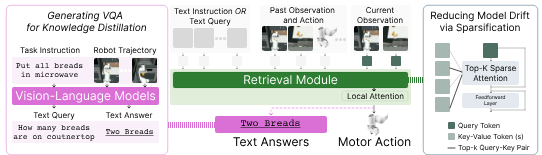
1/ A robot with memory can learn to cheat 📄
Long-horizon tasks need information that's no longer in view. Attention-based memory retrieval is promising, but has 2 failure modes: the policy latches onto past spurious correlations and errors compound as history grows 🧵
4/ Result: outperforms text-based memory summarization since the policy can exploit prior visual and action tokens that VLMs discard with text summarization
Why it matters: how you retrieve matters more than how much you store, co-training with VQA makes retrieval task-relevant
📢The #RSS2026 program is live now!
The technical sessions are now online and feature cutting-edge research across robotics, from robot learning and foundation models to perception, manipulation, planning, and embodied AI!
Explore the sessions here:
https://t.co/u9whk8ACOl