@ThinkAppraiser Why is that? Like what are common reasons for delays and budget over runs? Can’t it be as simple as structuring agreements to align incentives? Embed penalties or “
bonus-like payments to contractors if they don’t, or do, meet expectations?
The amount of financial illiteracy on this website makes me so sick.
For the love of god, if you think that the S&P/Nasdaq today represents a no-brainer opportunity because it only goes up, please read this.
Let's take a step back and decompose stock returns. Stock returns are the sum of dividend yield and price appreciation.
Dividend yield has historically been between 1% and 2% every year (excluding 2008), so there is not much debate here.
Price appreciation is the result of (i) earnings (EPS) growth and (ii) change in price to earnings (also called valuation/multiples)
(i) EPS have compounded at ~6% for decades. Some people argue that AI will change the growth algorithm, but let's keep this aside as this is not what is driving the narrative.
(ii) Change in multiple: this is essential to understand. If you buy stocks at a very expensive multiple, it will be really hard to make money, unless your earnings really grow quickly.
When I hear tech bros saying, "Imagine selling at the crash in March," I feel bad because they simply do not understand what they are buying.
Today, people who expect the S&P to keep performing like it has the last decade are honestly delusional and are not looking at the data.
They do not understand that buying the S&P means paying a certain amount of dollars for each dollar of earnings.
Today, you are paying a really steep price for each dollar of earnings.
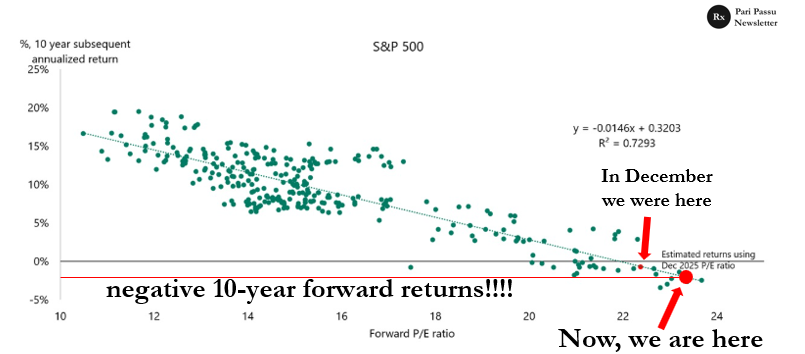
Do you remember when Apollo posted that image saying the next 10 years' returns will be 0%, and everyone talked about it for 2 days? Well, let's revisit that image with what has happened since.
The S&P has gone up more, and the forward multiple is ~23.5x today, vs 22.5x in December. What does this mean if we look at historical performance?
That the expected return when buying the S&P at this valuation is negative over the next decade. Read that again.
The expected return when buying the S&P at this valuation is negative for the next decade!
Does this mean that the S&P will keep going up? No one knows, and that's the point. Just do not buy because "it always goes up"
Obviously not investing advice.
@FreightAlley@FreightAlley Hi Craig, curious to hear your take on how the current crude environment might impact the demand/supply dynamic being setup. For carrier profits, do you think the positives from the building demand/supply dynamic will outweigh the negatives from higher fuel costs?
@CapexAndChill Hey, big fan and thank you for sharing all this, learning a ton. Was wondering if you have seen anything in the utilization rates of the Chilean logistics infrastructure. Fulfillment capacity rose significantly yoy - how much of that excess capacity is being used/planned 4 use?
US Treasury Department announced tentative buyback program for Tsy issues across the yield curve, which potentially includes TIPS. About 9 weekly purchases announced beginning 5/29/24. Details announced one day prior.
#USTreasury#marketupdates
Often (but not always) credit spreads will tighten when Tsy yields are rising, leading to a more muted increase in credit yields.
Last fall, credit initially ignored the big bond selloff, but spreads eventually began widening at the same time Treasury yields were rising...
1/6