We just raised $7.5M to build the infrastructure for identity and fraud.
The round is backed by @ycombinator, Orange Collective, Rebel Fund, Pioneer Fund, and other incredible VCs and angels.
AI is making fraud incredibly cheap to create: fake identities, fake businesses, fake transactions, all generated at internet scale. We believe every app will soon need trust infrastructure the same way apps today rely on payments or cloud hosting.
The future of the internet is verified. Didit (@didit) is building it.
We merged nearly 2,300 PRs in the last 30 days alone at @didit, 99% automated. Been heads down this month powering a true Company Factory: a company that runs itself, tapping humans only when strictly necessary.
The volume of output is massive. There is nothing quite like waking up to 50+ new PRs ready to go. These are fully reviewed by other agents arguing until they reach a consensus (a literal PR AI war). By the time they hit my queue, they have AI approval, clean CI passes, and visual proofs attached.
I will be dropping a video soon breaking down exactly how this works under the hood. Stay tuned.
Didit keeps evolving.
We started as a KYC product, but very quickly realized the problem was much bigger than verifying someone at sign-up.
Companies need infrastructure they can build on top of to understand who is behind an account, whether they can trust them, and whether that changes over time.
So Didit expanded into identity + fraud infrastructure across the full user lifecycle: KYC, KYB, biometrics, AML, transaction monitoring for fiat and crypto, authentication, device intelligence, and more.
People who follow us probably know we ship faster than we can even properly launch things 😅
So we thought it was finally a good time to record one video that explains what Didit is today, what you can build with it, and where we are going.
We are getting very close to the vision we had from the beginning: becoming the trust layer of the internet.
The internet should be a safe place to transact, build, and interact, and trust infrastructure should not only be accessible to the biggest companies in the world.
Unico IDCloud is now available on Didit for verifications in Brazil.
Selfie + CPF checked against a biometric database covering 96% of the economically active population. Answers in under 3 seconds, document capture only as a fallback.
https://t.co/LMHHynTJ5H
Face match, live. We ran a session against a mismatched ID and watched it decline at 1% similarity in real time, then re-ran with the right face and cleared at 95%. Every result streams back so you can build on top of it.
Robinhood Ventures Fund II has invested in Didit.
The fund lists on the NYSE as $RVII on August 13 with about 80 startups, most from @ycombinator. Anyone with a brokerage account can own a piece of them.
Including a small piece of Didit.
Read more: https://t.co/jU2EqkfdQB
Face matching now flags duplicates. If someone's already verified on your system, you get a warning the moment their face shows up again, and you set how strict those warnings are. One person, one account, no matter how many times they try.
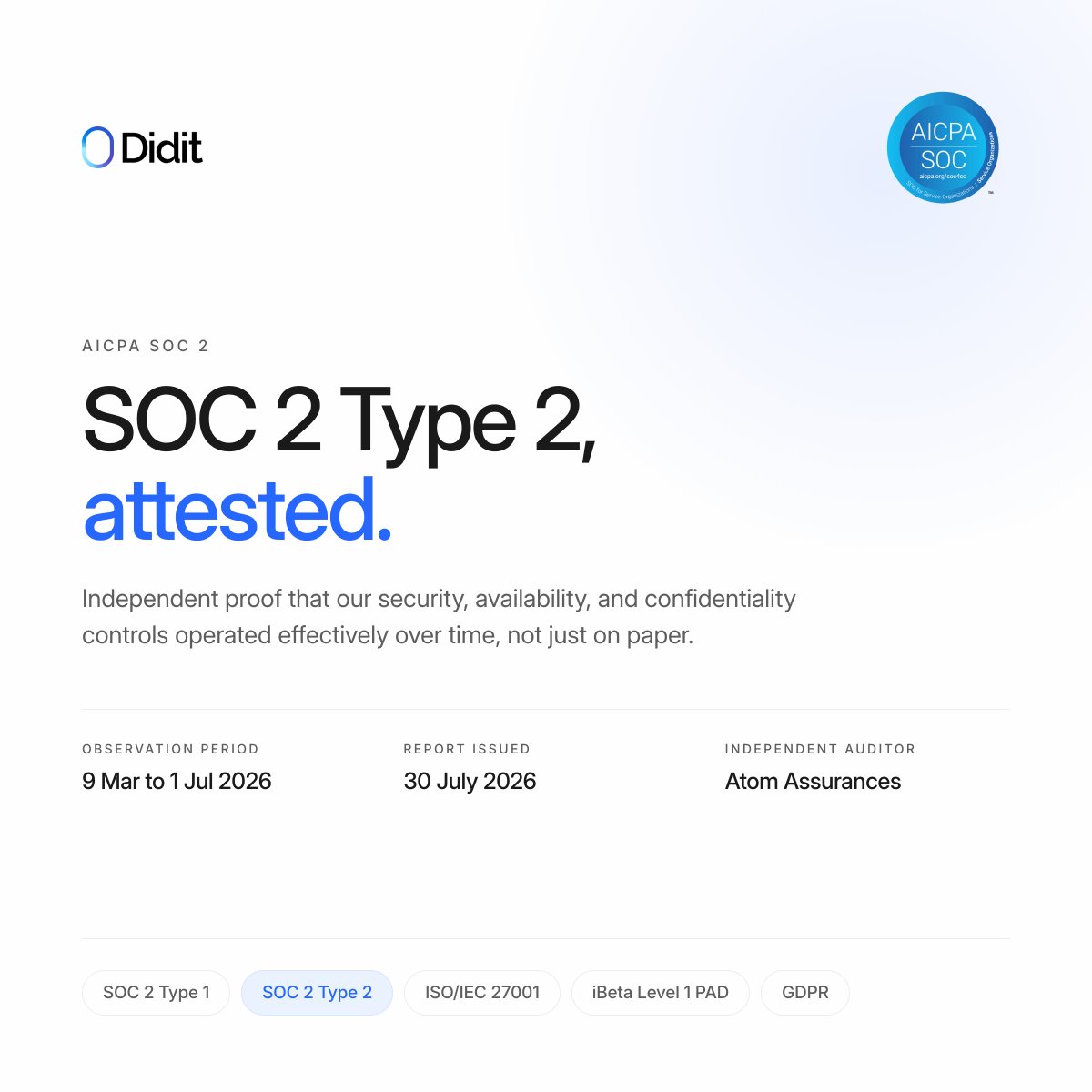
Didit is now SOC 2 Type 2 attested.
Type 1 says the controls are designed right. Type 2 says they ran that way, day after day, across a four-month independent audit of our security, availability, and confidentiality controls.
Identity fraud is easiest to understand when you watch the full verification happen live.
In this video, Alberto Rosas, CEO of Didit, builds a know your customer (KYC) workflow from scratch and tests it twice: the wrong face of Gabriel Jarrosson is declined, then the correct person passes.
https://t.co/oDgUH63h8M
Didit Console. Build an identity and fraud workflow the way you want it, pick your countries, connect any database with one click, preview exactly what the end user sees in real time. No code needed to design the flow. API first when you're ready to ship.
One of our team started as a filmmaker, then a designer pushing pixels in Figma. Now he clones the repo and ships the pull request himself. The line between designer and developer is gone. He just builds it.
Identity verification is heading toward something you do every day, not a few times a year. As AI agents flood the web and generated content erodes trust, proving you're human becomes the default for social platforms, marketplaces, and regulated apps alike.
Everyone says the identity layer of the future has to be blockchain. It doesn't. Blockchain is just a public database of timestamped proofs, and we already sign credentials cryptographically inside private registries. Same trust, no data exposed.
Payments used to be a mess of banks and country rules until Stripe made it a few lines of code. Identity is the same fight. Fragmented providers, compliance-only tooling, no one building for developers. So we did. Infrastructure for identity and fraud.