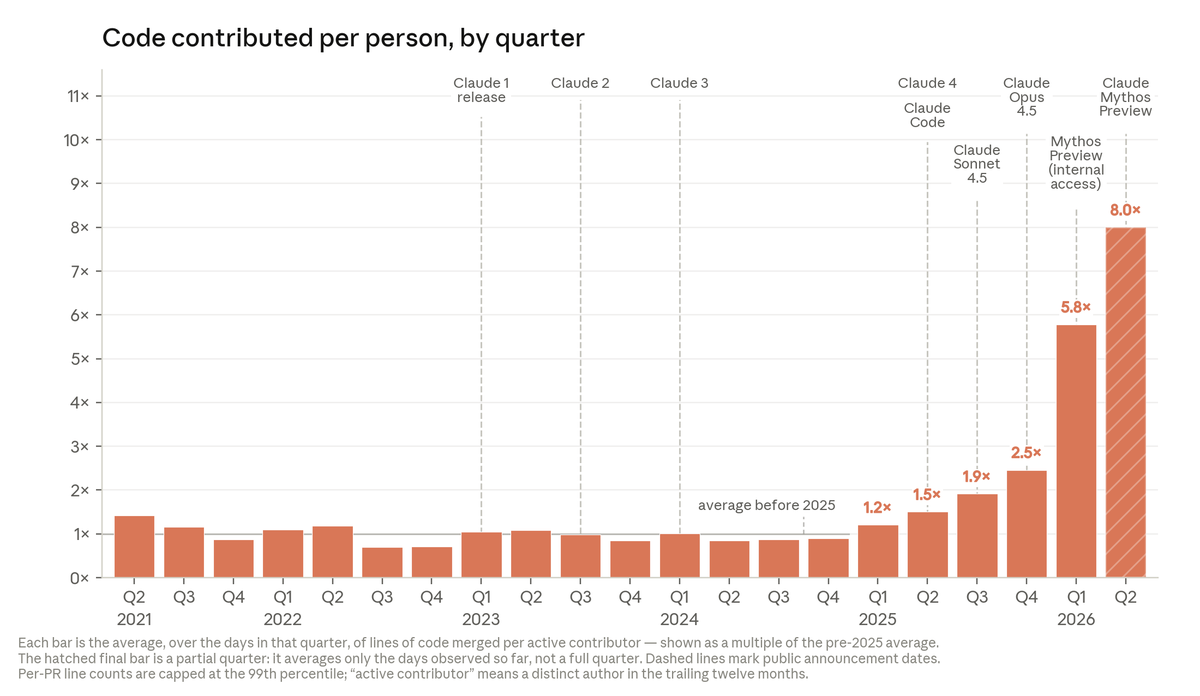
I'm impresed by the launching speed of Anthropic. They've been able to create so much value for me these last years.
I'm worried by their "LOC". Will they be able to maintain what they launched and keep adding value at this rate?
I hope so, the last months track record is amazing
I can't believe that "lines of code" is a metric in 2026.
I remember working in a software company 15 years ago where they bragged about the LOC of their product 😅
Lines of code means technical debt, it's plain bad.
You want as much value for users with as little LOC as possible
Supernatural is returning under a new independent company, with Meta handing the IP back to the original founders and coaches who are reuniting to carry the VR fitness service forward:
https://t.co/xdKublxB06
I have to say this again.
Here is what actually happened.
Apple did pause the Vision Air project last year, but not because it gave up on headsets. Internally, Apple concluded that Vision Air was still not light or thin enough. So the company chose a more aggressive path instead.
That new project is roughly similar in direction to Meta’s Phoenix, a much lighter and thinner headset. It is being developed by a separate, newer team inside Apple.
Apple will probably run another internal review toward the end of this year, comparing Vision Air with this newer, more aggressive direction, before making a final decision on which product to move forward with.
MAI-Thinking-1: el primer modelo fundacional de Microsoft SuperIntelligence (MSI). El equipo de MSI Madrid ha participado activamente en su diseño y entrenamiento! Y buscamos más AI engineers excepcionales para crear los próximos modelos de Microsoft desde España! DM para+info 🚀
@charliermarsh Sometimes they're a good reason to work on something. When people say a market is "crowded," what that often means is that there's a real problem and none of the solutions are good enough yet.
Exactly right. The bottleneck has never been compute or capital. Its taste and judgment about what humans actually want. Infinite compute just makes the great founders faster and the confused ones more confused. https://t.co/AmPmal8NYF
Thought experiment: if every company suddenly had infinite free compute, what new products would emerge?
My take: with very few exceptions, not much would change. The bottleneck is figuring out what people want, and it’s not so easy to apply compute to solve that.
I got to be one of the first to experience Real Madrid fighting for the Champions League in a way nobody ever has before.
The new Apple Immersive documentary behind the legacy of Real Madrid is coming out on Friday, and trust me, it’s one you can genuinely be excited for, even if you’re not into the sport.
In one moment, you’re getting closer to the players than any VIP ticket could ever get you, experiencing the action as if you could be in ten places at the same time, and in the next, you’re sitting together with the fans, feeling their reactions and emotions like you’ve always been sitting there with them.
It’s this kind of “god-view” that makes Apple Immersive so special. It’s not just visually immersive, it’s the first format that really manages to capture the full picture and show more than just a single perspective.
Personal update: I've joined Anthropic. I think the next few years at the frontier of LLMs will be especially formative. I am very excited to join the team here and get back to R&D. I remain deeply passionate about education and plan to resume my work on it in time.
My reply to someone considering starting a video game company:
The distribution of possible rewards for starting a video game company are generally not very good today. The market is well served, and gaining a foothold requires strong execution on both business and product issues, along with a substantial amount of luck. Plan to burn through seven figures with a not-great chance of making it back.
If you do go for it, some bits of advice:
Identify your customers clearly before you start. Not just a broad community, but specific people, and imagine them as you make decisions.
Initially, build the smallest, most concise game you can imagine anyone paying for. It will still take much longer than you expect.
Once something exists, hill-climb the value. Hopefully you will have some elements that clearly bring joy to people, which you can magnify. There will inevitably be tons of things that people find confusing, frustrating, or just boring that you will need to fix.
I mean... Apple may abandon VR. It could happen, it could have happened in 2026.
It wouldn't be such a shock.
But the @markgurman posts are about priorities changing, delays, less focus on VR.
Reporters reading this seem to conclude that "VR is dead again" :).
Unsurprisingly, many posts claim that Apple's VR "is dead".
The original reporting by @markgurman wasn’t about Apple abandoning VR at all. It was about slowing some developments, reassessing priorities, and possibly changing direction.
Delays & changes, but not "leaving VR".
Mark Gurman’s report captured part of the story, but there is another part it didn’t cover.
Here is what actually happened.
Apple did pause the Vision Air project last year, but not because it gave up on headsets. Internally, Apple concluded that Vision Air was still not light or thin enough. So the company chose a more aggressive path instead.
That new project is roughly similar in direction to Meta’s Phoenix, a much lighter and thinner headset. It is being developed by a separate, newer team inside Apple.
Apple will probably run another internal review toward the end of this year, comparing Vision Air with this newer, more aggressive direction, before making a final decision on which product to move forward with.
Dedicated wearable hardware for AI agents is starting to feel imminent.
The hardest part is privacy — especially other people’s privacy when you’re wearing AI-powered sensors.
I think glasses are the right form factor, but the social privacy problem needs to be solved.
Fun!
Anthropic gave these out yesterday at code with claude.
Added personalized memory and Claude to it.
You can just build things. @bcherny@trq212
Time to add managed agents to this. That’s going to be so cool.
Space launch was a clear case where there was a large difference in efficiency between what was possible and what was done in practice before SpaceX. A large part of that was due to everything being locked in to what (just barely) already worked, with huge risk aversion. WIth national prestige or a half billion dollar geosync satellite on the line, speculative engineering ideas that might result in a public debacle were not welcome.
When failure is not an option, success can stay very expensive. You need to experiment to improve, and that fundamentally means being comfortable with failure. If you know it is going to work, it isn’t an experiment.
I have long believed that nuclear power today is in precisely the same state as space launch two decades ago, but the even more pressing question now is if semiconductor fabrication might also be.
On the one hand, Moore’s Law has been a sequence of heroic miracles of technology at the wafer fabrication level, grinding out hundreds of compounding small improvements.
On the other hand, fabs are “too big to fail”, and there are elements of extreme conservatism at play. Intel’s “Copy exactly!” fab development exemplifies that mindset – instead of every new building being an opportunity to explore and optimize processes, it was deemed more valuable to just replicate.
While each individual machine may be straining against physical limits of technology, it is possible that the systems orchestrating them all together could be far from optimal.
The explore / exploit axis is fundamental to all decision making, but human risk avoidance probably biases away from optimal exploration.
you need to tattoo this Boris Cherny quote into your brain:
"coding is the easy part, it's knowing the domain that's the hard part"
every week a new startup drops a launch video saying they "killed influencer marketing" or something
but they don't get it.
creating the thing is NOT the hard part
it's understanding what thing you have to create, at what moment, and in what way
and that takes years of pattern recognition from actually being in the arena and seeing what works
AI can't shortcut that for you
Apple is including a small LED light on the AirPods that will indicate when data is being streamed to the cloud for processing. Privacy on these types of products is tricky and raises all sorts of questions.
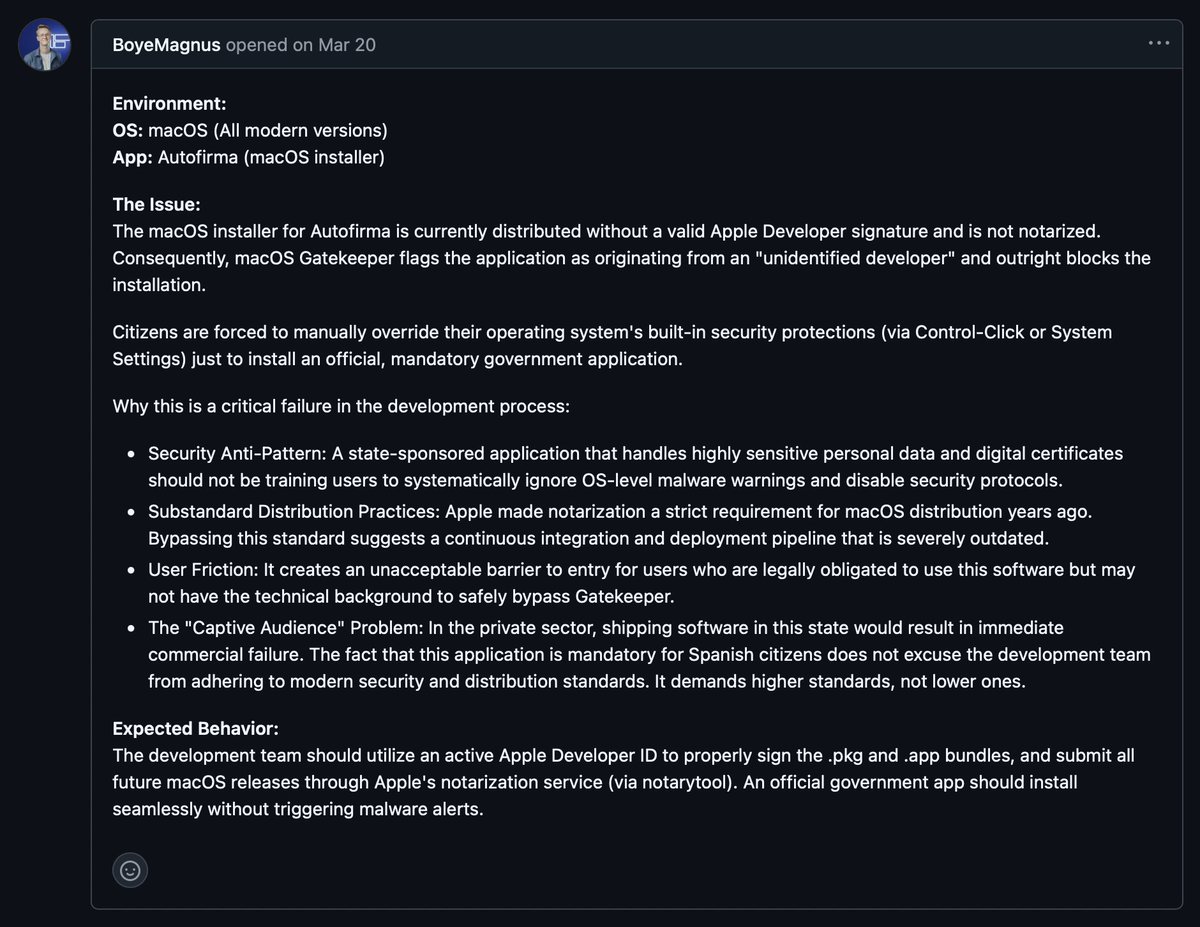
Un desarrollador danés, flipando con Autofirma, deja un educado comentario en el repositorio de desarrollo.
Es imposible explicarlo mejor:
«En el sector privado, lanzar software en este estado supondría un fracaso comercial inmediato. El hecho de que esta aplicación sea obligatoria para los ciudadanos españoles no exime al equipo de desarrollo de cumplir con los estándares modernos de seguridad y distribución. Exige estándares más altos, no más bajos».
¡Necesitamos más software de código abierto en la Administración pública!