Formada en la UBA, Milán y Harvard, reunió especialistas de muchas disciplinas y formó generaciones de investigadores. Su libro Los Sentidos. Bases de la Percepción sigue siendo obra de referencia.
Gracias, Miguelina, por abrir caminos para la ciencia argentina.
@CONICETDialoga
🕯️ Hoy despedimos a la Dra. Miguelina Guirao (1925–2026), Investigadora Superior del CONICET y una de las figuras más influyentes de la psicofísica y las ciencias de la percepción en Argentina. 🧵
En 1968 fundó el Laboratorio de Investigaciones Sensoriales (LIS), que bajo su dirección se volvió referencia en América Latina. En 1992 recibió el premio de la International Society for Psychophysics.
The entire AI industry spent a week convinced DeepSeek had secretly launched V4. Reuters reported it. Developers debated it. OpenRouter usage charts broke.
It was Xiaomi.
A smartphone and electric vehicle company just shipped a 1-trillion-parameter model that topped the world's largest API aggregation platform, and nobody guessed the origin because the model was too good to be associated with a hardware company.
The stealth launch as "Hunter Alpha" on March 11 was the most elegant product validation in recent AI history. No brand, no attribution, no expectations. Just raw performance. The model processed over 1 trillion tokens in 8 days. Developers organically chose it over every labeled frontier model on the platform. When Reuters tested the chatbot, it identified itself only as "a Chinese AI model primarily trained in Chinese" with a May 2025 knowledge cutoff, the exact same cutoff DeepSeek reports.
The person behind this is Luo Fuli. Born in 1995. Eight papers at ACL as a graduate student at Peking University. Alibaba DAMO Academy. Then DeepSeek, where she co-developed V2 and contributed to R1. Lei Jun reportedly offered tens of millions of yuan to recruit her. She joined Xiaomi in November 2025. Four months later, she's shipping a model that benchmarks alongside Claude Sonnet 4.6 and GPT-5.2 at one-fifth the API cost.
The detail that tells you everything about how this team operates: when Luo first experienced a complex agentic scaffold, she tried to convince the MiMo team to adopt it. They resisted. So she issued a mandate. Anyone on the team with fewer than 100 conversations with the system by tomorrow can quit. They all stayed. The imagination converted into research velocity.
The architectural bets matter. Hybrid Attention for long-context efficiency. MTP inference for low latency. 1M context window. 42B activated parameters out of 1T total. These are infrastructure decisions optimized for agents that run autonomously for hours, not chatbots that answer one question at a time.
Pricing: $1/$3 per million tokens up to 256K context. $2/$6 for 256K to 1M. Claude Sonnet 4.6 costs roughly 5x that. Xiaomi's shares rose 5.8% on the announcement.
The real DeepSeek V4 still hasn't shipped. The model everyone mistook for it already has a trillion tokens of real-world usage data.
In today's episode of programming horror...
In the Python docs of random.seed() def, we're told
"If a is an int, it is used directly." [1]
But if you seed with 3 or -3, you actually get the exact same rng object, producing the same streams. (TIL). In nanochat I was using the sign as a (what I thought was) clever way to get different rng sequences for train/test splits. Hence gnarly bug because now train=test.
I found the CPython code responsible in cpython/Modules/_randommodule.c [2], where on line 321 we see in a comment:
"This algorithm relies on the number being unsigned. So: if the arg is a PyLong, use its absolute value." followed by
n = PyNumber_Absolute(arg);
which explicitly calls abs() on your seed to make it positive, discarding the sign bit.
But this comment is actually wrong/misleading too. Under the hood, Python calls the Mersenne Twister MT19937 algorithm, which in the general case has 19937 (non-zero) bits state. Python takes your int (or other objects) and "spreads out" that information across these bits. In principle, the sign bit could have been used to augment the state bits. There is nothing about the algorithm that "relies on the number being unsigned". A decision was made to not incorporate the sign bit (which imo was a mistake). One trivial example could have been to map n -> 2*abs(n) + int(n < 0).
Finally this leads us to the contract of Python's random, which is also not fully spelled out in the docs. The contract that is mentioned is that:
same seed => same sequence.
But no guarantee is made that different seeds produce different sequences. So in principle, Python makes no promises that e.g. seed(5) and seed(6) are different rng streams. (Though this quite commonly implicitly assumed in many applications.) Indeed, we see that seed(5) and seed(-5) are identical streams. And you should probably not use them to separate your train/test behaviors in machine learning. One of the more amusing programming horror footguns I've encountered recently. We'll see you in the next episode.
[1] https://t.co/srv1ZBlDsi
[2] https://t.co/qpnKdvfVNS
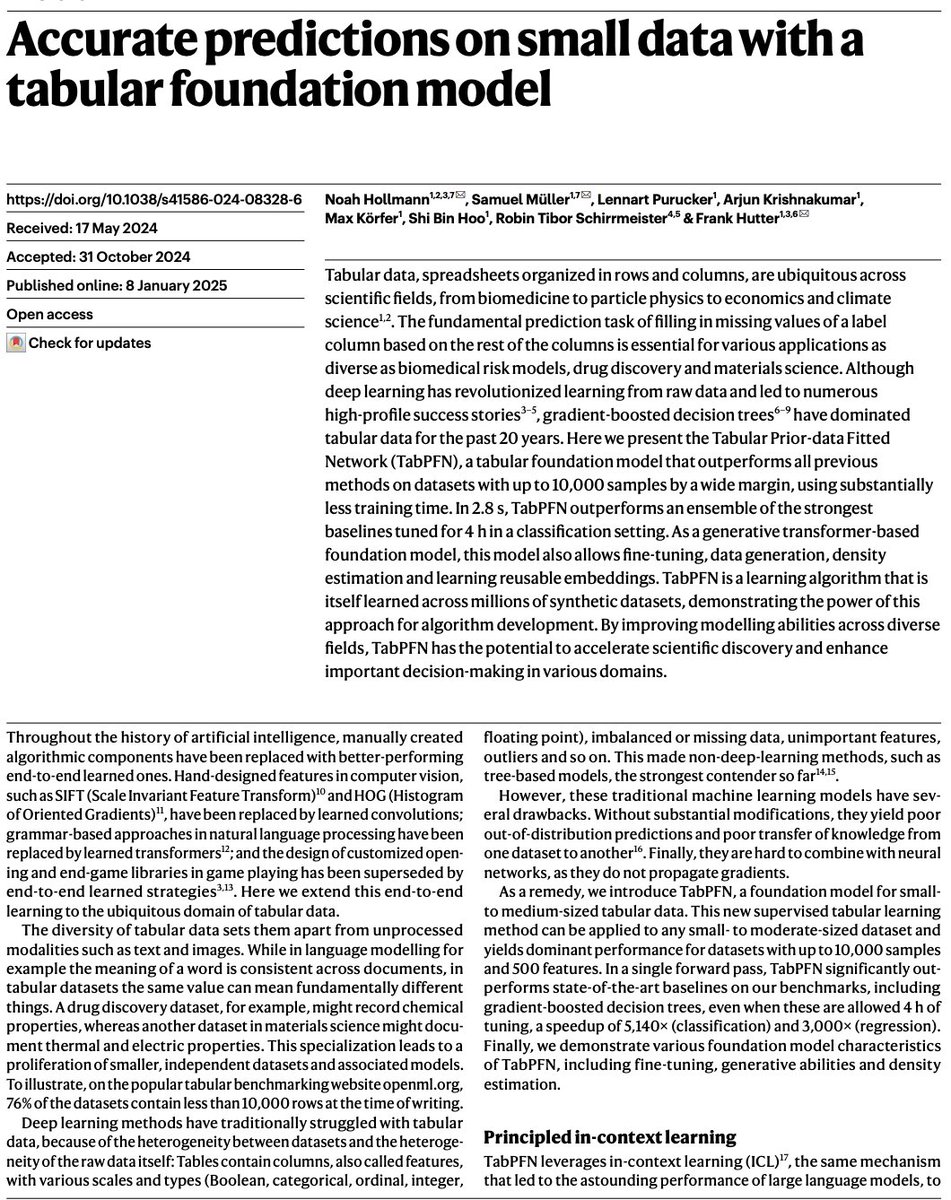
This paper really is groundbreaking. It solves a long-standing embarrassment in machine learning: despite all the hype around deep learning, traditional tree-based methods (XGBoost, CatBoost, random forests, etc) have dominated tabular data—the most common data format in real-world applications—for two decades. Deep learning conquered images, text, and games, but spreadsheets remained stubbornly resistant.
This paper's (published in Nature by the way) main contribution is a foundation model that finally beats tree-based methods convincingly on small-to-medium datasets, and does so very fast. TabPFN in 2.8 seconds outperforms CatBoost tuned for 4 hours—a 5,000× speedup. That's not incremental; it's a different regime entirely.
The training approach is also fundamentally different. GPT trains on internet text; CLIP trains on image-caption pairs. TabPFN trains on entirely synthetic data—over 100 million artificial datasets generated from causal graphs.
TabPFN generates training data by randomly constructing directed acyclic graphs where each edge applies a random transformation (using neural networks, decision trees, discretization, or noise), then pushes random noise through the root nodes and lets it propagate through the graph—the intermediate values at various nodes become features, one becomes the target, and post-processing adds realistic messiness like missing values and outliers. By training on millions of these synthetic datasets with very different structures, the model learns general prediction strategies without ever seeing real data.
The inference mechanism is also unusual. Rather than finetuning or prompting, TabPFN performs both "training" and prediction in a single forward pass. You feed it your labeled training data and unlabeled test points together, and it outputs predictions immediately. There's no gradient descent at inference time—the model has learned how to learn from examples during pretraining.
The architecture respects tabular structure with two-way attention (across features within a row, then across samples within a column), unlike standard transformers that treat everything as a flat sequence.
So, the transformer has basically learned to do supervised learning.
Talk to the paper on ChapterPal: https://t.co/hmWIA1dYji
Download the PDF: https://t.co/uxElyS85ge
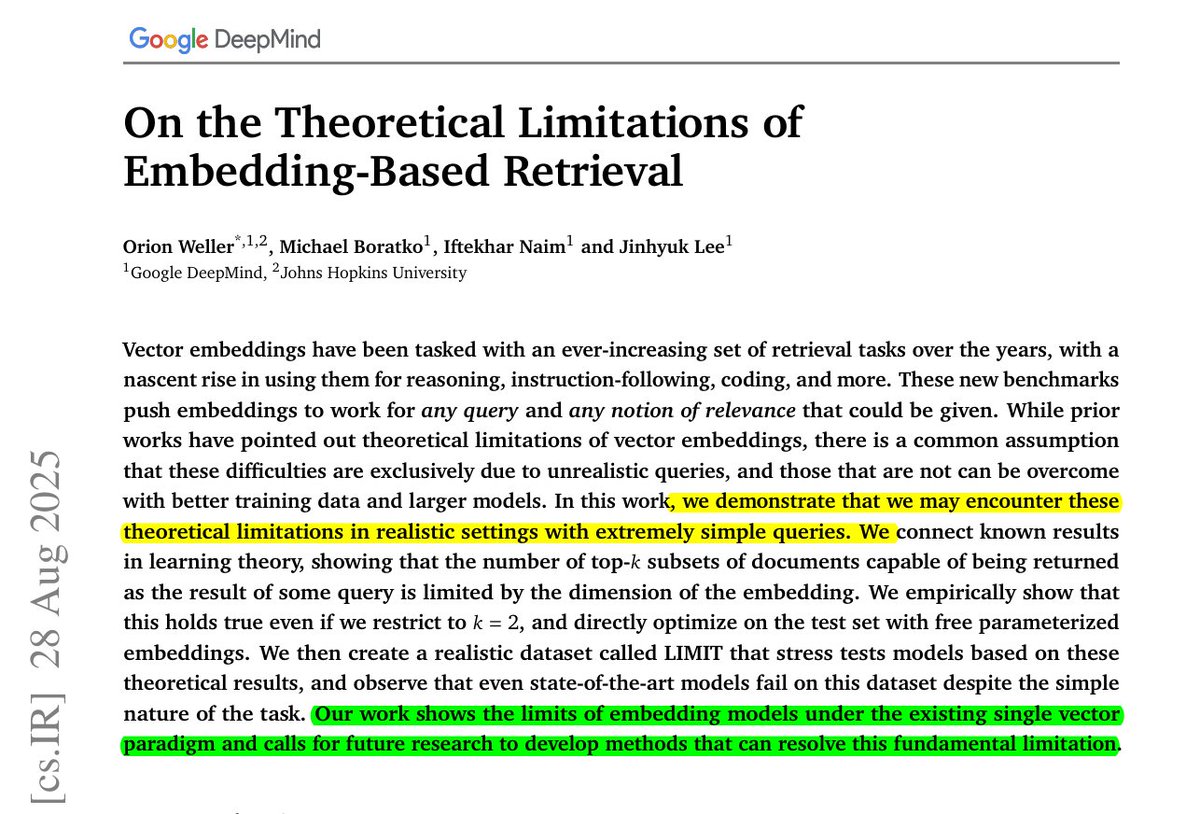
BRILLIANT @GoogleDeepMind research.
Even the best embeddings cannot represent all possible query-document combinations, which means some answers are mathematically impossible to recover.
Reveals a sharp truth, embedding models can only capture so many pairings, and beyond that, recall collapses no matter the data or tuning.
🧠 Key takeaway
Embeddings have a hard ceiling, set by dimension, on how many top‑k document combinations they can represent exactly.
They prove this with sign‑rank bounds, then show it empirically and with a simple natural‑language dataset where even strong models stay under 20% recall@100.
When queries force many combinations, single‑vector retrievers hit that ceiling, so other architectures are needed.
4096‑dim embeddings already break near 250M docs for top‑2 combinations, even in the best case.
🛠️ Practical Implications
For applications like search, recommendation, or retrieval-augmented generation, this means scaling up models or datasets alone will not fix recall gaps.
At large index sizes, even very high-dimensional embeddings fail to capture all combinations of relevant results.
So embeddings cannot work as the sole retrieval backbone. We will need hybrid setups, combining dense vectors with sparse methods, multi-vector models, or rerankers to patch the blind spots.
This shifts how we should design retrieval pipelines, treating embeddings as one useful tool but not a universal solution.
🧵 Read on 👇
@LuccasCorsino Temperatura de los Neumáticos: set-up subvirador podría no estar "encendiendo" correctamente los neumáticos delanteros blandos, y sobrecalentando los traseros al forzar la aceleración en la salida. Gomas medias, con ventana de funcionamiento más amplia, esto se mitiga. (15/15)
@LuccasCorsino Confianza: ciclo vicioso. Franco quizás no tiene confianza en la parte trasera del coche le dan un set-up más estable y subvirador que le impide ser rápido en qualy, lo que daña aún más su confianza. En carrera, donde todos deben ser más cuidadosos, se siente más cómodo. (14/15)






![karpathy's tweet photo. In today's episode of programming horror...
In the Python docs of random.seed() def, we're told
"If a is an int, it is used directly." [1]
But if you seed with 3 or -3, you actually get the exact same rng object, producing the same streams. (TIL). In nanochat I was using the sign as a (what I thought was) clever way to get different rng sequences for train/test splits. Hence gnarly bug because now train=test.
I found the CPython code responsible in cpython/Modules/_randommodule.c [2], where on line 321 we see in a comment:
"This algorithm relies on the number being unsigned. So: if the arg is a PyLong, use its absolute value." followed by
n = PyNumber_Absolute(arg);
which explicitly calls abs() on your seed to make it positive, discarding the sign bit.
But this comment is actually wrong/misleading too. Under the hood, Python calls the Mersenne Twister MT19937 algorithm, which in the general case has 19937 (non-zero) bits state. Python takes your int (or other objects) and "spreads out" that information across these bits. In principle, the sign bit could have been used to augment the state bits. There is nothing about the algorithm that "relies on the number being unsigned". A decision was made to not incorporate the sign bit (which imo was a mistake). One trivial example could have been to map n -> 2*abs(n) + int(n < 0).
Finally this leads us to the contract of Python's random, which is also not fully spelled out in the docs. The contract that is mentioned is that:
same seed => same sequence.
But no guarantee is made that different seeds produce different sequences. So in principle, Python makes no promises that e.g. seed(5) and seed(6) are different rng streams. (Though this quite commonly implicitly assumed in many applications.) Indeed, we see that seed(5) and seed(-5) are identical streams. And you should probably not use them to separate your train/test behaviors in machine learning. One of the more amusing programming horror footguns I've encountered recently. We'll see you in the next episode.
[1] https://t.co/srv1ZBlDsi
[2] https://t.co/qpnKdvfVNS](https://pbs.twimg.com/media/G7sc167aMAAuZi5.png)