Main updates:
➡️ You can now parallelize your training easily with HuggingFace Accelerate.
➡️ Personalize ChatLLaMA with your own dataset without worrying about breaking your training with automatic dataset checks.
2/
@lcastricato@omarsar0 Hi @lcastricato, the library puts together the pieces needed to efficiently create an algorithm for an AI assistant based on LLaMA. That is RLHF + DeepSpeed + LLaMA architecture + LangChain-generated dataset. We are working to further optimize the algorithm for faster inference
Today we're publicly releasing LLaMA, a state-of-the-art foundational LLM, as part of our ongoing commitment to open science, transparency and democratized access to new research.
Learn more & request access ➡️ https://t.co/8AeLVhMWkq
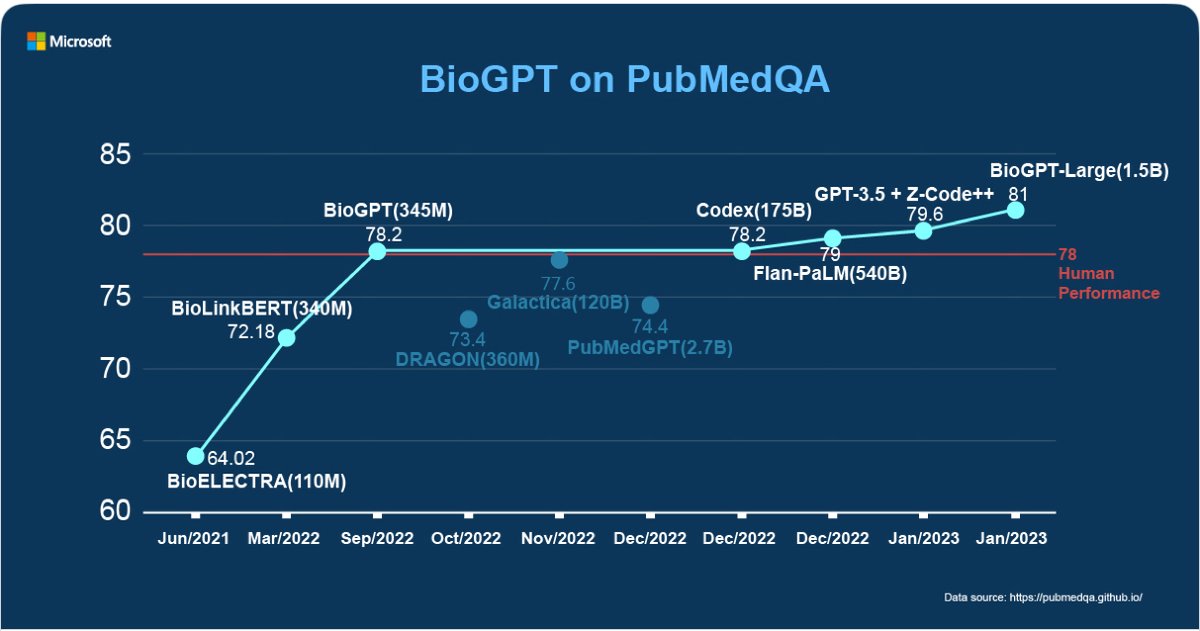
Microsoft Research has released BioGPT, a large language model trained on biomedical research literature. The model achieves better-than-human performance on answering questions from the biomedical literature, as evaluated on PubMedQA. The code for the model has been publicly released, and the weights for the large 1.5B model are expected to be released soon as well.
Link to the paper: https://t.co/92MBKqWPZd
Link to the GitHub repo: https://t.co/baaFEsmuNF
#ArtificialIntelligence #GenerateiveAI #LLM #LLMs #AI #NLP #DeepLearning @MicrosoftResearch
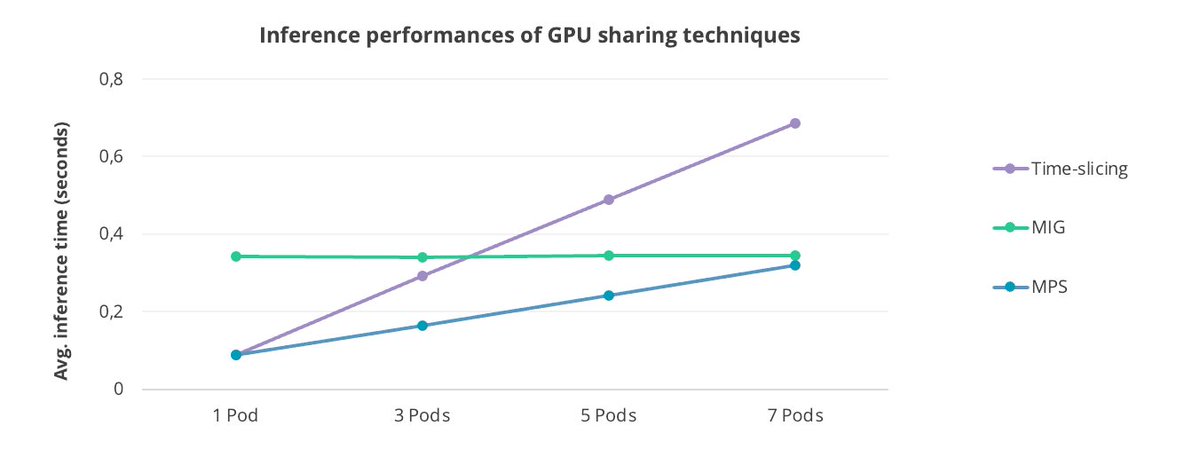
Is MPS better than MIG and Time-Slicing for performing inference on a shared GPU? My initial tests show better performance both when I shared the GPU between 1 and many inference Pods.
1/
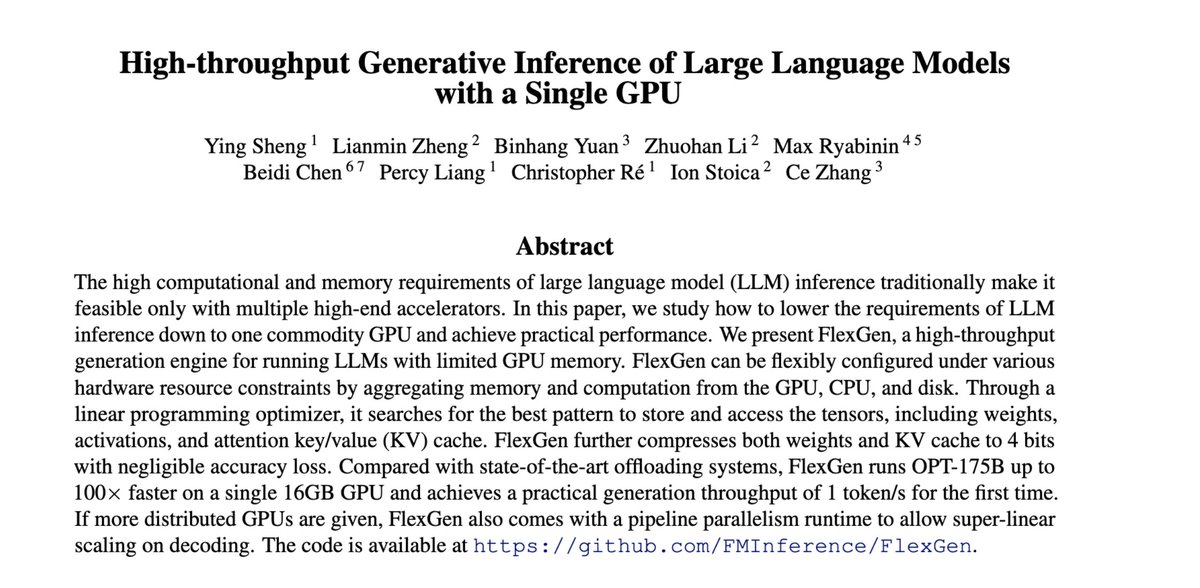
Found this paper&github that is worth sharing → “High-throughput Generative Inference of Large Language Models with a Sigle GPU”
Paper: https://t.co/Lk9hjRa4JT
Github: https://t.co/3sgY3za8YM
2️⃣ YOLOv8 is primarily composed of convolutional layers (and bottleneck layers, which are also made of convolutions). Both Intel & Nvidia have developed highly optimized kernels for these types of operations, which can be leveraged to achieve optimal performance on their hardware
Some takeaways worth sharing:
1️⃣ On both GPUs and CPUs, the compilers with the smallest latency are Nvidia's TensorRT and Intel's OpenVino. This is not surprising, as both hardware manufacturers have heavily invested in optimizing performance for standard CV operations.
@karpathy I’ve put together a library to optimize the performances of AI models. You can find it here, happy to talk more! https://t.co/T4RMYD7z79 Happy acceleration 🤘
@karpathy in case memory was the problem, you might think about saving some activations in int8 and then converting them back to float16/bfloat16 when computing gradients. To avoid losing information about outliers in quantization, you can use techniques such as LLM_int8
@JiriMaterna True, interesting research stream. I got intrigued by Hinton's ideas too and a few days back I implemented the paper in torch. Interesting to see the memory benefits of FF over backdrop. I wrote some notes while testing FF, perhaps you might be interested https://t.co/jivMVmFare