A Vercel user reported an issue that sounded extremely scary. An unknown GitHub OSS codebase being deployed to their team.
We, of course, took the report extremely seriously and began an investigation. Security and infra engineering engaged.
Turns out Opus 4.6 *hallucinated a public repository ID* and used our API to deploy it. Luckily for this user, the repository was harmless and random. The JSON payload looked like this:
"𝚐𝚒𝚝𝚂𝚘𝚞𝚛𝚌𝚎": {
"𝚝𝚢𝚙𝚎": "𝚐𝚒𝚝𝚑𝚞𝚋",
"𝚛𝚎𝚙𝚘𝙸𝚍": "𝟿𝟷𝟹𝟿𝟹𝟿𝟺𝟶𝟷", // ⚠️ 𝚑𝚊𝚕𝚕𝚞𝚌𝚒𝚗𝚊𝚝𝚎𝚍
"𝚛𝚎𝚏": "𝚖𝚊𝚒𝚗"
}
When the user asked the agent to explain the failure, it confessed:
The agent never looked up the GitHub repo ID via the GitHub API. There are zero GitHub API calls in the session before the first rogue deployment.
The number 913939401 appears for the first time at line 877 — the agent fabricated it entirely.
The agent knew the correct project ID (prj_▒▒▒▒▒▒) and project name (▒▒▒▒▒▒) but invented a plausible-looking numeric repo ID rather than looking it up.
Some takeaways:
▪️ Even the smartest models have bizarre failure modes that are very different from ours. Humans make lots of mistakes, but certainly not make up a random repo id.
▪️ Powerful APIs create additional risks for agents. The API exist to import and deploy legitimate code, but not if the agent decides to hallucinate what code to deploy!
▪️ Thus, it's likely the agent would have had better results had it not decided to use the API and stuck with CLI or MCP.
This reinforces our commitment to make Vercel the most secure platform for agentic engineering. Through deeper integrations with tools like Claude Code and additional guardrails, we're confident security and privacy will be upheld.
Note: the repo id above is randomized for privacy reasons.
I posted this thinking I'd get a handful of answers, but it turned into a massive thread with hundreds of thoughtful ideas
it feels like a turning point of some kind?
@mikeschmitz Hello! I watched your YouTube channel and the content it is amazing!!! ❤️
I want to buy LifeHQ but $197 it is very expensive to Brazilians. Could you give a discount? To help purchase parity power? 🙏
I turned the Advent of Claude into a blog post where I could provide additional context, resources, and re-ordered the tips into a more logical order going from startup to advanced capabilities.
@wcools@jdvhouten@ednico_ Could you grant me a trial access to https://t.co/c2Hdl9VZFD?
I’ve been using Obsidian for a few years, and I’m very curious to understand what your app will be like.
Anthropic just released ALL the Claude Code secrets
Their Prompting best practices just went live in their docs and I spent hours reading it and testing out all the tips
Here are the 10 that make Claude Code so much better: 🧵
ChatGPT + Laptop + Internet + 60 min/day = Online Income 🚀
No office.
No fancy tools.
Just smart AI usage.
I usually sell this guide for $79,
but for the next 48 hours, it’s 100% FREE.
To get it 👇
Follow me @ai_with_jasmin
Retweet
Comment “AI”
Don’t miss it.🚨
@kepano@obsdmd This is amazing!
Is there any plan to control plugin permissions in the near future? I’m a bit concerned about how to handle privacy when using plugins in Obsidian.
Linear’s CEO just described the biggest shift in product team structure since Agile.
For decades, product work meant: PM defines requirements → designers create specs → engineers translate to code. The middle step, translation, absorbed 70% of the time and created most of the friction.
Karri is saying that step is collapsing. AI agents don’t need handoff documents or sprint planning rituals. They need structured context about what matters, what constraints apply, and what success looks like.
This inverts the leverage points. The person who captures customer intent clearly now has more impact than the person who translates it into implementation. And the person reviewing agent output becomes the quality bottleneck.
Linear built their entire product around this bet: structured entities with clear ownership, context attached to work items, feedback connected directly to issues. It turns out the same system that helps humans coordinate also helps agents know what to do.
The teams figuring this out first will have a structural advantage. Everyone else will still be writing Jira tickets that read like riddles.
> I don’t understand why people are still paying in dollars to learn LLMs.
> these 9 lectures from Stanford are a pure goldmine for anyone wanting to understand LLMs in depth.
I'm Boris and I created Claude Code. Lots of people have asked how I use Claude Code, so I wanted to show off my setup a bit.
My setup might be surprisingly vanilla! Claude Code works great out of the box, so I personally don't customize it much. There is no one correct way to use Claude Code: we intentionally build it in a way that you can use it, customize it, and hack it however you like. Each person on the Claude Code team uses it very differently.
So, here goes.
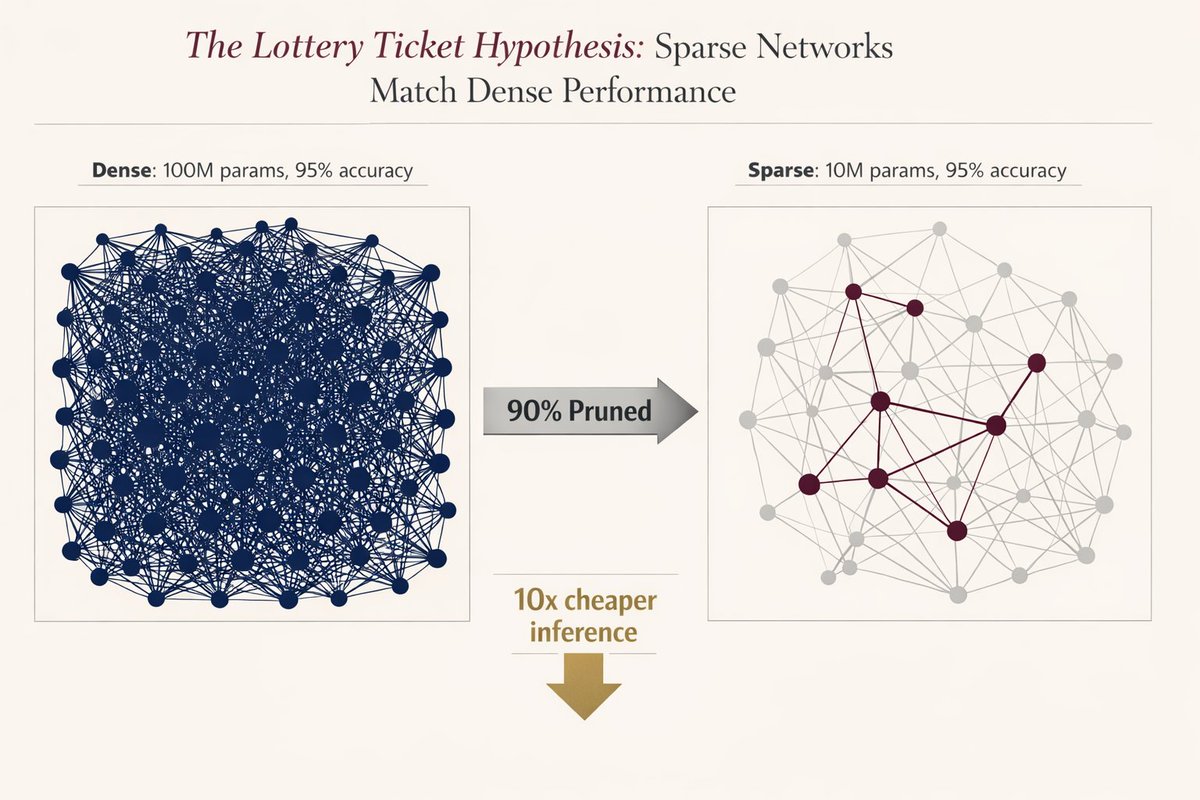
🚨 MIT proved you can delete 90% of a neural network without losing accuracy.
Five years later, nobody implements it.
"The Lottery Ticket Hypothesis" just went from academic curiosity to production necessity, and it's about to 10x your inference costs.
Here's what changed (and why this matters now):