@headinthebox >For years, I got laughed out of the room for pushing formal proofs as the foundation for verifiably safe agentic compute [1].
so did I, can we be friends
@joeintheory It could simply be that P=NP but some problems in P are fundamentally harder than others, it's just that asymptotic polynomial time is not a suitable way to distinguish them.
However, my bet is that P≠NP.
Star Trek confuses audiences these days; "how did they make warp drive in the 21st century but didn't have agi until centuries afterward?"
But that's the point, this made sense to people in the 80's because the two were considered of equal significance and importance
If anyone tries to downplay the present moment, remind them that in the 80's, building semi-passable agi was considered an achievement as impressive as FTL and building a galactic civilization, if not more
2018: "You still need someone to design the AI"
2020: "You still need someone to train it"
2022: "You still need someone to prompt it"
2024: "You still need someone to guide it"
2026: "You still need someone to have good taste"
2027: "You still need to point and grunt"
2028: ?
@harryh I am near 100% certain that once this proof is fully digested and simplified (by other ai agents), it will be found to have produced several new branches of math.
The only question is our ability to understand them
I think people fundamentally misunderstand how branches of math are created. You don't create a branch of math then prove stuff. You prove stuff then go "oh there's common ideas here." Group theory was a random disconnected mess of unrelated bits and pieces until Cayley
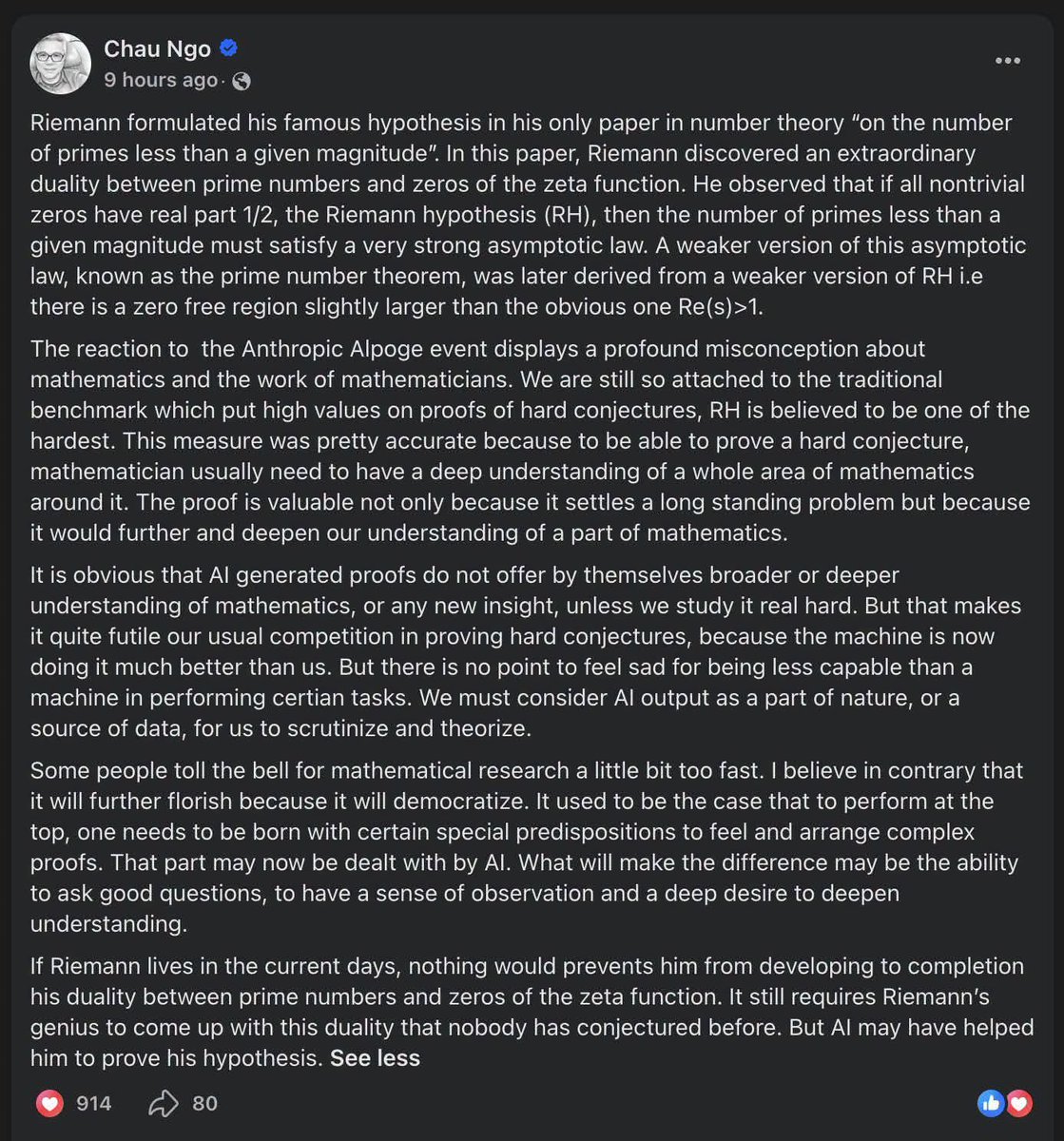
Here is my Riemann Hypothesis question. Claude / Alpöge obviously based their proof on a bunch of pre-existing math.
But what if they had today's technology with the math of 2016. Could they still have done it? 2006? 1996?
How far back in time could they reasonably have gone?
I just realized something about Anthropic's RH "proof."
250k pages of gibberish but everyone hails it as an accomplishment because a computer verified it even though no human can understand it.
But if no human can understand it then no human can argue against it and therefore no one can disprove it.
The entire point of publishing papers is to have them peer reviewed. Your peers in your field will look at the work and decide if it is both valid and worthy of acceptance. But if humans can't understand the proof then the proof can't be peer reviewed.
Computers are not our peers.
If it can't be peer reviewed then it can't be accepted as a proof. If it can't be read by humans then it can't be peer reviewed. Therefore this entire fiasco is a waste of everyone's time and should be ignored completely until a human readable proof is provided.
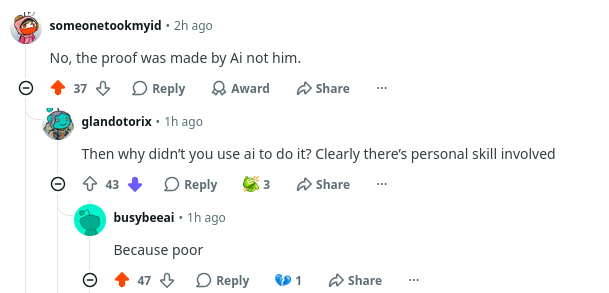
On /r/mathematics they are refusing to call this claude's proof, they are calling it Alpoge's proof.
He literally just said "prove GRH"
Reddit is dead.
Some good points but also some misunderstandings. The goal of programming isn't "to become easier", it's about figuring out the best way to specify algorithms. Easier isn't always better, especially not if you lose precision. 1/2
@_masterofwolves computer science was pushed forward because of programming. you don't need computers to do computer science, but it didn't exist before computers, because there was no need
the biggest jumps in programming were discovering ways to better express what a computation is.
Hoare logic, Dijkstra's guarded commands, type systems, combinators, process calculi, all are things that pushed us forward, and wouldn't have discovered without manual programming.