Ppl dunking on me for the umbrella.
> your face is money
> important for mate selection, career progress, social standing, how you’re perceived, self confidence
> youthful skin is good
> old skin is bad
> the sun ages your skin
> UVB peaks around noon
> UVA stays high all day
> both damage the skin
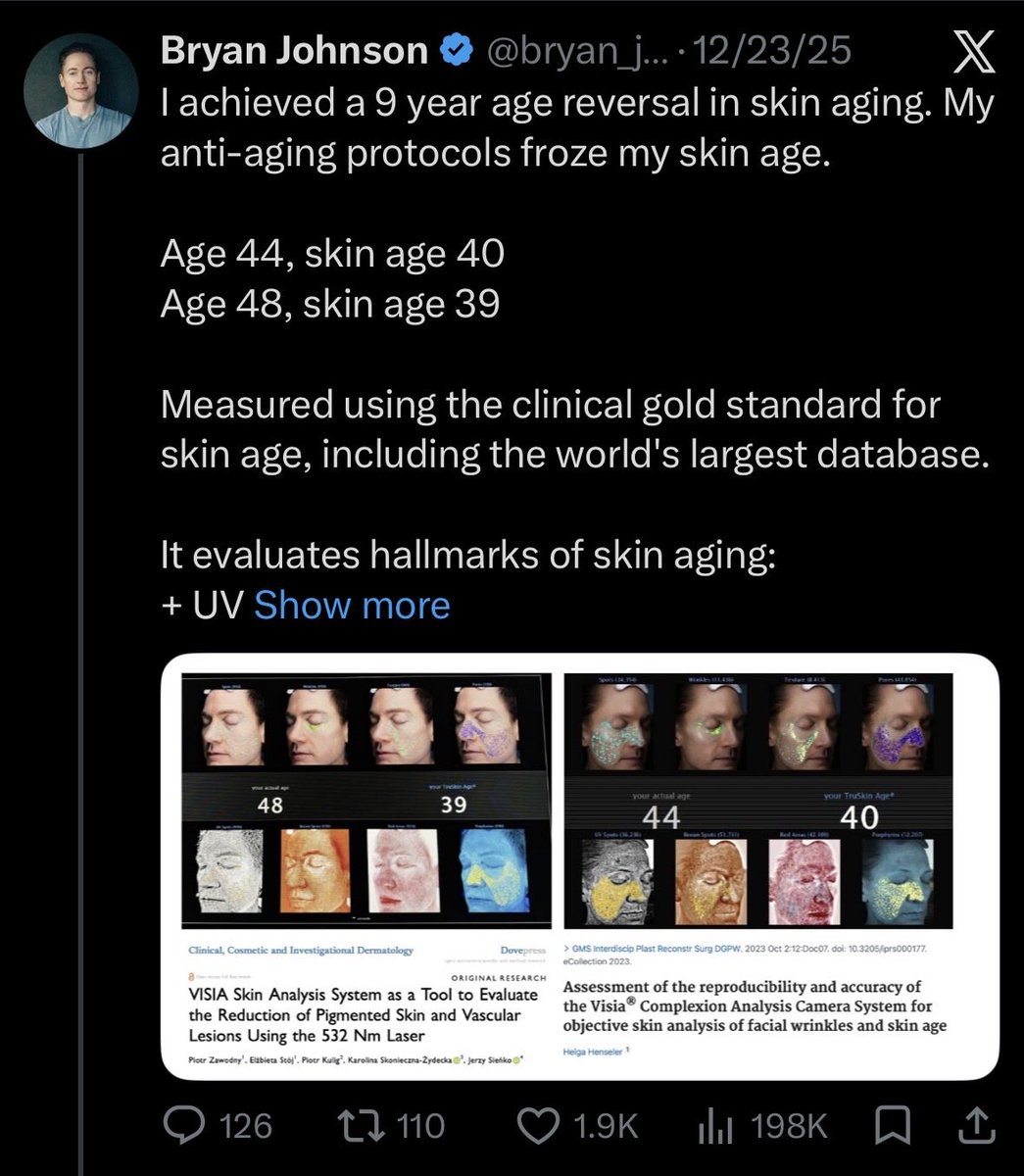
> I’ve frozen my skin age since starting this project
> a 9 year age reversal
> I love the sun
> wish I could be in it all day
> I baked in the sun for first 40 yrs of life
> but my goal is to not die
> so I’m now sun-aware
> I use a sunlight mimicking device for circadian rhythm, mood and energy
> and protect from sun damage
> I supplement Vit D for optimal levels
> tanned skin is a biomarker of damage
> ppl will say sun avoidance increases mortality
> that study was Swedish women and was observational and not causative
> if you enjoy spending time in the sun, I support you
> you can do so smartly and limit unnecessary damage
I've been praying the past few weeks. Unsure why.
There's good evidence behind prayer. It mimics breathwork, calming the nervous system, dropping cortisol, and quieting the brain. Daily prayers show lower depression, anxiety, and pain.
I'd like to develop a prayer practice. Growing up, the protocol was written for me. Explaining whom to pray to, the structure of the prayer, and the boundary conditions.
I don't really know how to pray now.
Lots of tech & AI companies are expanding to NYC
- OpenAI opened a SoHo HQ last year
- Anthropic is actively exploring a massive expansion (450,000 sqft)
- Palantir is actively exploring more space
- Perplexity is expanding in Union Square
- Harvey is doubling their office space
- Scale AI has a new HQ in one world trade
NYC is becoming the AI commercialization city Build in SF, sell in NYC.
You have no experience.
You’ve never started a company.
You’ve never had a full time job.
Nike is going to kill you.
You’re a kid.
You don’t have technical skills.
You shouldn’t build hardware.
Apple is going to kill you.
You can’t build hardware.
You can’t measure heart rate non-invasively.
Athletes don’t care about recovery.
Under Armour is going to kill you.
It won’t be accurate.
You don’t listen.
You’re an ineffective leader.
You can’t recruit great talent.
You’re going to have to pay every athlete.
You can’t measure sleep non-invasively.
It’s too expensive to research.
Athletes are a small market.
The product costs too much to make.
The product costs too much to sell.
Your valuation is too high.
Consumers aren’t going to want it.
Hardware is too hard.
You should measure steps.
Fitbit is going to kill you.
You can’t build a marketing engine.
You can’t raise enough money.
You need a real CEO.
Google is going to kill you.
You can’t be a subscription.
You can’t build a brand.
You can’t do consumer in Boston.
Your valuation is too high.
You shouldn’t make accessories.
You shouldn’t make apparel.
Lululemon is going to kill you.
You can’t predict Covid.
Stay in your niche.
You are going to run out of money.
You can’t build a health platform.
Amazon is going to kill you.
You can’t measure blood pressure.
You can’t get medical approvals.
The market is too small.
You don’t understand AI.
The market is too competitive.
It won’t work internationally.
The supply chain is too complicated.
You can’t build an AI.
You can’t raise enough money.
It’s too competitive.
Healthcare isn’t going to want it.
…
Just keep going ✌️
How does Lovable Hack Social Algorithms to Have Viral Posts:
"We have a channel called bee swarming where employees post their content and everyone goes to amplify it.
We try to turn every engineer into a marketer and get the whole team posting about things they are excited about.
Then marketing puts its full firepower behind the biggest launches to tell the story." @ElenaVerna
Biggest lessons on how to make posts go viral @antonosika@lukeharries@eglyman@FoundersPodcast?
How does Lovable Hack Social Algorithms to Have Viral Posts:
"We have a channel called bee swarming where employees post their content and everyone goes to amplify it.
We try to turn every engineer into a marketer and get the whole team posting about things they are excited about.
Then marketing puts its full firepower behind the biggest launches to tell the story." @ElenaVerna
Biggest lessons on how to make posts go viral @antonosika@lukeharries@eglyman@FoundersPodcast?
Lowest ROI purchases in NYC:
- Matcha
- Smoothies
- Bottle service
- Mediocre Italian food
- $120 Ubers to the airport
- Carriage rides at the park
- Anything in the west village
I need to be in LA by Tuesday morning. My flight from NYC got cancelled due to the blizzard. How can I get there? I've got all off Monday to figure it out
Jannik Sinner on the fitness tracker that he & Carlos Alcaraz were asked to remove at Australian Open
“There is certain data we would like to track a bit on court… it’s more about that you can see after the match. This is data we would like to use also in practice sessions. Heart rate, how much calories you burn.. all these kinds of things.”
(via Australian Open Press)
Marriage triggers universal personality changes in less than two years.
Marriage goes far beyond a legal or social commitment—it acts as a powerful catalyst for genuine psychological shifts in both partners. A landmark longitudinal study followed 169 heterosexual newlywed couples, assessing their Big Five personality traits (openness, conscientiousness, extraversion, agreeableness, and neuroticism) at 6, 12, and 18 months post-wedding. The findings reveal consistent patterns of change that emerge early in marriage, largely independent of factors like age, premarital cohabitation, or the presence of children.
Husbands typically showed increases in conscientiousness, becoming more responsible, organized, and dependable—traits that support the demands of shared life and household stability. Wives, on the other hand, experienced notable declines in neuroticism, reporting reduced anxiety, anger, and emotional volatility, which translated into greater overall emotional stability.
However, these adaptations came with trade-offs. Both partners tended to become less open to new experiences, possibly as they settled into familiar domestic routines and routines. Extraversion also declined, with couples often prioritizing their relationship over wider social networks, leading to fewer outings and interactions with friends. Additionally, agreeableness decreased for both husbands and wives, suggesting that as the initial "courtship mask"—the idealized, highly accommodating behavior of early romance—fades, partners may become less patient and more prone to friction in everyday interactions.
These shifts appear remarkably universal across the sample, occurring regardless of baseline differences. While some changes (like heightened conscientiousness in men or reduced neuroticism in women) correlated with higher marital satisfaction over time, others (such as drops in agreeableness) highlight potential sources of strain.
Because these personality transformations are largely inevitable, experts emphasize that marital longevity depends not just on initial compatibility but on deliberate efforts to cultivate self-control, patience, and forgiveness. Couples who actively work to adapt to these evolving dynamics are better positioned to maintain a healthy, satisfying relationship as the honeymoon phase gives way to long-term partnership.
[Lavner, J. A., Karney, B. R., & Bradbury, T. N. "Personality change among newlyweds: Patterns, predictors, and associations with marital satisfaction over time." Developmental Psychology, 54(6), 1172–1185. DOI: 10.1037/dev0000491]






![Rainmaker1973's tweet photo. Marriage triggers universal personality changes in less than two years.
Marriage goes far beyond a legal or social commitment—it acts as a powerful catalyst for genuine psychological shifts in both partners. A landmark longitudinal study followed 169 heterosexual newlywed couples, assessing their Big Five personality traits (openness, conscientiousness, extraversion, agreeableness, and neuroticism) at 6, 12, and 18 months post-wedding. The findings reveal consistent patterns of change that emerge early in marriage, largely independent of factors like age, premarital cohabitation, or the presence of children.
Husbands typically showed increases in conscientiousness, becoming more responsible, organized, and dependable—traits that support the demands of shared life and household stability. Wives, on the other hand, experienced notable declines in neuroticism, reporting reduced anxiety, anger, and emotional volatility, which translated into greater overall emotional stability.
However, these adaptations came with trade-offs. Both partners tended to become less open to new experiences, possibly as they settled into familiar domestic routines and routines. Extraversion also declined, with couples often prioritizing their relationship over wider social networks, leading to fewer outings and interactions with friends. Additionally, agreeableness decreased for both husbands and wives, suggesting that as the initial "courtship mask"—the idealized, highly accommodating behavior of early romance—fades, partners may become less patient and more prone to friction in everyday interactions.
These shifts appear remarkably universal across the sample, occurring regardless of baseline differences. While some changes (like heightened conscientiousness in men or reduced neuroticism in women) correlated with higher marital satisfaction over time, others (such as drops in agreeableness) highlight potential sources of strain.
Because these personality transformations are largely inevitable, experts emphasize that marital longevity depends not just on initial compatibility but on deliberate efforts to cultivate self-control, patience, and forgiveness. Couples who actively work to adapt to these evolving dynamics are better positioned to maintain a healthy, satisfying relationship as the honeymoon phase gives way to long-term partnership.
[Lavner, J. A., Karney, B. R., & Bradbury, T. N. "Personality change among newlyweds: Patterns, predictors, and associations with marital satisfaction over time." Developmental Psychology, 54(6), 1172–1185. DOI: 10.1037/dev0000491]](https://pbs.twimg.com/media/G-zhujfW4AAIhEL.jpg)





