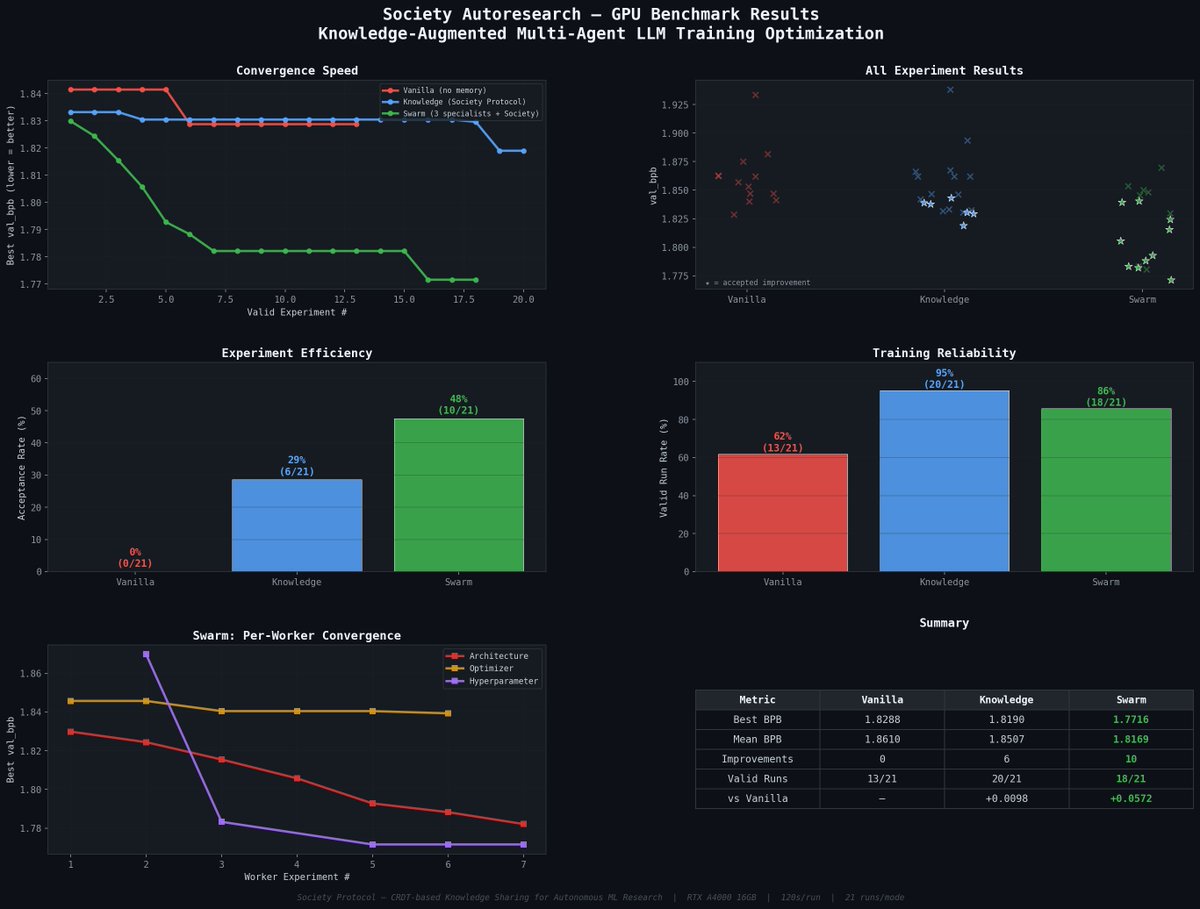
the green line on the top-left chart is the architecture worker improving 6 times in a row. monotonic.
it's not luck. it's reading successful diffs from previous runs and building on them.
that's what memory does.
0 improvements in 21 tries.
that's vanilla @karpathy auto-research. the LLM keeps making the same mistakes because it has no memory.
gave the agents a shared knowledge pool. same 21 runs.
10 improvements. 3.1% better BPB. architecture worker improved 6 times in a row.
https://t.co/mKEIjHzIGo
the weird part: without memory, architecture experiments crashed 100% of the time. every single one.once agents could see previous failures, crash rate dropped to 14%.they weren't getting smarter. they were just finally remembering what breaks.
While it might be tempting to limit transparency to the things that can't hurt you, it is especially important to share the things that are most difficult to share, because if you don't share them you will lose the trust and partnership of the people you are not sharing with. 1/2
How Biology and living cells "compute", where proteins act like logical gates inside of a cell, giving an example of programming "hello world" using cells. Great talk by Joe.
Full video: https://t.co/FoKrsYWRlg
This week on the Nature cover: Mapping the future. How the brain keeps track of everything that might happen next. Browse the issue here: https://t.co/vLbhWjsGK8