@matinathom Δυστυχώς υπάρχουν πολύ έντονες απόψεις για το πώς πρέπει να είσαι/συμπεριερεσαι είτε όταν περιμένεις παιδί, είτε όταν έχεις παιδί, παρότι υπάρχουν πολλοί διαφορετικοί αλλά αντίστοιχα έγκυροι τρόποι.
Today a crazy quantum story just got wilder.
On March 31, the Google Quantum AI team published a landmark result on Shor's algorithm for elliptic curve cryptography. Technically, the paper was a bombshell: a dramatic 10x improvement over the state-of-the-art. As a stunt and wakeup call to the blockchain space, those optimisations were illustrated on secp256k1, the elliptic curve underlying Bitcoin and Ethereum signatures.
But perhaps the most striking part of the paper was sociological, not technical. Instead of following standard academic process, the optimisations were kept secret, hidden behind a zero-knowledge (ZK) proof. Google's accompanying blog post mentions they "engaged with the U.S. government". The ZK proof demonstrates the existence of algorithmic improvements without leaking details. Academic censorship with ZK, a historic first!
As a co-author of the Google paper I witnessed some of the context surrounding this censorship. To be honest, multiple aspects of that context don't sit well with me. As much as I believe the general public ought to know more, I am limited in my ability to whistleblow. Though let me be clear about one thing: the Google team's professionalism has been absolutely exemplary, and they deserve nothing but praise.
Censorship has a way of backfiring. The Streisand effect, where an attempt to bury something only draws more attention to it, is exactly what's unfolding today. First, Google's key optimisation has been rediscovered by the French. And in a thrilling turn of events, a collaborative Shor-at-home challenge just launched. The initiative, available at ecdsa[.]fail, breached a new Shor world record in a matter of hours.
Let's start with the rediscovery. Just two months after Google's paper, French quantum expert André Schrottenloher cracks the main secret optimisation. His paper, titled "Optimized Point Addition Circuits for Elliptic Curve Discrete Logarithms", landed on the arXiv today. Big congrats to André, who beat several other nerdsnipped experts to it. In a blog post also published today, Craig Gidney, the world expert on Shor optimisations, revealed that he'd been sitting on this very optimisation for a whole year under censorship pressure.
Interestingly, André missed a handful of minor optimisations, both from Google's original publication and from improvements found since. It's plausible there's still plenty of juice left to squeeze out of Shor, and this is exactly what the ecdsa[.]fail challenge is about. The verifier program developed for the ZK proof does double duty, automatically filtering for valid submissions. Dozens of compounding small and micro improvements are rolling in. As of the time of writing there's an 8.4% improvement to Google's circuit, as measured by the product of logical qubit count and Toffoli gate count. Nice!
The nerdsnipping ran deeper than anyone expected. Over the last few weeks it became clear it extended well beyond André and other quantum experts. Behind the scenes, a small army of amateurs quietly got to work. Inspired by Karpathy-style autoresearch, they turned AI on Shor. Ironically, the verifier program for the ZK proof makes an ideal reward function for AIs. The barrier to entry for this modern style of research is refreshingly low, with several non-experts, even a teenager, finding nice optimisations. Get in touch if you'd like to join a Telegram group with fellow autoresearchers :)
Part 2: neutral atoms and qday
The story doesn't end with Google. On the same day Google went public, a stealthy startup called Oratomic published its own Shor paper in a coordinated release. It made a splash, ultimately becoming the most upvoted paper on scirate[.]com, a website ranking arXiv papers.
Oratomic's claim was wild. By building on Google's logical optimisations and applying custom physical optimisations for neutral atoms, they claimed just 10K physical qubits were sufficient to run Shor's algorithm on secp256k1. That number is mind-bogglingly low.
Knowing essentially nothing about neutral atoms when Oratomic's paper landed, I was intrigued and decided to learn more about the tech. I fell straight down the rabbit hole and spent a couple hundred hours on the topic. I got a little obsessed and watched every YouTube video I could find and spoke to a bunch of experts.
My conclusion? The tech is real, very real. Even Google recently decided to start a neutral atom lab, a notable pivot from their sole focus on superconducting qubits. If you care about qday, i.e. the day a quantum computer will break the first piece of cryptography in production, neutral atoms demand your attention. I shared some of my learnings on Shor and neutral atoms in a 30min talk at the ZKProof cryptography conference. You can find it on YouTube by searching "zkproof neutral atom".
Here's an interesting observation about this duo of breakthrough papers: neither Google nor Oratomic say a word about what their results mean for qday. No timelines. Zero. Nada. That is especially baffling given that the whole point of whitehat quantum cryptanalysis is to inform qday estimations and help the general public make good decisions.
So let me attempt to partially fill the silence, similarly to what Scott Aaronson did in his April 29 post. Given everything I know, including scary non-public information, I now put the odds of qday by 2032 at 50%. 10% by 2030.
Anecdotally, the US government has its own date: 2035. Originating at the NSA and later adopted by NIST, it's when branches of the US government will be disallowed from using quantum-vulnerable cryptography. In plain language: with hindsight, that date is a joke and should be discounted entirely. I don't see how NIST avoids being forced to pull it forward by years.
Part 3: post-quantum cryptography
There are good reasons to sound the alarm today, but please do not panic. Rushing carelessly towards immature post-quantum cryptography is a recipe for disaster. IMO a good target date for migration is 2029, roughly 3.5 years out. 2029 happens to be the date selected by Google, Cloudflare, and the Ethereum Foundation.
These days most of my time goes to safely migrating Ethereum towards post-quantum cryptography as part of the broader lean Ethereum effort. There's a lot to do. We need to rip out and replace BLS signatures at the consensus layer, KZG commitments at the data layer, and ECDSA signatures at the execution layer.
The plan to get there is compelling, and is based on hash-based cryptography. Within the Ethereum Foundation we've developed a Swiss army knife called leanVM (github[.]com/leanEthereum/leanVM) powered by the magic of hash-based SNARKs. Thanks to truly exceptional work by Emile, Thomas, and others, its performance is derisked. Regarding security, leanVM is a jewel, a minimal zkVM crafted for end-to-end formal verification and maximum security.
Want to help? There are two $1M initiatives. First, the Proximity Prize (proximityprize[.]org). Solve a long-standing mathematical conjecture in coding theory, improve hash-based SNARKs, and go home a millionaire. Second, the Poseidon Initiative (poseidon-initiative[.]info), offers $1M for breaking Poseidon, the SNARK-friendly hash function.
@stevenstrogatz Does it feel good even when you consider that the model was explicitly trained to draw from distributions that increase approval from humans (RLHF)?
@nrehiew_@DimitrisPapail Indeed. But the next breakthrough for a far more scalable RL paradigm than GRPO is already here:
Train your self-teacher to be a pedagogical, gently off-policy sampler for RL rollouts that are both correct AND easy to follow in every step.
https://t.co/wriGo2OJ9t
We’re dropping Gemini Omni: our first step towards a model that can create anything from anything - starting with video.
It combines Gemini’s intelligence with our generative media systems - representing a leap forward in world understanding, multimodality, and editing 🧵
@eunoiawhy@MIT_CSAIL Nice link. Nevertheless, even that is not perfect as discussed in the comments. Specifically, we don't see bumps in births right before/after major holidays.
Also the day-of-week effect must have grown in more recent years with the prevalence of C-section.
We’re releasing a 30B-A3B reasoning model that reaches gold-medal level across both physics and math Olympiad evaluations: IPhO directly, and IMO/USAMO with test-time self-verification and refinement.
A simple, unified scaling recipe for proof search.
https://t.co/yc2ZlLVbD2
Ten years in academia and the best part has not been what many value most ie freedom to pursue your ideas. It’s experiencing your students grow and go on to incredible trajectories.
What I’ve come to know about myself is that I value permanence, presence, and people. And for all the illusions that institutions, titles, awards etc offer, none at all come close to this: watching a human absorb, even in tiny amounts, the care and effort you’ve put into trying your best to just be there for them.
I gained a lot of respect for Dario for being principled on the issues of mass surveillance and autonomous killbots. Principled leaders are rare these days
It’s extremely good that Anthropic has not backed down, and it’s siginficant that OpenAI has taken a similar stance.
In the future, there will be much more challenging situations of this nature, and it will be critical for the relevant leaders to rise up to the occasion, for fierce competitors to put their differences aside. Good to see that happen today.
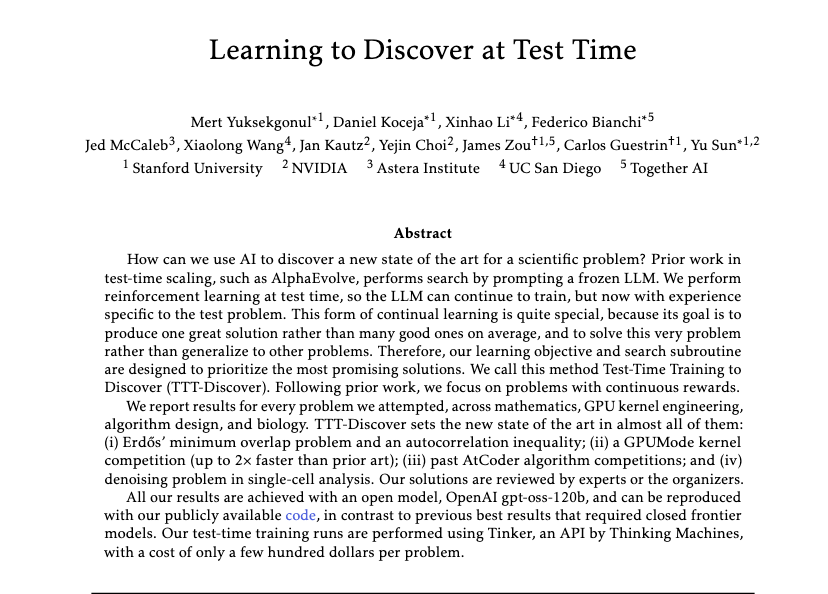
I don't think people have realized how crazy the results are from this new TTT + RL paper from Stanford/Nvidia.
Training an open source model, they
- beat Deepmind AlphaEvolve, discovered new upper bound for Erdos's minimum overlap problem
- Developed new A100 GPU kernels 2x faster than the best human kernel
- Outperformed the best AI coding attempt and human attempt on AtCoder
The idea of Test Time Training is to train a model *while* it's iteratively trying to solve a task. Combining this with RL like they do in this paper opens up the floodgates of possibilities for continual learning
Authors: @mertyuksekgonul@LeoXinhaoLee@JedMcCaleb@xiaolonw@jankautz@YejinChoinka@james_y_zou@guestrin@sun_yu_
🏛️ The Greeks Who Shaped Human History
🇬🇷 Socrates — father of Western philosophy
🇬🇷 Plato — ideas, forms, the Academy
🇬🇷 Aristotle — logic, science, politics
🇬🇷 Alexander the Great — conquered most of the known world
🇬🇷 Homer — Iliad & Odyssey
🇬🇷 Archimedes — math, physics, engineering
🇬🇷 Pythagoras — numbers rule reality
🇬🇷 Euclid — geometry as we know it
🇬🇷 Hippocrates — medicine without superstition
🇬🇷 Herodotus — history begins
🇬🇷 Thucydides — realism in war & politics
🇬🇷 Pericles — democracy’s golden age
🇬🇷 Leonidas I — Thermopylae
🇬🇷 Solon — foundations of democracy
🇬🇷 Democritus — atom theory
🇬🇷 Epicurus — happiness through reason
🇬🇷 Zeno of Citium — Stoicism
🇬🇷 Aeschylus — tragedy is born
🇬🇷 Sophocles — Oedipus
🇬🇷 Euripides — psychology on stage
🇬🇷 Phidias — classical beauty
🇬🇷 Ptolemy — astronomy for 1,400 years
🇬🇷 Constantine XI — fall of Constantinople
🇬🇷 El Greco — Greek soul, European art
🇬🇷 Maria Callas — voice of the century
Western civilization wasn’t started in Greece —
it was defined there.
📊 World of Statistics
I just watched a really great conversation about the future of AI. Every politician should watch it before they join the lemmings saying that regulation of AI will interfere with innovation.
https://t.co/w8H1ZFLHdg