@NVIDIA PM. ZJU. Builder. Marathoner. Decoding AI, Product Strategy & Global Growth. Ex-Head of Product for a global startup. Long $TSLA. (Views are my own.)
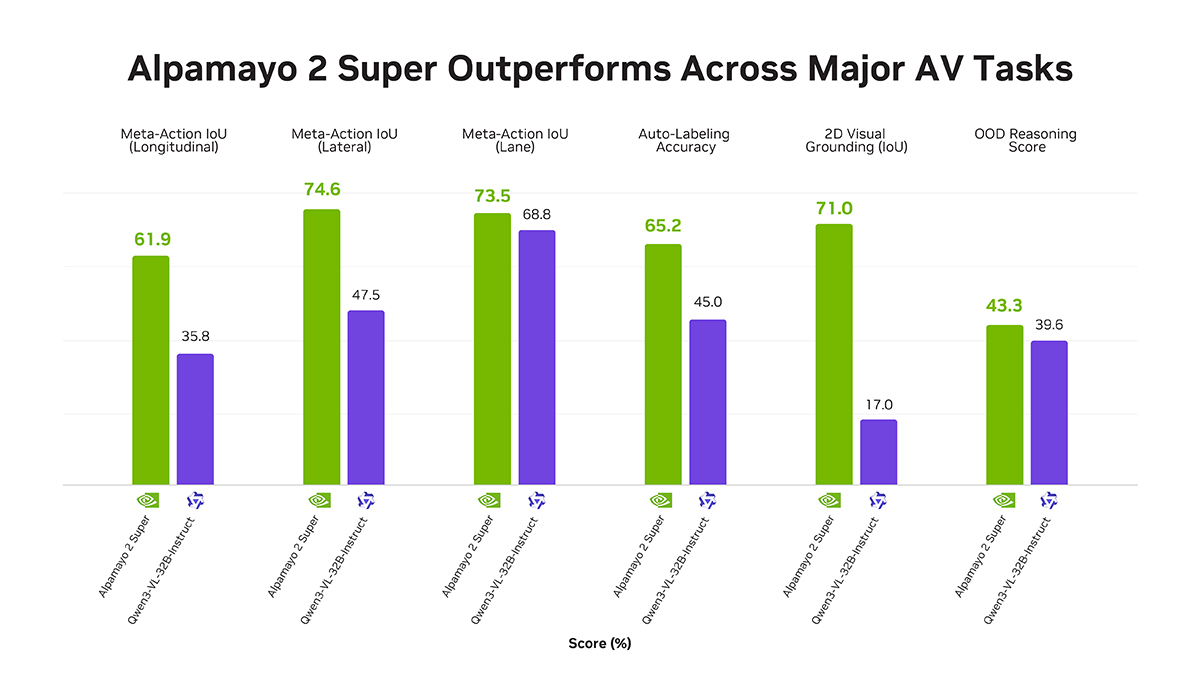
Today, we’re launching Alpamayo 2 Super, our frontier open reasoning model for autonomous vehicles.
Beyond seeing, Alpamayo understands and reasons through the complex world - thinks before it acts.
It’s a powerful backbone for robotaxis, trucks, shuttles, delivery vans, tractors and the long tail of mobile robots—billions of autonomous machines someday.
We’re releasing it for commercial use under OpenMDW-1.1 so teams can inspect it, fine-tune it and deploy it—open models advance safety and security.
The next wave of AI is robotics—and it starts with autonomous vehicles.
Great work, Alpamayo team!
https://t.co/2PYCCXWjZh
For my first post, I’m sharing a letter @NVIDIA signed on why open models matter.
AI will transform every industry, power every company, and be built by every country.
Open models strengthen safety and cybersecurity, accelerate innovation and diffusion, and enable sovereignty.
The world needs both frontier closed models and frontier open models.
https://t.co/AUKzoQ5Ikb
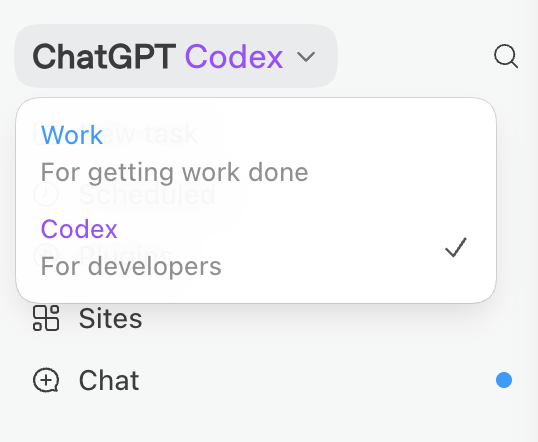
OpenAI 把 ChatGPT、Work和 Codex 装进了同一个桌面应用,Chat、Work、Codex三个模式应该会共用同一套记忆和历史记录?
Chat的优先级被调这么低,我猜,就是想明确告诉大家:
“ChatGPT is no longer just a chatbot — it’s a full work platform.”
但是!!!
Codex直接更新后直接没了,也没有提示告诉我会合并进 ChatGPT……
而且我两次更新都出了问题,左上角根本切不了Work和Codex。
这个更新提示也太烂了,��得我以为自己电脑坏了,一直在找“Codex怎么不见了”
ASPIRE turns robots from “clueless on every new task” into skill-compounding masters.
Shipping know-how instead of weights finally makes sim2real and cross-embodiment transfer practical.
Today, we give robots a /skills library that self-evolves and compounds indefinitely! Introducing ASPIRE: a robot solving its 100th task is no longer as clueless as solving its first. Coding agents observe multimodal sensory traces from simulation and real robots, launch an evolutionary search over control programs, and distill the best know-how into an ever-expanding library.
ASPIRE is a new type of continual learning: "training" is skill refinement instead of gradient descent.
"Trained model" is a repo of sensorimotor skills instead of floating weights.
“Distributed training” is a panel of agents each practicing a different skill instead of sharded minibatches.
Here's the beauty: ASPIRE gives the tired terms "sim2real transfer" and "cross-embodiment transfer" a whole new meaning. Bridging the sim-to-real gap is notoriously brutal. An end-to-end policy has to swallow both the visual shift (sim looks toyish next to a real camera) and the subtle contact physics it never quite gets right. ASPIRE sidesteps the mess, because it doesn't ship pixels or weights across the gap, but ships the know-how. The robot still has to practice in the real world, not zero-shot, but it gets there way faster because it isn't rediscovering the strategy from scratch. Same for going single-arm to bimanual hardware, which usually requires new data and retraining from zero. ASPIRE achieves up to ~10x cut in "transfer learning” tokens (yes, tokens are the new unit of *training* compute ;)
Check out our gallery of 150+ tasks and 90+ skills the robots taught themselves, all on the website! Kind of wild that we can ship the "learned weights" as an HTML page rather than a GGUF. We'll open-source the full stack so your own robot library starts compounding from ours!
Deep dive in thread:
Tesla began pushing FSD V14 Lite to early-access HW3 owners this week.
Via model distillation, Tesla brought its HW4 V14 driving stack to the ~4M older cars whose computers have only ~15% of HW4's memory bandwidth.