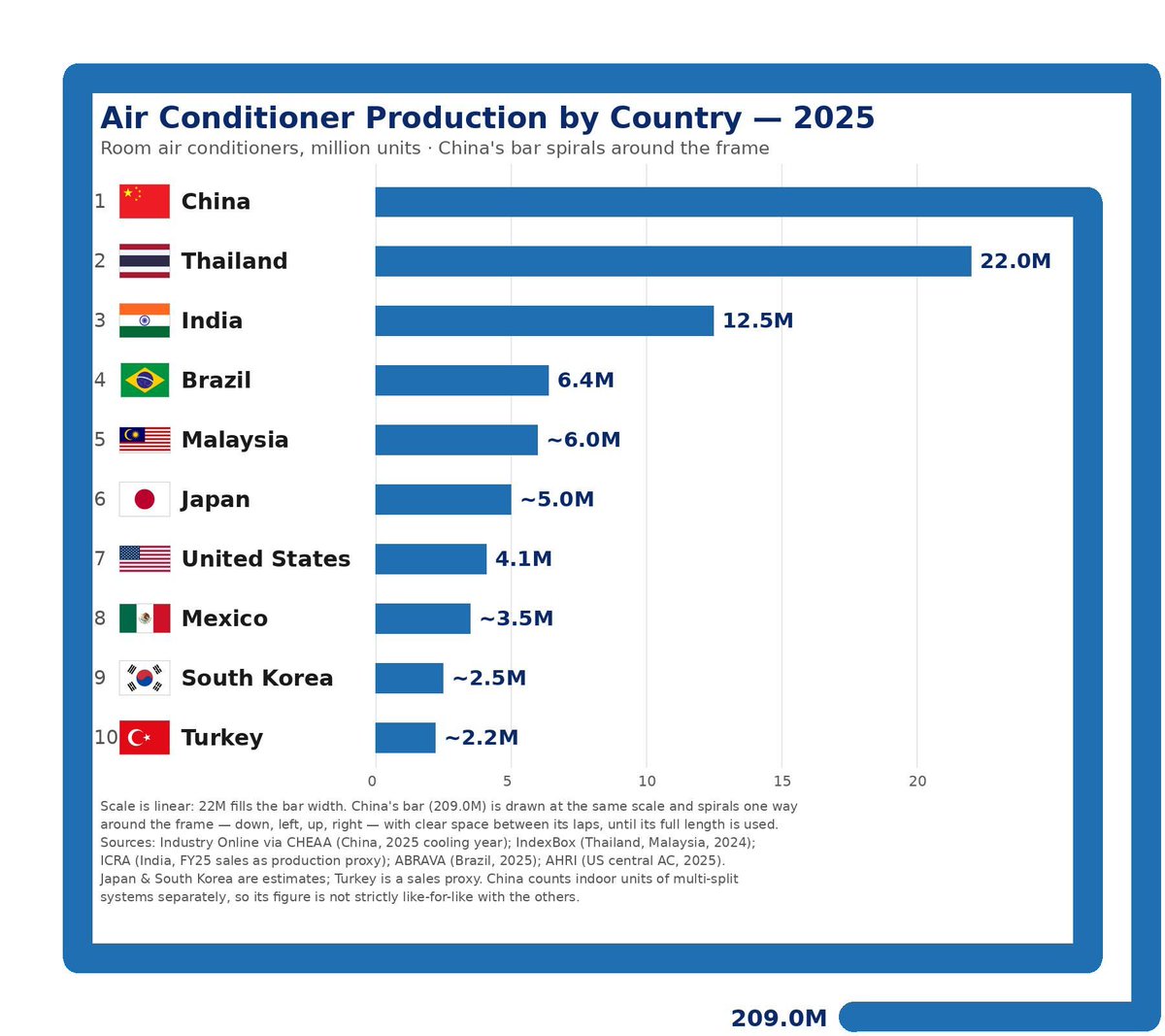
I am sharing this chart partially because it shows just how impressive the size of the Chinese manufacturing sector is but also because of the nice design choice.
🚨 750 gallons of water flowing every MINUTE, and it's being reused.
CNBC goes inside the next generation of data center cooling technology, where water circulates in a closed loop instead of constantly drawing fresh water from local supplies.
Walmart and Kroger are quietly rolling out an internal store technology across America that could either modernize retail or bankrupt the middle-class family budget.
Starting across thousands of locations heading into 2027, traditional paper price tags are being ripped off grocery shelves and replaced with cloud-connected digital screens. Raise the price of bottled water by 20 percent the second the afternoon temperature hits 90 degrees. Surge the cost of ground beef, milk, and sandwich bread between 5 PM and 6 PM when exhausted commuters are rushing home from work. Drop prices at 10 AM on a Tuesday, then hike them right back up the minute the after-school crowd walks through the sliding doors.
Every price change happens wirelessly in seconds from a central corporate dashboard. No store employee has to touch a single shelf.
Walmart has already signed a massive deployment deal with VusionGroup to wire 2,300 American supercenters with EdgeSense digital shelf rails by 2027. Kroger is expanding its own Microsoft-backed system called EDGE across hundreds of supermarkets. Over 60 million digital price tags are already blinking on US grocery aisles right now.
This is not supply chain inflation. This is Uber-style surge pricing built directly into the shelves where Americans buy baby formula, eggs, and medicine.
Last week I sat down for coffee with a former retail pricing director who spent 14 years building supermarket margin algorithms before leaving the industry. What he shared over the table completely changed how I look at a grocery aisle.
"Retailers just turned static shelves into live stock tickers. The question is not whether grocery chains will use instant price changes, because they already spent billions installing the hardware. The question is how much extra money a family of four will lose every week simply because both parents work until 5 PM and cannot shop during off-peak hours."
Here is how the digital grocery pricing system actually works, how it tracks you in the aisle, and the exact phone settings and checkout playbook you need to beat it.
Is crypto actually BETTER OFF without the Clarity Act?
Former CFTC Chairman @giancarloMKTS tells @itsciaranlyons why he's glad the bill failed and why he believes the US crypto industry can thrive without it.
#CHAINREACTION
I'm intrigued by containerized data centers, but the mention of a moratorium suggests the constraint may lie less in compute and more in power infrastructure. 🧐
If I had to choose one, I'd pay for resolved customer problems. Answers are outputs. Closed cases are process metrics. Problem resolution is the outcome. The challenge is measuring it consistently and objectively.
Would you pay an AI supplier for an answer sent, a case resolved, or a customer problem that stays solved?
Those are three different products.
Simon-Kucher's pricing framework distinguishes the role of human work from the value delivered. Consider an AI support service:
1. Access pricing pays for availability.
2. Usage pricing pays for activity.
3. Outcome pricing pays for a defined result.
The difficulty sits in that last definition. Who checks completion? What happens when a customer returns? Which exceptions still need people?
Outcome pricing can align incentives only when buyer and vendor can verify the same result.
Source: Simon-Kucher, “A how-to guide to monetizing GenAI and AI agents”
@RLDI_Lamy@sulefati7@ILoveBooks786@Corix_JC@FrRonconii@Nicochan33@faryus88@ramonvidall@ozsilverfox@jameslhbartlett@dinisguarda@PatrickCFOD@Eli_Krumova@BCAgroup@ricardo_ik_ahau@timo_vi@violetainsights@DioOmega@66Iot
Before steamships, global trade followed the winds rather than the shortest route. This brilliant animation by @BartGonnissen uses 250,000+ historical ship positions (based on logs from 1750–1855) to reveal how winds shaped global shipping routes. Source: https://t.co/eU8waXbBvV
Corruption in sports annoys me even more than corruption in politics. In Argentinian football Barracas Central (run by the AFA president's son) leads in VAR decisions favouring the club. For good measure, Barracas Central also didn't have a red card in 2026. Could just be a coincidence... Source: https://t.co/x9LHzypSfP
BREAKING: A robot developed by Caltech and funded by DARPA has successfully built part of a structure in orbit without astronauts, marking what researchers describe as the first autonomous construction of a structure in space.
The experiment, called ASTRA, uses a robotic arm to retrieve individual structural tubes and connecting joints, then assemble them into sections of a larger framework directly in orbit.
Launched aboard a SpaceX Falcon 9 in March, the system has spent approximately six months in space testing the technology.
The robot successfully constructed a new section of a truss structure, demonstrating that spacecraft could eventually assemble large structures from smaller components rather than launching them fully assembled.
The experiment is part of DARPA's NOM4D program, which aims to enable construction of enormous structures in orbit, potentially hundreds of meters or even kilometers across.
Potential applications include:
> Giant space telescopes
> Large satellite communications antennas
> Orbital solar power stations
>Future space infrastructure too large to fit inside conventional rockets
The demonstration did not complete the full planned antenna, but establishes an important proof of concept for autonomous orbital construction.
The technology could eventually allow the size of structures built in space to exceed the physical limits of the rockets used to launch their components.
Link to official report submitted by Caltech: https://t.co/63Mpylbisb
Radioactive bananas 🍌?
Radioisotopes are unstable atoms that decay and emit excess energy.
They have hundreds of uses and can be found in countless everyday products, including these 5️⃣ for starters 👇
https://t.co/ohSv6kG7yL
Scientists have uncovered shock new evidence based on carbon isotopes that suggests the recent rise in atmospheric CO2 has little or nothing to do with fossil fuels, says Chris Morrison. https://t.co/2s7u5oBpWl