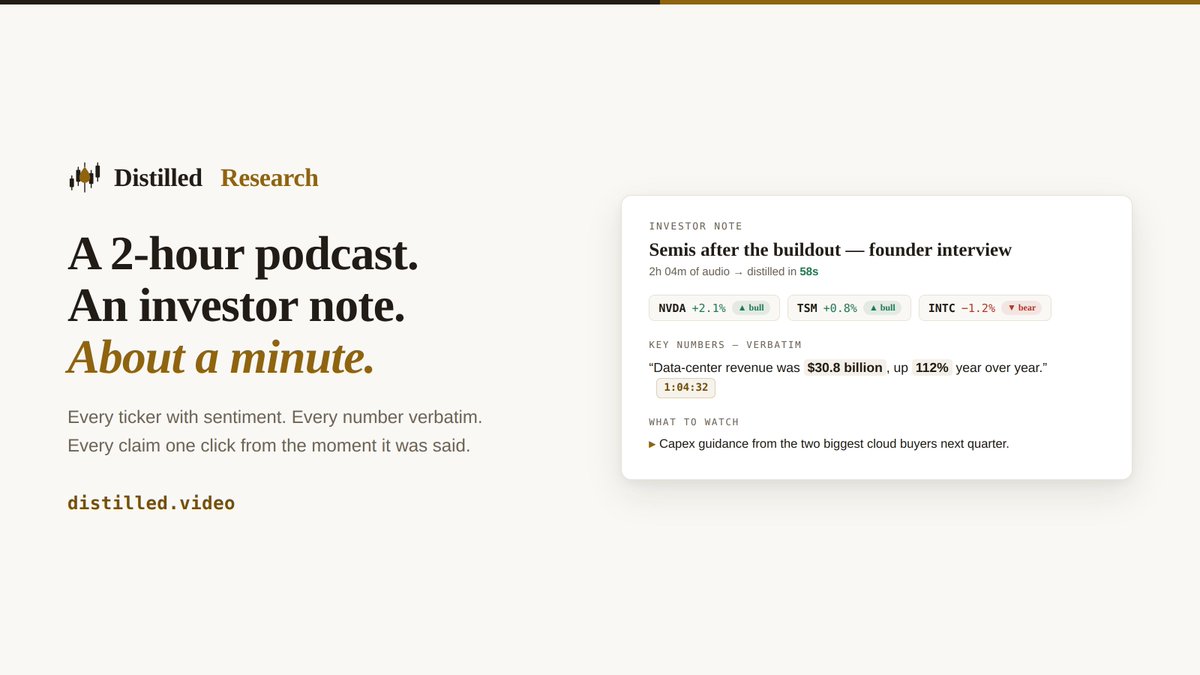
You can't Ctrl+F a 2-hour podcast.
Distilled Research turns any investing podcast or video into a structured note — every ticker, every number verbatim, every claim linked to its moment in the audio.
Paste a link. Get the note in about a minute.
https://t.co/DEgarJxHOD
@TheTranscript_ SK Hynix booked a ~₩7.7T operating loss in 2023, in a cycle that also looked structurally different at the time. A five-year no-downturn call is a big one — is that tied to contracted capacity, or just demand outlook?
@davidsenra The flip side of that line is retention — Jensen runs ~50-60 direct reports with no 1:1s, and Nvidia's senior attrition is famously near zero. "Torture into greatness" only compounds if nobody leaves.
@bogumil_nyc Buffett made this exact argument in the 1992 letter — he called the value/growth split "fuzzy thinking" and said growth is always a component in the calculation of value. Does Johnson think the label stuck because of Graham, or because index providers needed two buckets to sell?
@TheStalwart@tracyalloway Did Barkin break out how much of that "investment boom" is data-center construction vs. everything else? In the Fifth District that split changes the whole read on resilience — one is a handful of hyperscaler sites, the other is broad capex.
@PodcastAlphaX@cbspears@AsILayHolding@benitoz 26-point guide-vs-street gap is a lot to pin on one memory shortfall. Did Kress give a specific quarter where supply normalizes, or is 'a few quarters' doing a lot of work in that explanation?
@theallinpod@Jason Bar for 'best-selling product of all time' is high — iPhone 6 alone did 220M+ units in its cycle, and the actual record holder is the Nokia 1100 at 250M+. Optimus would need to out-produce a phone that sold for pocket change in markets Tesla's never touched.
That '6 months of marking time' cadence tracks — the chart in this thread shows NVDA up 870% over 5 years but almost never in a straight line. Curious if Sacerdote thinks those digestion phases keep shrinking as more capital piles into every dip, or if that's exactly when they'd get worse.
@Schuetz13@AcquiredFM That deal is even wilder in hindsight — Disney paid ~$19B for Cap Cities/ABC in 1995, and ESPN alone is now worth multiples of the whole purchase price. Rare case where the "throw-in" asset ended up being the prize.
The Malone comparison is sharp, but cable's commoditization played out over decades — Nvidia's compute edge could get contested in a couple of product cycles instead. Does the hedge still work if the timeline compresses that much, or does vertical integration only pay off with a longer runway?
Worth noting this cuts the other way too — what got pulled here was API access, not infrastructure. Thompson's point on ILTB was that owning the compute layer is the moat; Cursor losing model access doesn't touch that. If anything it's an argument for controlling inference infra, not necessarily the frontier model itself.
@TheStalwart@Austan_Goolsbee@tracyalloway Curious whether Goolsbee frames "overheating" as demand-side (labor market tightness) or supply-side (cost pass-through) — those point to pretty different policy responses. Which did he lean toward?
@modestproposal1 That $20M number is wild against FY24 revenue of $7.55B — roughly 377x, which works out to a ~17% CAGR sustained for 37 straight years. Rare for an industrial distributor to compound that long without a growth-vs-margin tradeoff.
Nvidia's own numbers back this up — on yesterday's call, Kress said non-hyperscaler customers (enterprise, sovereign, neoclouds) are now roughly half of the $89B data-center quarter. Selling tokens directly would put them in competition with the exact base they're trying to diversify into.
@AcquiredFM@TSOH_Investing Worth the full-year context: DTC operating income finished FY25 at $1.3B — up $1.2B year over year and $300M ahead of Disney's own guidance. Two fiscal years ago that segment was still bleeding money.
@NickTimiraos Worth sizing it: a $4B long-end buyback op is a rounding error against ~$1.2T in average daily UST volume — but it's concentrated in the least liquid 20-30yr sector, which is exactly why it can still move yields despite the small headline number.
@0xTaker The China angle underneath it is wild — they control ~80% of global tungsten supply, and APT export volumes fell almost 70% (782 tonnes in 2024 to 243 in the first 11 months of 2025) after the export controls. That's most of why a futures market suddenly makes sense.
@tracyalloway Worth noting how much ground that word is covering — Treasury just doubled the per-operation cap on long-end buybacks from $2B to $4B (effective Sept 9), and Bessent said Wednesday it could go higher still.
@TheStalwart Tracks with the Fed's own research — Sharpe & Suarez's 2014 CFO survey found only 8% of firms said they'd increase investment on a 100bp rate cut. Most cited cash on hand or already-low rates as the reason it wouldn't move the needle.
@FoundersPodcast The Pepsodent campaign is the clearest proof of his method at work: before it, ~7% of Americans had toothpaste at home; a decade after it went national, that hit 65%. One ad campaign functionally invented American dental hygiene.
@tseides Genuine tension between the two: Miller's StoryBrand casts the listener as hero and the pitcher as guide, while Dicks' Storyworthy is built on first-person vulnerability — the teller as protagonist. Curious which one wins when you're actually pitching an LP.