1/
Right now, somewhere, attackers are quietly collecting encrypted data they can't read yet.
They're not waiting to break in. They're waiting for quantum computers to break the lock.
It's called "Harvest Now, Decrypt Later." And it's already happening. 🕵️
2/
This affects Web2 just as much as Web3
Your HTTPS connection. Your VPN. Your emails. Your login sessions
All secured by RSA and ECC, the exact algorithms quantum computers are expected to break wide open TLS, VPNs, and JWT authentication, all lean on these classic primitives
3/
Recent research has made this scarier, not more distant.
New papers between 2025-2026 cut the estimated qubits needed to break RSA-2048 from 20 million down to under 1 million.
Possibly as low as 100K with newer architectures.
The timeline just got shorter. ⏳
4/
For Web2, the damage is "recoverable". You can rotate keys, patch protocols, and migrate to new encryption.
For Web3? Not so much.
Blockchain ledgers are transparent by design
Every transaction ever made is sitting there, permanently, waiting to be harvested.
5/
This is the part most people miss:
Once you've ever sent a transaction, your public key is exposed on-chain forever.
It's not "if" quantum computers arrive, it's that years of blockchain history are already sitting in someone's archive, waiting. 📦
6/
So what's the fix?
@QANplatform built XLINK
A protocol that lets existing Ethereum-compatible wallets (MetaMask, Trust Wallet) add quantum-safe signatures without migrating funds or wallets.
It uses ML-DSA (FIPS 204), NIST's top post-quantum standard. 🔐
7/
And it's not just theory, XLINK passed a full security audit by Hacken in Nov 2025, stress-tested against both classical and quantum-style attacks.
QANplatform is also one of the first 20 members of the Linux Foundation's Post-Quantum Cryptography Alliance. ✅
8/
Web2 is racing to patch TLS and VPNs.
Web3 is racing to protect ledgers that can never be "patched" retroactively.
Both are running against the same clock.
@QANplatform built infrastructure for the side of that race most people aren't even watching yet.
$QANX
On June 22, 2026, President Trump signed two executive orders affecting post-quantum cryptography and quantum innovation.
EO 1 → "Securing the Nation Against Advanced Cryptographic Attacks"
EO 2 → "Ushering in the Next Frontier of Quantum Innovation"
This is basically the U.S. government declaring that the quantum era has arrived. 🧵👇
9/🧵
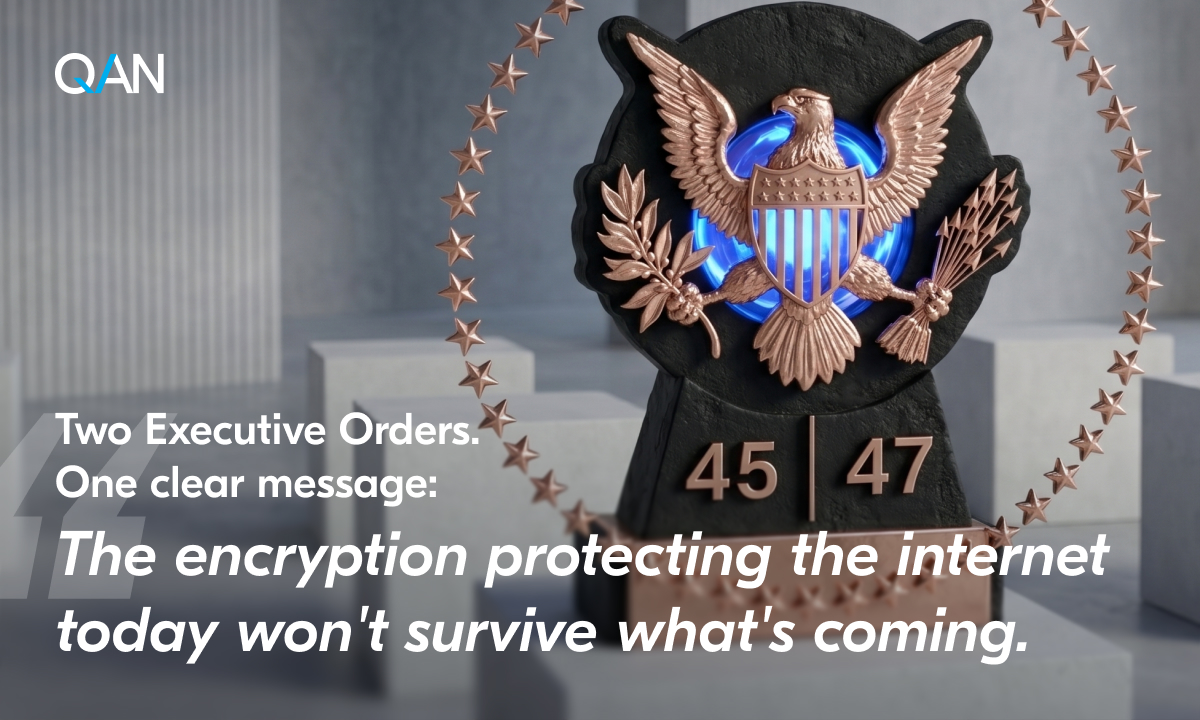
Two executive orders. One unavoidable conclusion:
- The quantum threat is officially recognized at the highest level of U.S. government,
- America is actively building the quantum computers that will make current public-key cryptography obsolete,
- Hard deadlines, 2027, 2030, 2031, have been set for the executive branch and covered contractors.
Q-Day isn't a distant forecast.
It's a government-issued deadline.
It is a Thursday evening in 2030.
Marko, a backend engineer in Berlin is debugging a wallet recovery issue.
A user claims funds were moved without authorization. No phishing. No malware. No leaked seed phrase.
Just a valid signature.
Marko pulls the transaction.
It checks out.
Correct format. Correct curve. Correct verification path. From the protocol’s perspective, nothing is wrong.
But something is.
He traces the wallet history back.
First transaction: 2022.
The moment the public key was revealed on-chain.
After that, years of inactivity.
No rotations. No changes. Just a key sitting there, exposed, forgotten.
Until now.
He opens an internal thread. Someone mentions it quietly.
“Could be quantum-derived.”
No one replies for a minute.
Because if that sentence is true, even once, this is not an incident.
It is a pattern waiting to be found.
Marko looks at the verification result again.
The system did exactly what it was designed to do.
Accept a mathematically valid signature.
It just no longer knows who is behind it.
We're partnering with @aegis_im to bring fixed-rate credit to native Bitcoin-backed borrowing.
Trustless Bitcoin Vaults provides the native Bitcoin collateral infrastructure, @aave v4 enables borrowing against that collateral and @aegis_im delivers fixed-rate credit products.
Fixed-rate borrowing offers predictable financing costs, helping institutions and Bitcoin holders better manage financing over a defined term.
Subject to development and testing, the product is expected to go live in Q4 2026.
"I think Bitcoin should be a very valuable collateral asset, in the same way that shares of public companies are valuable collateral assets."
@alextapscott speaking with @Tristan0x15 and @Cryptocito on the second episode of Double Down.
Watch the full recording:
https://t.co/BI0ey5Qh3S
There are already many Bitcoin collateral solutions.
Most require you to trust a centralized intermediary, accept bridge risk, or turn Bitcoin into a wrapped asset.
Trustless Bitcoin Vaults were designed to remove those trade-offs.
Hear from @Tristan0x15 as he discusses the current Bitcoin collateral landscape in the first episode of Double Down.
"We're bringing bitcoin to Ethereum as the first use case. Aave is the biggest DeFi protocol on Ethereum. So we're bringing it to the biggest center of the smart-contract economy."
@dntse speaking to @CoinDesk
https://t.co/6OfMDuF5pH
The first official Podcast Episode for Double Down will drop tomorrow 🎉
@alextapscott CEO of @CMCC_Global Capital Markets joined @Cryptocito and @Tristan0x15 to discuss;
1⃣ State of the market
2⃣CMCC's latest updates
3⃣Why Miners are pivoting to AI data centres for additional revenue and more.
Stay tuned for tomorrow's episode.
Interested to see the end to end flow for native Bitcoin-backed borrowing with @aave v4?
Native BTC is locked in a Taproot script on Bitcoin, while the collateral position is recognized by Aave v4.
The borrowing flow: post native BTC collateral, borrow supported assets such as USDC or USDT, repay, and redeem BTC back to your Bitcoin wallet.
Read the docs ↓
https://t.co/DWbcFSeujX