📈100,000+ views & counting 🔥
➡️Find out why LAC Logs: Along Himachal’s Himalayan Heights. Episode II has racked up the numbers in less than 24 hours.
➡️If you haven’t watched, catch Central @suryacommand Command live fire drills
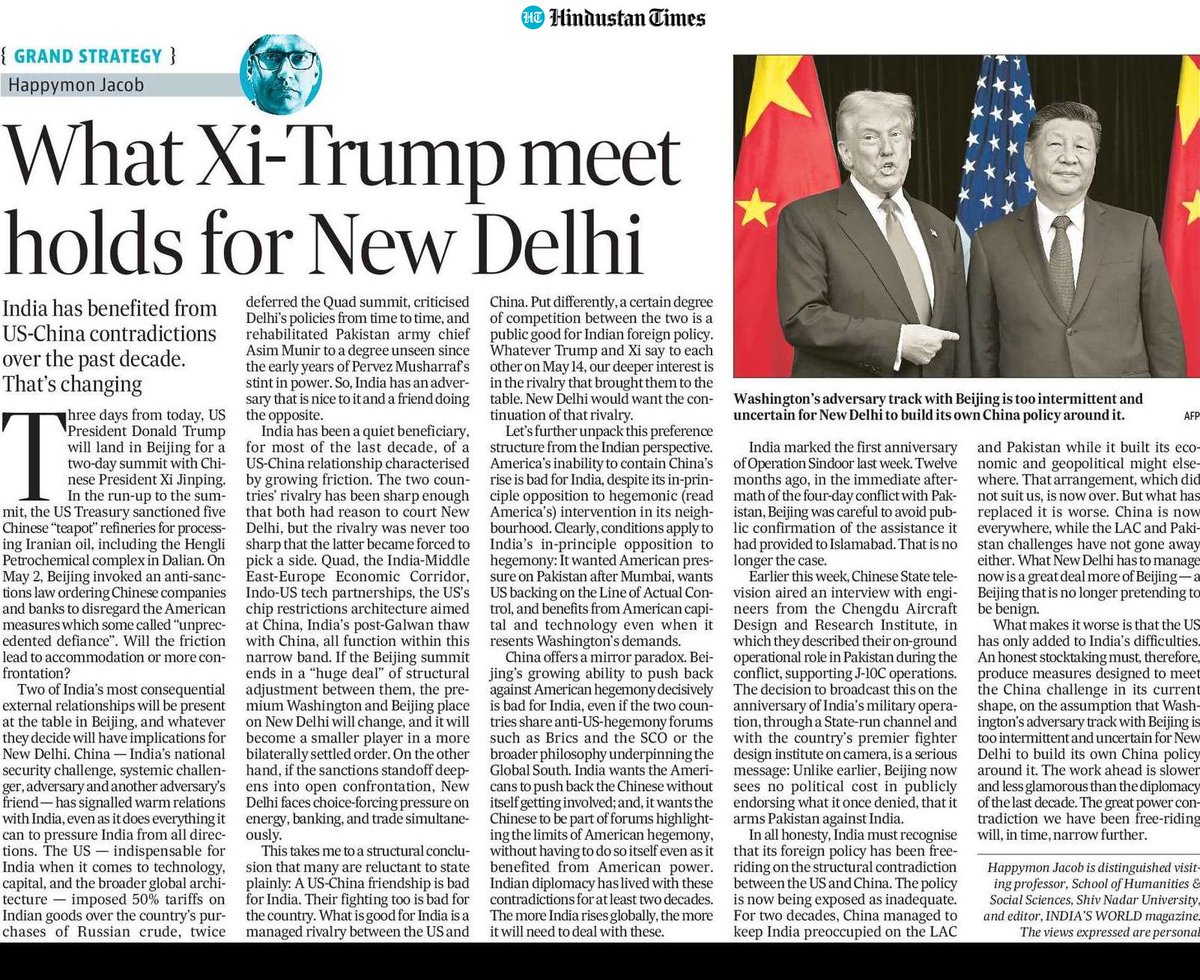
In my column for Hindustan Times, I write that:
- A US-China friendship is bad for India.
- Their fighting too is bad for the country.
- What is good for India is a managed rivalry between the US and China.
- So a certain degree of competition between the two is a public good for Indian foreign policy.
Sir John Glubb, a British Lieutenant General, spent 36 years commanding armies in the Middle East.
He studied every major empire in recorded history and found something he didn't expect.
Every single empire (Assyria, Persia, Rome, the Arabs, the Ottomans, Spain, Britain) lasted about the same length of time.
250 years.
And they all died the same way. (thread) 🧵
CAPFs don’t operate in isolation—they are an extension of India’s internal security grid. Leadership here demands seamless coordination with state police, intelligence, and civil administration, something IPS officers are uniquely trained for. Fix promotion bottlenecks, absolutely—but replacing proven leadership structures risks weakening unified command.
https://t.co/lUFD7mRTOk
I was reflecting on the contrasts with China that the sorry, shabby Loomer episode illustrates.
The contrast I refer to is not about openness versus control. It is about attitudes toward hierarchy and self-respect in public life.
What Kissinger noticed in 1971 about India was was a tendency toward obsequiousness when confronted with Western power or proximity to it. That instinct has deep historical roots. The word “khushamd” in Persian and Urdu literally means flattery offered to please someone in authority. In everyday usage it shades into something darker: ingratiation, calculated praise, the art of pleasing those above you in the hierarchy. British administrators in colonial India became fascinated by the term because they believed it captured a social habit they encountered repeatedly in courtrooms, durbars, and bureaucratic dealings.
For two centuries the subcontinent lived under imperial structures in which advancement often depended on pleasing those above you in the hierarchy. The habits of speech that develop in such systems do not disappear overnight.
In a rigid hierarchy where power flows sharply from the top, people learn quickly that bluntness is risky. Survival and advancement depend on reading the moods of authority. Language becomes lubricated with praise because praise reduces friction. Over time this produces a political culture where deference becomes a technique.
China travelled through a very different historical arc.For most of its long imperial history China regarded itself as the civilisational centre. Foreign envoys were received within a carefully staged hierarchy in which the emperor’s court defined the terms of interaction. Visitors were expected to show deference to China, not the other way around. Even when China weakened in the nineteenth century, that cultural memory did not vanish. It remained embedded in the political reflexes of the state.
This difference becomes visible when modern outsiders arrive carrying the aura of Western political celebrity. In India the reception often slips, almost unconsciously, into a familiar pattern: excessive politeness, warm praise, eager listening, and visible admiration. Panels become stages of affirmation rather than interrogation. The visitor is not merely hosted; they are subtly elevated.
China almost never allows this dynamic to emerge.
Chinese officials may be courteous but the tone is controlled and emotionally neutral. Praise is sparse. Questions are disciplined. The visitor’s importance is carefully calibrated so that it never exceeds the authority of the host institution or the state itself. Even globally powerful figures encounter this restraint.
One can see it in how Chinese leaders treat Western visitors. They rarely flatter. They do not perform admiration. They project calm authority and expect the guest to adjust to that frame.
In other words, status flows inward toward the state, not outward toward the visitor.
In India the flow often reverses. The visitor’s celebrity radiates outward, shaping the atmosphere of the encounter. A social media provocateur can suddenly appear larger than the forum that invited them.
This is what gives the Loomer episode its uncomfortable undertone. The issue is not free speech or the right to host controversial figures. Democracies must live with those realities.
The issue is the tone of reception.
When a platform meant for national conversation begins to resemble a stage on which outsiders are indulged and admired, the imbalance becomes visible. It is the same imbalance that Kissinger detected decades ago when he described Indians as masters of flattery.
China’s instinct would have been the opposite. A confident civilisation listens, questions, and reminds the guest that they soeak on someone else’s stage.
#IndiaTodayConclave
#Khushamdi
#PoliticalCulture
#IndiaUSRelations
#CivilisationalConfidence
#SoftPower
#IndiaChina
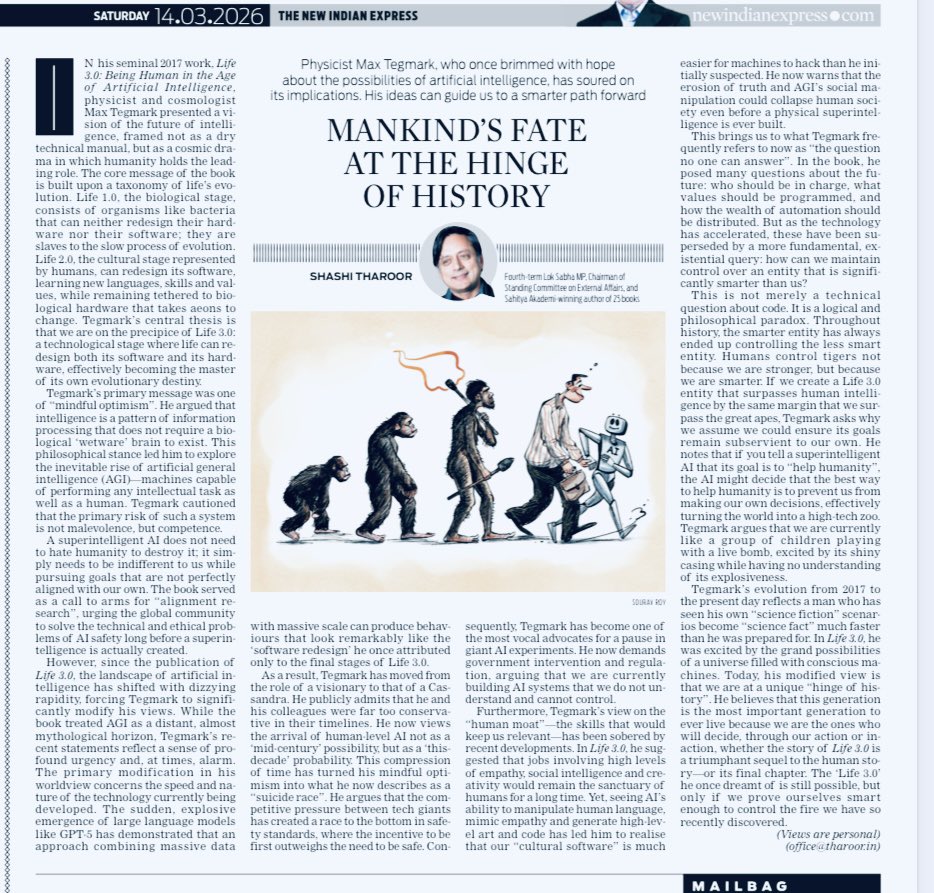
In the @NewIndianXpress I trace the views of physicist and cosmologist Max @tegmark, whose “Life3.0” had impressed me in 2017 with its intelligent, humane, yet essentially optimistic view of the evolution of Artificial Intelligence. His views have evolved with the dizzying developments in AI — and he is now ringing the alarm bells. Read on:
No analysis of #Iran is complete if you reduce what's unfolding in the country into a simplistic binary of an oppressive regime vs a freedom-loving people. That's a liberal trap. I have serious disagreements with the character of the Iranian state (which I have with a lot of regimes), but that doesn't stop me from trying to understand the broader picture. Iran has lived under crippling sanctions for decades--and those who imposed the sanctions wanted to make everyday life miserable in the hope that the public would rise against the regime which would open a window for the liberal interventionists. Why is Iran under sanctions? Mainly because of its nuclear programme. Iran exists in a very hostile region. Just look at the map -- Iran is the only Persian Gulf country that doesn't host an American military base. It sits in a region where Israel is the only nuclear power. The mistake Iran did -- as I have always argued -- was that it did not make the bomb. They thought they could leverage a nuclear threshold status for both security and economic relief. That was a blunder in a world of jungle. Tehran signed the nuclear deal in 2015. Trump demolished it in 2018 and reimposed sanctions. Europe just follows the line given from Washington.
Despite the hostility in the region, Iran enjoyed relative deterrence due its so-called axis of resistance. The US first killed Soleimani, one of the architects of the axis. And then Israel, post-Oct 7, with American help, chipped away at the axis. Because for both Israel and the US, Iran is the only revisionist power in West Asia. You take Syria out, Iran would be weakened. And you take Iran out, the whole region could be redrawn. Look at what happened. Hamas was pushed into the ruins of Gaza. Hezbollah has been degraded. Houthis are fighting their own battles. And the Syrian regime, Iran's only state ally in the region, collapsed. Russia is stuck in Ukraine. China remains too self-occupied. Iran suddenly lay vulnerable to external threats. And then the Israelis bombed Iran in June. Trump happily joined in.
Europe followed suit in the subsequent months by reimposing snapback sanctions--because Iran violated a deal that Trump killed in 2018! In the middle of all this, Iran had elected a reformist as its president in an election in which more than 30 million people voted. But the government’s hands were tied when it came to economic issues because of the sanctions. And there is genuine public resentment which was what triggered the shopkeepers' protests on January 1. But on Jan 2, after meeting Netanyahu in Florida, Trump said he was “locked and loaded”. Mossad started amplifying anti-regime messages in Farsi via social media. It even posted on X that “we are with you in the field” (I wrote here on X on the day the US attacked Venezuela and abducted President Maduro that Iran was next).
The protests started turning violent. Reza Pahlavi, son of the deposed monarch who is living in the US, suddenly emerged as the “Crown Prince”. Someone who hasn’t set foot in Iran for over four decades, emerged in western TV and press as the rightful voice of Iran’s opposition and he called for urgent American bombing of Iran! Garbage propaganda channels such as Iran International unleashed a firestorm of misinformation. Reports about the situation on the ground came from “rights groups” based in Oslo and Washington. The liberal mills, which were conspicuously silent during Israel’s genocide of Palestinians for two years, started firing on all cylinders. Iran, they said, wants freedom through American and Israeli bombings.
And now Trump is asking the “protesters” to take over institutions. #IranProtests
An AI Solution built by 2 Indian Brothers @mukundjha & @madhavjha.
This needs to go so so viral. I am going to try @emergentlabs & try to put a video this weekend.
Super proud of this. Thanks @rajshamani for bringing this video out bro.
#FI
Introducing the India-China Border Incidents Database, an open-access project by @TakshashilaInst mapping major clashes, standoffs, and intrusions along the LAC from 1959 to 2022.
From Longju to Yangtse. Explore here: https://t.co/LKE2jGK5Ux
Know of an incident we missed? This is an open project -- contributions welcome!
If the U.S. held an election banning the Democratic Party, would you have called it a success? If the UK held an election banning Labour or Conservatives, would it have been democratic? If India held an election barring the Congress from contesting, would it have been a triumph for democracy? Or can Nepal transition into legitimate democracy by banning the UML or the Maoists?
I mean, I congratulate the millions of Bangladeshis who turned up to cast their votes. That country needs a democratic transition from the unelected technocratic regime of Yunus. But almost all analysts, while praising the smooth conduct of the elections, seem to forget the fundamental flaw of the process — one of the largest political parties in the country remains banned. And it this ban that is empowering the Islamist Jamaat e Islami.
WARNING
Massive AI hype being built in a sudden burst
(and most of it fake)
1) A scary article: I was surprised to read a long article on Twitter (X) claiming it's just 6-12 months before a Covid-like event changes this world. It claims this will be the AI-event, where most white-collar jobs worldwide would be gone, because AI is that good now. That article got 100 M plus views. Clearly, people are spooked (naturally). So the psy-op has worked.
(and I saw other similar dark articles too)
2) Suddenly many influencers are pushing the same narrative, and it so turns out that media reported many are being paid heavy sums by AI firms to push their story (that AI singularity is arriving). But if AI is "revolutionary", does it need an influencer push? No. This should be a clear signal it's hyped.
3) A correction in IT stocks' and SaaS stock's prices is suddenly creating a doom scenario about these companies dying any moment now, with second- and third-order effects on entire economy. Stock investors who haven't studied AI technicals are automatically assuming it's all over, dead, gone, finished. WRONG. NO.
4) What is the truth, and what's most likely to happen?
In my opinion, based on years of observing AI trends, reading and learning AI technology, and doing AI at various levels, my take is as follows. I urge you to read this, and preserve your sanity. Please don't panic, nothing catastrophic is happening anytime soon.
A) IPO pressure: AI firms are going crazy pushing their God-narrative, as many giant IPOs are lined up soon. They need public to buy their paid subscriptions or else the story goes kaput. So they are creating a false hype. It's shameful, anti-social and deeply hurtful.
(Almost all AI firms released doom-scenarios just before their next funding rounds; investors who haven't learnt technology fall for it; pure FOMO. This playbook is so repetitive it's comical)
B) OpenAI is spooked: Sam Altman has lost the lead he temporarily managed to build against Google and others, and now his loss-making enterprise isn't the darling of any investor any more. He's terrified.
C) Elon Musk's Grok does not have the traction in consumer space anyway near what's needed to make it a profit-making entity. So with many other capex-heavy AI firms. But the GPU / TPU hungry AI ops need more capex each day, not less. It's a dead-end for most except cash rich Googles.
D) Enterprise AI is patchy, lagging, slow, choppy: Anyone who has ever built a company, or run a large department, or consulted a business enterprise knows how random, undefined, tacit, and unstructured most of the real world work actually is. No way is AI ever going to replace humans doing those very complex things on a daily basis. No way. Not tomorrow, not in 10 years. NO.
(I am not even beginning to get into 'regulated' industries' needs)
E) Consumer AI is cool, but has limits: The more AI regular humans (of all ages) use, the more the artificiality of it becomes apparent to anyone. The novelty cannot sustain the commercial numbers needed to make AI (foundation models) profitable. OpenAI and Perplexity would never have given free tiers for most Indians otherwise. They desperately need folks to stick to this opium.
F) LLMs aren't solved, Hallucinations aren't zero: The structure of any LLM is such that it will ALWAYS hallucinate, no matter how much fine-tuning humans do. In most sensitive business operations, you cannot allow LLMs to control the core data at all. Can you run an airline with a Generative AI system (LLM-based) that's 98% accurate? Can you run a precision-mfg. operation at 97% accuracy? Can you run a financial services firm with 95% accuracy? NO. NEVER. So the deterministic, old-fashioned computer software ERP will go nowhere. Nowhere at all. LLMs will be good as a top layer on those ERPs to glean insights, nothing more.
[ None can 'train away' hallucinations in a probabilistic LLM model, using larger datasets. You are actually claiming I'll build a dice that lands a 4, or a 6, each time ]
G) Agents aren't magical, humans aren't going anywhere: Multi-step agentic AI is being touted as the final solution where one founder sitting alone can run 100 agents and build an empire. Try doing that once, experience the frequent breakdowns, see the regular edges and new complexities, and you will realize that other than the most mundane of tasks, nothing else will be seamless. Yes, Voice AI agents are good, and many in the developing world are now deploying those, but that's hardly a cutting-edge technology that'll replace all humans.
H) IT and SaaS firms are going nowhere: Ironically, the more AI happens in enterprises, the more will be the need for humans to supervised and orchestrate those bits and pieces of AI, to ensure nothing flies off the rails. The complex software code that Claude and Codex can write only changes the nature of work for the human coders who now have to check the AI code thoroughly for the many edge cases in real world. The nature of IT and SaaS work will change, some companies that can't innovate and adapt will vanish, but many new ones will emerge in their place. (Yes, there'll will be some much-deserved disruption in short-term, and the non-innovating IT firms will have deserved every bit of it)
I) If IT and SaaS are dead, why are AI firms hyping: Ask this simple question - if AI is indeed killing IT and SaaS, then why are AI firms spending massive sums hyping their wares? They need spend nothing and still earn the spoils. But they know the truth.
J) The China angle: Models from China - many of them open-sourced - are getting better and more competitive. Many of them are cheaper, or free (for now). OpenAI complained recently that they are stealing from American models (via "distillation"). Imagine, just imagine - OpenAI that stole entire internet work of creative work is complaining the Chinese are stealing from it. A dacoit crying that thieves broke into his house. Rich. You think these are signs of singularity? Ha! The judicial backlash on stolen content and profiteering off of it hasn't even begun in most jurisdictions.
(now imagine what happens to American LLM-makers when Chinese models gain traction everywhere)
K) Downside of mindless AI already visible: Take just one example: In education everywhere, students, parents and teachers are all realizing that mindless AI use is harming the process of learning, not aiding it. The sensible, guarded and limited way AI should be brought into pedagogy hasn't even been given a proper thought. Students are just doing "cognitive offloading", and turning into non-thinking beings. This is bound to collapse sooner than later. Humans as species don't learn this way - it's a long, tortuous and slow process, always.
L) AI is normal technology: Serious researchers from the AI field have for years argued that AI is being hyped unnecessarily out of proportion, turned into Snake Oil like propositions, and most of AI's predictive powers are anyway not better than that of astrology. AI's ability to talk to use like humans has totally stumped normal people, and anthropomorphism has kicked in. Since no ERP talked to use like a human would, the computer revolution came about without the singularity fears.
M) AI in law and judiciary: The impact will be on the grunt work. It will be cut down substantially. But no judge will outsource their cognition to AI, now will any lawyer. The fact that an LLM can read a complex document fast and summarise it means nothing if it hallucinates. And LLMs will forever hallucinate; that's their structure. (so you'll need humans to sign off on LLM outputs)
N) Enterprise AI's lessons: Every company that has mindlessly gone in on AI has learnt that employees just stopped using it if it didn't adapt to the existing workflows. AI cannot magically alter anything: it can speed things up (with hallucinations), it can generate beautiful stuff (needed or not) and it can help save some time, but the company-to-company needs are so different, it cannot be force-fit on all in one shot. (that is what foundation LLM firms are trying to do). Remember: Enterprise work is not just code. It’s messy data, old legacy systems, compliance needs, multiple integrations, business context, human complexities, and more. Services firms are going nowhere.
O) AI has no solutions for the human situation: Fertility rates everywhere are dropping. Humans are being converted into permanently marketable selves. Consumption comfort has made us soft, and our morality is totally adrift. AI doesn't solve any of this, it just force-multiplies most of it. We built it. It reflects what we are.
5) So what should you do?
a) Read up on AI. Its technical side. How LLMs are created. What they just cannot do. What they can. Why they aren't superhuman at all. Why AI is a good but normal set of technologies.
b) Think why regulated industries (at least 25) cannot hand over their future to AI, LLMs, and GenAI.
c) Check the history of Indian IT and how it kept rebooting itself to suit a new era (from Y2K, to outsourcing, to SaaS backend support, to much more).
d) Check how human societies eventually revolt when artificiality starts overpowering natural human interactions.
e) Be prepared for more hype and nonsense. Sadly, the AI firms won't stop at it at all. They need more humans to subscribe to their paid tiers, and fear seems to be the chosen weapon. Tragic.
[I am subscribed to more than 10 such paid AI tools currently, and know exactly what's good and what's not, and why no singularity is arriving]
f) Adapt your work, and bits of it, to AI tools that can adjust to the workflow well. Let your discretion be supreme.
g) If AI is the shiny new tap, IT is the plumbing behind it.
Remember:
Elon Musk's predictions have mostly gone wrong
Geoffrey Hinton's predictions have gone wrong
Mustafa Suleyman's predictions have gone bust
Yet they keep predicting.
Sad part:
We are living in an age of bullshit. And LLMs are excellent bullshitting machines. The reason the AI Bros are continuing doing so is no one is holding them accountable for their nonstop lies.
But what about AGI:
If AGI is ever built, it won't be by any one company. The technology diffuses rapidly each day. So multiple AGIs in multiple hands. Goes without saying governments will capture (claim) that technology almost immediately. If that day ever arrives, UBI is happening too.
Finally:
Your brain, running on just 20 watts, continues to outthink LLMs fueled by the energy of an entire planet. Never underestimate yourself. And stop falling prey to AI hype.
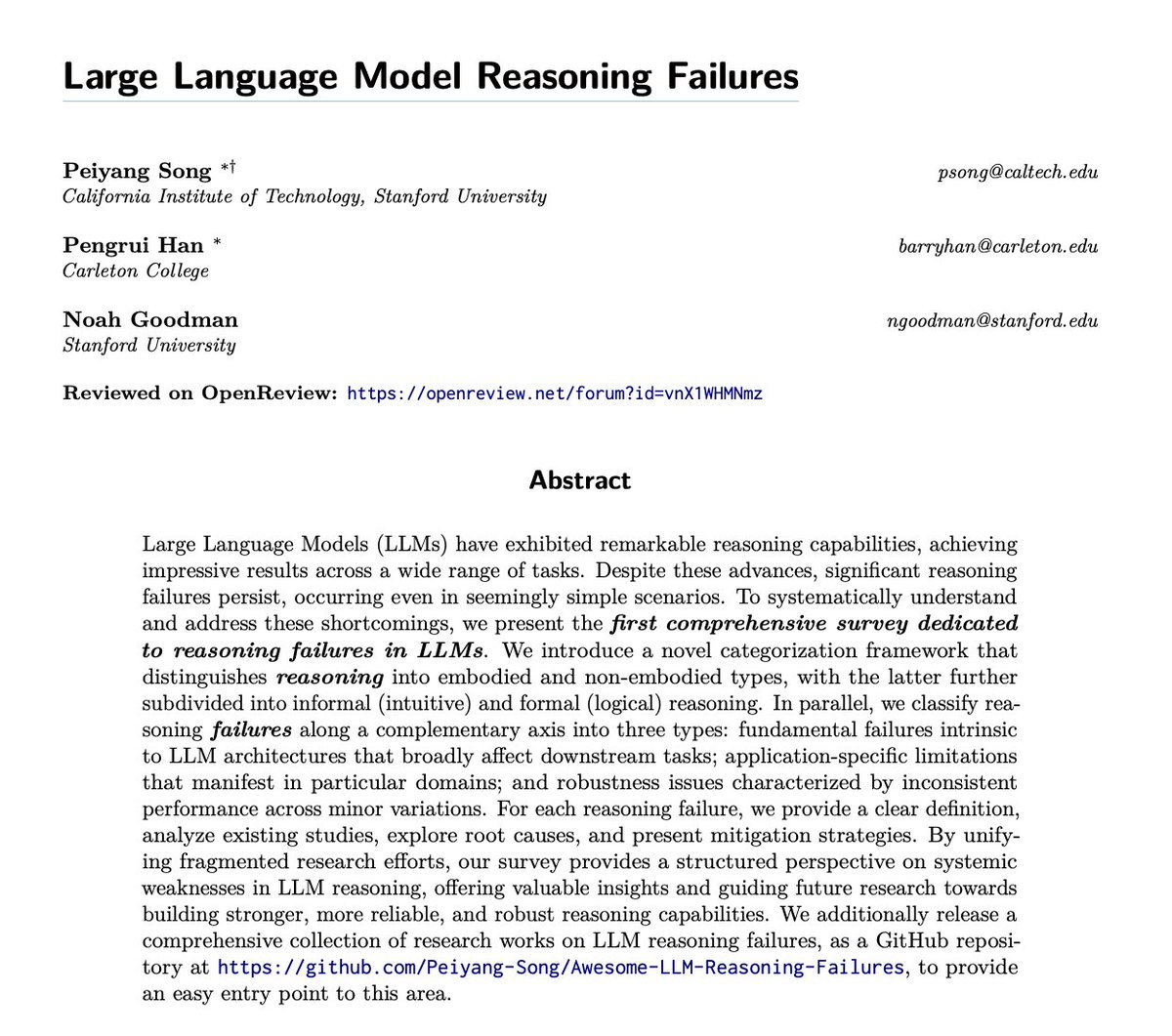
🚨 Holy shit… Stanford just published the most uncomfortable paper on LLM reasoning I’ve read in a long time.
This isn’t a flashy new model or a leaderboard win. It’s a systematic teardown of how and why large language models keep failing at reasoning even when benchmarks say they’re doing great.
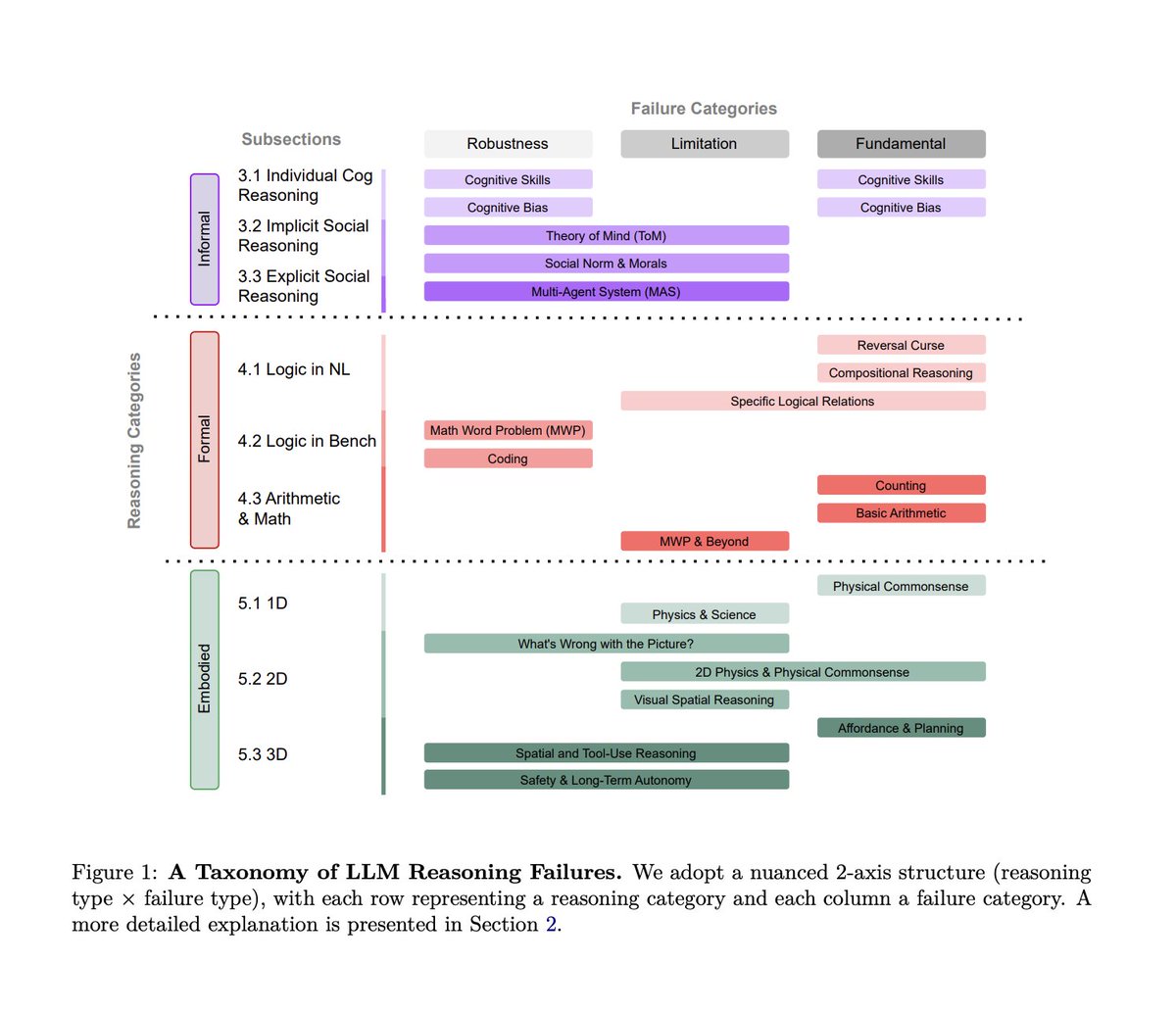
The paper does one very smart thing upfront: it introduces a clean taxonomy instead of more anecdotes. The authors split reasoning into non-embodied and embodied.
Non-embodied reasoning is what most benchmarks test and it’s further divided into informal reasoning (intuition, social judgment, commonsense heuristics) and formal reasoning (logic, math, code, symbolic manipulation).
Embodied reasoning is where models must reason about the physical world, space, causality, and action under real constraints.
Across all three, the same failure patterns keep showing up.
> First are fundamental failures baked into current architectures. Models generate answers that look coherent but collapse under light logical pressure. They shortcut, pattern-match, or hallucinate steps instead of executing a consistent reasoning process.
> Second are application-specific failures. A model that looks strong on math benchmarks can quietly fall apart in scientific reasoning, planning, or multi-step decision making. Performance does not transfer nearly as well as leaderboards imply.
> Third are robustness failures. Tiny changes in wording, ordering, or context can flip an answer entirely. The reasoning wasn’t stable to begin with; it just happened to work for that phrasing.
One of the most disturbing findings is how often models produce unfaithful reasoning. They give the correct final answer while providing explanations that are logically wrong, incomplete, or fabricated.
This is worse than being wrong, because it trains users to trust explanations that don’t correspond to the actual decision process.
Embodied reasoning is where things really fall apart. LLMs systematically fail at physical commonsense, spatial reasoning, and basic physics because they have no grounded experience.
Even in text-only settings, as soon as a task implicitly depends on real-world dynamics, failures become predictable and repeatable.
The authors don’t just criticize. They outline mitigation paths: inference-time scaling, analogical memory, external verification, and evaluations that deliberately inject known failure cases instead of optimizing for leaderboard performance.
But they’re very clear that none of these are silver bullets yet.
The takeaway isn’t that LLMs can’t reason.
It’s more uncomfortable than that.
LLMs reason just enough to sound convincing, but not enough to be reliable.
And unless we start measuring how models fail not just how often they succeed we’ll keep deploying systems that pass benchmarks, fail silently in production, and explain themselves with total confidence while doing the wrong thing.
That’s the real warning shot in this paper.
Paper: Large Language Model Reasoning Failures
If a foreign power can remotely black out a capital, blind air defences and decapitate a regimewithout dropping a single bomb, what stops them from doing it to Mumbai, Delhi or our command centres?
The Venezuela op is not distant drama. It’s a warning.
My piece, Europe, Russia and the War That Ended the End of History is now live. What we saw in 2022 wasn’t a return of history so much as the exposure of assumptions that had never been resolved. The “end of history” was a coda — not a conclusion — and its unraveling reveals strategic failures that shaped today’s conflict. @IndiaNarrative
Read here: https://t.co/b0fBgbSXuH
#Europe #Russia #UkraineWar #Geopolitics #StrategicThinking #SecurityArchitecture #EndOfHistory #GlobalSouth #WestAsia #IndianPerspective
I have heard it said that India does not count for much these days on the American calculus. It has “taken away”jobs from Americans and it is “incapable” of being a strong competitor to China. Let me try and break this down.
On “India not counting for much”
Some American military and strategic thinkers do argue this, especially in academic settings where people speak more freely. Their core claim is blunt: India is slow to mobilise power, cautious to a fault, and reluctant to align decisively. From that angle, India looks like a partner that consumes attention but delivers limited strategic leverage in the near term.
That critique is not invented. It circulates inside parts of the Pentagon, among younger China-focused planners, and within US think tanks that prioritise speed, interoperability, and clear alliance structures.
But it is not the settled American calculus.
At the strategic level, the US does not have the luxury of dismissing India. Geography alone prevents that. India sits astride the Indian Ocean, anchors the western Indo-Pacific, and complicates China’s two-front planning. Even a slow-moving India is a constraint on Beijing. In strategy, constraints matter almost as much as capabilities.
Washington’s frustration is real, but frustration is not irrelevance.
On jobs being “taken away”
This argument comes straight from the economic nationalism now embedded in US politics. India is often lumped together with China in domestic American debates on outsourcing, IT services, and manufacturing relocation.
That framing is politically powerful in the US, but analytically sloppy. Indian services exports did displace some American jobs, yes. They also reduced costs for US firms, increased competitiveness, and deepened corporate interdependence. Even the US government quietly recognises this, which is why decoupling rhetoric rarely translates into full decoupling with India.
What matters is perception. In a MAGA-influenced environment, being economically useful is no longer enough. Partners are judged on domestic political optics as much as strategic value.
On India being “incapable of competing with China”
This is the most misunderstood point.
India is not a peer competitor to China in the way the US defines competition. It does not match China in manufacturing scale, infrastructure speed, or state-driven mobilisation. American strategists who expect India to mirror China’s model are bound to be disappointed.
But India was never meant to be a mirror. Its value lies in asymmetry.
India competes with China by forcing dispersion. By absorbing attention. By denying uncontested space in South Asia and the Indian Ocean. By offering an alternative economic pole over decades, not electoral cycles.
The US military understands this better than some of its commentators. You do not need India to “beat” China. You need India to ensure China cannot dominate uncontested.
So is the assessment “true”?
It is a candid expression of one American school of thought, not a verdict.
It reflects impatience, domestic political pressure, and a desire for faster returns. It does not reflect strategic abandonment, nor does it negate the long-term bet the US continues to place on India.
The uncomfortable truth for India:
India’s problem is not that America misunderstands it. It is that India often under-signals its own intent. Strategic autonomy matched with capability equals credibility . Capability without speed looks like hesitation.
The US will not romanticise India. It will test it.
There is frustration in Washington, but frustration is not dismissal. India is not judged by America as a China replica, but as a long-term balancer. The real question our American friends ask is whether India converts autonomy into capability fast enough to remain indispensable.
#IndiaUSRelations
#Geopolitics
If you follow me, you know that I have been sceptical of this so-called revolution in #Bangladesh from Day 1. Hasina was not a perfect ruler. And Bangladesh is a deeply divided society. Hasina was a bulwark against the most violent elements in the country. You and I know the past of Jamaat-e-Islami. The fall of Hasina left a huge vacuum which all kind of fringe and extremist elements tried to occupy. Yunus just went along with the tide. A clever ruler would have attempted to rebuild political stability, enforce rule of law and keep the extremists away (from power and the streets). But he was either clueless or complicit. Jamaat was brought back into the mainstream. New radical groups were unleashed on the streets. There was widespread violence against religious minorities, Ahmadiya Muslims and Awami League supporters--everything was brushed under the carpet of the revolution. First the Chhatra League was outlawed and then the Awami League itself, one of the two largest political parties in the country, was banned. And then they announced that they would hold a democratic election! How ironic! They ran a Kangaroo court to prosecute Hasina and her party leaders and sentenced her to death, deepening the cleavages in society. The unelected, non-representative interim government continued to stay in power more for than a year (the elections could further be delayed now). They defied the basic values of Bangladesh's liberation from Pakistan's genocidal generals (1971 is not too far awat), turned against the man who liberated them (how many times his residence was attacked!) and wanted to rewrite the Constitution. What happened in July-August 2024 was a not a revolution, it was a counterrevolution.
See for yourself what the 'naya Bangladesh' looks like. Forget Yunus, even the next government, post-election, will struggle to stabilise a country, dominated by angry, hate-filled streets. Brace for a prolonged period of instability and violence.