The @DiscipulusVent Spring Cohort just wrapped up in the 'Gundo. 🇺🇸
Joined by @PalmerLuckey, @isaiah_p_taylor, @ADoricko & more throughout the week.
10 hardtech founders building for the American Interest. Companies below 🧵👇
Today we're announcing Shepherd's $42M Series B — and I want to share what we're actually building.
Commercial insurance underwriting works the same way it did 30 years ago. Broker emails a submission. Underwriter manually keys data across a half-dozen tools, cross-references loss runs, pulls comparable accounts. A great underwriter handles twenty accounts a month.
We've spent four years building the intelligence layer that changes that.
We're months away from the first fully agentic submission in commercial insurance. A submission arrives by email. The system reads it, enriches it, prices it, and returns a quote. No human intervention. A year from now, this industry will be unrecognizable.
None of this happens without the underwriters who pushed us to build something actually useful, and the investors who saw the vision before it was obvious. Thank you to Justin Smith-Lorenzetti and Intact Private Capital for leading this round, and to Costanoa Ventures and Spark Capital for doubling down again.
https://t.co/dL1aZTKCz7
America is the greatest country in the world.
But we need more founders working on real problems.
If you are in the early stages of building something that matters, you have to be in El Segundo.🇺🇸
Apply to the Spring Cohort in bio.
Deadline February 20th.
.@anduriltech COO @mttgrmm on how partnering with @DiracInc surprisingly helps ACCELERATES SALES:
“We’ve honestly see this very fascinating, and honestly unpredicted, outcome of our work with @DiracInc — is that by talking to our customers,
so talking to the Navy, the Air Force, about how we are going to scale manufacturing,
we’ve been SPECIFICALLY PITCHING @DiracInc’s solution as part of that whole system to help them understand exactly this question about how we get from that idea to that work instruction to the factory floor to help us accelerate.
In a bizarre way, it has been an ACCELERANT for OUR SALES to help our customers see that we’re leveraging … this AI … and here’s how it’s ultimately going to get you better end products, for cheaper.“
The day is fast approaching.
Showing the BuildOS features that actually changed how factories built in 2025. Register now.
Jan 20 — 2:30 PM ET
https://t.co/GdsGTg5D2F
Lately I've been seeing a very interesting major shift.
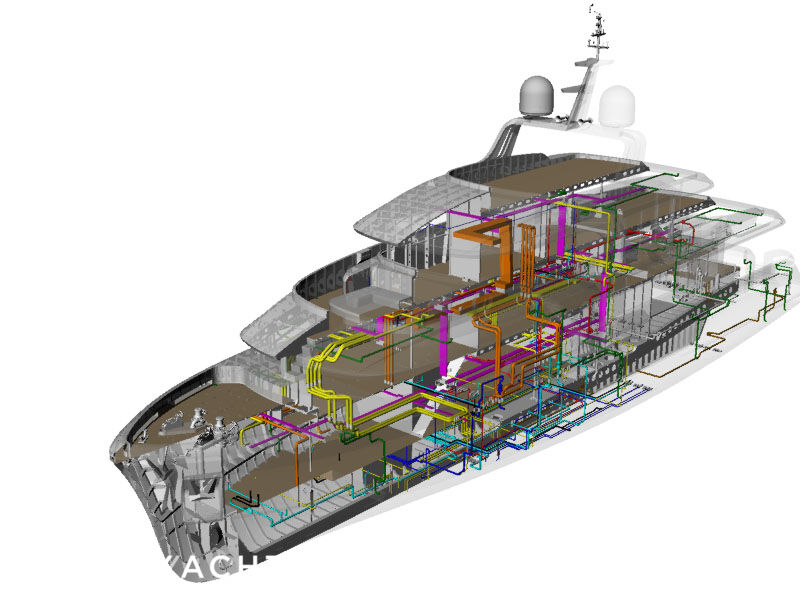
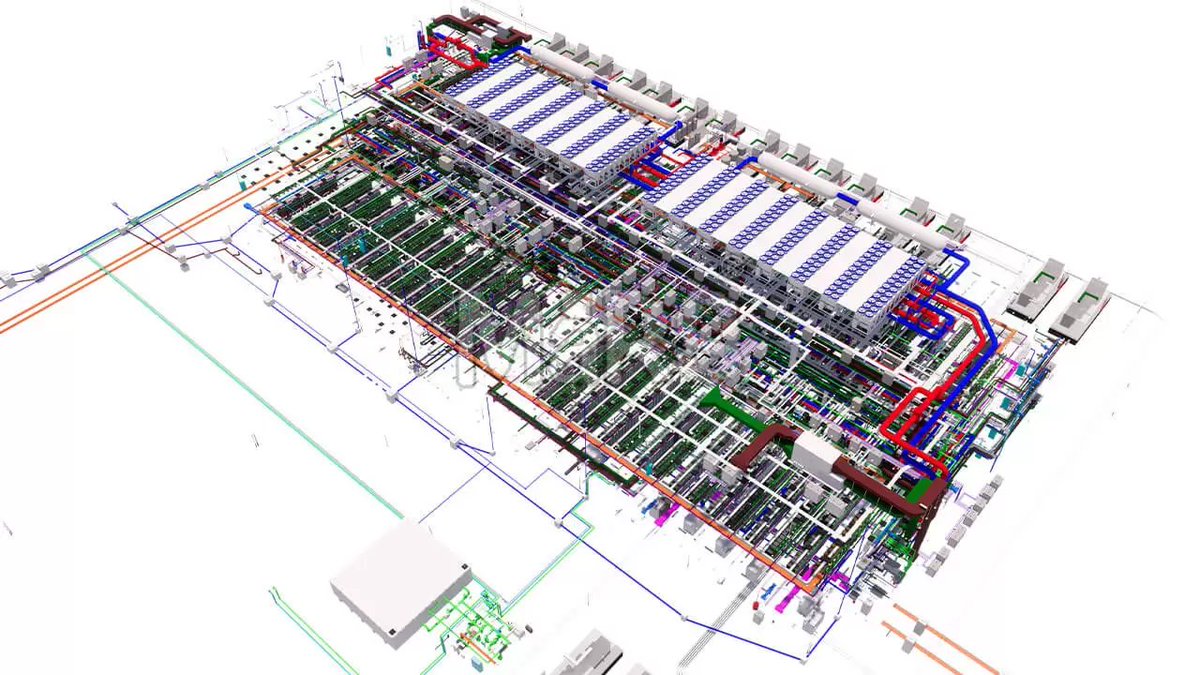
Large, man-made things that used to be designed and build-planned like they’re architecture are being moved to be designed and built like manufactured products:
Ships and data centers.
Historically, these systems were "architected".
What does that mean? For the sake of brevity, I'm going to be overly reductive.
There are 4 major "CAD" companies that people use to design and plan "big assemblies with lots of parts". 3 focus on manufacturing (Siemens, PTC, Dassault -- actual CAD), 1 focuses on architecture (Autodesk -- called BIM).
Historically, ships were "architected". To this day, the person who is responsible for the design and manages the build of a ship and submarine is called a "Naval Architect".
When software came along, ships mostly either stayed on paper (ouch!) or made their way into the same software as buildings -- architecture-oriented CAD (BIM).
Similarly, the way data centers have been designed and planned were as buildings. This is somewhat understandable if you consider them to be one-offs, as they've often historically been. Thus, they too have lived entirely in the BIM/architecture world -- until now.
We're seeing two massive surges occur simultaneously: the AI boom demanding more more more data centers, and the defense boom demanding more more more ships.
To go from bespoke build (architecture) to modular, repeatable, scaled production, I've been seeing data center companies and maritime companies make a massive push:
All of them are migrating all of their designs away from BIM/architecture software (Autodesk) and onto manufacturing software (Siemens, PTC, Dassault).
We're seeing a migration away from a "bespoke, architected" built world to a more "modular, repeatable, scalable" built world.
To achieve the scale of product volume that their customers now demand, companies building ships and data centers have now moved to standardize and modularize their products so they can achieve economies of scale, allowing their systems and subsystems to be mass manufactured with consistency and reliability across different locations. This is needed so that they can be built quickly, repeatably, with the expectation that their subsystems have reliable interoperability and composability.
BuildList 2.0: An updated list of companies doing important work.
• Upvote — pull your fav companies to the top of the list
• Explore — by sector, by stage, by location
• Discover — find new companies close to you
Join the builders. https://t.co/eHWVEOYmpS