@CarlosReusser Hola Carlos, una consulta sobre la estrategia digital del gob. La idea de digitalizar es ofrecer un espacio digital exclusivo para la relacion gobierno / cuidadano? O vendra una fase donde el gob ofrece servicios digitales que ayuda al individuo en general, como lo hace Google?
In some important ways, a user’s LLM chat history is an extended interview. The social media algorithms learn what you like, but chats can learn how you think.
You should be able to provide an LLM as a job reference, just like you would a coworker, manager, or professor. It can form an opinion and represent you without revealing any private data.
Most resumes are culled by crude filters in HR long before they get to the checking-references stage, but this could greatly increase the fidelity. Our LLM will have an in-depth conversation with your LLM. For everyone.
Most people probably shudder at the idea of an LLM rendering a judgement on them, but it is already happening in many interview processes today based on the tiny data in resumes. Better data helps everyone except the people trying to con their way into a position, and is it really worse than being judged by random HR people?
Candidates with extensive public works, whether open source code, academic papers, long form writing, or even social media presence, already give a strong signal, but most talent is not publicly visible, and even the most rigorous (and resource consuming!) Big Tech interview track isn’t as predictive as you would like. A multi-year chat history is an excellent signal.
Taken to the next level, you could imagine asking “What are the best candidates in the entire world that we should try to recruit for this task?” There is enormous economic value on the table in optimizing the fit between people and jobs, and it is completely two-sided, benefitting both employers and employees.
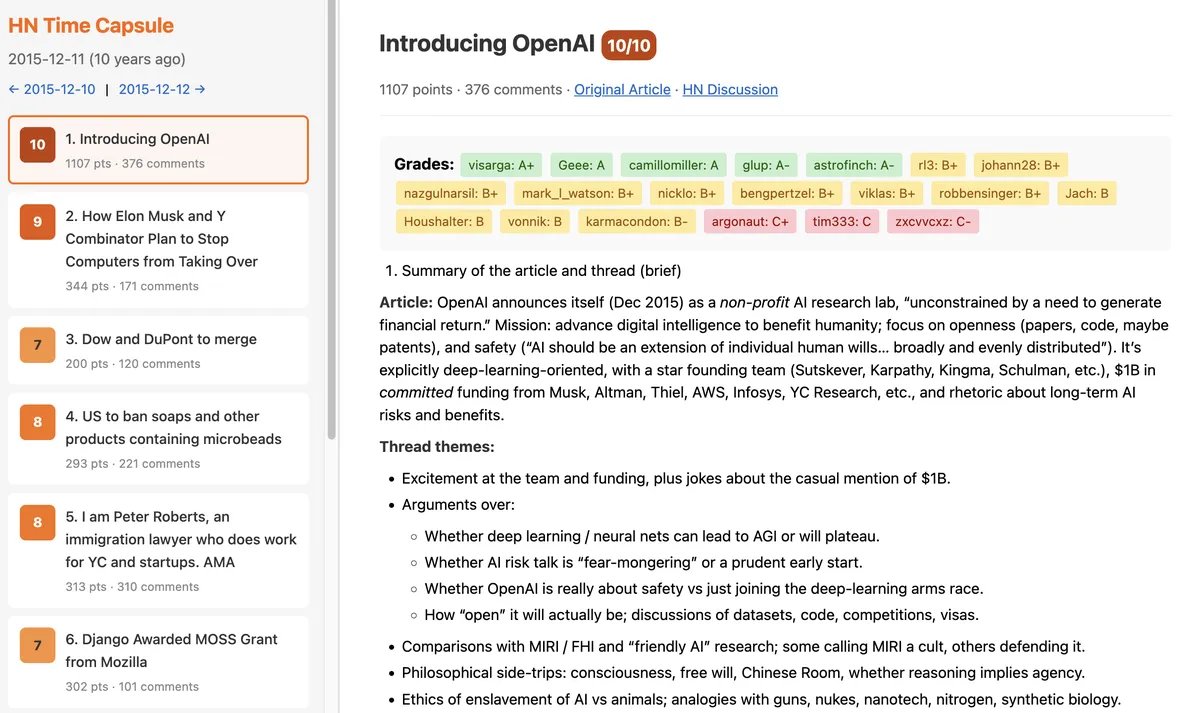
Quick new post: Auto-grading decade-old Hacker News discussions with hindsight
I took all the 930 frontpage Hacker News article+discussion of December 2015 and asked the GPT 5.1 Thinking API to do an in-hindsight analysis to identify the most/least prescient comments. This took ~3 hours to vibe code and ~1 hour and $60 to run. The idea was sparked by the HN article yesterday where Gemini 3 was asked to hallucinate the HN front page one decade forward.
More generally:
1. in-hindsight analysis has always fascinated me as a way to train your forward prediction model so reading the results is really interesting and
2. it's worth contemplating what it looks like when LLM megaminds of the future can do this kind of work a lot cheaper, faster and better. Every single bit of information you contribute to the internet can (and probably will be) scrutinized in great detail if it is "free". Hence also my earlier tweet from a while back - "be good, future LLMs are watching".
Congrats to the top 10 accounts pcwalton, tptacek, paulmd, cstross, greglindahl, moxie, hannob, 0xcde4c3db, Manishearth, and johncolanduoni - GPT 5.1 Thinking found your comments to be the most insightful and prescient of all comments of HN in December of 2015.
Links:
- A lot more detail in my blog post https://t.co/7LpJEVgbyk
- GitHub repo of the project if you'd like to play https://t.co/WVQUbUzt2y
- The actual results pages for your reading pleasure https://t.co/e2XIYElnc5
A number of people are talking about implications of AI to schools. I spoke about some of my thoughts to a school board earlier, some highlights:
1. You will never be able to detect the use of AI in homework. Full stop. All "detectors" of AI imo don't really work, can be defeated in various ways, and are in principle doomed to fail. You have to assume that any work done outside classroom has used AI.
2. Therefore, the majority of grading has to shift to in-class work (instead of at-home assignments), in settings where teachers can physically monitor students. The students remain motivated to learn how to solve problems without AI because they know they will be evaluated without it in class later.
3. We want students to be able to use AI, it is here to stay and it is extremely powerful, but we also don't want students to be naked in the world without it. Using the calculator as an example of a historically disruptive technology, school teaches you how to do all the basic math & arithmetic so that you can in principle do it by hand, even if calculators are pervasive and greatly speed up work in practical settings. In addition, you understand what it's doing for you, so should it give you a wrong answer (e.g. you mistyped "prompt"), you should be able to notice it, gut check it, verify it in some other way, etc. The verification ability is especially important in the case of AI, which is presently a lot more fallible in a great variety of ways compared to calculators.
4. A lot of the evaluation settings remain at teacher's discretion and involve a creative design space of no tools, cheatsheets, open book, provided AI responses, direct internet/AI access, etc.
TLDR the goal is that the students are proficient in the use of AI, but can also exist without it, and imo the only way to get there is to flip classes around and move the majority of testing to in class settings.
@drmichaellevin@hyperstitial Its not a number, if life is to feel "natural" in the sense of reasonably finite there should be a graceful maturing process that goes with how your body changes. Anti aging in early stages questions that, though.