In 1994, software was dead. People told me programming was for nerds and that I should become a doctor or a lawyer instead.
In 2004, software was dead. People told me that someone from India would take my job for $5/hour.
In 2014, software was dead. People told me that no-code was going to kill every job and doom my career.
In 2024, software was dead with Devin, Windsurf, Copilot, and OpenAI o1.
We kill software every 10 years, and yet the demand for good Software Engineers has never been higher.
Kubernetes is beautiful.
Every Concept Has a Story, you just don't know it yet.
In k8s, you run your app as a pod. It runs your container. Then it crashes, and nobody restarts it. It is just gone.
So you use a Deployment. One pod dies and another comes back. You want 3 running, it keeps 3 running.
Every pod gets a new IP when it restarts. Another service needs to talk to your app but the IPs keep changing. You cannot hardcode them at scale.
So you use a Service. One stable IP that always finds your pods using labels, not IPs. Pods die and come back. The Service does not care.
But now you have 10 services and 10 load balancers. Your cloud bill does not care that 6 of them handle almost no traffic.
So you use Ingress. One load balancer, all services behind it, smart routing. But Ingress is just rules and nobody executes them.
So you add an Ingress Controller. Nginx, Traefik, AWS Load Balancer Controller. Now the rules actually work.
Your app needs config so you hardcode it inside the container. Wrong database in staging. Wrong API key in production. You rebuild the image every time config changes.
So you use a ConfigMap. Config lives outside the container and gets injected at runtime. Same image runs in dev, staging and production with different configs.
But your database password is now sitting in a ConfigMap unencrypted. Anyone with basic kubectl access can read it. That is not a mistake. That is a security incident.
So you use a Secret. Sensitive data stored separately with its own access controls. Your image never sees it.
Some days 100 users, some days 10,000. You manually scale to 8 pods during the spike and watch them sit idle all night. You cannot babysit your cluster forever.
So you use HPA. CPU crosses 70 percent and pods are added automatically. Traffic drops and they scale back down. You are not woken up at 2am anymore.
But now your nodes are full and new pods sit in Pending state. HPA did its job. Your cluster had nowhere to put the pods.
So you use Karpenter. Pods stuck in Pending and a new node appears automatically. Load drops and the node is removed. You only pay for what you actually use.
One pod starts consuming 4GB of memory and nobody told Kubernetes it was not supposed to. It starves every other pod on that node and a cascade begins. One rogue pod with no limits takes down everything around it.
So you use Resource Requests and Limits. Requests tell Kubernetes the minimum your pod needs to be scheduled. Limits make sure no pod can steal from everything around it. Your cluster runs predictably.
@jasnamatic Poštovana Jasna, kako se uklapa Ponoseva izjava da ES nije za uvodjenje sankcija Rusiji sa principom II , član 6, stav a iz navedenog dokumenta? Šteta je igrati se politikanstva sa jednom takvom idejom.
Vi ste naravno, izuzetni u svojim objavama.
@Anarhitektura Sam Ponos je izjavio da je ES protiv uvodjenja sankcija Rusiji. Sto je, jelte, porazavajuca cinjenica za koaliciju koja sebe vezuje za pro-EU politiku.
*BRILLIANT*
The French made a short film about what could happen after all immigrants would follow the ‘_white, angry old man’s_’ advice to go back where they came from.*
The October 25 elections in Serbia must be FREE and they must be FAIR. The Serbian people deserve to be actually heard, not receive a rubber-stamp regime. Vucic has attempted to transform Serbia into a corrupt authoritarian state and will try to rig the elections. We must watch CLOSELY.
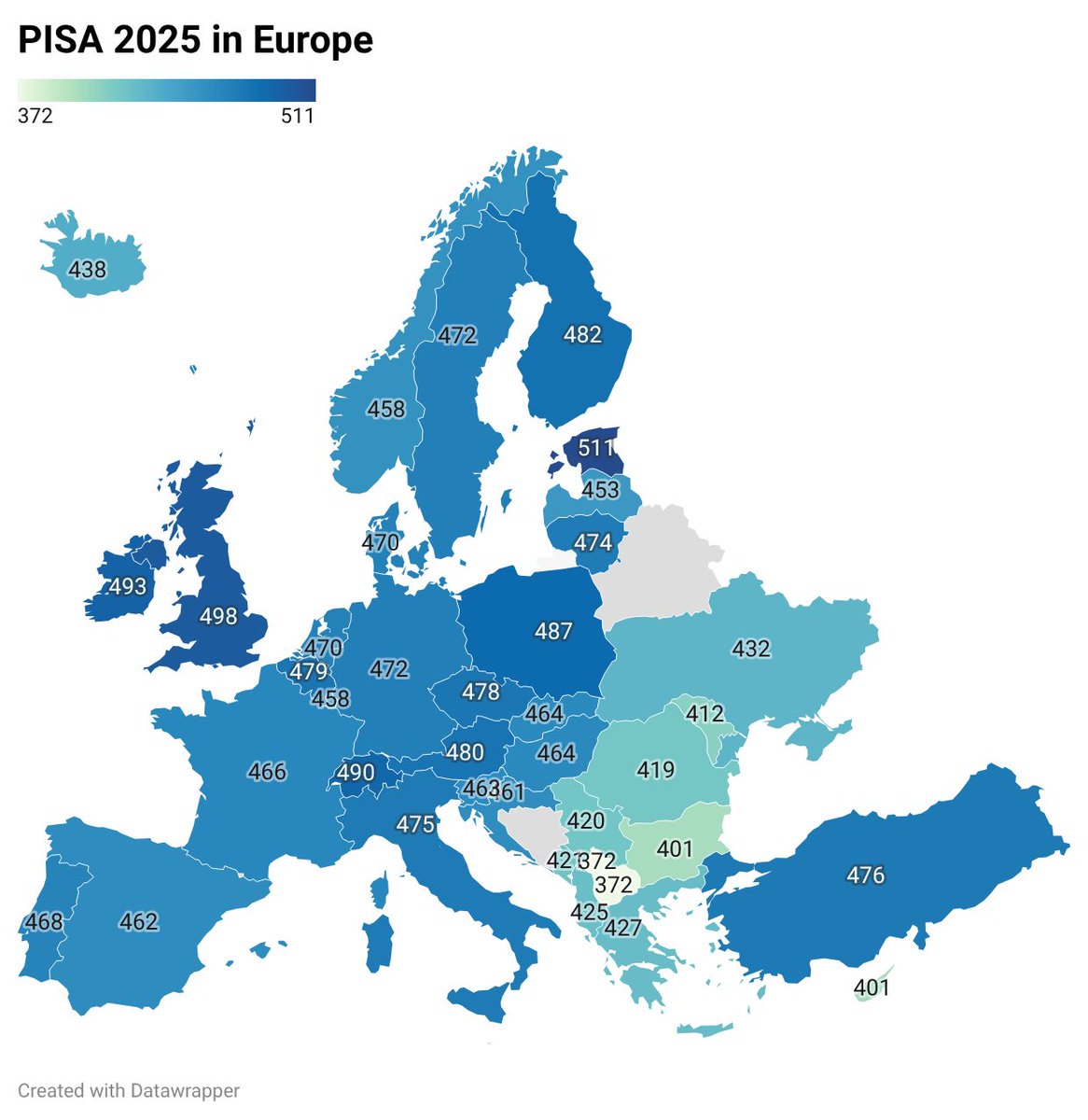
If you really want to understand where the world is at and where it's going, you probably cannot get anything more meaningful than the OECD's PISA study - a global test given every 3 years to an insane 760,000 15-year-olds across 91 countries.
No report globally, by any institution, better captures whether countries are building or squandering their future.
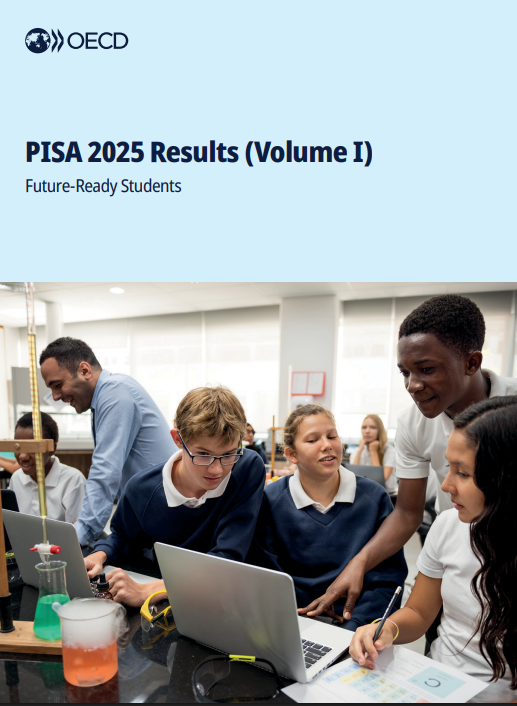
The latest PISA results just came out yesterday (https://t.co/FbHx266LH4) and the results are genuinely fascinating, and in some way pretty depressing.
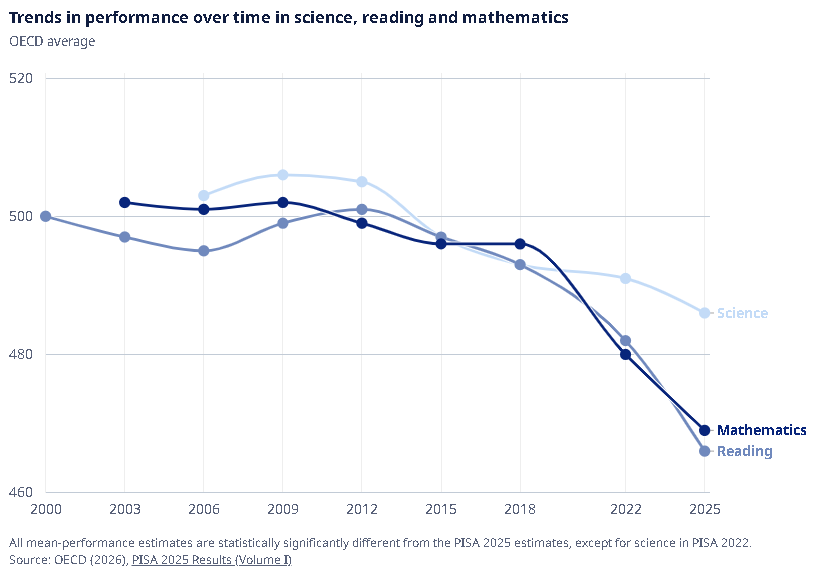
Why depressing? Because, sadly, the numbers show that the world is getting dumber: as you can see on the first graph below 👇, since roughly 2012 scores in science, reading, and mathematics have been in continuous decline across OECD countries.
The reading score is particularly concerning: it literally cratered, dropping 28 points since 2015, the equivalent of almost 1.5 years of schooling lost according to the report.
To make matters even worse, the reading skill that's dropped the most across the board is precisely the one we most desperately need: the capacity to critically assess what you read, cross-reference sources, and tell signal from noise.
On average, sadly, 15-year-old kids globally are - more and more - incapable of slowing down and actually thinking about what they're reading.
Interestingly though, when you look into the details, this great "dumbing down" isn't across the board: it's overwhelmingly concentrated in wealthy Western countries, while many developing countries are actually getting significantly smarter.
For instance rich countries like Finland, the Netherlands, and Norway are in freefall, while countries like Cambodia, Türkiye, and the UAE are posting big gains.
To be clear, this doesn't mean that developing countries are now "smarter" than rich ones: save for one notable exception, that's still not the case. But they are catching up fast, both because rich countries are getting "dumber" and because they're themselves getting smarter.
The one exception is, as you'd expect, the "smartest" of them all, by a huge margin: China.
It is pretty much in a league of its own: just look at the ranking in the table (only kids in Beijing, Shanghai, Jiangsu and Zhejiang got tested - 4 regions covering 200 million people).
China's maths results are particularly insane: according to the report, the best level in maths - level 5, where "top performers" begins - starts at 607. The AVERAGE kid in China is 612: "normal" Chinese kids are at a level that is considered elite in the rest of the world.
In fact, and that's probably the funniest number in the entire report, look at the column called "Share of low performers in science, reading and mathematics": China is only at 1.8% 😅
Which means that only 1.8% of Chinese kids are rated as low performers in all 3 subjects, almost a rounding error. Even Singapore, the second best and generally considered best-in-class in education, is at 6.8% - almost 4 times worse. My country France, is at 21.3% - almost 12 times worse 😢
All of this - incidentally - dispels the common myth that there would be some kids who are just genetically beyond redemption and simply can't be taught: China proves that with the right system, virtually every child can reach proficiency.
So what does this all say about the world and where it's going, besides the fact that, if the future belongs to those who can think, China has never been better positioned to own it?
I think the more general picture is this: there is nothing inevitable about any country's trajectory.
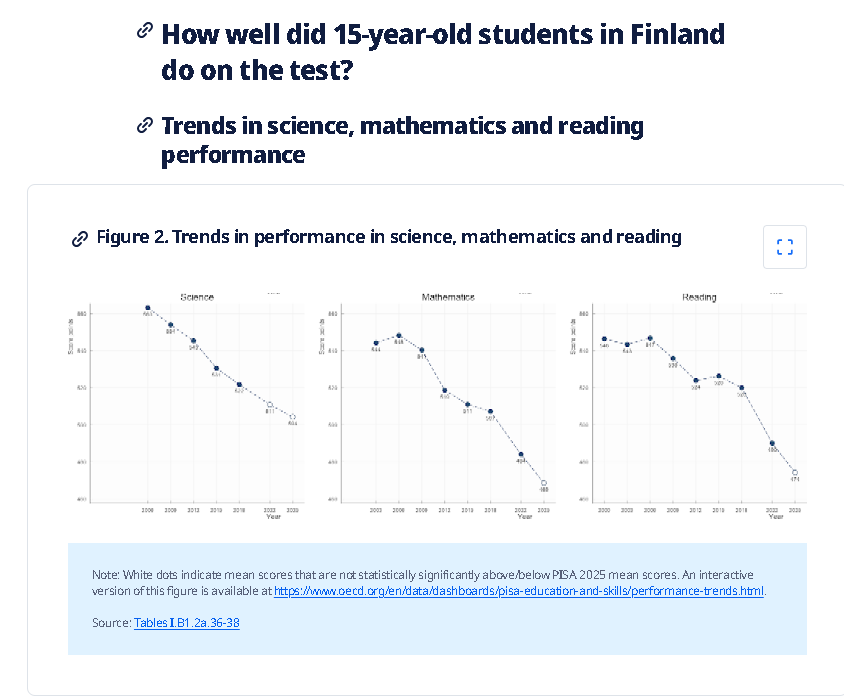
Finland was the world's education darling fifteen years ago - now it's in complete freefall (see the last graph 👇). Cambodia was at the bottom of every table - now it's posting the biggest gains ever recorded in the study. What changed wasn't the children: it's still Finnish kids (Finland has one of the lowest levels of immigration in the West), and it's still Cambodian kids.
It also doesn't matter much - or at least it matters less - if a country is wealthy or not. For instance in Southeast Asia, both Malaysia and Indonesia - the 2 biggest ASEAN economies after Singapore - are faring very badly, while Thailand and Vietnam, both poorer, have better educated kids whose scores are continuing to improve.
So that's the final takeaway: the kids don't change, they all have potential, always, as China's 1.8% proved.
What does change is what adults decide to do with that potential. It's both hopeful - because it means any country can choose to turn things around at any time - and also sad given the results - because it means so many countries are choosing to fail their children.
Vucic tries to present the Serbian people as pro-Russia, pro-CCP, and pro-war criminal but this is a propagandistic LIE. The Serbian people want economic opportunity, prosperity, rule of law, and PEACE in the region. It is the Vucic regime alone that invites in authoritarian forces and fans the flames of hatred.
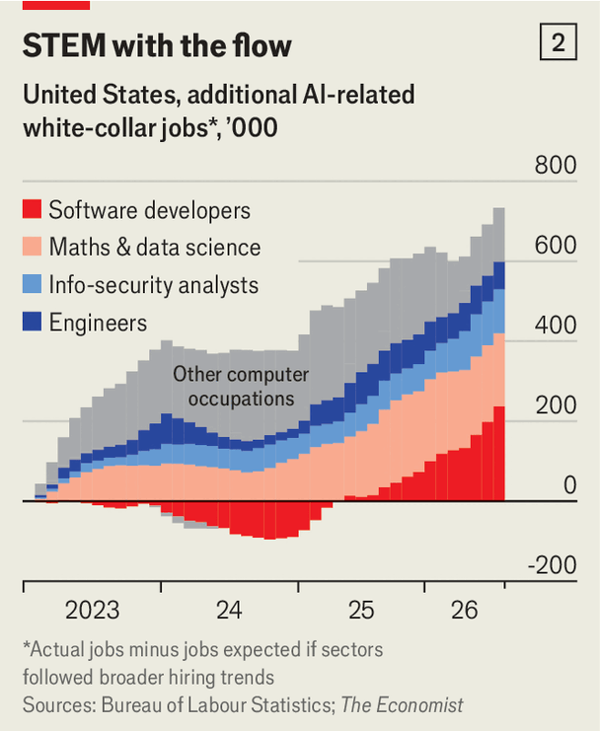
The jobs apocalypse is postponed. An AI jobs boom is here
According to @TheEconomist, AI is actually proving to be a net job creator in the US, easily generating over 1M new positions (from data center construction to AI engineering) to offset back-office layoffs.
While routine admin and customer service roles face real disruption, the overall labor market is proving resilient.
https://t.co/uVomCUvwSf
Heute zeigt das Regime von Aleksandar Vučić und seiner Serbischen Fortschrittspartei (SNS) erneut, wie groß die Angst vor den eigenen Bürgern geworden ist. Wenige Stunden vor dem angekündigten Großprotest der Studierenden in Belgrad wurde ohne jede nachvollziehbare Erklärung der gesamte Zugverkehr in Serbien eingestellt.
Ganz Serbien steht plötzlich still – ausgerechnet an jenem Tag, an dem Tausende Menschen zur Protestkundgebung auf der Slavija reisen wollen.
Wenn eine Regierung Züge stoppt, um Bürger von Demonstrationen fernzuhalten, dann ist das kein Zeichen von Stärke mehr. Sondern von Panik.
Ask Claude to document and describe the main flows in your app and output in a single page html + json data file.
Incredibly useful for humans and the JSON file is very useful for explaining the flow to the LLM when working on new features/bugfixes.
#Repost@nova.rs_sport
Saga o statusu Željka Obradovića i njegovoj budućnosti na klupi Partizana još uvek traje, a dobila je jedan neočekivan nastavak.
Video: Goran Srdanov
Dvadeset i tri godine živim na zapadu, u demokratskoj zemlji.
I jednu stvar nisam nikad ovde doživela
:skup podrške vladajućoj stranci
Za Zapadnjaka, to je nezamislivo.
Nemoguće.
Strano.
Neshvatljivo.
Jer, taj Zapadnjak je naučen da kritikuje vlast - ne da joj kliče.
On je plaća. On ima očekivanja.
Zapadnjak vlast drži pod lupom, ne na postolju.