Really proud of my team which tirelessly works on the development of design methods for #QuantumComputing—available as #opensource in our Munich Quantum Toolkit. To provide a better overview of these tools, we now created a flyer.
Check it out!
👉https://t.co/8DALS9s1cP
@decodoku I contacted the authors of the paper, and they confirmed my guess that there was an error in estimating the readout fidelity that was used for error mitigation. They estimate that, after correcting this error, the fidelity will be between 90% and 99% instead of 99.97%.
@DulwichQuantum@ArvindKrishna@IBM "Definitively within a decade, at the most" - Arvind Krishna about when Quantum Computers will break today's encryption
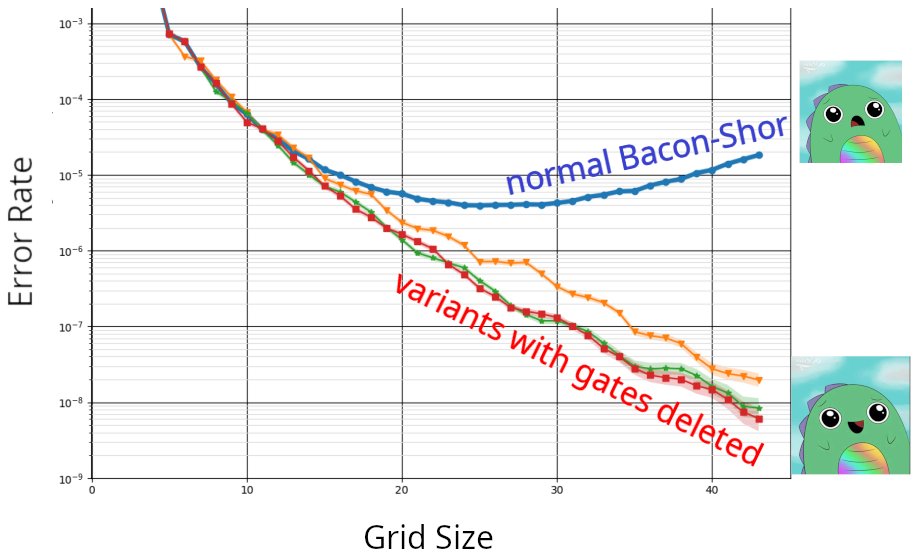
Can you improve a well known quantum code by only subtracting things? Turns out yes! Bacon-Shor's lack of threshold can be fixed by deleting the right pattern of gates from its circuit. Weird!
Read about it in "Less bacon more threshold": https://t.co/RNCqLctMCH
This code can be used to reduce the runtime on *now-term quantum computers* for estimating observable expectation values, e.g., as a subroutine in the VQE pipeline.
I'm glad to announce that Kyano Levi (a Bachelor's student that I am mentoring) just finished his open-source implementation of our algorithm for the construction of *Hardware-Tailored Readout Circuits* and an accompanying *Pauli Grouper*.
https://t.co/cJ854bygR4
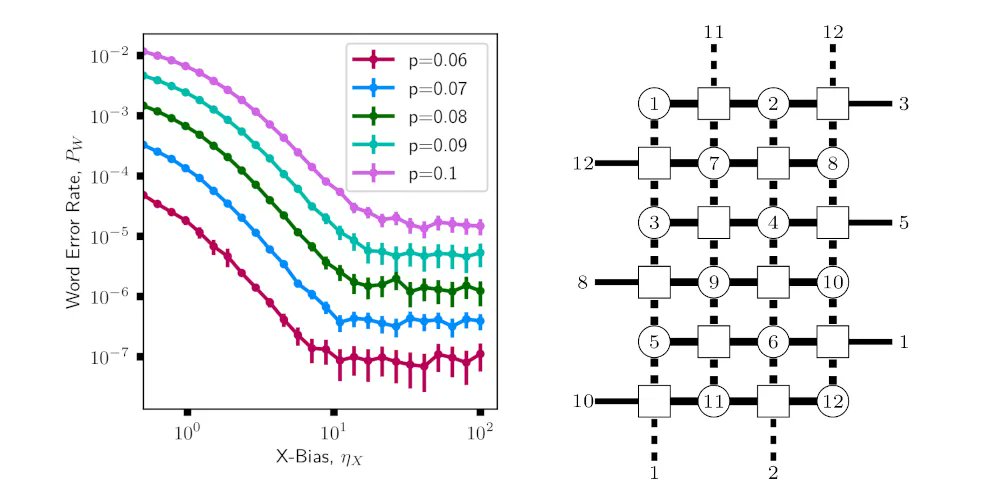
Quantum has recently published: Bias-tailored quantum LDPC codes by Joschka Roffe, Lawrence Z. Cohen, Armanda O. Quintavalle, Daryus Chandra, and Earl T. Campbell https://t.co/qZs8SuXZBO