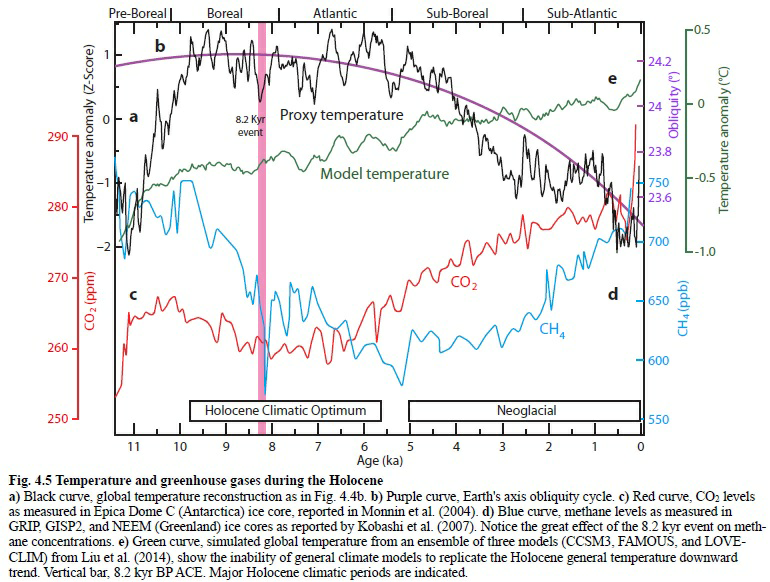
It is pretty simple. If the climate models cannot reproduce the past, then they are missing key inputs and therefore cannot accurately predict the future.
This is a graph of past 11,000 years of global proxies. Notice the "Model temperature" mostly follows "CO2" ... but neither follow the actual "Proxy temperature." Conclusion - climate models are failures at predicting temperature.
A staggering 7 to 8 billion solar panels have been deployed globally—but up to 90% of them are currently on a direct trajectory toward disposal.
While modern solar panels are technically made of roughly 95% recyclable materials (glass, aluminum, copper, and silicon), recycling currently runs at a steep economic loss.
* The cost: Processing runs $500–$1,000 per tonne ($10 to $40 per panel).
* The yield: The value of recovered materials doesn't even cover the transport fees.
Compared with minimal landfill fees, economics dictate that burial is the default option. But the world is rapidly running out of room, and governments are beginning to panic.
We are already seeing a preview of this crisis in the wind sector, where an expected 43 million tonnes of turbine blade waste by 2050 has led several European nations—including Austria, Germany, Finland, and the Netherlands—to actively ban decommissioned blades from landfills.
Solar is hitting the same wall. Panels built over two decades ago are reaching the end of their 20-to-24-year lifespans, while many more become economically obsolete and are replaced long before that.
This has created a massive regulatory catch-22: To prevent heavy metals like lead and cadmium from potentially leaching into groundwater, jurisdictions like Victoria, Australia, have implemented strict bans on putting solar panels into landfills, classifying them as hazardous e-waste.
Yet, with recycling remaining economically non-viable, we are creating an impossible bottleneck. While industry bodies like the IEA maintain that leaching risks from broken panels are negligible and within safety limits, the sheer volume of impending waste tells a different story.
If it costs too much to recycle, and it is illegal to landfill, where do several billions of panels go?
The 'clean energy' solution is rapidly staring down the barrel of a multi-generational hazardous waste problem.
Image: Last year, the world built more new solar capacity than every other power source combined - Shutterstock.
.@SECWAR “The first waves of soldiers took devastating casualties. Thousands of our absolute best—cut down, but the American warfighter NEVER QUIT.
Fueled by an unwavering love of country and the men beside them, they pushed forward.
They chose to face death rather than surrender or quit. As they fought – inch by bloody inch – the Atlantic Wall crumbled.”
On the morning of June 4, 1942, Ensign George Gay climbed into his TBD Devastator torpedo bomber and flew toward the largest concentration of Japanese naval power ever assembled.
He knew exactly what he was flying into.
Torpedo Squadron 8 had 15 planes and 30 men. Their aircraft were slow, outdated, and completely unescorted. No fighter cover. Command had promised them protection. It never showed. The flight leader, Lieutenant Commander John Waldron, had written a farewell letter to his wife before takeoff. He knew.
Waldron found the Japanese fleet first. Before the attack, he got on the radio one last time: "My greatest hope is that we encounter a favorable tactical situation, but if we don't, and the worst comes to worst, I want each one of us to do his utmost to destroy our enemies. If there is only one plane left to make a final run in, I want that man to go in and get a hit."
Then they dove.
The Japanese Combat Air Patrol fell on them like wolves. Dozens of Zeros. The Devastators had no altitude, no speed, and no cover. They had to fly low and straight to line up torpedo shots, which meant they couldn't evade. They could only absorb fire and keep flying.
One by one, the planes went down.
Gay watched them fall around him. Friends. Bunkmates. Men he had trained with, eaten with, played cards with. Going into the water one after another. No parachutes. No survivors.
His gunner, Robert Huntington, was hit. Dying in the backseat as Gay flew forward.
Gay himself took a 20mm cannon round. His left hand was hit. The plane was on fire.
He kept flying.
He lined up on the Japanese carrier Soryu and dropped his torpedo at point-blank range, closer than doctrine called for, because he had no other choice. He watched it run toward the ship.
Soryu turned. The torpedo missed.
Then his plane was hit again and went in.
As the nose of the Devastator knifed into the Pacific, Gay forced the canopy open against the rushing water pressure and pulled himself free. He surfaced surrounded by burning fuel and wreckage, wounded, alone, in the middle of the Japanese fleet.
He had one Mae West life vest. One seat cushion. That was it.
The Japanese destroyers were close enough that he could see sailors moving on their decks. He knew if they spotted him, they would not rescue him. So he did the only thing he could do.
He held the seat cushion over his head and floated.
Every time a Japanese aircraft flew low over the water, he pushed himself under and pressed the cushion above him to break his silhouette. For hours he did this. Treading water. Hiding. Bleeding. Watching his friends' planes burn on the surface around him.
He was the last man. Every single other pilot and gunner in Torpedo Squadron 8 from the Hornet was dead. All 29 of them.
And then, from high altitude, the American dive bombers arrived.
SBD Dauntlesses. They had found the fleet almost by accident, following the wake of a Japanese destroyer. And when they arrived, the sky above the carriers was empty.
Here is the part that will haunt you.
VT-8's attack had looked like a catastrophic failure. But it wasn't. By flying low, slow, and straight into the teeth of the Japanese fleet, they had pulled every single Zero in the Combat Air Patrol down to sea level to kill them. For those few critical minutes, the carriers below had nothing above them. No protection. No altitude cover.
The dive bombers came straight down out of the sun.
Akagi: hit. Fires reached the torpedo magazine. Gone.
Kaga: hit. Fuel ignited. Gone.
Soryu, the same carrier Gay had attacked alone minutes before: hit. Gone.
Three of Japan's six fleet carriers, the core of the force that had attacked Pearl Harbor, were mortally wounded in under five minutes.
George Gay watched all of it.
From fifty yards away, treading water with a shot-up life vest and a seat cushion over his head, he watched three Japanese aircraft carriers burn to the waterline. He watched the explosions. He watched the smoke columns rise so high they could be seen for miles. He watched the fleet that had seemed invincible that morning begin to die.
He floated there for thirty hours total. When darkness finally fell, he inflated the life raft. It was full of bullet holes but held enough CO2 to keep him on the surface through the night.
A Navy PBY Catalina patrol plane found him the next morning and pulled him out.
He later met with Admiral Chester Nimitz personally and confirmed what he had seen: three carriers destroyed. His eyewitness account was among the first human confirmation that the battle had turned.
He was 26 years old.
He was awarded the Navy Cross. He recovered from his wounds. He went back to flying, eventually spending 30 years as a commercial pilot for Trans World Airlines, carrying passengers on routes across America. He never made a big show of what he had done. He gave interviews when asked. He wrote a book. He went to reunions.
He died in 1994 in Marietta, Georgia.
His name was Ensign George Henry Gay Jr. He is, to this day, the only known combatant in history to survive a major naval battle by floating in the middle of it while it happened around him.
He flew in with 29 men. He came home alone. And the battle those men died in changed the course of the entire war.
Today is the 84th anniversary of the Battle of Midway.
Remember his name.
I’m going to say something that may make some people uncomfortable, but at this point I don’t care.
I am tired of watching Black Americans refuse to ask the most important question in modern politics. For most of the last sixty years, Black voters have given Democrats somewhere between ninety and ninety-five percent of their vote. That’s not support. That’s loyalty on a scale few political parties in history have ever enjoyed.
So where are the results? WHERE?
When I drive through many of our neighborhoods, I don’t see the success we were promised. I see memorials on street corners. I see boys growing up without fathers. I see schools where a shocking number of children cannot read or do math at grade level. I see poverty that survives election after election while politicians return every few years demanding the same vote and offering the same explanations.
Before anyone changes the subject, blames somebody else, or starts reciting talking points, answer that question. Not with feelings. Not with corny buzzwords . Not with excuses. Answer it with results.
Because history is not a record of what Democrat politicians promised. History is a record of what actually happened. OUTCOMES.
#AStoneGroove #SilentMajoritySpeaks
Fred Astaire and Rita Hayworth found an instant rhythm on YOU’LL NEVER GET RICH (1941). Astaire later named her among his favorite dance partners, praising how quickly she mastered his demanding choreography and matched his precision step for step.
BUTCH O'HARE and QUIET INTEGRITY. On February 20, 1942, a 28-year-old Navy pilot looked at his fuel gauge and realized someone had made a mistake.
His tank wasn't full. He didn't have enough fuel to complete the mission and return to the carrier.
His commander ordered him back immediately. Butch O'Hare turned around, frustrated, heading toward the ship alone.
Then he saw them.
A squadron of Japanese bombers racing toward the American fleet. The entire division was out on the mission. The fleet was defenseless.
Butch had no way to warn them. No way to bring back his squadron.
He had a choice. Continue to safety with his limited fuel. Or do something about it.
Butch dove into the Japanese formation alone. He fired until his guns emptied. Then he dove at enemy aircraft, trying to clip their wings and send them spiraling down.
One pilot against an entire squadron.
The Japanese, stunned and confused, changed direction. The fleet survived.
When Butch landed, the gun-camera footage told the story. Five enemy aircraft shot down. He became the Navy's first flying ace of World War II and the first Naval Aviator to receive the Congressional Medal of Honor.
A year later, Butch O'Hare was killed in combat. He was 29.
Today, Chicago's O'Hare Airport bears his name.
Here's what stays with me about this story: Butch wasn't trying to become a hero that day. He was just a pilot heading back to the ship because of a fuel tank mistake. No one would have blamed him for continuing home.
But in that small moment of decision, with no one watching and nothing to gain, his character showed up.
That's what quiet integrity looks like. It's not the grand gestures people plan for. It's what you do in the moments no one expects anything from you.
Small choices reveal who we really are. And sometimes, those choices change everything.
The Fighter That Helped Crush Japan’s Air Power 🇺🇸🇯🇵
Built specifically to counter the Japanese Zero, the heavily armored F6F Hellcat was a rugged beast powered by a massive 2,000-horsepower Pratt & Whitney Double Wasp engine and designed to survive brutal combat over the Pacific.
This rare restored WWII footage showcases the intense coordination of U.S. Navy carrier operations, launching Hellcats from pitching decks in the middle of the Pacific.
The aircraft that helped turn the tide of the Pacific War.
Carolyn Davidson was a graphic design student at Portland State University when Phil Knight, who was then teaching accounting part-time, asked her to create a logo for his fledgling shoe company.
She billed the project at $2 per hour and received a total of $35 for her work. The design she produced would eventually become the iconic Nike swoosh.
Twelve years later, in 1983, Knight invited Davidson to a company event and surprised her with a special gift: a gold ring featuring the swoosh logo set with a diamond, along with an envelope containing 500 shares of Nike stock.
Over time, those shares grew in value and are now worth millions of dollars.
"I am a man. See me as a human being—not a birth defect, not a syndrome. I don’t need to be eradicated."
Frank Stephens pleads for the humanization of people with Down syndrome, studies suggest 67-90% are aborted in the United States due to faulty prenatal screenings.
On This Day — June 4, 1967
Israel stood completely alone — betrayed by its allies and facing annihilation.
France — Israel’s main arms supplier — imposed a total weapons embargo on Israel at the direct order of President Charles de Gaulle.
Already, every major Western power, including the United States, had Israel under a weapons embargo.
The Israeli Cabinet met in emergency session as massive Arab armies gathered on its borders. Egypt alone had nearly 100,000 troops and 1,000 tanks in Sinai, with Jordan, Syria, and Iraq adding more forces. Arab leaders were openly calling for Israel’s destruction.
A cable from U.S. President Lyndon Johnson made the situation brutally clear:
“Israel will not be alone unless it decides to go it alone.”
Israel got the message.
With no strategic depth, vastly outnumbered, and abandoned by its supposed friends, the Cabinet voted 12–2 to launch a preemptive strike on the largest Arab military, Egypt (which had already committed an act of war by closing the Straits of Tiran). The war would begin the next morning.
The mood across Israel was somber and resolute. Parks were dug up for mass graves. Schools became bomb shelters. Teenagers filled sandbags. The entire nation understood it faced an existential threat — a potential second Holocaust.
Yet on June 5, Israel acted.
This was the moment a small, isolated nation chose survival over waiting for the mercy of others.
Never forget how alone Israel truly was on the eve of the Six Day War.
The Guardian claims ocean warming is causing a staggering collapse in marine life, but the study it cites actually shows the opposite.
When a year is warmer, fish biomass is found to increase by as much as 24%. When years turn colder, biomass falls by around 15%.
That is the observed data.
To preserve the climate narrative, however, the authors then abandon real year-to-year results and switch to a modeled decadal trend.
The model assigns warming a negative effect and reports a decline. That decline is not observed, it is modeled.
The authors go on to admit they cannot separate temperature effects from overfishing, which is the primary, well-known driver of fish declines worldwide.
Since fishing pressure is not included, the model loads losses onto temperature by default. Even though, as per the study's own data, warmer years mean more fish.
The collapse exists only in the model.
On the morning of June 4, 1942, a US Navy pilot strapped into his dive bomber, took a breath from his oxygen canister, and inhaled caustic soda fumes.
The canister was defective. His lungs were already burning.
He flew the mission anyway.
By sunset, Dick Best had done something no pilot in history has done before or since. And he paid for it with everything.
Best was 31, commander of Bombing Squadron Six aboard USS Enterprise. Six months after Pearl Harbor, America was losing the Pacific. Four Japanese carriers, the same fleet that had attacked Hawaii, were steaming toward Midway to finish the US Navy for good.
His air group launched that morning and found nothing but empty ocean. Fuel running low, the formation was minutes from turning back when group commander Wade McClusky spotted a lone Japanese destroyer racing north at full speed. He made a gut call: follow it.
The destroyer led them straight to the entire Japanese fleet.
Then came the mistake that almost ruined everything. Doctrine said McClusky's group should take the far carrier and Best's squadron the near one. Instead, nearly all 30 dive bombers poured down on the same ship, Kaga.
Best watched his own squadron dive past him onto the wrong target. So he pulled out, signaled his two wingmen, and went after the other carrier with 3 planes instead of 15.
That carrier was Akagi. The flagship. The ship that had launched the attack on Pearl Harbor.
Best rolled into his dive through anti-aircraft fire and put a 1,000 lb bomb through the flight deck near the midship elevator. It exploded in the hangar below, packed with fueled and armed torpedo planes. The blast set off a chain reaction that no one aboard could stop.
One bomb. One hit. Akagi was finished.
In roughly five minutes that morning, three of Japan's four carriers were burning wrecks. Historians call it the most decisive five minutes of the entire war.
But one carrier was left. That afternoon, coughing and getting worse, Best climbed back into his cockpit and flew again. His squadron found Hiryu at dusk and sent her to the bottom too.
Two carriers in one day. The only pilot ever to do it.
That night, Best was coughing blood. The caustic fumes had activated latent tuberculosis in his ruined lungs. He spent 32 months in hospitals and never flew again.
June 4, 1942 was his last flight.
Japan never recovered. The empire that had been undefeated for centuries lost the initiative in a single morning and spent the rest of the war in retreat.
And the most consequential single bomb dropped before Hiroshima was delivered by a man who was slowly suffocating as he aimed it.
84 years ago today.