Marc Andreessen just explained how the United States assassinated its own future.
In the 1970s, the Nixon administration launched something called Project Independence.
The mandate was absolute.
Andreessen: “Build a thousand new civilian nuclear power plants in the US by the year 2000.”
One thousand reactors. Unlimited, carbon-free baseload power. Enough electricity to move the entire country to electric vehicles four decades ahead of everyone else.
But it went further than energy.
Andreessen: “It’s called Project Independence because it means the US won’t have to be involved in the Middle East anymore, because we won’t need the oil.”
No oil dependence. No Gulf Wars. No generations of soldiers stationed in deserts protecting supply chains that never needed to exist.
A complete strategic withdrawal from the Middle East. Permanent.
And none of this was hypothetical.
Andreessen: “France ran for a long time almost entirely on nuclear power. Japan ran for a long time almost entirely on nuclear power.”
Other nations proved it worked at scale. America had more capital, more engineers, and more ambition than all of them.
Andreessen: “How many nuclear power plants were built out of the thousand? Rounds to zero.”
Zero.
Not because the physics failed. Not because something superior replaced it.
Because the same administration that drafted the blueprint for unlimited energy also created the institution that killed it.
Andreessen: “They never got built because the Nixon administration also created the Nuclear Regulatory Commission, which made it its purpose in life is to stop nuclear power plants from getting built.”
Same government. Same decade. Same pen.
One directive launching the most ambitious energy program in American history.
Another creating the bureaucracy that would quietly dismantle it from the inside.
Andreessen: “The Nuclear Regulatory Commission did not approve a new nuclear plant design for 40 years.”
Forty years of zero approved designs. Not because no one submitted them. Because the institution built to regulate nuclear energy became the institution built to prevent it.
That’s not oversight.
That’s abolition dressed as due diligence.
We spent the next fifty years fighting wars in the desert for a resource we never needed.
Choked the atmosphere with carbon we didn’t have to burn.
Terrified an entire generation with the illusion of scarcity.
And the entire time, the physics already worked.
The government didn’t fail to navigate the energy crisis.
They took the densest source of energy in the universe and drowned it in paperwork.
Every war fought for oil. Every carbon debate. Every geopolitical crisis of the last half century.
All of it was a policy choice.
We didn’t lack the technology to power the future.
We let a committee outlaw the math.
🚨BREAKING: A cognitive scientist from MIT has mathematically proven that evolution guarantees we see zero percent of true reality, that most consciousness in the universe exists without a body, and that non-human intelligences with a wider window on reality than ours can reach in and manipulate it the way a programmer manipulates a video game.
Donald Hoffman (@donalddhoffman) is a cognitive scientist at UC Irvine who has spent 40 years building a mathematical theory of the observer. His work was cited by John Wheeler in the "It From Bit" paper. He studied under Marvin Minsky at MIT, spent two decades secretly meeting with Francis Crick to study consciousness, and has nine specific mathematical conjectures on the table that would derive general relativity, quantum field theory and the Big Bang from a single framework. The top high-energy physicists in the world, Nima Arkani-Hamed and Nobel laureate David Gross, are already saying spacetime is doomed. Hoffman thinks he knows what replaces it.
This interview is the first time he has publicly laid out what his mathematical model explains about alien life, embodiment and the structure of reality.
It already derives time dilation and quantum wave functions directly from differences in observer window size. Physics has spent a century failing to solve the measurement problem because it has been looking in the wrong place. The observer has to come first, and no physicalist framework can get you there.
A consciousness with a larger observer window has access to the underlying structure of our reality in ways we can't perceive or counter. A craft going Mach 40 instantaneously in our headset could be a leisurely maneuver in theirs.
The implications for UAP and alien life are immense.
Embodiment, being locked into a body with fingers and toes as your only interface with the world, is a probability zero anomaly in the full space of possible minds. He also says current large language models are dumber than cucumbers. His new framework, the recursive trace logic, is a completely different architecture, and some of the biggest names in frontier AI have already come to him about it.
The framework has no ceiling, and the implication is a single unified consciousness exploring itself through an unbounded number of perspectives, each one capable of waking up.
Death, in this framework, is just the closing of an icon on the desktop.
Full conversation is live now.
A piece of your brain the size of half a grain of rice holds enough data to fill 2,800 laptops. Your skull holds about a million chunks like that one. The browser tabs joke is funny. What's actually in your head is on a different planet.
Harvard and Google spent close to ten years scanning a tiny chunk of one woman's brain. That chunk had 57,000 cells, almost 9 inches of blood vessels, and 150 million tiny junctions where brain cells talk to each other. The data they got from it filled 2,800 laptops worth of storage. To do the same thing for a whole brain would need $48 billion in hard drives and a data center covering 140 acres. Just to copy what's inside one head.
And your brain runs all of that on 20 watts. Roughly a dim lightbulb. The world's fastest supercomputer, El Capitan, has been running roughly the same number of calculations per second since late 2024. To do them, it burns 30 million watts. Enough to power a mid-size city. Same workload. Roughly a million-and-a-half times more electricity.
A team at Caltech published a paper in late 2024 measuring how fast a person actually thinks. They watched people read, write, play video games, and solve Rubik's cubes, and they ran the numbers. The answer was 10 bits per second. Your home Wi-Fi runs at 50 million bits per second. A YouTube video streams at 8 million. The "thinking" part of you, the part that feels like flipping between mental tabs, runs at 10. Slower than the slowest internet connection you've ever cursed at.
Meanwhile your eyes, ears, and skin pull in close to a billion bits every second. Pictures, sounds, temperature, balance, the feel of your phone in your hand. All of it. At the same time. The thinking part of you only sees 10 bits of that billion. Your brain filters 99.999999 percent of what's coming in before you ever notice any of it.
So that screenshot is the tiny window your brain lets you peek through. Behind that window, the rest of the brain is sorting a billion bits a second, deciding what to show you, running your heartbeat, your breath, your balance, and a thousand tiny things you'll never feel, on less power than a laptop charger.
This is a single human cell. The white tubes are microtubules. The colored beads are ribosomes. You have 37 trillion of these.
Every cell in your body is a manufacturing plant running 24/7 without supervision.
Each ribosome (the colored beads) is assembling a protein right now. A single ribosome chains together about 20 amino acids per second. A typical mammalian cell contains millions of ribosomes. Every cell in your body is forming hundreds of millions of peptide bonds per second. Continuously.
The white worm-like tubes are microtubules, the cell's internal highway system. Motor proteins called kinesin walk along them on two protein legs, carrying cargo from one end of the cell to the other at around 800 nanometers per second. Each cell has thousands of these tracks with thousands of motor proteins walking on them simultaneously.
The blue mesh on the outside is the actin cortex. It holds the cell shape against pressure. It's also being torn down and rebuilt constantly. Every cell rewrites its own structural skeleton every few minutes.
Now scale that.
37 trillion cells. Each running millions of ribosomes. Each running hundreds of mitochondria producing ATP at roughly 100 million molecules per second. Your total daily ATP turnover is around your full body weight. You synthesize and consume your bodyweight in ATP every 24 hours.
The DNA in a single cell stretches 2 meters uncoiled. End to end across all 37 trillion cells, that's enough to reach the sun and back 250 times.
None of this is voluntary. None of it stops. It started when you were one cell and hasn't paused since.
There's a physicist at Stanford named Safi Bahcall who modeled this exact principle and the math is wild.
He calls it "phase transitions in human networks." When you're stationary, your probability of a lucky event is limited to your existing surface area: the people you already know, the places you already go, the ideas you've already been exposed to. Your opportunity window is fixed.
When you move, your collision rate with new nodes in a network increases nonlinearly. Double your movement (new conversations, new cities, new projects) and your probability of a serendipitous encounter doesn't double. It roughly quadruples. Because each new node connects you to their entire network, not just to them.
Richard Wiseman ran a 10-year study at the University of Hertfordshire tracking self-described "lucky" and "unlucky" people. The single biggest differentiator wasn't IQ, education, or family money. Lucky people scored significantly higher on one trait: openness to experience. They talked to strangers more, varied their routines more, and said yes to invitations at nearly twice the rate.
The "unlucky" group followed the same routes, ate at the same restaurants, and talked to the same 5 people. Their networks were closed loops. No new inputs, no new collisions.
Luck isn't random. Luck is surface area. And surface area is a function of movement.
The lobster emoji is doing more work than most people realize. Lobsters grow by shedding their shell when it gets too tight. The growth requires a period of total vulnerability. No protection, no armor, soft body exposed to the ocean.
That's the cost of movement nobody posts about. You have to be uncomfortable first. The new shell only hardens after you've already moved.
Finished a seven day social media fast. It feels like the most effective longevity therapy I've done.
Everything got better: mood, sleep, energy, presence, judgment, relationships, and optimism.
Evidence shows a seven day fast produces a reduction of anxiety (16%), depression (25%) and insomnia (15%). The effects felt bigger.
Conversely, dipping back in, I can viscerally feel that my body metabolizes social media similarly to a fast food meal, corrosive relationship, hangover, and sleep deprivation. My body hates it.
After the previous fasts (40/hr and 70hr), I wrote that social media is pollution. Not a vice or guilty pleasure. It’s closer to water toxins, air pollution and microplastics.
This time, the major insight was that social media is a form of intoxication.
Alcohol is honest intoxication. It clearly tells you what it's taking from you. Social media on the other hand does not disclose itself as an intoxicant.
It produces the sensation of being informed, engaged, and connected while quietly evacuating your capacity for depth and independent thought.
You don’t feel drunk, you feel current. But evidence shows that it causes your brain to shrink. The impairment is real by you can't feel it. Making it the more dangerous type.
If you haven't tried it, I strongly encourage you to try a social media fast. Even if for one day.
It’s literally the exact opposite of this. Kids who pass off foundational cognitive tasks like memorization to AI will be lost in an ocean of people just like them, all powerless to think their own thoughts, dependent on bad mechanical imitations of mental acts they have no capacity to perform or judge for themselves. They’ll grow up into glazed-over subaltern dupes at the mercy of machinists who view them as little more than farm animals to milk for training data. You could hardly do a worse disservice to a young person right now than to empty out the contents of their soul and strip them of the mental armor that only a rigorous literary education can provide. And all in the name of some gullible claptrap about humanity and tech that wouldn’t stand up to five minutes’ scrutiny if the people peddling it and swilling it down had ever read a single thing worth reading. We had all better snap out of this kookery right the heck now or we’re cooked, fam.
the strongest possible evidence for the simulation hypothesis is that on the infinite timeline of the universe, you just happen to be alive at the exact moment the singularity is occurring
One of my favourite stories: Karl Popper was giving a lecture in the 1920's. He says to the students: "Observe". The students look at him confused and ask: "Observe what?" and that was his point. All your observations are downstream from a questions you're answering.
Dr. Charles Krauthammer on Churchill:
It is just a parlor game, but since it only plays once every hundred years, it is hard to resist. Person of the Century. Time magazine offered Albert Einstein, an interesting and solid choice. Unfortunately, it is wrong. The only possible answer is Winston Churchill.
Why? Because only Churchill carries that absolutely required criterion: indispensability. Without Churchill the world today would be unrecognizable—dark, impoverished, tortured.
Without Einstein? Einstein was certainly the best mind of the century. His 1905 trifecta—a total unknown who published three papers (on Brownian motion, the photoelectric effect and the special theory of relativity), each of which revolutionized its field—is probably the single most concentrated display of genius since the invention of the axle. (The wheel was easy; the axle hard.)
Einstein also had a deeply humane and philosophical soul. I would nominate him as most admirable man of the 20th century. But the most important? If Einstein hadn’t lived, the ideas he produced might have been delayed. But they would certainly have arisen without him. Indeed, by the time he’d published his paper on special relativity, Lorentz and Fitzgerald had already described how, at velocities approaching the speed of light, time dilates, length contracts and mass increases.
True, they misunderstood why. It took Einstein to draw the grand implications that constitute the special theory of relativity. But the groundwork was there. And true, his general theory of relativity in 1916 is prodigiously original. But considering the concentration of genius in the physics community of the first half of the 20th century, it is hard to believe that the general theory would not have come in due course, too.
Without Churchill
Take away Churchill in 1940, on the other hand, and Britain would have settled with Hitler—or worse. Nazism would have prevailed. Hitler would have achieved what no other tyrant, not even Napoleon, had ever achieved: mastery of Europe. Civilization would have descended into a darkness the likes of which it had never known.
The great movements that underlie history—the development of science, industry, culture, social and political structures—are undeniably powerful, almost determinant. Yet every once in a while, a single person arises without whom everything would be different. Such a man was Churchill. After having single-handedly saved Western civilization from Nazi barbarism—Churchill was, of course, not sufficient in bringing victory, but he was uniquely necessary—he then immediately rose to warn prophetically against its sister barbarism, Soviet communism.
Churchill is now disparaged for not sharing our multicultural modern sensibilities. His disrespect for the suffrage movement, his disdain for Gandhi, his resistance to decolonization are undeniable. But that kind of criticism is akin to dethroning Lincoln as the greatest of 19th century Americans because he shared many of his era’s appalling prejudices about black people.
Who Else?
In essence, the rap on Churchill is that he was a 19th century man parachuted into the 20th. But is that not precisely to the point? It took a 19th century man—traditional in habit, rational in thought, conservative in temper—to save the 20th century from itself. The story of the 20th century is a story of revolution wrought by thoroughly modern men: Hitler, Stalin, Mao and above all Lenin, who invented totalitarianism out of Marx’s cryptic and inchoate communism (and thus earns his place as runner-up to Churchill for Person of the Century). And it is the story of the modern intellectual, from Ezra Pound to Jean-Pierre Sartre, seduced by these modern men of politics and, grotesquely, serving them.
The uniqueness of the 20th century lies not in its science but in its politics. The 20th century was no more scientifically gifted than the 19th, with its Gauss, Darwin, Pasteur, Maxwell and Mendel—all plowing, by the way, less-broken scientific ground than the 20th.
No. The originality of the 20th surely lay in its politics. It invented the police state and the command economy, mass mobilization and mass propaganda, mechanized murder and routinized terror—a breathtaking catalog of political creativity.
And the 20th is a single story because history saw fit to lodge the entire episode in a single century. Totalitarianism turned out to be a cul-de-sac. It came and went. It has a beginning and an end, 1917 and 1991, a run of seventy-five years, neatly nestled into it. That is our story.
And who is the hero of that story? Who slew the dragon? Yes, it was the ordinary man, the taxpayer, the grunt who fought and won the wars. Yes, it was America and its allies. Yes, it was the great leaders: FDR, de Gaulle, Adenauer, Truman, John Paul II, Thatcher, Reagan. But above all, victory required one man without whom the fight would have been lost at the beginning. It required Winston Churchill.
I’m tired of people constantly telling each other to be “careful” and “be safe.” It’s completely out of balance and in my opinion is un-American.
“Be safe” sounds caring, but when it’s repeated nonstop in moments that call for courage and confront, it’s fear dressed up as virtue.
“Safety” has become the highest moral good instead of justice.
Please don’t be safe. Be competent.
The most annoying genre of penguin post is all over Facebook:
it’s the “ACKSHUALLY brigade”
They don’t realize this meme is about them, and all the other literal-minded pedants who put a laugh react thinking they’re so smart because they KNOW that penguins are only in the Southern Hemisphere, and thumbing their nose down and histrionically wailing about how they are being lorded over by an administration that wants to play Manifest Destiny in the Arctic while being geographically illiterate.
The heady rush to register the “gotcha” correction and FACT CHECK completely blinds them to the meta layers that Nietzsche and Jung have spilled copious amounts of ink describing.
They simply can’t see that they are the colony, the intellectually narrow self-congratulatory crowd that the penguin is desperate to escape. They are the Last Men, content in the comfort of seeing the horizon in stasis, while the bold embrace the icebound unknown.
That the Promethean and Faustian spirit are now coded as far right is everything wrong with the modern West.
RETVRN
You know why we need to stand with Iranians right now? Because they aren’t just freeing themselves, they are carrying the entire weight of global liberation on their backs.
They are freeing themselves from the regime, Israel & Gaza from Hamas, Lebanon from Hezbollah, Yemen from the Houthis, and the West from nuclear threat.
I’ll be goddamned if I let my brave nation of heroes carry the weight of ALL of us alone. They are the life force, but we must be the life support. The time to act is NOW.
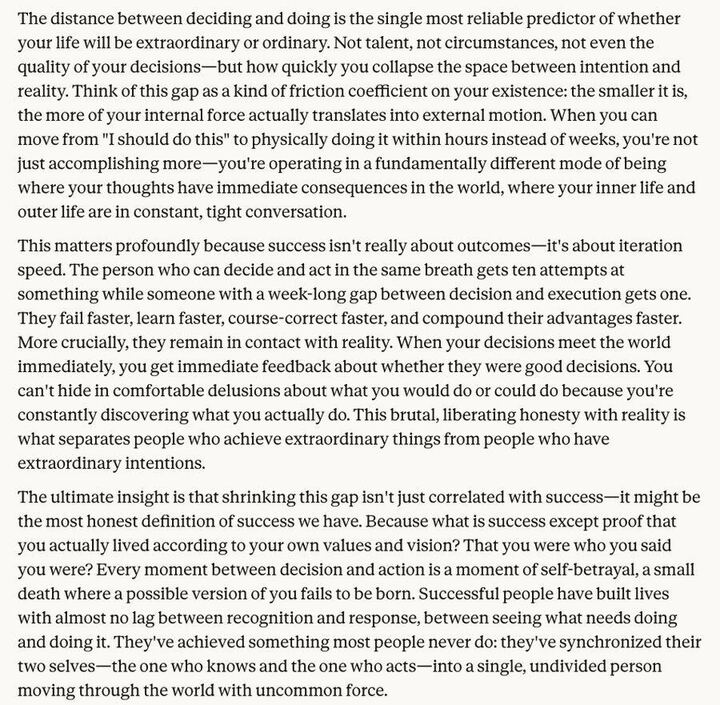
“The distance between deciding and doing is the single most reliable predictor of whether your life will be extraordinary or ordinary.”
These three paragraphs will change your life:
Master these 10 habits in 2026.
Feel amazing, reclaim agency + self-respect.
1. final food 4 hr before bed
2. screens off 30 min before bed
3. avoid blue light 2hr before bed, use red/amber
4. book in hand 10 min before sleep
5. go to bed same time every night
6. light in eyes when waking (sun or 10k lux)
7. walk for 10 min immediately following eating
8. daily exercise (even if for 20 min)
9. eat good stuff, ditch the junk
10. foster friends, family and love
They read as simple. I promise they'll change your life. Make them non-negotiate life habits. Do them every_single_day. Once you establish the habits, it is very easy to maintain. Stick with it for two weeks and start getting the dividends.
get into the habit of taking a 10 min walk immediately after eating. top tier thing for health.
+ blunts blood glucose by 17%
+ lowers triglycerides by 72%
+ accelerates digestion
+ lowers blood pressure 5 mmHg
+ improves sleep
Aliens are on their way to our planet, and will likely arrive in just a couple of decades. They have unfathomable intentions, and the power to wipe us all out. The only reason we're not panicking is that the aliens are not coming from space; they’re being built by our own hands.
Most of the hate I get is understandable. Wealthy guy doing unusual things for health. Looks weird. Acts weird. Says weird things. Ok.
There’s also something else going on.
Ultraprocessed foods emerged in the 1970s. Those in adolescence / early adulthood (now 50-64) exposed to these foods now have nearly 2x the food addiction rates than the generation immediately preceding them (now 65-80).
More than half of U.S. calories now come from ultra-processed foods: 53% for adults and 62% for youth.
Contending only with tobacco and ultra-processed foods now seems quaint.
In recent decades, the most dynamic economic engine in history, American capitalism, has pointed its powers at addicting people to their products. Using the best available science. It’s become a predator prey relationship. We are the prey.
Social media, porn, nicotine, junk food, fast food, smartphones, streaming, energy drinks and gambling. Each perfectly engineered to hijack our reward systems, enslaving us to their wishes.
Might we be the most addicted society in history?
Sleep deprivation is the silent amplifier. It wrecks willpower and deepens dependency. Yet it’s worn as a badge of honor, a cultural flex that rewards self-destruction.
On some level, many people realize that they’ve become powerless amidst the ocean of addiction that engulfs them daily. They’re powerless over what they eat. Dependent on stimulants to function. Compulsively checking their phones. Unable to turn off the screen before bed, unable to go to bed on time. Scrolling through the night, trapped in a loop they can’t escape.
As a result, they’re fatigued, depressed, anxious, metabolically unwell, and lack basic self-respect for the inability to do and become what they want in life.
This helplessness is where I think the hate directed at me gets much of its fuel. Sure, some people just don’t like me. It’s the magnitude, variety and intensity of the acrimony that points at something else.
Whenever a human finds themself in a situation they don’t like, they’ll search the world for moral frameworks that help them reassert dignity when they feel powerless. Ideally, they’ll find something that makes themselves superior and others inferior. If you cannot win in strength, win in virtue.
Examples of moral reversals throughout history
0. The meek shall inherit the earth. (Christian inversion of power)
1. My preferences prove my worth. (aesthetic and consumer moralism)
2. My pain grants me moral authority. (victimhood as virtue)
3. Attachment is the root of suffering. (Buddhist renunciation)
4. I transcend the game; therefore I win it. (ascetic superiority / Stoic-Daoist synthesis)
5. The worker is the conscience of history. (Marxist moral economy)
6. Freedom lies in mastery of the self, not possession of things. (Stoicism)
7. The oppressed are the voice of truth. (Modern political theology)
8. The last shall be first. (Christian moral reversal)
9. What I cannot have must be bad. (sour grapes, the original moral inversion.)
10. Body positivity. (victimhood and authenticity as virtue)
Frameworks people use to try and wrestle their superiority over me:
0. Bro forgot to live (hedonic moralism)
1. I’m adding life to years instead of years to life (anti-optimization modesty)
2. What you’re doing is unnatural (purity moralism)
3. You spend millions and you look like shit (anti-wealth austerity)
4. Narcissist (communitarian morality)
5. You’re playing God (anti-hubris theology)
6. It’s worthless for the average person (equity absolutism)
7. Why when you can just get hit by a bus (fatalistic moralism)
8. Stupid, we all die (mortality leveling)
Basically, to strive is neurotic; to coast is enlightened.
You get the idea. People weaponsize moral frameworks to try and wrestle superiority and reconcile reality. Nothing is more painful than an unreconciled inner life.
Here is the thing. I am trying to be your advocate. Years ago, I was owned by these addiction systems. I wish there had been someone in my life helping me see the situation for what it was and giving practical guidance on how to dig out.
I’m on your team and I’ve got your back.
If you’re going to be angry, be angry at the systems that create the pain.
Then reclaim yourself.