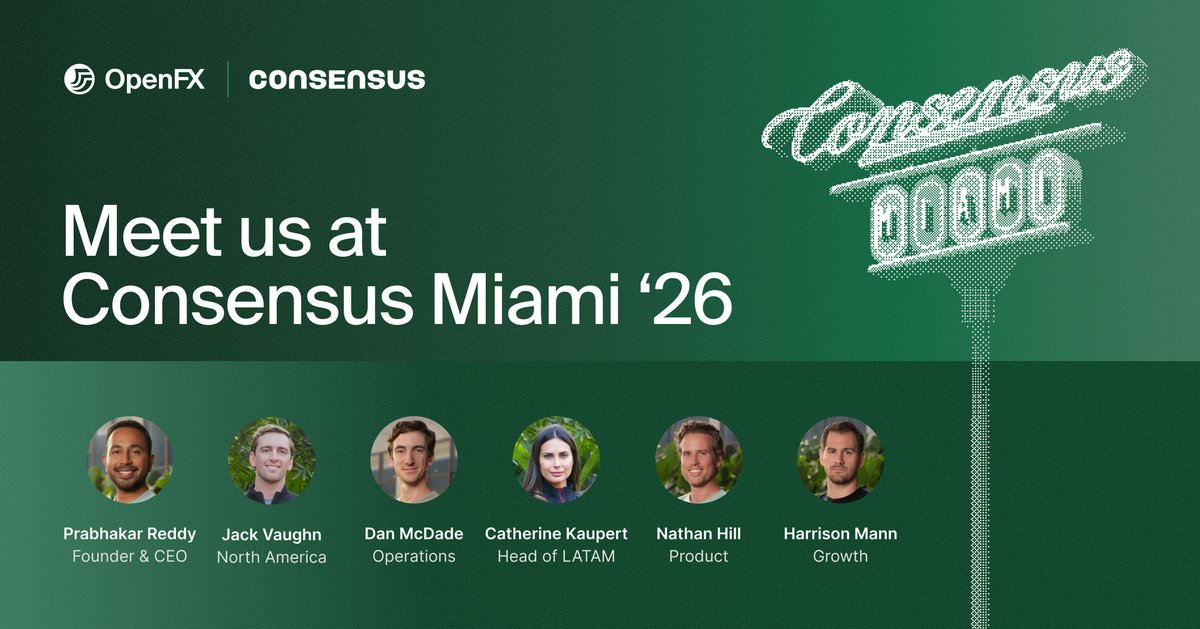
We're at Consensus Miami May 5-7 and holding time for in-person meetings.
If you're moving cross-border volume (or building rails for someone who is), grab 30 minutes with us, on-site or nearby.
We'll cover live corridor pricing for your pairs, give you a sandbox account, and explain where stablecoin settlement actually moves your balance sheet.
Book time here: https://t.co/kzJHLD75rM
It's Saturday night. The Peso just dropped 4%.
Your company has $40 million exposed and the hedge you meant to place Friday is stuck in queue.
You're texting your RM. He's at a birthday party. He's really sorry.
This is how trillion-dollar FX infrastructure actually works.
Bloomberg terminals and 2-5 day settlement times, assuming nothing gets held.
We've stopped noticing how insane this is because for a long time the world did not move fast enough for it to matter.
If the last several years has taught us anything, it is that this is no longer the case.
Once-in-a-generation shocks show up quarterly, a system that can't handle a 4% Friday move won't survive what's coming.
To keep up, cross-border payments will increasingly need to be automated.
Routine work is migrating to systems that don't sleep. And human treasurers are increasingly called on to exercise judgement, and provide transparency.
We're building our tooling with that future in mind, APIs and automated treasury systems that help treasury desks survive this future.
Read more here: https://t.co/KELt3mnynV
Our Founder @prabhakar2reddy had the opportunity to sit down with Atomico to discuss his entrepreneurial journey.
In this clip, he describes how he decides which ideas to pursue, and the personal story that led him to start OpenFX.
Some of the key take-aways:
- Have a clear vision of the future, of what is possible.
- Double down in those domains where this future meets your unique abilities.
- Invest in others who can carry the torch in those areas outside of your expertise.
This is a part of a much longer interview that you can see if you visit @atomico's page.
$4 trillion is stuck in legacy payment rails. Cross-border FX is still broken. OpenFX is fixing it.
@prabhakar2reddy CEO of @openfx_ joins our Stateful podcast, hosted by @masonnystrom.
In this episode, they discuss the future of money movement:
- Zero to $40B+ annualized TPV in 18 months, 99.99% automated, 3 people on trade ops
- Stablecoins replace SWIFT: cross-border settlement in under 60 minutes, 24/7
- FX spreads compressed by 90-95% in every market OpenFX enters
- Agentic payments timeline just collapsed from 7-10 years to 24-36 months
- Spot FX could grow from $2 trillion to $200 trillion a day as the pipes widen
00:59 Why Cross-Border FX Is Still Broken in 2025
03:35 GBP to MXN in Minutes: How Open FX Works
07:14 $4 Trillion Stuck in Transit Right Now
07:44 Zero to $40B TPV in 18 Months
09:07 The 3 Factors Behind Open FX's Explosion
12:08 Payments Is Going Through a Complete Upheaval
14:55 AI Agents Won't Wait 3 Days for Money to Move
16:42 Open FX Is Building the AWS of Money
17:10 Do Fintech Moats Still Exist?
18:40 Moving $100B in Crypto vs. 5 Days for Wires
19:40 Why Crypto Companies Die Without Compliance
20:14 Culture Is Just the Founder's Personality Scaled
22:08 The World Order Is Changing
23:22 Agent Payments: From 10 Years Away to 24 Months
24:35 Where a Payments Insider Would Bet Today
25:47 Why There's No Universal Founder Advice
We came out of stealth nine months ago at $8B in volume. As of February we crossed $45B. Revenue is up 10x.
This week we raised a $94M Series A.
@Accel, @atomico, @FactionVC, @northzoneVC, @M13Company, @PanteraCapital, some of the biggest names on both sides of finance chose to back us.
You might be wondering why.
There are two ways to touch 8 billion lives: acquire 8 billion individual customers, or build the infrastructure for the institutions that already serve them.
We chose the latter.
Today we're announcing OpenFX’s $94M Series A from @Accel, @atomico, @FactionVC, @M13Company , @northzoneVC, @PanteraCapital, and with support from existing investors @flybridge and @hash3xyz.
Cross-border payments remain stuck in the past — slow, expensive, and reliant on legacy systems.
@prabhakar2reddy is building the fix: @openfx_, a real-time FX settlement network that moves money as seamlessly as data.
Today, global payments take 2–7 days to settle. OpenFX clears 90% of transactions in under 60 minutes — and does it at up to 90% lower cost.
With its continuous settlement model and multi-layer liquidity engine, OpenFX is radically rethinking how capital moves across borders.
In just a year, it has scaled to $10B+ in annualized transaction volume, serving neobanks, remittance players, brokerages, and global payroll platforms.
We’re excited to partner with Prabhakar and the OpenFX team as they modernize the world’s financial plumbing.
Welcome to the #AccelFamily!
Read more: https://t.co/O06oMPkesu
@leojrr Free tier (though as others have said 2+1 is best. Get them on the platform and provide value and keep them from going to others. Figure out the right way to offer more value that they will eventually pay.
I think its funny that whenever I need to research something about AWS I always try to scroll past the official AWS documentation to find a different source that is more helpful
@kevinleeme Depends a little bit, id say A is harder especially if bootstrapping but there are some growth hacks that can make A actually very easy. B can be a lot harder if you scale too quickly with the growth hacks
@adammench@MichaelThiessen@vuejs@reactjs Agree my best example is navbars. Good to just have everything including nav items and changes for mobile vs desktop in one place