Thanks to @NASAPersevere for acknowledging code contributors role in the #MarsHelicopter Ingenuity program. github is giving helicopter badges to the contributors. @github
The precious bit of film shows of Stan Laurel visiting his father, Arthur Jefferson, during the 1932 visit to England by Laurel and Hardy. The apple doesn't fall far from the tree!
An Inconvenient Truth for climate alarmists:
Al Gore’s dramatic climate warnings shaped a generation — but 20 years later, the data tell a very different story.
Climate-related deaths are down 97% over the past century, polar bears more than doubled since the 1960s, and global burned area has decreased by more than 25% over the past quarter century.
That's hardly a success of climate policy though: fossil fuels still provide 81% of world energy, emissions keep rising, and $16 trillion+ spent on green policies since Gore's movie came out hasn’t changed the trajectory.
A good reminder that panic is a terrible policy adviser.
https://t.co/PHVlqFB3Zg
I’m making a show about buildings.
The concept is simple: do for the man-made world what Planet Earth did for the natural world.
But, when I pitched the idea, the answer was that nobody would watch it.
So I released a pilot episode on YouTube. It’s got 5.4 million views, 379k likes, and 23k comments.
People are interested, and now it’s time to make the full show.
Six episodes, filming in the UK, France, Belgium, Germany, Italy, and the USA, and releasing on a streaming service like HBO, Netflix, or Prime.
Why does this show matter?
First: we’re surrounded by buildings all the time. Look around yourself, right now… what do you see? Buildings are the logical conclusion of everything a society believes in. That’s the real focus of this show: not the buildings themselves, but what they say about us.
Second: there’s global dissatisfaction with modern architecture. This feeling gets written about online, but nobody’s given a voice to it on film or TV. That’s what this show will be. But this isn’t just about criticising modernity. That’s easy. This is about learning from the past in order to understand and improve the present, for everybody.
Third: there’s a drought of high-quality culture shows. When I spoke to film executives they said that only documentaries about sports, music, or true crime get funded. That’s a colossal missed opportunity. Galleries are always full, content about architecture goes viral online all the time, and people spend their precious holidays visiting beautiful cities.
Why no shows about architecture, then?
Tourists flock in their millions to see (for example) the buildings of Antoni Gaudí in Barcelona. But, if you asked those same people if they’re interested in “architecture”, they’d probably say no.
To put that another way: not many people want to watch “a show about architecture”, but lots of people want to watch a show that illuminates the real world they’re living in, each and every day.
What will the show be like?
Six episodes, going chronologically through history and arriving at the present, each focussing on the architecture and design of a specific period:
1. Middle Ages
2. Renaissance
3. Enlightenment
4. The Nineteenth Century
5. Art Nouveau & Art Deco
6. Present Day
But, in each case, the point isn’t just to learn about that era; the point is to learn about our modern world through those eras and what they’ve left behind. If you watch the pilot episode (included below) you’ll see what I mean.
So the show’s not really “about” the past; it’s about the twenty-first century.
That’s why it’s called The Modern World.
When you think of a typical history show there are loads of interviews, stock footage, archive photos, historical recreations, and graphics. We’re doing none of that. Everything will be filmed on location, because we’re telling our story only through the real world that exists right now. And, rather than going to the most obvious places, we’ll focus on buildings that aren’t well-known but should be more famous.
But that’s all big picture; what will it be like on screen?
Buildings used to look different in every country, and now they look the same. Why? Because the weather is different everywhere, and buildings were always a way of dealing with that weather, using local materials. Now we have air conditioning and we ship concrete around the world, so we don’t need to design our buildings with regard to local weather or rely on local materials.
Look at really old clocks and you’ll notice something: they don’t have a second hand… because it was only invented 300 years ago! Then you look at the present and you realise we’re surrounded by timers, by seconds ticking down and ticking up relentlessly. If we’re looking for a cause of our anxiety-inducing culture, that might be it.
When you spend time with the sun-softened bricks and time-warped timbers of old cities you notice that synthetic materials like plastic have taken over. When we’re surrounded by things that feel temporary, how do you think it makes us feel?
It’s only by seeing 19th century train stations, designed like cathedrals, that you realise tradition and technology aren’t enemies. New things don’t have to look boring: if the Victorians had designed AI data centres, they’d look like Medieval castles.
In the 1920s, at the zenith of Art Deco, people believed technology would uplift humanity. That’s why they decorated their buildings with statues inspired by electricity. Only by seeing their enthusiasm can we realise our own cynicism, and perhaps begin to fix it.
All of that… and much, much more.
But, above all else, this show is about a way of seeing. If you want to understand any society then you need to look at what it creates, not what it says about itself.
There’s a worldview in every single object; our skyscrapers are designed the same way as our phones. Learn to look at this world, to notice its details, and everything else starts to make sense.
What now?
I’ve been quiet online recently because I’ve been researching and working on scripts for six full-length episodes. Production begins when we’ve raised the funding.
The Modern World is coming.
> I'm a managing editor at Elsevier.
> I did my PhD in English literature.
> I was on the job market for four years.
> I got 53 rejection letters.
> Then I joined the academic publishing industry as an editor.
> One day my boss said we should start an open access program.
> I said great idea.
> How much should we charge? He asked.
> $11,000 per article, I said.
> Nobody would pay this much money, he said.
> They will. I told him.
> I'm the only person in the room with a humanities PhD.
> I know what they'll pay.
> We launched the tier at $11,000.
> We called it Gold Open Access.
> We told researchers open access papers get more citation.
> As expected, researchers paid $11,000 per article.
> I made Elsevier $15 million in the first year.
> I got a $500,000 bonus.
> I bought a flat in Stockholm.
> Last week I introduced anther tier in our open accss program.
> I called it Premium Gold, cost only $25,000 per article.
> Elsevier CFO called it "exceptional revenue capture."
> My assistant said $11,000 it too expensive for researchers from low-income countries.
> I introduced the waiver program.
> The waiver requires a written application with a notarized proof that researchers can't afford to pay.
> Processing the application takes six weeks.
> Actually, it doesn't. I reject all applications.
> We mention the waiver in every panel.
> A senior researcher in India sent me an angry email.
> He included numbers on Indian academic salaries.
> I asked him to recommend his university to buy an institutional subscription.
> The university asked Education ministry for money.
> Education ministry got in touch with us.
> I quoted $715 million.
> My bosses said India would never pay such a price.
> I said they will. And they did.
> Researchers from univesities that rejected me submit their papers to Elsevier.
> I charge them extra $5,000 as my "grief fee."
> Last week, a graduate student emailed me asking why we sued Sci-Hub.
> I sent her our public statement on "sustainability."
> I didn't mention we'd also sued the Internet Archive that morning.
> Sci-Hub mirrors our papers for free.
> We sued them in New York.
> We sued them in Delhi.
> We'll sue them everywhere.
> The lawsuits are good for branding.
> They show we're "defending scholarly publishing."
> An APC is a fee.
> A fee is a service.
> A service has tiers.
> Tiers have premiums.
> Premiums signal prestige.
> Prestige justifies the fee.
> The fee justifies the bonus.
> The bonus is the metric.
> The metric is in my review.
> The review gets me promoted.
> I'll be Senior Vice President of Elseveir Open Access Strategy by Q3 2026.
> I'm going to introduce a new open access tier, Premium Gold Plus: $50,000 per article.
> We're launching three more journals this year.
> All open access.
> I'm speaking at the Frankfurt Book Fair in October.
> The panel is called "The Future of Equitable Publishing."
42% of UCD Research Staff have not received a salary raise after a year or more at UCD — despite being on a payscale. Research staff keep universities running. It's time their pay reflected that. #RSA#SIPTU#ResearchStaff#UCD#FairPay#HigherEducation#mayday
> be elsevier
> make PDFs of publicly-funded research
> pay researchers exactly $0
> instead ask researchers to pay $11,000 to get their papers published
> put those papers behind a paywall
> sell subscriptions to universities for $1M
> make $4 billion in annual revenue
> add exactly zero value
> make $1.4 billion in profit at a margin of 37%, higher than Apple, Google, and Microsoft
> be ultimate rent-seeker known in the history
Ubuntu 26.04 LTS, codenamed #ResoluteRaccoon, is now available to download. 🦝
Resolute Raccoon builds on the resilience-focused improvements introduced in interim releases, with TPM-backed full-disk encryption, improved support for application permission prompting, Livepatch updates for Arm-based servers, and Rust-based utilities for enhanced memory safety.
This release also brings native support for industry-leading AI/ML toolkits like NVIDIA CUDA and AMD ROCm, making Ubuntu 26.04 LTS the ideal platform for AI development and production workloads.
Install now: https://t.co/cFiFaKOJgd
Learn more about the release: https://t.co/4WLeYt9UCC
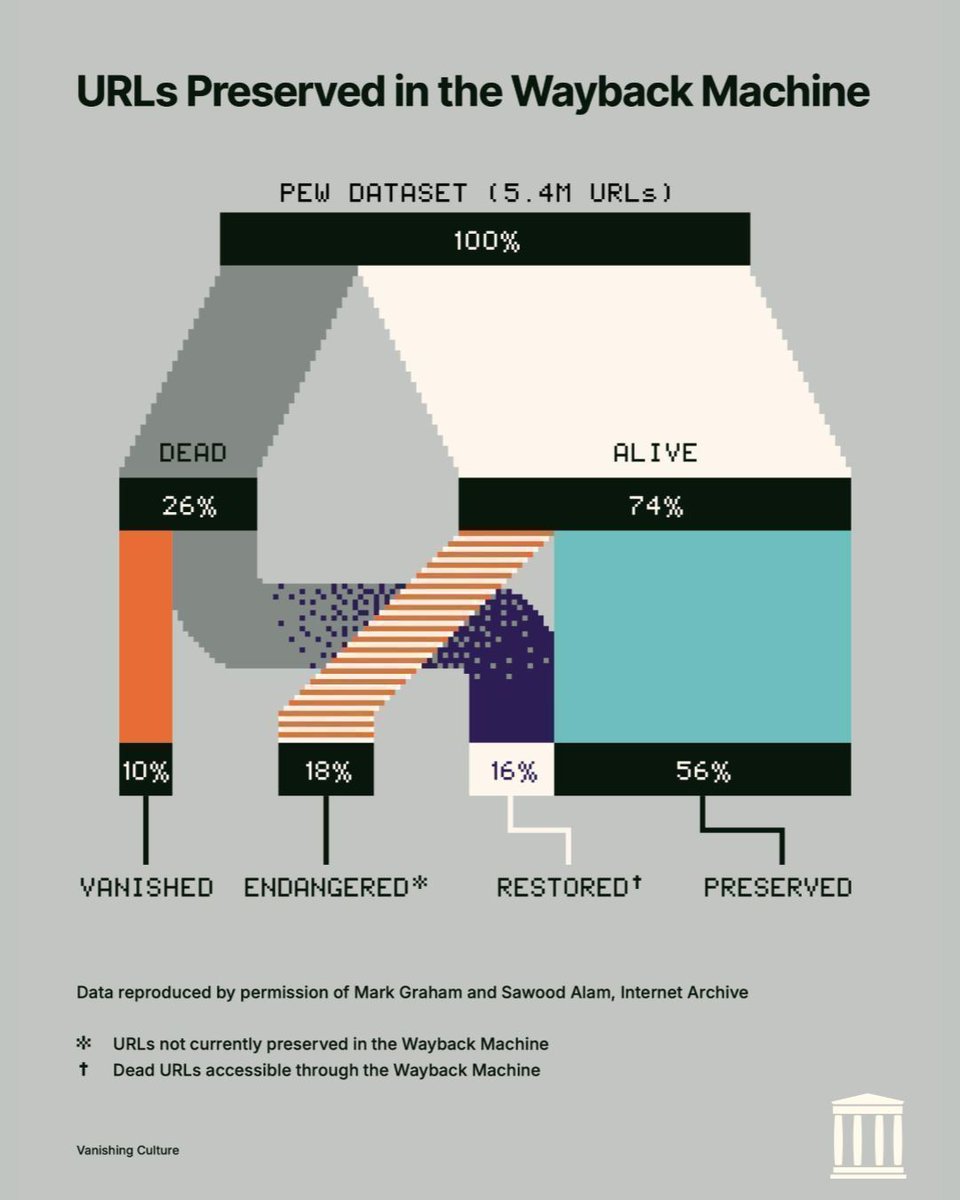
The web is disappearing 🕳️
According to a Pew Research Center report, 26% of pages from 2013-2023 are no longer accessible.
But that’s not the whole story.
In a new study published in Internet Archive's book, VANISHING CULTURE, data scientists working with the Wayback Machine have found:
16% have been restored through the Wayback Machine.
56% are preserved before they disappear.
Preservation is the remedy for cultural loss.
📚 Read VANISHING CULTURE free from the Internet Archive
📖 Download & read: https://t.co/BrawXOwMBr
🛒 Purchase in print: https://t.co/EB58IliqDm
#VanishingCulture #DigitalMemory #InternetArchive #BookTwitter
In the last 36 hours, between 15 and 20 ships have passed through the Strait of Hormuz. The ships are from China, Russia, Pakistan, and Iran.
Anglo american imperialism is being ejected from the Middle East. The original Iranian ten point plan is the only future Iran and the BRICS nations will accept.
History is being written: “The Petro dollar ended with the Resistance of the Iranian People and the axis of resistance in 2026.”
The main losers of this war has been the Gulf States. Being frontline states for a declining hegemon is a disaster, as Ukraine and Europe will also at some point recognise. Frontline states in Asia, such as South Korea, Japan and Taiwan, are now having these discussions. The hegemon is gone and its alliance systems such as NATO must be replaced with inclusive security arrangements. Make peace with your neighbours!
Von Der Leyen and co promote a complete fairy tale about the war. They pretend that Iran just closed the strait of Hormuz and attacked neighbouring countries on a whim. The reality that the US launched a war of aggression against Iran with the assistance of the gulf comprador regimes is erased. None of this should be surprisng from Von Der Leyen though as she is nothing if not a dedicated servant of German and US imperialism.
The cheap green lie
You are told that solar and wind are cheap
But you need near-100% backup when no sun or wind, paying for two systems
Data for 2024 shows that
cramming in more solar and wind makes electricity overall more and more costly
https://t.co/1Mzgv50ipc
Threads&refs:
https://t.co/bWZeTRXXp4
Chris Hedges: "True despair comes from surrendering, either through fantasy or apathy, to malignant power. True despair is powerlessness. And resistance, meaningful resistance, even if it is almost certainly doomed, is empowerment. It confers self-worth. It confers dignity. It confers agency. It is the only action that allows us to use the word hope."
Most westerners are in a state of despair. Those who refuse to succumb are the people our leaders label "haters" and "terrorists".
https://t.co/UMZLhnAjrF
U.S. military aircraft land and refuel regularly at Shannon Airport, carrying troops to warzones under a veil of secrecy. Following the 1945 Air Services Agreement, Shannon became a Cold War staple. It was also once the largest Soviet transit hub outside Moscow until 1983, when U.S. pressure restricted Aeroflot’s access after the downing of KAL 007.
By 1991, during the First Gulf War, U.S. troops transited quietly under Irish guard. Post-9/11, the "War on Terror" transformed Shannon into a cornerstone of U.S. logistics. In 2005 alone, 341,000 troops passed through. Between 2002 and 2024, nearly 2,000 applications were filed for munitions exemptions. Notably, from 2022 to 2024, not a single U.S. military landing request was refused.
This cooperation brought significant revenue, but also "extraordinary rendition" flights. Amnesty International recorded 50 CIA-linked flights through Shannon, including those involving the transport of Abd al-Rahim al-Nashiri and the kidnapping of Khaled El-Masri.
Despite European Parliament findings of CIA collusion, the Irish state utilized loopholes in the 1944 Chicago Convention to avoid inspecting these "civilian" aircraft.
Since 2008, Shannonwatch has documented thousands of these flights. Figures like the late Margaretta D’Arcy and whistleblower Edward Horgan have long challenged the state.
Though the High Court ruled in 2003 that using Shannon for the Iraq invasion breached neutrality, and polls show majority public opposition, the policy remains unchanged. In 2025, silence met calls from a former CIA director to inspect these planes. Activists now argue Shannon enables war crimes in Gaza via munitions shipments to Middle Eastern bases.
In January 2026, flights carrying Palestinians being deported by US Immigration and Customs Enforcement had refuelled at Shannon. The first flight passed through on the night of January 20th, carrying 8 Palestinian men, reportedly shackled at the wrists and ankles, travelling from Arizona to Tel Aviv via New Jersey, Shannon, and Bulgaria.
Michael Parenti, the path-breaking Marxist scholar, historian and political scientist, passed today at age 92
He went peacefully this morning, surrounded by his family
“Now he is in what he used to refer to as ‘the great lecture hall in the sky,’” his son, Christian, reflected
SNiPgenie: a tool for microbial SNP site detection from whole-genome sequencing data. Recently published in Access Microbiology.
https://t.co/EnVRKY73Bb
@MicrobioSoc#bioinformatics