LLMs often generate incorrect code.
Instead, what if they can generate provably correct code?
Presenting AlphaVerus: A self-reinforcing method that automatically learns to generate mathematically correct code using inference-time search and verifier feedback.
🧵
LLMs learn to generalize morphological derivation by analogy from exemplars rather than rules (which is probably also true of humans). However, their behavior is different from human morphological behavior in interesting ways. Read our paper to find out how.
📢 New paper 📢
What generalization mechanisms shape the language skills of LLMs?
Prior work has claimed that LLMs learn language via rules.
We revisit the question and find that superficially rule-like behavior of LLMs can be traced to underlying analogical processes.
🧵
📢 New paper 📢
What generalization mechanisms shape the language skills of LLMs?
Prior work has claimed that LLMs learn language via rules.
We revisit the question and find that superficially rule-like behavior of LLMs can be traced to underlying analogical processes.
🧵
I am on the industry job market, and am planning to interview around next March. I am attending @NeurIPSConf, and I hope to meet you there if you are hiring! My website: https://t.co/p9D18CH79a
Short bio about me:
I am a 5th year PhD student at CMU MLD, working with @rsalakhu and @ybisk. My current research focuses on the confidence of LLM agents - how LLM agents can assess their own limitations and determine when to leverage increased inference compute, larger models, or human intervention.
I am a recipient of Apple AI/ML Scholars Fellowship for 2023. I have interned at Apple AI/ML and Meta FAIR. My research has been recognized through multiple features in CMU news. I hold B.S., M.Eng from MIT EECS.
I am also presenting two of my recent works: Embodied-RAG/Situated Instruction Following in AFM and LangGame workshops.
RT appreciated!
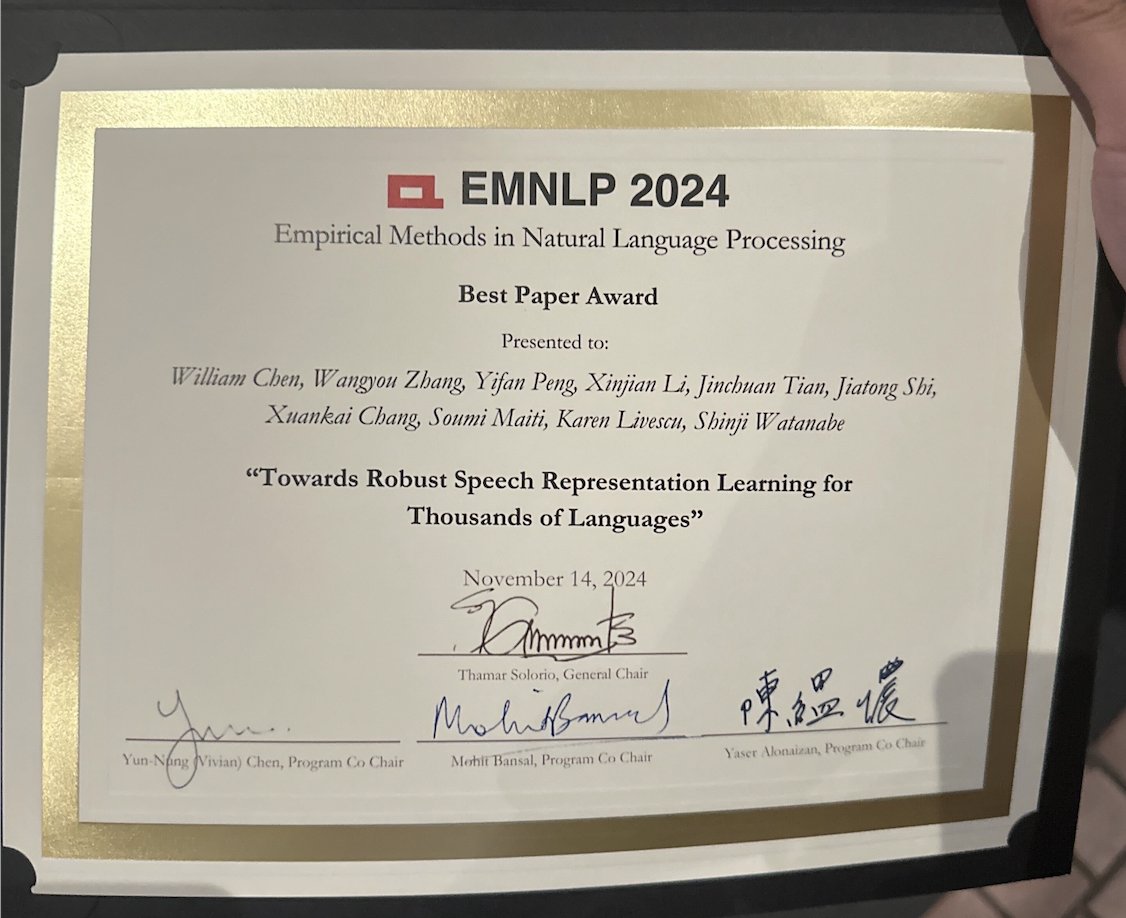
Thank you so much @emnlpmeeting for this wonderful recognition! I’m so honored and humbled 💕 Thanks @gneubig for your support throughout!
We’ve been working on this for 1.5 years and everyone who has spoken with me in the recent past knows how passionately I feel about this work and this task in general 🥹 Thanks again to everyone who recognized and appreciated our efforts ✨
This is a really great paper on which we are building a number of other projects and was really deserving of this award. Congratuations, @chenwanch1, @_shinjiwatanabe, and team!
Who wants to come to JHU and do a postdoc with me?? I'm always enthusiastic about new modeling / inference / algorithmic ideas in NLP/ML. Also selected applications.
💥 New #EMNLP2024 main paper 💥 It’s pretty established by now that the in-context log probability of a word, called surprisal, is predictive of the time the word takes to read. But how important is contextual information, really? Summary below 🧵
https://t.co/gTF4T7wDvO
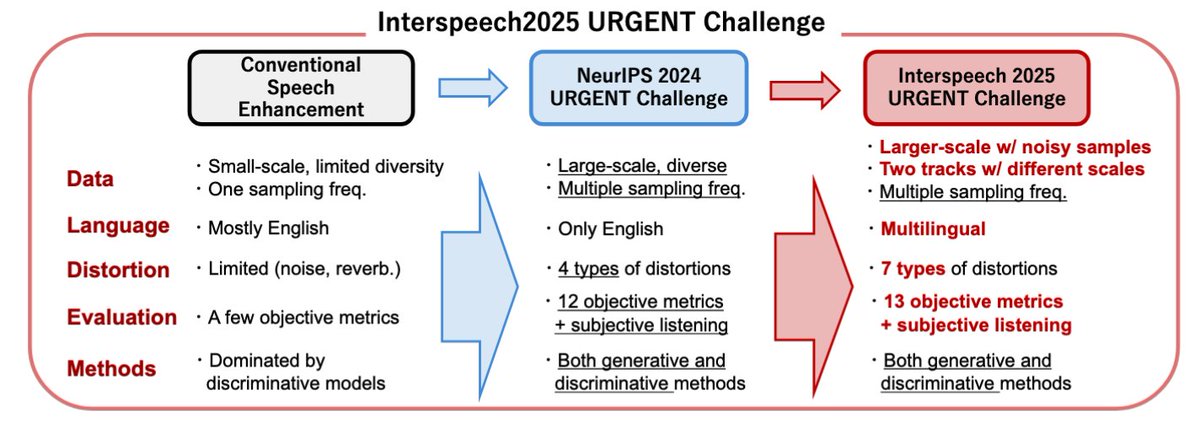
We are thrilled to announce the Interspeech 2025 URGENT Challenge, starting on 11/15!
Join us in building universal speech enhancement models to tackle in-the-wild speech data using large-scale, multilingual data. Details: https://t.co/bZrAqCYwQa
I’m thrilled to be at EMNLP this week presenting our paper, “The Empirical Variability of Narrative Perceptions of Social Media Texts”
I’ll be giving an oral presentation during the CSS + Cultural Analytics Session 2 (Nov 14).
Paper: https://t.co/fKKF9T903u 🧵(1/12)