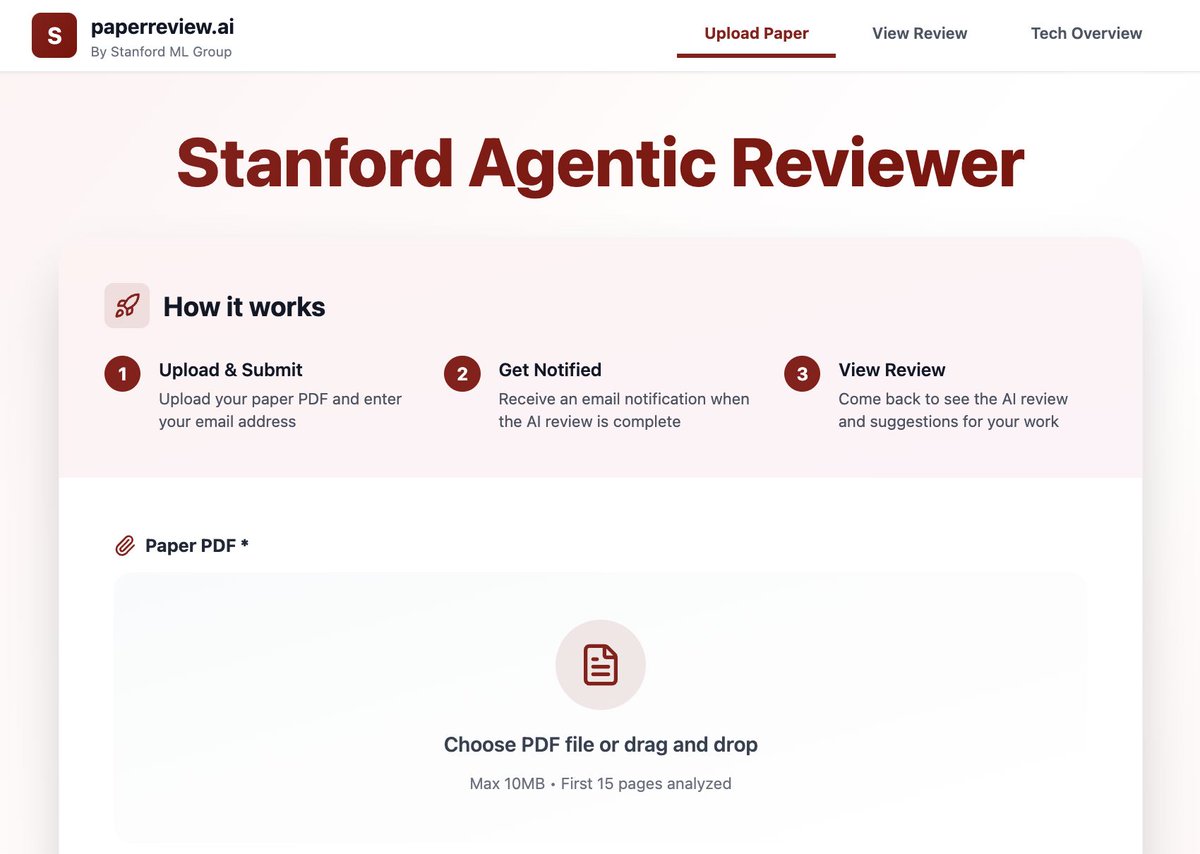
Releasing a new "Agentic Reviewer" for research papers. I started coding this as a weekend project, and @jyx_su made it much better.
I was inspired by a student who had a paper rejected 6 times over 3 years. Their feedback loop -- waiting ~6 months for feedback each time -- was painfully slow. We wanted to see if an agentic workflow can help researchers iterate faster.
When we trained the system on ICLR 2025 reviews and measured Spearman correlation (higher is better) on the test set:
- Correlation between two human reviewers: 0.41
- Correlation between AI and a human reviewer: 0.42
This suggests agentic reviewing is approaching human-level performance.
The agent grounds its feedback by searching arXiv, so it works best in fields like AI where research is freely published there. It’s an experimental tool, but I hope it helps you with your research.
Check it out here: https://t.co/n7ctnDilJJ
"Move 37" is the word-of-day - it's when an AI, trained via the trial-and-error process of reinforcement learning, discovers actions that are new, surprising, and secretly brilliant even to expert humans. It is a magical, just slightly unnerving, emergent phenomenon only achievable by large-scale reinforcement learning. You can't get there by expert imitation. It's when AlphaGo played move 37 in Game 2 against Lee Sedol, a weird move that was estimated to only have 1 in 10,000 chance to be played by a human, but one that was creative and brilliant in retrospect, leading to a win in that game.
We've seen Move 37 in a closed, game-like environment like Go, but with the latest crop of "thinking" LLM models (e.g. OpenAI-o1, DeepSeek-R1, Gemini 2.0 Flash Thinking), we are seeing the first very early glimmers of things like it in open world domains. The models discover, in the process of trying to solve many diverse math/code/etc. problems, strategies that resemble the internal monologue of humans, which are very hard (/impossible) to directly program into the models. I call these "cognitive strategies" - things like approaching a problem from different angles, trying out different ideas, finding analogies, backtracking, re-examining, etc. Weird as it sounds, it's plausible that LLMs can discover better ways of thinking, of solving problems, of connecting ideas across disciplines, and do so in a way we will find surprising, puzzling, but creative and brilliant in retrospect. It could get plenty weirder too - it's plausible (even likely, if it's done well) that the optimization invents its own language that is inscrutable to us, but that is more efficient or effective at problem solving. The weirdness of reinforcement learning is in principle unbounded.
I don't think we've seen equivalents of Move 37 yet. I don't know what it will look like. I think we're still quite early and that there is a lot of work ahead, both engineering and research. But the technology feels on track to find them.
https://t.co/JCxTdKpuzv
After DeepSeek R1, there's new OpenAI o1 level model from China that outperforms Claude Sonnet 3.5 & GPT-4o.
Meet Kimi 1.5 - Multimodal model with advanced Chain-of-thoughts reasoning and real-time web search.
And it's 100% FREE with unlimited chats. Let that sink in.
reading a deepseek paper and stumbled upon a very beautiful formula where they unify SFT and MOST RL TYPES (DPO, PPO, GRPO, etc.) into ONE FORMULA*
*that requires additional reward functions to be defined.
But the fundamental insight - that all these training methods can be framed as gradient ascent on observed logprobs - is beautiful.
Complete hardware + software setup for running Deepseek-R1 locally. The actual model, no distillations, and Q8 quantization for full quality. Total cost, $6,000. All download and part links below:
Programming is changing so fast... I'm trying VS Code Cursor + Sonnet 3.5 instead of GitHub Copilot again and I think it's now a net win. Just empirically, over the last few days most of my "programming" is now writing English (prompting and then reviewing and editing the generated diffs), and doing a bit of "half-coding" where you write the first chunk of the code you'd like, maybe comment it a bit so the LLM knows what the plan is, and then tab tab tab through completions. Sometimes you get a 100-line diff to your code that nails it, which could have taken 10+ minutes before.
I still don't think I got sufficiently used to all the features. It's a bit like learning to code all over again but I basically can't imagine going back to "unassisted" coding at this point, which was the only possibility just ~3 years ago.
A lot of Machine Learning (ML) I learned during my Ph.D. was from youtube. I didn't have a guide to do this effectively and thus here it is:
A complete guide to studying ML from youtube: 13 best and most recent ML courses available on YouTube. 👩🏫🧵⤵️
All crypto exchanges should do merkle-tree proof-of-reserves.
Banks run on fractional reserves.
Crypto exchanges should not.
@Binance will start to do proof-of-reserves soon. Full transparency.
Keeping a level head is probably the most important skill you can develop.
It can literally save your life when you had no idea it was even in danger.
You never know who's packing, who doesn't care about going to jail, who is mobbed up, or who is "protected" from the law.
In Zotero, you can mark items "Read," "Not Read," etc. to better organize your library.
But most people don't know about it.
Here's how to do it 👇
A step-by-step guide with visuals 🧵
Yesterday, a student share her writing process with me.
While writing response papers, she pastes a paragraph of the source text (Benedict Anderson's "Imagined Communities" in her case), and then starts writing her comments under it.
Zotero's inbuilt Note Editor can REVOLUTIONIZE your note-taking and writing processes.
But most academics don't know much about it.
Here's how to supercharge your writing using Zotero's Note Editor 👇
A step-by-step guide with visuals 🧵
One of the MOST CHALLENGING parts of any research project: Literature Review
Here's how to fast-track your literature review process using two FREE tools - Zotero and Research Rabbit 👇
A step-by-step guide with visuals 🧵
Get big enough so people don't want to fight you.
Carry in case they try to anyway.
Learning how to fight is for kids and combat athletes. Adults need to deter, avoid, and if shit happens anyway, neutralize quickly.
"Better to be judged by 12 than carried by 6."