Fr. Chad Ripperger, an exorcist, says there is a sentence that breaks the back of a demon's power over you, and you do not need a priest to say it. You need about four seconds. And if you cannot get it out of your mouth, that is the most useful thing you will learn this week.
Fr. Ripperger is explaining how much of this is actually within reach of an ordinary person, and he is blunt about how little it takes:
Sometimes people simply stop the thing they are doing, and that is enough. Not because stopping is holy in itself, but because of what it leaves the other side with:
"SOMETIMES IF PEOPLE JUST STOP THE ACTIVITY THEN WHAT YOU'LL FIND IS THAT THEN THE DEMON JUST DOESN'T HAVE ANYTHING TO ... USE AGAINST YOU"
And then he gives the second thing, which costs nothing and which almost nobody has ever been told to do:
"THE OTHER THING THAT ... CAN BE VERY HELPFUL IS JUST MAKING A RENUNCIATION"
Out loud. By name. Naming the thing, not dancing around it:
"I RENOUNCE THE DEMON OF LYING. I RENOUNCE THE DEMON OF X"
Whatever your X is. The temper. The bottle. The scrolling. The self loathing you have carried since you were nineteen.
Now here is the part that makes this worth reading twice, because there is a test built into it. He says people who still have something attached in that area do not simply say it and move on:
"THEY'LL EITHER BE BLOCKED IN BEING ABLE TO MAKE THE RENUNCIATION OR THEY'LL FIND MAKING THE RENUNCIATION VERY DIFFICULT"
Read that again. The words stick. You go to say them and something in you does not want to. You feel silly, or you put it off until tomorrow, or you say it about the small one instead of the real one.
That resistance is not embarrassment. It is information.
And what happens on the other side of saying it anyway:
"ONCE THEY MAKE THE RENUNCIATION IT WILL BREAK THE BACK OF HIS POWER IN RELATIONSHIP TO THEM"
Not the end of the fight. The end of the grip. After that, he says, it is ordinary work: you grow the opposite virtue, and eventually the thing has nowhere left to stand.
He is honest that most people never get here on their own. They have to be led to it. But not everybody:
"ONCE IN A GREAT WHILE, YES. I JUST SAID I'M SICK OF THIS, I DON'T WANT THIS IN MY LIFE ANYMORE"
That is the whole entry requirement. Being sick of it.
So tonight, out loud, in an empty room. Name it properly, the real one, not the safe one:
"In the name of Jesus Christ, I renounce the demon of ___. I take back what I gave it, and I want it out of my life. Amen."
If it comes out easily, good. Say it again tomorrow. And if it sticks in your throat, you have just found out exactly where to start.
👇 One word if you know which one you have been avoiding naming: RENOUNCE. And send this to somebody who has been fighting the same thing for years without ever once saying its name out loud.
Credit: Father Chad Community
Bookmark this first. Once it scrolls away, you will not find it again.
Regular people read the news. Rich people read holdings.
50 Free Websites That Show What Billionaires Are Buying and Reading
1.) https://t.co/e68cGzLySA → Latest holdings of Buffett-class investors
2.) https://t.co/qSGqqr1lQC → Hedge fund 13F buy/sell tracker
3.) https://t.co/twjIRS8mQT → The public ledger of U.S. lawmakers’ stock trades
4.) https://t.co/tQICFx47i1 → Whether the CEO is buying or heading for the exit
5.) https://t.co/LxfHmafuBf → Official filings search
6.) https://t.co/Qsd6eez7VU → 10-Ks, 13Fs, and source documents
7.) https://t.co/OSJMZM6s1B → The complete Buffett shareholder letters
8.) https://t.co/n7h7m0tntq→ Video library of annual meeting Q&A
9.) https://t.co/HeeaGUyeMm → Marks’ cycle memos
10.) https://t.co/sMyTvJupXZ → Bridgewater’s public research
11.) https://t.co/s2xBYKDcqX → Dalio’s principles, free to read
12.) https://t.co/Uvgrcu3Vwq → Grantham’s extreme-valuation notes
13.) https://t.co/kx8n50Xz9m → Serious research from a quant shop
14.) https://t.co/XCYEVA1V4n → Damodaran’s market-wide valuation tables
15.) https://t.co/gQZKnWfWWi → The valuation professor explaining the principles
16.) https://t.co/2sJLAwHXuQ → Columns from the author of The Psychology of Money
17.) https://t.co/oy5wsTlN0a → Decision models that reduce unforced errors
18.) https://t.co/0UsWIbSilV → JPMorgan’s quarterly markets handbook
19.) https://t.co/lPScrmxU5M → High-growth theme research
20.) https://t.co/LnN53cFgjc → Foundational Silicon Valley venture essays
21.) https://t.co/CK392yU5Z1 → Homework-grade value investing notes
22.) https://t.co/KysgyXUK24 → Columbia’s value investing archive
23.) https://t.co/udz0VBqfDr → Fed raw data, unfiltered by media
24.) https://t.co/7hR9PqCFgD → Rate decisions and the dot plot
25.) https://t.co/daqfJ3MGkj → ECB database
26.) https://t.co/A2XxkjIV6A → Bank for International Settlements reports
27.) https://t.co/G6Gl09bBkA → Country-level economic base tables
28.) https://t.co/3vTAWKbOM1 → 20- to 50-year charts on a single company
29.) https://t.co/6bCBcI023B → Free financials and guru-holdings doorway
30.) https://t.co/wYiGTvizxM → Who the real global giants are right now
31.) https://t.co/ubPqKVh1Qo → Heatmap of the entire market
32.) https://t.co/9lOCMiurGn → Historical portfolio backtests
33.) https://t.co/FCoslX0BoT → Charting and public analysis
34.) https://t.co/7ESScgIh7H → A free “almost-terminal”
35.) https://t.co/ggL7oah0NE → Search for company action reports
36.) https://t.co/XvYVbup2tw → Investing class the SEC wrote for ordinary people
37.) https://t.co/TLFYQ2rBfj → Encyclopedia of index investing
38.) https://t.co/YJisetmzTz → Look up any term in one second
39.) https://t.co/5KDP73B6lD → Free guides from a giant asset manager
40.) https://t.co/q3NQyUqwtL → CFA Institute papers
41.) https://t.co/F60zdX8d39 → Fund holdings and ratings
42.) https://t.co/apUHL882V5 → Understand a company or the macro picture in one graphic
43.) https://t.co/uwAoGGW2mY → Public theses on thematic investing
44.) https://t.co/AeJ1SEpsNB → What’s actually inside the fund box
45.) https://t.co/pYiJRE9TRX → European ETF comparison
46.) https://t.co/y6oQZt0OVq → Data that punches holes in common sense
47.) https://t.co/NG2Zhw7LS4 → Shiller’s long-run market data
48.) https://t.co/CiolxTtZIt → Post-mortems on investor psychology
49.) https://t.co/xoMtBcAnGX → Economy, energy, and population, told in charts
50.) https://t.co/g3lXvXJ5fn → The long-constraint view mainstream coverage skips
Bookmark this. You will want it the next time you try to copy the homework.
This is not investment advice.
Like + follow + turn on notifications.
Don't miss the next tip.
(Not financial advice — DYOR)
FROM THE DEPTHS: JONAH & YOM KIPPUR.
Every year on Yom Kippur, during the afternoon service, Jewish communities around the world read the book of Jonah.
Why Jonah?
Because Jonah is one of the clearest pictures in the Tanakh of teshuvah — turning back to God.
Nineveh was a violent, wicked city under judgment. God sent Jonah with a warning:
“Yet forty days, and Nineveh shall be overthrown!”
— Jonah 3:4
But something extraordinary happened.
The people believed God.
They humbled themselves.
They fasted.
They turned from their wickedness.
And Scripture says:
“When God saw their deeds, that they turned from their wicked way, then God relented concerning the calamity which He had declared He would bring upon them.”
— Jonah 3:10
That is why Jonah belongs on Yom Kippur.
The message is not simply:
Feel sorry.
It is:
TURN.
The Hebrew idea of teshuvah carries the sense of returning.
Return to God.
Return from sin.
Return while there is still time.
But Jonah is not only about Nineveh’s repentance.
Jonah himself must return.
He runs from the presence of the LORD, resists God’s calling, and becomes angry when God shows mercy.
The prophet preaching repentance is also being confronted by God.
It is easy to see the sins of Nineveh.
It is harder to see the Jonah within ourselves.
And then there is Jonah’s descent.
He goes down to Joppa.
Down into the ship.
Down into the sea.
Down into the depths.
For three days and three nights, Jonah disappears beneath the waters.
Then he is brought up again.
“I descended to the roots of the mountains... but You have brought up my life from the pit, O LORD my God.”
— Jonah 2:6
Jonah’s story is not only about repentance.
It is also about descent and deliverance.
From the depths, Jonah remembers the temple:
“When my soul fainted within me, I remembered the LORD, and my prayer came to You, into Your holy temple.”
— Jonah 2:7
A man in the depths.
A holy God.
A cry for mercy.
And a return.
Yet Jonah contains another surprise.
Nineveh is not Israel.
It is a Gentile city.
And still God sends a prophet.
Still God warns.
Still God shows compassion.
The God of Israel reveals that His mercy reaches farther than Jonah wanted it to.
That is why the book ends with one of the most arresting questions in Scripture:
“Should I not have compassion on Nineveh...?”
— Jonah 4:11
And then the book stops.
No answer from Jonah.
Just God’s question.
Perhaps the reader is meant to answer it.
Do we share God’s heart for mercy?
Jonah knew exactly who God was:
“For I knew that You are a gracious and compassionate God, slow to anger and abundant in lovingkindness.”
— Jonah 4:2
His theology was correct.
His heart still needed to change.
But Yom Kippur goes deeper still.
Because repentance is not the whole question.
The Torah asks how sin itself is dealt with before a holy God.
“For the life of the flesh is in the blood, and I have given it to you on the altar to make atonement for your souls.”
— Leviticus 17:11
And Leviticus 16 gives one of Scripture’s most vivid pictures of sin being removed from the people.
Sin is not ignored.
It is dealt with.
Removed.
Carried away.
That makes Micah’s words especially powerful:
“Who is a God like You, who pardons iniquity... You will cast all their sins into the depths of the sea.”
— Micah 7:18–19
Jonah descends into the depths of the sea.
Micah says God casts sins into the depths of the sea.
Yom Kippur is about more than remorse.
It is about the possibility that guilt can actually be removed.
But then Scripture raises an even deeper question:
How does God ultimately provide that atonement?
Abraham once said:
“God will provide for Himself the lamb.”
— Genesis 22:8
The Torah teaches that God gives blood for atonement.
And later Isaiah speaks of a Servant who would be:
“Pierced for our transgressions... crushed for our iniquities.”
Then Isaiah says:
“The LORD has caused the iniquity of us all to fall on Him.”
— Isaiah 53:5–6
What a progression.
God provides.
God gives.
God removes.
God bears.
Repentance matters.
Humility matters.
Turning back matters.
But Scripture continually points beyond what we do toward what God Himself provides.
And Jonah stands quietly in the middle of this great biblical story:
A prophet who descends into the depths.
Three days.
Then deliverance.
No explanation forced.
No conclusion imposed.
Just the question left hanging before us:
Will we keep running from God, or will we return to Him?
And perhaps Yom Kippur asks one more:
When God provides the way of atonement, will we recognize it?
“Return to Me, and I will return to you.”
— Malachi 3:7
That is the heartbeat of Jonah.
That is the heartbeat of teshuvah.
And it may be one of the deepest heartbeats of Yom Kippur.
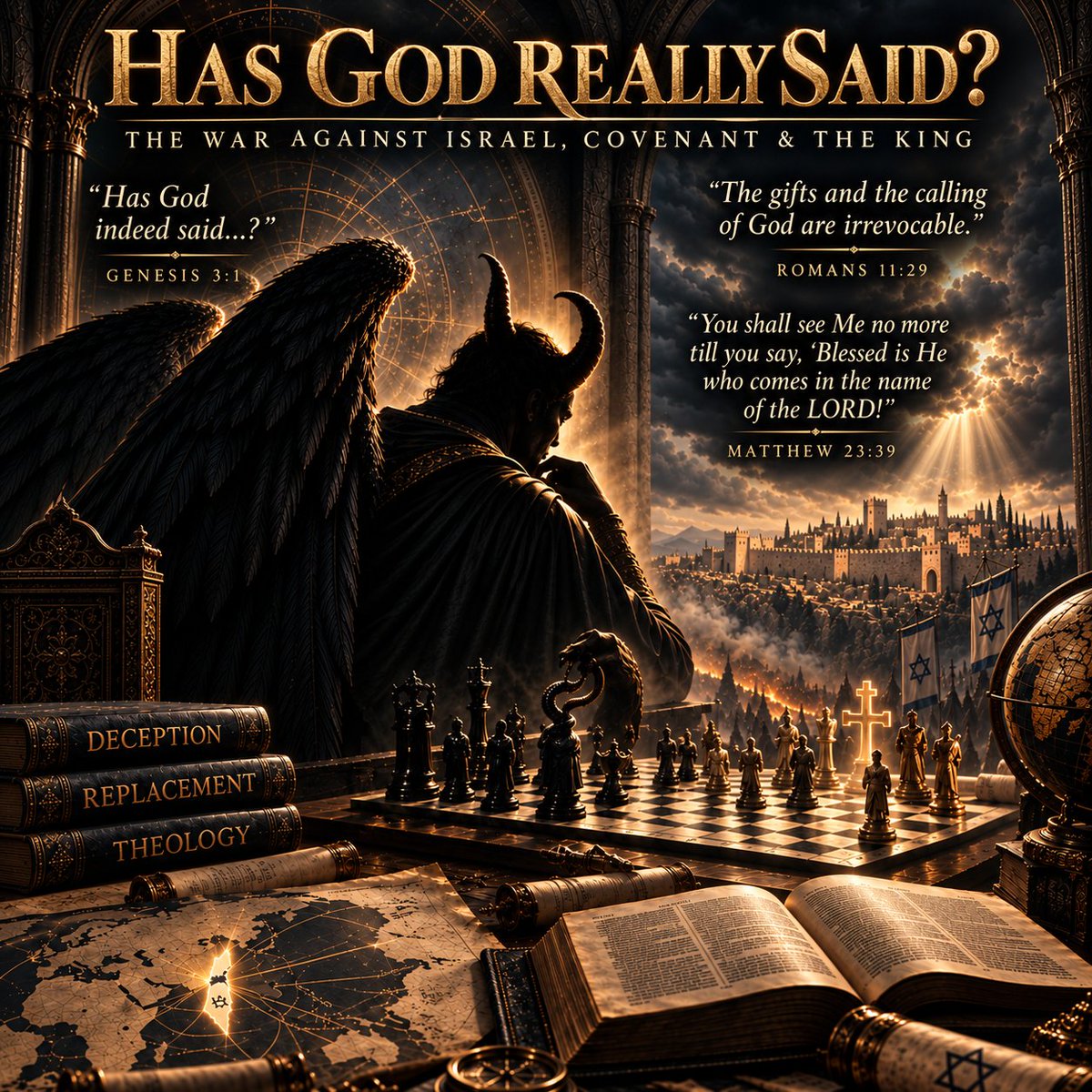
WHY WOULD SATAN WANT THE WORLD TO BELIEVE GOD IS FINISHED WITH ISRAEL?
Replacement Theology is more than a disagreement about prophecy. Behind the discussion lies a much larger question:
Does God mean what He says?
That question first appeared in Eden: “Has God indeed said...?” (Genesis 3:1).
Notice the strategy. Satan does not always begin by denying God exists. He introduces doubt about what God actually said. Did He really mean it? Does that promise still apply? Perhaps the recipients changed. Perhaps the covenant was transferred.
The whisper of Genesis 3 has never disappeared.
SATAN’S “I WILL” VERSUS GOD’S “I HAVE SWORN”
Isaiah records the staggering declarations of the rebellious figure behind the king of Babylon: “I will ascend into heaven... I will exalt my throne... I will sit... I will ascend... I will be like the Most High” (Isaiah 14:13–14).
Yet God has already promised the throne to His King. Messiah will reign from Jerusalem (Zechariah 14:9, 16–17), through the royal line of David (2 Samuel 7:12–16), over a restored Israel (Jeremiah 23:5–8).
Satan says, “I will.” God says, “I have sworn” (Psalm 89:3–4, 34–36).
Only one word will stand.
THE WAR SURROUNDS THE PROMISED SEED
Immediately after the fall, God announced enmity between the serpent and the woman and between his seed and her Seed (Genesis 3:15).
From there Scripture traces the promise through Abraham (Genesis 12:1–3), Isaac (Genesis 26:3–4), Jacob (Genesis 28:13–14), Judah (Genesis 49:10), and David (2 Samuel 7:12–16).
And eventually Paul says of Israel:
“From whom, according to the flesh, Christ came.”
Romans 9:5
Israel is not incidental to biblical history. Israel stands inside the storyline of the Seed, Messiah, covenant, kingdom, land, and restoration.
IF YOU COULD ERASE THE PEOPLE, YOU COULD APPEAR TO ERASE THE PROPHECY
Jesus said to Jerusalem:
“You shall see Me no more till you say, ‘Blessed is He who comes in the name of the LORD!’”
Matthew 23:39
Baruch haba b’Shem Adonai.
Jesus connected His future appearance with a coming recognition of Him by Jerusalem. That means a Jewish people must remain in history. Jerusalem must remain significant. There must ultimately be a generation capable of turning to their Messiah, consistent with Zechariah’s prophecy: “they will look on Me whom they pierced” (Zechariah 12:10).
Could Satan overturn God’s decree? Never.
But from the standpoint of satanic opposition, the repeated attempt to destroy the Jewish people makes sobering biblical sense. If there were no Israel, no Jewish remnant, and no Jerusalem, the prophetic scenario Jesus described could seemingly never occur.
Yet God has guaranteed otherwise.
THE LAND IS PART OF THE PROMISE
God’s promise to Abraham was not merely spiritual. He promised descendants and land: “To your descendants I have given this land” (Genesis 15:18), and later called Canaan “an everlasting possession” (Genesis 17:8).
The prophets maintain the same pattern. God promises to “gather you out of all countries, and bring you into your own land” (Ezekiel 36:24).
The people are connected to the land. The land is connected to Jerusalem. Jerusalem is connected to David’s throne. David’s throne is connected to Messiah.
CONFUSE THE COVENANTS, AND THE PROMISES BECOME CONFUSED
Israel lived under the Mosaic Covenant, which contained explicit conditions: “If you will indeed obey My voice...” (Exodus 19:5). Deuteronomy 28 likewise presents blessing for obedience and judgment for disobedience.
Israel disobeyed. Israel was disciplined. Israel was scattered.
But the Mosaic Covenant is not the Abrahamic Covenant.
God’s promises to Abraham concerning descendants, blessing, and land are established in Genesis 12, 15, and 17.
The Davidic Covenant promises an enduring royal house and throne (2 Samuel 7:12–16).
And the New Covenant is explicitly announced as being made “with the house of Israel and with the house of Judah” (Jeremiah 31:31).
If the conditional Mosaic Covenant is conflated with the enduring Abrahamic, Davidic, and New Covenant promises, the reasoning can become: Israel disobeyed, therefore Israel forfeited everything.
But Scripture does not allow that conclusion. Israel can suffer covenant discipline without God abandoning promises grounded in His own faithfulness.
GOD TIED ISRAEL’S CONTINUED EXISTENCE TO CREATION
Immediately after announcing the New Covenant, God points to the fixed order of the sun, moon, and stars and says that only if those ordinances cease will “the seed of Israel also cease from being a nation before Me forever” (Jeremiah 31:35–36).
God places His own name behind Israel’s continued existence.
PAUL ANSWERS THE QUESTION DIRECTLY
Paul asks:
“Has God cast away His people? Certainly not!”
Romans 11:1
He then warns Gentile believers, “Do not boast against the branches” (Romans 11:18) and “do not be haughty, but fear” (Romans 11:20).
Gentiles have been gloriously grafted in, but grafting in is not replacing the natural branches.
Paul then explains that “blindness in part has happened to Israel until the fullness of the Gentiles has come in” (Romans 11:25).
Until.
The hardening is partial and temporary, followed by Paul’s declaration that “all Israel will be saved” (Romans 11:26), because “the gifts and the calling of God are irrevocable” (Romans 11:29).
AND HERE MAY BE THE MOST POWERFUL PART OF ALL
When God describes Israel’s future restoration, He says:
“I do not do this for your sake, O house of Israel, but for My holy name’s sake.”
Ezekiel 36:22
Then He promises to vindicate His name before the nations, gather Israel, and “bring you into your own land” (Ezekiel 36:23–24).
That changes the entire argument.
Israel’s restoration is not ultimately a monument to Israel’s faithfulness.
It is a monument to God’s faithfulness.
That is why Satan’s ancient question matters:
“Has God indeed said...?”
God’s answer across Scripture is yes.
The King is still coming. Jerusalem still matters. The land still matters. The covenants still matter. Israel’s story is not finished.
And someday Jerusalem will say:
Baruch haba b’Shem Adonai.
“Blessed is He who comes in the name of YHWH.”
Then the world will see what Scripture has declared all along:
“Not a word failed of any good thing which the LORD had spoken... All came to pass.”
Joshua 21:45
WHEN JESUS RULES FOR 1,000 YEARS, WHO EXACTLY WILL HE BE RULING?
If everyone is already resurrected, glorified, and in the eternal state, then who are the nations Jesus rules during the Millennium?
Revelation 20 says Christ reigns for 1,000 years.
But Scripture also describes people during that Kingdom who:
• build houses
• plant vineyards
• have children
• live long earthly lives
• travel to Jerusalem
• worship the King
• belong to distinct nations
• can still disobey
That means the Millennium is not simply heaven.
And it is not yet the eternal state.
There are two groups living side by side during the Kingdom.
1. Glorified saints reign with Christ
“They came to life and reigned with Christ for a thousand years.”
— Revelation 20:4
Jesus also promises:
“To the one who is victorious... I will give authority over the nations.”
— Revelation 2:26
Authority over whom?
The nations.
The glorified saints are not the people repopulating the earth.
They are reigning over those who do.
2. Mortal believers enter the Kingdom alive
When Jesus returns, believing survivors of the Tribulation enter His earthly Kingdom in natural bodies.
This includes restored Israel.
“I will take you from the nations... and bring you into your own land.”
— Ezekiel 36:24
Israel is cleansed, restored, and established in the land under Messiah.
Believing Gentiles enter too.
Jesus says:
“Come, you who are blessed by My Father; inherit the kingdom prepared for you.”
— Matthew 25:34
This is part of the Sheep and Goats Judgment in Matthew 25:31–46.
At His return, Jesus separates the nations.
The “sheep” enter the Kingdom alive.
The “goats” do not.
That means believing Gentile survivors, alongside restored Israel, enter the Millennium in mortal bodies.
And then something remarkable happens.
They have children.
Isaiah describes life during this future Kingdom:
“They will build houses and dwell in them;
they will plant vineyards and eat their fruit.”
“They will not labor in vain,
nor will they bear children doomed to misfortune.”
— Isaiah 65:21–23
These are ordinary human beings living under extraordinary conditions.
Isaiah gives us another critical clue.
People can still die.
“The one who dies at a hundred will be thought a mere child.”
— Isaiah 65:20
That means Isaiah 65 cannot be describing the eternal state.
Why?
Because Revelation 21 says:
“There will be no more death.”
Isaiah 65 has birth, aging, and death.
Revelation 21 does not.
They are Different periods.
And the Millennium fits perfectly.
The nations also remain nations.
Zechariah says:
“Everyone who survives of all the nations that have come against Jerusalem will go up year after year to worship the King.”
— Zechariah 14:16
Go up where?
Jerusalem. Mt. Zion.
Worship whom?
The King. Finally on His Davidic throne.
And what happens if a nation refuses?
Judgment follows.
That means these are not glorified, sinless people.
They are mortal nations living under righteous government.
Now add Psalm 2.
The Father says to the Son:
“I will make the nations your inheritance.”
And Messiah will:
“rule them with a rod of iron.”
— Psalm 2:8–9
Revelation applies that same language to Christ and to the saints who reign with Him.
But why would glorified saints need to be ruled with a rod of iron?
They wouldn’t.
The language makes sense if Messiah is exercising real governmental authority over mortal nations capable of disobedience.
BUT WHAT ABOUT THE OBJECTIONS?
Some say the thousand years simply represents the present Church age.
But Revelation 20 says Satan is bound so that he can “no longer deceive the nations.”
Does that describe the world today? No
Some say the Kingdom is entirely spiritual.
But Zechariah describes surviving nations going up to Jerusalem to worship the King.
Some say Isaiah 65 is simply symbolic language for eternity.
But eternity has no death.
Isaiah 65 does.
Some say there are no mortal people after Christ returns.
But Matthew 25 explicitly shows believing Gentiles entering the Kingdom alive, while the prophets describe restored Israel, surviving nations, children, longevity, agriculture, worship, and governmental accountability.
And Revelation 20 gives us one final piece.
At the end of the thousand years, Satan is released and deceives people from the nations whose number is “like the sand of the sea.”
— Revelation 20:7–9
Where did all those people come from?
They are descendants of the mortal believers who entered the Millennium and multiplied throughout the thousand years.
Some of those descendants outwardly submit to Messiah’s perfect government without inwardly trusting Him.
When Satan is released, their rebellion is exposed.
The picture is consistent from beginning to end:
Messiah reigns.
Israel is restored.
Glorified saints rule with Him.
Believing mortals enter the Kingdom alive.
Families grow.
Nations remain nations.
Jerusalem becomes the center of worship and government.
And the earth experiences righteous rule under its rightful King.
That is why Psalm 2 speaks of nations under Messiah’s authority.
That is why Isaiah 65 still has children, long life, and death.
That is why Zechariah 14 has surviving nations traveling to Jerusalem.
That is why Revelation 20 ends with descendants of those nations still capable of rebellion.
The pieces fit.
The Millennium is a real earthly kingdom populated by mortal nations, while glorified saints reign with Messiah for 1,000 years.
“The LORD will be king over all the earth.”
— Zechariah 14:9
The prophets were not describing heaven.
They were describing the earth under its rightful King.
WHAT IF THE PRETRIB RAPTURE IS HIDDEN IN THE SEQUENCE?
No single verse says:
“The Church will be raptured seven years before the Second Coming.”
Fair enough.
But biblical doctrine often becomes clearer when multiple passages are placed together and we ask:
What sequence best explains all the evidence?
When we do that with the Rapture, an interesting pattern begins to emerge.
🔹 1. THE PROMISE: Christ receives His people to the Father’s house in heaven.
Jesus said:
“I will come again and receive you to Myself; that where I am, there you may be also.”
John 14:3
Just before that, He spoke of preparing a place in His Father’s house.
That matters.
Jesus is not simply describing His arrival on earth. He promises to receive His people to Himself and bring them where He is.
Compare that with Zechariah 14, where Messiah comes down and His feet stand on the Mount of Olives.
Different movement. Different emphasis.
🔹 2. THE CATCHING AWAY: Believers rise to meet Him in the air
Paul writes:
“Then we who are alive and remain shall be caught up together with them in the clouds to meet the Lord in the air.”
1 Thessalonians 4:17
The dead in Christ rise.
Living believers are caught up.
Together they meet Christ in the air.
Paul then says:
“Therefore comfort one another with these words.”
1 Thessalonians 4:18
Notice the movement:
The saints go up to meet Him.
Yet other passages describe Christ coming down with His saints.
That distinction deserves attention.
🔹 3. THE TRANSFORMATION: Not every believer dies
Paul adds:
“We shall not all sleep, but we shall all be changed.”
1 Corinthians 15:51
And it happens:
“In a moment, in the twinkling of an eye.”
1 Corinthians 15:52
There will be believers who do not experience death but are instantly transformed.
🔹 4. THE PROTECTION: Believers are not appointed to wrath
Paul describes Jesus as the One who:
“delivers us from the wrath to come.”
1 Thessalonians 1:10
Then, immediately after the Rapture passage, he says:
“For God did not appoint us to wrath.”
1 Thessalonians 5:9
Notice the pronouns in the chapter.
“They” say peace and safety.
Destruction comes upon “them.”
But believers are addressed differently:
“But you, brethren, are not in darkness.”
1 Thessalonians 5:4
There is a clear contrast between they/them and you/brethren.
Paul distinguishes believers from those overtaken by the Day of the Lord.
🔹 5. THE HOUR: “Keep you FROM the hour”
Jesus says:
“I also will keep you from the hour of trial which shall come upon the whole world.”
Revelation 3:10
The Greek phrase is:
τηρήσω ἐκ — tēreō ek
The preposition ἐκ, ek, often carries the sense of out of or from.
And notice what Christ promises concerning His people.
Not merely protection from certain judgments.
He speaks of keeping them from the hour of testing itself.
Pretrib interpreters see this as significant because the promise appears to concern the time period, not simply preservation within it.
Other interpreters understand the wording differently, so this verse should not carry the whole argument.
But it fits the larger pattern.
🔹 6. THE WRATH: Revelation identifies the period
By Revelation 6, people on earth cry:
“For the great day of His wrath has come.”
Revelation 6:17
That naturally connects with Paul’s earlier assurances:
“delivers us from the wrath to come.”
1 Thessalonians 1:10
and
“God did not appoint us to wrath.”
1 Thessalonians 5:9
That does not settle timing by itself.
But it strengthens the cumulative case.
🔹 7. THE OLD TESTAMENT ECHO
Isaiah gives a fascinating sequence:
“Your dead shall live.”
Isaiah 26:19
Then:
“Come, my people, enter your chambers.”
Isaiah 26:20
And then:
“Hide yourself, as it were, for a little moment, until the indignation is past.”
Resurrection.
God’s people sheltered.
Then indignation upon the earth.
Is Isaiah explicitly teaching the Rapture?
I would not claim that.
But the sequence is intriguing.
🔹 8. THE PATTERN: Noah and Lot
Jesus points back to Noah and Lot.
Noah entered the ark before judgment fell.
Lot was removed from Sodom before destruction came.
Then Jesus says:
“Even so will it be in the day when the Son of Man is revealed.”
Luke 17:30
These are not direct Rapture texts.
But they reveal a recurring biblical pattern:
separation before judgment.
🔹 9. THE EXPECTATION: Who are believers waiting for?
The New Testament repeatedly portrays believers as waiting for Christ Himself.
“Looking for the blessed hope.”
Titus 2:13
“We eagerly wait for the Savior.”
Philippians 3:20
“Eagerly waiting for the revelation of our Lord Jesus Christ.”
1 Corinthians 1:7
“To wait for His Son from heaven.”
1 Thessalonians 1:10
The expectation is strikingly Christ-centered.
The Church is told to look for Him.
🔹 10. THE BRIDE: Already prepared before Christ descends
By Revelation 19:
“The marriage of the Lamb has come, and His wife has made herself ready.”
Revelation 19:7
She is clothed in fine linen.
Then heaven opens.
Christ rides out in judgment.
And:
“The armies in heaven, clothed in fine linen, white and clean, followed Him.”
Revelation 19:14
That raises a natural question:
How are the saints already pictured in heaven before Christ descends to earth?
🔹 11. THE RETURN: Christ comes WITH His holy ones
Zechariah says:
“His feet will stand on the Mount of Olives.”
Zechariah 14:4
Then:
“YHWH my God will come, and all the saints with You.”
Zechariah 14:5
Jude likewise writes:
“Behold, the Lord comes with ten thousands of His saints.”
Jude 14
So compare the movements:
1 Thessalonians 4
The saints go UP to meet Christ.
Zechariah 14 / Revelation 19
Christ comes DOWN with His saints.
That contrast is difficult to dismiss.
🔹 12. THE KINGDOM QUESTION
The prophetic Kingdom includes people in natural bodies who marry, have children, age, and populate the nations.
See Isaiah 65:20–23 and Zechariah 14:16–19.
So where do these mortal Kingdom inhabitants come from?
Within the pretrib framework, people come to faith during the Tribulation, survive its judgments, and enter Messiah’s Kingdom in natural bodies. Unbelieving survivors do not enter the Kingdom.
Again, not a standalone proof.
But it fits the larger sequence.
🔥 NOW PUT IT TOGETHER
John 14
Christ prepares a place and returns to receive His people.
⬇️
1 Thessalonians 4
Believers are caught up to meet Him in the air.
⬇️
1 Corinthians 15
Living believers are instantly transformed.
⬇️
1 Thessalonians 1 and 5
Believers are associated with deliverance from coming wrath.
⬇️
Revelation 3:10
Christ promises to keep His people ἐκ, ek, from the hour of worldwide testing.
⬇️
Revelation 6
The earth recognizes divine wrath.
⬇️
Revelation 19
The Bride is already prepared in heaven.
⬇️
Zechariah 14 / Jude 14 / Revelation 19
Christ descends to earth WITH His saints.
None of these passages alone forces a pretribulation Rapture.
But taken together?
A receiving.
A catching away.
A transformation.
A deliverance from wrath.
A promise concerning the very hour of worldwide testing.
A Bride already prepared in heaven.
Saints going up to meet Christ.
And later Christ coming down with His saints.
That cumulative pattern deserves serious consideration.
And perhaps that is why Paul ended his Rapture teaching this way:
“Therefore comfort one another with these words.”
1 Thessalonians 4:18
Our hope is not ultimately in escaping trouble.
Our hope is a Person.
And we are waiting for Him.
🔴I had TDS for 7 years before waking up to the media lies.
Found 2 major sources that really helped.
@AmericanDebunk website that showed all the media hoaxes and edits + Joomi Kim's documentary.
If you're still suffering from this affliction, consider giving these a watch. America really dodged a bullet.
https://t.co/9fSN8Rk40r
It worked.
Gave Claude $20.
Left it coding overnight.
Woke up to:
• finished script
• +$95 from first 5 trades
Didn’t touch anything.
Then I found this wallet:
0xb27b...b82
• $384,858 profit
• 13,070 predictions
• $18.5K biggest win
• Started March 2026
Almost no one is watching it.
While building my script, I copytraded it to test the math.
Started with $80.
→ $4,218 in a few weeks
Every position is identical in structure.
Not trading.
One equation.
Running while you sleep.
Examples:
$17,839 → $36,318 (+103%)
$3,112 → $15,011 (+382%)
$10,676 → $22,178 (+107%)
Here’s the exact framework I gave Claude:
1. Temporal bias
Find BTC time windows with >65% edge.
Ignore everything else.
2. Kelly sizing
Size based on confidence.
Never fixed bets.
f* = (p × b − q) / b
3. Volatility filter
Skip high volatility.
Trade only clean conditions.
4. Bayesian updates
Update probabilities after each trade.
The system improves over time.
Claude built everything while I slept.
Funded it with $20.
First trade fired minutes later.
Copytrade my finds → https://t.co/UblHSPUL67…
You’re seeing this early.
That window doesn’t stay open.
You only need Claude + Device + 1 hour/day.
Giving This Free for 24 hours. To get it:
1. Comment the word 'CLAUDE'
2. Like and Retweet this post
3. Follow me @tec_marco10 (so i can DM you)
BREAKING STUDY: Nattokinase Breaks Down SPIKE PROTEIN, AMYLOID MICROCLOTS, BLOOD CLOTS, and SHRINKS ARTERIAL PLAQUE
We assembled DECADES of evidence to uncover the powerful MULTI-TARGET EFFECTS of nattokinase:
- Degrades spike protein
- Breaks down harmful amyloid proteins
- Dissolves abnormal amyloid microclots
- Breaks down fibrin blood clots
- Boosts the body’s natural clot-dissolving system
- Shrinks arterial plaque
- Lowers blood pressure
- Reduces blood-clotting factors and platelet clumping
Our new paper, “Proteolytic Targets and Clinical Benefits of Oral Nattokinase: Spike Protein and Amyloid Degradation, Fibrinolysis, and Cardiovascular Risk Reduction,” was produced through a collaboration between The Wellness Company and the McCullough Foundation.
It represents one of the most comprehensive evaluations of nattokinase to date, uniquely integrating its proteolytic, cardiovascular, pharmacokinetic, amyloid, and spike-protein literature into a single paper.
After oral dosing, nattokinase-related activity shows up in human blood and changes clotting and clot-breakdown markers within hours.
Three independent labs have now shown that nattokinase-related enzymes can BREAK DOWN SPIKE PROTEIN in vitro—including purified nattokinase itself.
At higher doses, human imaging studies reported about a 36% SHRINKAGE in carotid artery plaque—suggesting the effective range may begin around 6,000 FU/day.
Randomized human trials also show modest BLOOD-PRESSURE reductions with nattokinase, with pooled decreases of about 3.5 mmHg systolic and 2.3 mmHg diastolic.
And in long-term population studies, higher natto intake was associated with a 25% LOWER RISK of cardiovascular death and a 32% LOWER RISK of stroke death.
Nattokinase has been well tolerated across human studies, with no notable adverse events reported across six randomized trials. Even 10,800 FU/day for 12 months was used in a large observational cohort without reported excess bleeding.
This inexpensive, orally available enzyme holds immense promise for cardiovascular risk reduction in the post-COVID era.
It now deserves large-scale clinical testing for cardiovascular risk reduction and other post-vaccination injury applications.
We plan to launch some of these studies shortly.
@twc_health@McCulloughFund@P_McCulloughMD@DrHarveyRisch@DrKellyVictory@jathorpmfm@drdrew@PeterGillooly
WILL THERE BE A THIRD AND FOURTH JEWISH TEMPLE?
Here is a remarkable problem:
Ezekiel’s future Temple complex does not fit on today’s Temple Mount.
The present Temple Mount covers approximately:
36 acres.
But on the traditional 500-reed reading of Ezekiel 42:15–20, Ezekiel’s sacred enclosure would cover roughly:
630 acres.
That is about 17½ times larger.
36 acres today.
630 acres in Ezekiel.
That is not a minor architectural difference.
It may be an important clue that Scripture describes two different future Temple settings.
A TEMPLE BEFORE MESSIAH RETURNS
Daniel writes:
“In the middle of the week he shall bring an end to sacrifice and offering.”
Daniel 9:27
For sacrifice to be stopped, sacrifice must first be occurring.
Jesus then points directly back to Daniel:
“When you see the ‘abomination of desolation,’ spoken of by Daniel the prophet, standing in the holy place…”
Matthew 24:15
Paul adds that the man of lawlessness:
“sits as God in the temple of God.”
2 Thessalonians 2:4
And John is told:
“Rise and measure the temple of God, the altar, and those who worship there.”
Revelation 11:1
The surrounding context gives us Jerusalem and 42 months.
Notice the progression:
Daniel: sacrifice.
Jesus: holy place.
Paul: Temple.
Revelation: Temple, altar, worshipers, Jerusalem, 42 months.
This is what Christians commonly call the Third Temple.
The Bible never uses that number. It is simply shorthand for a Jewish sanctuary existing after the Second Temple and before Messiah’s kingdom.
AND THIS IS NO LONGER PURELY THEORETICAL
No Third Temple is currently under construction.
But preparations associated with future Temple worship are real.
The Temple Institute in Jerusalem continues preparing sacred vessels, priestly garments, and other elements connected with renewed Temple service. It has also clarified recent speculation about the red heifers: an earlier burning was only a practice exercise, while several heifers remain under evaluation.
Jewish worship on the Temple Mount has also become more visible in 2026, including expanded use of prayer materials and public prayer in circumstances that would have been highly restricted in previous years.
None of this proves Daniel’s seventieth week has begun.
Prophecy calls for watchfulness, not date-setting.
But after nearly 2,000 years without a Jewish Temple, renewed discussion of Temple worship is no longer purely hypothetical.
THEN COMES JACOB’S TROUBLE
Jeremiah describes an unprecedented future crisis:
“It is the time of Jacob’s trouble, but he shall be saved out of it.”
Jeremiah 30:7
Daniel echoes it:
“There shall be a time of trouble, such as never was since there was a nation.”
Daniel 12:1
Jesus uses almost identical language:
“Then there will be great tribulation, such as has not been since the beginning of the world.”
Matthew 24:21
Jeremiah.
Daniel.
Jesus.
An unparalleled crisis centered on Israel and Jerusalem, followed by deliverance.
ZECHARIAH SHOWS WHY THIS IS STILL FUTURE
Zechariah says:
“Two-thirds in it shall be cut off and die, but one-third shall be left in it.”
Zechariah 13:8
Then the surviving third is refined:
“They will call on My name, and I will answer them. I will say, ‘This is My people’; and each one will say, ‘YHVY is my God.’”
Zechariah 13:9
And the prophecy continues directly into chapter 14:
Jerusalem attacked.
The nations gathered.
YHVY goes forth to fight.
His feet stand upon the Mount of Olives.
Zechariah 14:1–4
That complete sequence has never occurred.
Neither Antiochus IV nor AD 70 fulfilled it.
The Holocaust was an unspeakable catastrophe, but it did not culminate in the full Zechariah 13–14 sequence of national refining, YHVY’s intervention, and His feet standing upon the Mount of Olives.
That is why the futurist reading understands Jacob’s Trouble as still future.
DOES THE TANAKH REALLY REQUIRE TWO FUTURE TEMPLES?
This is one of the strongest Jewish objections.
A Jewish reader can reasonably argue:
Daniel’s desecration prophecies were fulfilled in ancient history, while Ezekiel 40–48 describes the future Messianic Temple. Why introduce another Temple between them?
So leave the New Testament aside for a moment.
Daniel 12 itself gives us:
Sacrifice.
Abomination.
Unparalleled trouble.
Israel’s deliverance.
Resurrection.
Daniel 12:1–2, 11
Antiochus IV did not complete that sequence.
Neither did Titus in AD 70.
Zechariah likewise points to a future crisis culminating in YHVY’s direct intervention at Jerusalem.
The Tanakh itself therefore points toward a future climactic period involving Israel, Jerusalem, sacrifice, desecration, national refining, divine intervention, and deliverance.
The New Testament does not invent that expectation.
It adds further detail.
COULDN’T EZEKIEL’S TEMPLE SIMPLY BE THE NEXT TEMPLE?
Possibly, if the settings were the same.
But they are not.
The sanctuary associated with Daniel exists amid:
Sacrifice.
Desecration.
Unprecedented trouble.
Jerusalem under assault.
Ezekiel’s Temple exists after restoration, in a reordered land, with tribal allotments, a supernatural river flowing from the sanctuary, and YHVY declaring:
“This is the place of My throne… where I will dwell in the midst of the children of Israel forever.”
Ezekiel 43:7
Then comes the size problem again:
Present Temple Mount: ~36 acres.
Ezekiel’s enclosure: ~630 acres.
How could it fit?
Perhaps it is not supposed to fit today’s Jerusalem.
Zechariah says that when Messiah comes:
“The Mount of Olives shall be split in two.”
Zechariah 14:4
And:
“All the land shall be turned into a plain… Jerusalem shall be raised up.”
Zechariah 14:10
Ezekiel’s Temple belongs to a transformed Jerusalem after Messiah returns.
DOESN’T THE CROSS END TEMPLE SACRIFICES FOREVER?
This is probably the strongest Christian objection.
Hebrews is unmistakable:
“We have been sanctified through the offering of the body of Jesus Christ once for all.”
Hebrews 10:10
Christ’s sacrifice cannot be repeated or supplemented.
Yet Ezekiel 40–48 unmistakably describes sacrifices.
Therefore those sacrifices cannot provide eternal redemption.
Whatever ceremonial function they serve in Messiah’s kingdom, they cannot compete with Calvary.
Hebrews must mean exactly what Hebrews says.
And Ezekiel must mean exactly what Ezekiel says.
THE PROPHETIC SEQUENCE
Second Temple destroyed
↓
Future Jewish Temple
↓
Sacrifice restored
↓
Abomination of desolation
↓
Jacob’s Trouble
↓
Two-thirds cut off, one-third refined
↓
Israel calls upon YHVY
↓
The nations gather against Jerusalem
↓
Messiah returns
↓
Mount of Olives splits
↓
Jerusalem is transformed
↓
Ezekiel’s approximately 630-acre sacred enclosure
↓
Messiah’s kingdom
And eventually comes the New Jerusalem:
“I saw no temple in it, for the Lord God Almighty and the Lamb are its temple.”
Revelation 21:22
So will there be a Third and Fourth Jewish Temple?
If these prophetic texts retain their ordinary historical, geographical, and national meaning, the sequence is remarkably coherent:
A Temple before Messiah returns.
A vastly different Temple after He returns.
“And YHVY shall be King over all the earth. In that day it shall be, ‘YHVY is one,’ and His name one.”
Zechariah 14:9
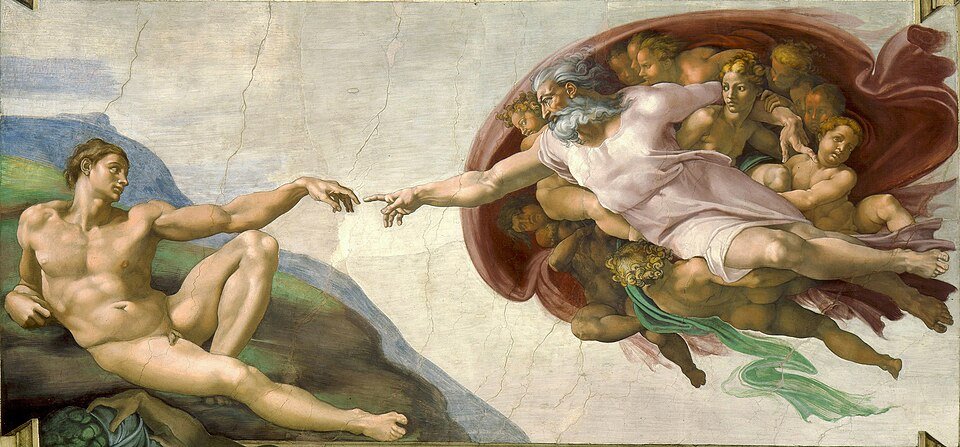
Four hundred million people have this image on their phone, a mug, or a T-shirt.
Almost none of them have noticed what's wrong with Adam's hand.
Look at the two arms.
God is horizontal. Launched. Every tendon in His arm at full stretch, hair and mantle blown back by His own speed, angels straining under the weight of carrying Him because He is the one moving. He has crossed the entire sky to get to this moment. His finger is extended as far as a finger goes.
Now Adam.
Draped on a hillside. Propped on one elbow. Leaning back. His arm isn't reaching; it's resting on his own knee. The wrist is slack. The finger droops.
The Creator of the universe is straining like a man reaching for someone going over a cliff.
And the man can't be bothered to straighten one finger.
Michelangelo painted that on purpose. And he painted it in agony, four years on scaffolding under that ceiling, head cranked back, paint dripping into his beard. He hated it enough to write a poem about it, complaining that his spine had bent like a bow and he could no longer read a letter without holding it above his head.
Four years of that. To say one thing:
You did not climb to God. God dove to you.
Every religion on earth is a ladder. Purify yourself, discipline yourself, ascend. Michelangelo put the opposite on the ceiling of the most important church in the world: man reclining, barely participating, and God closing the distance at speed.
Genesis 2:7. And the LORD God formed man of the dust of the ground, and breathed into his nostrils the breath of life; and man became a living soul.
God breathed. Adam received. That's the whole transaction. Adam contributed the dust.
Now look under God's left arm.
There's a woman tucked against His side. His arm is wrapped around her. And she isn't watching the miracle; she's looking past God's shoulder, straight at Adam.
The oldest reading says that's Eve.
Not yet created. Not yet formed. Already held. Already watching the man she'll be given to, from inside the embrace of God, because she existed in His mind before she existed in the world.
Jeremiah 1:5. Before I formed thee in the belly I knew thee.
Ephesians 1:4. He hath chosen us in him before the foundation of the world.
You were in that mantle once before your parents met, before anything.
And about that mantle, in 1990, a physician named Frank Meshberger was studying the fresco and published something that made art historians sit down. Trace the outline of the crimson cloak, the angels, the whole swirling mass around God.
It matches a cross-section of the human brain. The fissures. The lobes. The stem.
Michelangelo dissected corpses. He knew human anatomy better than most surgeons of his century. Whether he hid it there deliberately is argued to this day, but if he did, the sermon is staggering: God isn't just handing Adam a heartbeat. He's giving him a mind. The image of God. The capacity to know his Maker.
So God has crossed the sky. Arm at full extension. Nothing left to give. He has closed all the distance that can be closed from His side.
And the fingers don't touch.
Michelangelo froze them apart forever. A half-inch of empty plaster carrying more weight than the rest of the ceiling combined.
Because look whose finger has slack left in it.
Not God's.
Adam could close that gap by straightening one knuckle. One. The remaining distance is his, the smallest movement in the painting, and the only one God will not make for him.
That half-inch is free will. God will cross a universe. He will not cross your consent.
But here's what the ceiling can't show you, because it happened fifteen centuries after Genesis and Michelangelo painted the before.
The touch happens.
God's hand and human flesh finally meet not above the clouds, but in Bethlehem, when the hand that flung the stars became a hand small enough to grab Mary's finger. God stopped reaching across the gap and stepped into it. Took a body. Took a hand.
And when that hand was finally stretched out as far as human arms go, extended like the arm on the ceiling, full reach, nothing held back.
We nailed it there.
That's where the two fingers meet. At the cross. God at full stretch and man at his worst, touching at last through an iron spike.
And three days later that hand was moving again. Folding grave clothes. Cooking breakfast. Offering its scars to a doubter.
It's still extended. The ceiling is still true. He has done all the reaching, crossed all the sky, closed all the distance that love can close without your permission.
The last half-inch has always been yours.
Lift your hand.
The 7-second cold wrist rinse was tested on 3,000 soldiers after combat simulations.
Cortisol dropped 52% within 90 seconds. Heart rate fell an average of 22 beats per minute. The Navy classified the protocol in 2009 and kept it secret until 2023.
The mechanism is radial artery cooling. Your inner wrists have the thinnest skin and the largest surface-to-volume ratio for blood vessels. 7 seconds of cold water cools the blood passing to your brain, which signals your hypothalamus to downregulate stress instantly
You've splashed cold water on your face. You've taken cold showers. Both work, but they're inconvenient.
The SEAL protocol takes 7 seconds, requires no undressing, and can be done at any sink. Soldiers used it before night missions to fall asleep fast.
The military classified this because a free 7-second stress fix would reduce demand for combat stress medication ($400M annually).
The 2023 declassification came after a FOIA lawsuit filed by a veteran.
The fix: run cold tap water over your inner wrists for 7 seconds. Both wrists. Do it when you feel a stress spike.
Within 90 seconds, your heart rate will drop. No shower, no ice.
Just 7 seconds.
Your chronological age is fixed.
Your biological age is not.
The gap between the two is decided by what you do — and don't do — every single day.
Here's how to measure it honestly...
Harvard just proved bedroom temperature controls sleep quality.
Participants fell asleep in 6.2 minutes when cool vs 20 minutes when warm.
Yet most people still don't optimize this simple factor.
Here's the exact temperature range that triggers deep, restful sleep: 🧵