Millennials and Gen Z are wealthier at age 34 than previous generations were at the same age:
🟨 Millennials/Gen Z: $347,000
⬜ Gen X: $283,000
🟧 Baby Boomers: $257,000
That’s roughly 23% more wealth than Gen X and 35% more than Baby Boomers, adjusted for inflation.
Bullion Faces a Lose-Lose vs. Treasuries, Stocks
Gold may have reached too extreme a premium vs. US Treasuries to sustain its rally. My graphic emphasizes the wide crocodile jaws between the Bloomberg US Treasury 20+ Year Total Return Index vs. bullion at about 30 (from a base of 100 in 2006) and the surging stock market.
Full report on the Bloomberg here: https://t.co/R0X3XkGsjN {BI COMD}
#gold #bonds #stockmarket @Bloomberg
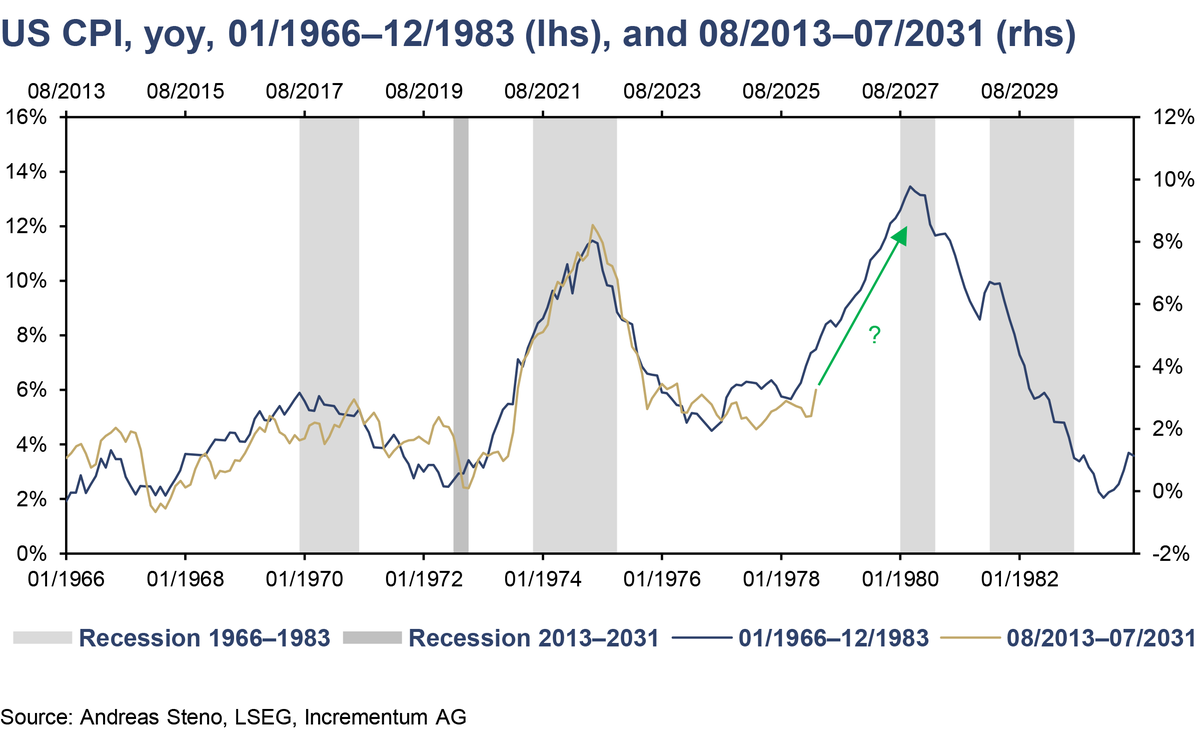
The peace deal is welcome, and oil has fallen on it. But a lower oil price is not lower inflation.
The 1970s showed the shape of it: inflation came in two waves, and the gap between them, when the first shock faded, was when the second took hold.
The all-clear and the next wave tend to be the same moment.
@worldbankdata Sobering. But pace isn't fixed. Sovereign capital and regulatory frameworks compress timelines. UAE went from underdeveloped to advanced in 50 years.
A key dynamic is the divergence in the forward policy path between the Federal Reserve and Bank Negara Malaysia. While the Fed is expected to keep policy relatively tight over the next year, the implied easing path from BNM is more gradual, resulting in a widening or at least sustained policy rate differential in favor of Malaysia on a forward-looking basis.
This relative stability in Malaysia’s policy trajectory versus a still-restrictive Fed supports yield differentials that are conducive to currency strength, as markets price a more anchored rate path in Malaysia compared to the U.S.
U.S. and Iran finally reached a peace deal to end the war, open the Strait of Hormuz and remove the U.S. blockade, and to continue negotiating on the nuclear program and sanctions.
I joined @FRANCE24 to discuss.
https://t.co/NlFLe0gyUp
INSIGHTS:
AI is now driving inflation higher.
Consumer prices for computer software and accessories up 14.5% year over year in May.
The biggest annual increase on record since 2000.
Producer prices for electronic components up 27% year over year.
Also the biggest increase on record.
Before 2026 these prices fell almost every year since 2000.
Now they're surging.
Memory prices alone up 290% year over year.
DDR5 and DDR4 RAM more than doubled.
AI data centers absorbing the vast majority of global chip supply.
The Iran War is driving energy inflation.
AI is driving technology inflation.
Both hitting at the same time.
RAM price shocks will likely keep inflation elevated well into 2027.
The Fed wanted to cut rates.
The data keeps making it impossible.