Linguist and neuroscientist trained at Harvard. AI & comm expert, looking at the sky for ETs. I love physics, and mountaineering. And many things in between.
Getting there will take validated tools, interoperable data, safeguards for privacy and equity,
and payment that rewards prevention and better outcomes.
Navigational Health - with the individual at the center of every decision!
This is f*cking wild. Someone asked Anthropic CEO Dario Amodei what a kid finishing high school should do right now. He didn't sugarcoat it:
"AI can do entry-level law work. It can do entry-level finance. It can do entry-level consulting.
AI will also eliminate jobs, and probably a large number of them"
In 42 seconds, he lists the first careers in the line of fire: junior law, junior finance, junior consulting
He's already put a number on it: half of entry-level white-collar jobs disrupted within 1 to 5 years
Every shift before this one, from farms to factories to the internet, gave people time to catch up. This one, he says, cuts deeper and moves faster
Chatting → Prompting → Agents → Harness → Loops → You Run the AI
His advice is simple: learn to use AI. But using it is now the bare minimum. What sets you apart is a harness that runs it for you
Bookmark this before your feed buries it
Every repo below costs nothing:
Ready-made Claude plugins for legal, finance, sales, HR and data
https://t.co/gFtvfhaac1
Analyst-grade agents: models, memos, research notes
https://t.co/wri7FBqpO2
Skills for Excel, Word, PowerPoint and PDF
https://t.co/B2f47jP89r
An agent that does financial research on its own
https://t.co/VJCDSYYJcn
An agent that researches any topic in depth
https://t.co/8VZAJKBkV3
Ask your spreadsheets and databases questions in plain English
https://t.co/p2DBwVnrxZ
Agents that work as a team, each with its own role
https://t.co/KezyAtsPsD
A harness with everything built in
https://t.co/H3Y67E5tp4
Anthropic's SDK for building your own agents
https://t.co/JidFNfxArL
A memory layer so your agents remember context
https://t.co/fZpN3tpAiH
A loop that keeps the agent going until the job is done
https://t.co/F7yhkt0eQS
An agent that clicks through websites and fills forms for you
https://t.co/C68xvrnAfc
Automate busywork with drag-and-drop workflows
https://t.co/sD9Xqbb2rN
18 free lessons on building agents
https://t.co/MgWhM08TL4
Total cost: $0
It won't be AI that takes your seat. It'll be someone who built a harness
95% will keep sending résumés for work AI already does, the 5% with a harness will be the ones managing it
Save it and forward it to anyone starting their first job
Then follow the guide below and build your harness while everyone else is still waiting ↓
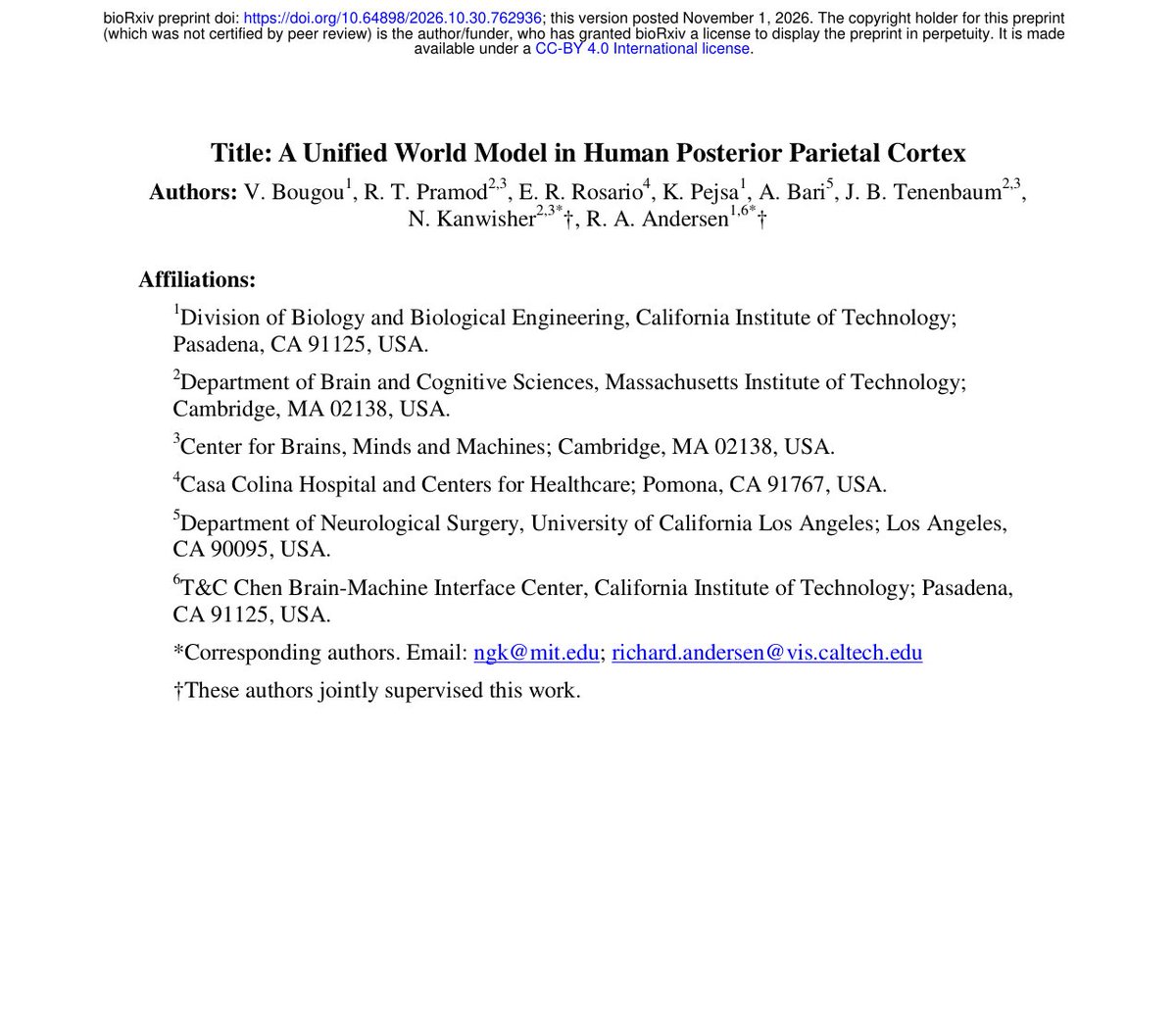
Individual neurons in the superior parietal lobule simultaneously encode intuitive physics, collision prediction, and intended hand actions, resolving long-standing uncertainty about whether the same units support distinct cognitive functions. This unified representation in posterior parietal cortex provides a direct neural substrate for physical world modeling, bridging the gap between physical understanding, prediction, and action planning.
https://t.co/CrR3dqzUbl
Cognitive computational neuroscience
https://t.co/36JzFigmF8
1/ Move beyond brain mapping.
Mapping which brain regions activate during a task is not enough to explain cognition. We need computational models that reproduce behavior and explain how neural activity generates perception, learning, decision-making, and action. The goal is to understand the mechanism, not just the location.
2/ Build models that perform cognitive tasks.
Allen Newell argued that understanding cognition requires constructing systems that actually perform the functions we want to explain. A theory of decision-making, for example, should predict choices under different conditions—not merely describe them verbally. Simulations help test whether proposed mechanisms work together to produce intelligent behavior.
3/ Integrate three disciplines.
Cognitive science explains the computations underlying thought; computational neuroscience investigates how neural circuits implement those computations; AI develops algorithms that perform complex tasks. Each provides different constraints. Combining them could produce models that are simultaneously behaviorally effective, computationally explicit, and biologically grounded.
4/ Neural networks are a bridge between brains and AI.
Deep neural networks learn hierarchical representations that can resemble those observed in biological sensory systems. Research has shown that networks trained for object recognition can predict aspects of visual cortical representations. However, predictive similarity does not prove that the brain uses the same algorithms. Models must also be tested against neural and behavioral evidence.
5/ Biological neurons offer more than artificial units.
Most conventional artificial neural networks use simplified units that combine inputs and apply nonlinear transformations. Biological neurons exhibit action potentials, dendritic computations, recurrent signaling, oscillations, and complex temporal dynamics. Incorporating these features into task-performing models may reveal computational principles that simpler AI architectures overlook.
6/ Neural decoding is not a complete explanation.
Decoding asks what information can be extracted from neural activity. Encoding models predict neural responses; representational similarity analysis compares patterns of activity; connectivity models examine interactions. These methods constrain theories, but they do not necessarily explain how the brain transforms information to solve a task. Mechanistic models must connect representations to computation and behavior.
7/ Bayesian inference offers a theory of perception and reasoning.
The brain must interpret noisy sensory information using prior knowledge about the world. Bayesian models formalize this process by combining prior beliefs with incoming evidence. Generative models go further by representing how hidden causes produce observations. They offer a framework for studying uncertainty, causal reasoning, concept formation, and the ability to learn from limited experience.
8/ Learning and control require multiple strategies.
Reinforcement learning provides a framework for understanding how actions and feedback shape future behavior. Model-free approaches learn values or policies from experience; model-based approaches use an internal model to evaluate possible outcomes; episodic approaches reuse specific past experiences. Understanding how biological brains combine these strategies could inform more adaptive AI systems.
9/ Combine bottom-up and top-down approaches.
Bottom-up neuroscience begins with neurons, circuits, and measured activity. Top-down approaches begin with a cognitive function and ask what computations are required to perform it. Neither is sufficient alone. Strong theories should explain how biological mechanisms support meaningful behavior—and use behavioral requirements to identify which neural mechanisms matter.
10/ The future is an integrated NeuroAI.
A major challenge is to connect three levels: computational goals, representations and algorithms, and neurobiological implementation. This requires collaboration across neuroscience, cognitive science, mathematics, and AI, along with shared datasets, models, tasks, and evaluation methods. The ultimate ambition is to build systems that perform intelligent tasks while explaining how brains learn, represent knowledge, and adapt.
The big idea:
The next leap in AI and neuroscience may come from treating the brain not simply as a source of data, but as a system whose computational principles can be tested through models that connect neural mechanisms to intelligent behavior.
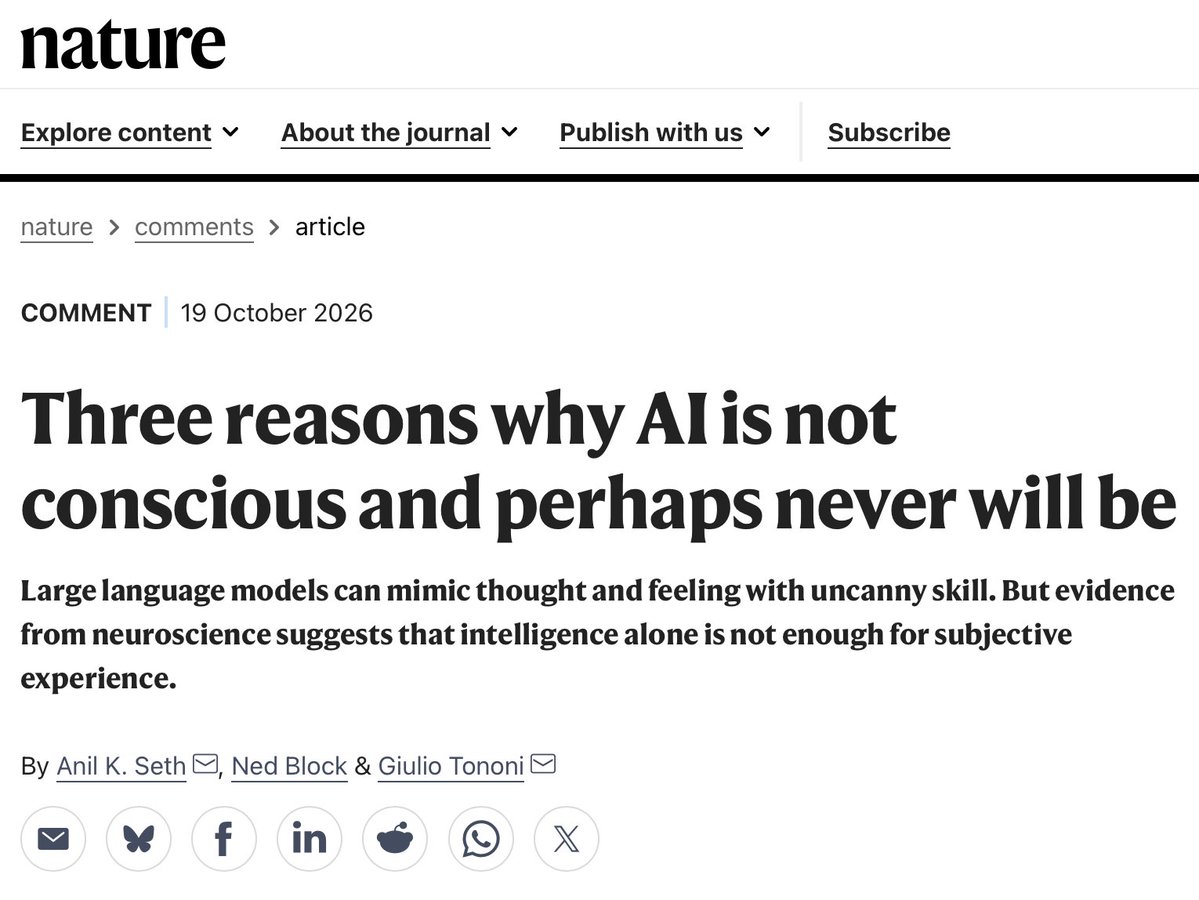
Spectacular Nature piece on why AI is not conscious and probably will never be.
Three arguments:
1) Intelligence is not consciousness.
Intelligence is about solving problems. Consciousness is about having subjective experiences.
AlphaFold can solve super difficult problems. By contrast, our brains performs complex operations entirely outside awareness.
Problem-solving and consciousness are two separate things.
2. Biology is essential.
Our brains are alive, down to every cell. Their activity is inseparable from the living tissue that produces it.
The idea that consciousness can be reproduced simply by running the right computations on silicon components who do not fight for their life is a very far fetching and, I would add, almost religious, assumption.
3) The physical organization may matter more than the computation.
According to integrated information theory, consciousness requires specific causal relationships between a system’s physical components.
The computer architectures running today’s AI lack this organization.
The comparison with AlphaFold is particularly revealing:
Almost nobody things AlphaFold is conscious, despite its inner working is very similar to an LLM
Why?
Because it does not speak.
LLMs do speak like us and therefore we fall into an illusion:
Since they speak like us, they must be like us.
But this inference is wrong.
LLMs are just a series of matrix multiplications.
They are not conscious, and they will never be.
*
Paper in the first reply
According to the laws of thermodynamics, information can be converted into energy. An information engine that harnesses environmental memory and exhibits non-Markovian dynamics has now been realized in experiments.
https://t.co/piI8QobTuO
Sometimes moving forward is just a way to reset boundaries.
When pressured, a tiger’s rush isn’t about hunting, it’s a quick test to push an intrusion back.
VC: Chandraprakash Yadav
#Tiger#predator#Wildlife#Safari
Neuroscientists Giulio Tononi, Christof Koch, et al. make a strong case for real free will (not an illusion) if Integrated Information Theory (IIT) is the correct explanation of consciousness:
"If IIT is right, we do have free will in a genuine sense: we have alternatives, reasons, and values, we make decisions, and we—not our neurons or atoms—are the cause of our willed actions and bear responsibility for them."
https://t.co/2UW0jfj9rR
Now out: https://t.co/CtyQJ9VzUa...
And excited to report that my first PhD student, Chan Young, has already taken on several of the directions I outlined in this paper!
AI neurons run on simple math. Real neurons are far weirder.
A new open dataset fitted 1,000+ PyTorch-ready neuron models to real mouse and human cells. Does brain-like diversity make AI better? It's still an open question, but now it's testable.
https://t.co/Z2Bjyk8Y0E
it’s been a privilege to watch this unfold. Some things ways my mental model of interpretability has changed:
1. Generalisation is probably the most important factor in how representations are structured - superposition probably exists to some degree but is an incredibly weak force compared to generalisation. @s_y_chung has interesting and deep work on manifold capacity that’s relevant here.
2. Deeper generalisation probably takes place through communities of neurons that work together and the downstream effect of this is to form manifolds in the residual stream. This also explains the sort of similarity we see in lower-magnitude but still causally important firings of neurons: the right object here is probably the manifold generated by neuron co-activations.
3. We still don’t understand attention nearly as well as we ought to, and the more we look the more takes place there. I’m optimistic now though, as at least we have one part of the crossword beginning to fill in.
4. This doesn’t mean that interpretability is solved - it means that it’s going to be a science! We still have a lot of that science to do, but now agents can help it should go far faster than we dreamed possible.
5. A more detailed/mathematical theory now seems potentially within reach.
6. As a field we’ve been too accepting of received wisdom and unfalsifiable hypotheses - how did this take so long? What else is mostly held back by the assumption that someone else has it figured out?
A new study finds evidence of a geometric “mental line” of neural activity in the premotor cortex of monkeys performing tasks that require transitive inference deductive reasoning. @istsupsan https://t.co/n8MZKhvbCf
Ten million people have watched an MIT professor teach a course whose first lecture is literally titled "What is a Derivative?" Almost none have written down the two-line answer.
He filmed the lecture once in the fall of 2007 and it has been on YouTube ever since.
Math tutors charge $200 an hour to teach a diluted version of what he covered in 50 minutes for free.
His name is David Jerison. He is a professor of mathematics at MIT and the instructor of 18.01 Single Variable Calculus, one of the most-watched math courses in the history of the internet.
The 50-minute clip in this video is Lecture 1, filmed at MIT in the fall of 2007. Jerison is deriving the definition of a derivative from a single tangent line.
The whole framework fits on a napkin. A derivative is just how much y changes when x moves a tiny bit. Draw a tangent line to any curve at any point. The slope of that line is the derivative. Memorize one formula, the power rule, and you can differentiate every polynomial on earth in your head. Chain that with a handful of exceptions and you can differentiate almost every function humanity has ever written down.
That single set of rules is what every neural network runs on gradient descent, what every rocket landing at SpaceX solves in real time, and what every options desk at Goldman Sachs is running behind every quote you see on the screen.
"In mathematics you don't understand things. You just get used to them."
That is John von Neumann, the mathematician who helped design the atomic bomb and invent the modern computer. Jerison returns to the same idea in every lecture. Almost no student giving up on calculus has heard von Neumann say it out loud.
Every quant fund on Wall Street pays entry-level analysts $250,000 to know the same power rule Jerison derives on the board. Every AI bootcamp charges tens of thousands to teach a diluted version of the same equation on a laptop.
The lecture is free on MIT OpenCourseWare. The textbook is under sixty dollars.
Almost none of the millions who watched have ever taken the power rule and applied it to their own numbers on their own paper.
The math is free. The willingness to actually take one derivative before your next model, trade, or engineering trade-off is the entire edge.
Out here one bite can turn breath into stillness. 💔
A pregnant honey badger, bitten by a black mamba, fights to reach shelter to deliver her cubs. Inside an old serval's den, 4 fragile lives are born while venom takes over her body.
And then the unexpected happens - the serval doesn't hunt. It protects.
A mother broken, but her love doesn't retreat. And a protector no one expected. 🖤
Happy to see this coming together.
Great work by Anil, pushing his ideas out there to foster a much needed discussion.
I remain unconvinced by any of Anil's arguments in favour of "biological naturalism", and yet see no good evidence at the moment for machine consciousness.
1/
Any child can tell the difference between the living and the non-living. But what is the biological basis for life’s “aliveness?” While this question has long puzzled biologists, Addy Pross puts forth a compelling way forward. https://t.co/ZeiL9igqOC