Incredible thread.
Silver Fox drops a master class, I can't describe how generous this is, this is knowledge you'd normally have to pay thousands for
And he just posted it
Okay, since you asked, here’s my American opinion.
Soccer will never be as popular in America as football for 3 reasons:
1. The Fake Injuries
Players are incentivized to flop because the other team is more likely to get a penalty.
In football, it is the opposite. If a player has a real injury, play toughs it out and plays through it, it is seen as heroic.
Americans like toughness and grit.
2. Chance Goals
Many goals are scored by chance as opposed to skill. The chaos at the net when the ball is near is remarkable. Defenders blocking the goalie’s line of sight. The ball bouncing and ricocheting off of random body parts often determines if the ball goes in the net or out of bounds.
In football, there are some elements of chance, but because players are allowed to use their hands, the points are primarily scored based on skill. Less is left to chance.
Americans like control.
3. Low Scoring
In football, it is still challenging to score, but it happens much more often. Also, every play has a chance for gratification and excitement: a first down, a big catch, a big hit, a sack, an interception, etc
American like constant excitement.
🚨 Arsene Wenger on Lionel Messi's hat-trick and becoming the World Cup's all time leading goalscorer:
🗣“What we witnessed today goes beyond another record. It is the continuation of a career that has consistently redefined the standards of excellence in football.
It wasn't simply a hat-trick,it was the quality of the goals, the intelligence behind every decision, and the efficiency with which Messi influenced the game. Those are the qualities that separate truly exceptional players from the rest.
For many years people have tried to compare Messi with other great footballers, but there comes a point where comparisons lose their meaning. He has built a legacy that stands on its own.
What fascinates me most is his evolution. I genuinely don't know whether the young Messi, with his explosive pace and dribbling, was better than the experienced Messi we see today, who controls every moment of the game with his intelligence and understanding. Very few players improve with age the way he has.
The emotion after his second goal revealed another side of his greatness. It reminded everyone of the difficult journey he has had with Argentina,the disappointments, the criticism, and the perseverance that eventually led to glory. That emotional connection with his country continues to drive him.
To score his first World Cup hat trick while becoming the tournament's all time leading goalscorer is an extraordinary achievement. It is another milestone in a career that already seemed impossible to improve.
Perhaps the most remarkable aspect is his longevity. He finished the 2022 World Cup by lifting the trophy after scoring twice in the final, and he has opened the 2026 tournament with a hattrick. At almost 39 years of age, he continues to perform with the same clarity, technical quality, and love for the game that defined him in his twenties.
That is the mark of a truly timeless footballer.”
• Ice water and ceiling fans do not contain respiratory viruses. A sore throat is an infection. But your environment drastically alters your body's local defense system.
• When your throat is exposed to freezing water or chilled AC air, the blood vessels in your pharynx instantly constrict to conserve heat. Less blood flow means fewer white blood cells (your immune soldiers) are actively patrolling the area.
• Fans and ACs strip moisture from the air, drying out the protective mucosal layer in your respiratory tract. Normally, this sticky mucus traps pathogens. A dry throat is an undefended throat.
• Here is the clinical secret: you constantly have low levels of bacteria and viruses already residing in your upper airway. Usually, your immune system keeps them completely in check. But the moment cold and dryness temporarily drop your local defenses, these resident bugs rapidly multiply.
• The Golden Rule: Cold water doesn't give you a virus; it temporarily disarms your throat's security system, giving the viruses already waiting at the gates the perfect opportunity to attack.
👉Hi, I am Dr. Priyam. I break down complex medical science and advocate for Evidence-Based Medicine. Follow me for more clinical truths.
USA. A Mexican restaurant. We had not yet ordered anything, and the food was already arriving.
Chips. Salsa. Unrequested. Free.
I stopped the waiter. "We have not earned these."
"They just come with the table, man."
They come with the TABLE. In my land, hospitality is a debt. Every gift creates an obligation, weighed carefully, returned in the proper season with interest of feeling. Here, the gift arrives before you have even proven you can pay for dinner.
This is not an appetizer. This is a declaration: we trust you. Eat.
I ate with the gravity the moment deserved. And then — I must report this calmly — the basket emptied, and a new one appeared.
"Did we…?"
"Refill," the waiter said. "It's bottomless."
Bottomless. They have wells of salsa. The supply lines of this nation are beyond anything my ancestors imagined.
My friend warned me. "Don't fill up on chips, dude."
Too late. I had accepted three baskets. Honor demanded each one be finished — an unfinished gift is an insult. By the time my actual food arrived, I was a ruined man.
I was not hungry. I was not comfortable. I had been defeated by a courtesy.
Generosity that arrives before the request cannot be repaid. It can only be survived.
I know the rule now. I have made my peace with the basket. One basket. Two at the most.
Who am I deceiving. There is no number of baskets I would refuse. The trust of a nation is in that salsa, and I intend to honor all of it.
USA. A restaurant. I could not finish my meal, and I bowed my head in shame.
Then they handed me a box, and I nearly wept.
The plate had been enormous. I am a samurai; I do not surrender to food. But this was a siege, and halfway through I knew I could not win. I set down my fork. In my country, to leave food on the plate is to insult the rice, the farmer, the cook, and your own ancestors, roughly in that order. So I sat there, quietly making peace with my dishonor.
Then the waitress smiled and said the most beautiful sentence I have heard here.
"You want a box for that?"
A box. To take it. Home.
I went still.
"You would save it?" I asked.
"Yeah, of course. It's still good."
It's still good. Three words my grandmother said to me a thousand times, across an ocean, in another language, over a bowl I was not allowed to leave.
I had crossed the world expecting to find everything different here. And a stranger in an apron had just handed me my grandmother's exact heart, in a small paper container, without knowing she had done anything at all.
I took the box. I held it like a newborn. I bowed to her, to the cook, and to the half a sandwich within, which would now live to see another day.
That night I ate it by a window, slowly, the way you eat something that was nearly lost. It was, if anything, better the second time. Everything saved is.
So now I order too much on purpose. Not from greed. From faith. Because I have learned that here, the same as home, a meal does not end when you are full.
It ends when the box is empty.
And the box is never empty the same day.
Which means a good meal can last forever,
as long as someone, anyone, still believes it is too good to waste.
A neurologist studied patients whose emotional brain was perfectly disconnected from their rational brain, expecting to find hyper-logical supercomputers, and instead found people who could not decide what to eat for lunch or which day to schedule a meeting.
His name was Antonio Damasio.
He was the head of neurology at the University of Iowa. In 1994 he published a book called Descartes' Error that quietly broke 350 years of Western philosophy in 300 pages, and the entire field of behavioral economics was built on top of what he discovered.
The story that changed his career started with a patient he simply called Elliot.
Elliot was a successful businessman in his thirties. Good husband. Good father. High income. Sharp mind. Then a small benign tumor started growing in his frontal lobe and his doctors had to remove it. The surgery was a success. The tumor came out clean.
The recovery looked perfect. His IQ tests came back in the superior range. His memory was sharp. His vocabulary was intact. His logic was airtight.
His life collapsed inside a year.
He could not finish a project at work. He would sit at his desk and try to organize a pile of papers and get stuck for an entire afternoon trying to decide which sorting method was best. Alphabetical. Chronological. By topic. By client.
He could see the pros and cons of each one with perfect clarity. He just could not pick. He would still be sitting there at 6pm with the same pile in front of him.
He got fired. He took his savings and made a series of bizarre business decisions and lost all of it. He got divorced. He married someone his family hated and got divorced again.
He ended up living with his parents in his late thirties, unable to hold a basic clerical job, with a measured intelligence that put him in the top few percent of the population.
His doctors could not figure out what was wrong with him. They eventually sent him to Damasio.
Damasio ran every test he could find. Elliot scored perfectly on all of them. He could solve logic puzzles. He could discuss moral dilemmas with sophisticated reasoning. He could analyze a hypothetical business scenario and identify the optimal strategy faster than most people. On paper he looked like the most rational person you could meet.
Then Damasio noticed something nobody else had thought to test.
He showed Elliot photographs of horrific things. A burning house. A car accident. A drowning child. The kind of images that make most people flinch. Elliot looked at them calmly. He described them in detail. He could explain why a normal person would find them disturbing. He just did not find them disturbing himself.
The surgery had cut out a small region of his brain called the ventromedial prefrontal cortex, and along with the tumor, it had taken his entire emotional response system with it.
Elliot was not a man with damaged logic. He was a man with no emotions.
And he could not decide what to eat for lunch.
Damasio sat with this for years. He found more patients with similar damage. The pattern was identical every time. High IQ. Perfect memory. Sound logic. Total inability to make even the smallest decision in their own life. They could explain in detail what they should do. They could not actually do it.
This was supposed to be impossible.
For 350 years, the entire Western tradition had been telling people that emotion was the enemy of rational thought. Descartes had drawn the line in 1641. The mind is one thing. The body and its feelings are another. To think clearly, you must separate yourself from your emotions, suppress your gut, listen only to pure reason.
This is the foundation that almost every philosophy class, business school, and self-help book still rests on today.
Damasio had just produced the cleanest counterexample in medical history. He had patients whose brains had done exactly what Descartes told everyone to do. They had successfully disconnected emotion from reason. The result was not a hyper-rational super-thinker. The result was a man who could not pick between two appointment dates.
The reason became clear once Damasio worked it out.
Every decision you face in a single day has more options than you have time to logically evaluate. Where should I sit on this train. What should I eat for breakfast. Which email should I answer first. Should I take this call.
Each of these has dozens of variables. If you tried to consciously analyze every variable on every decision, you would freeze inside an hour. You would never get out of bed.
The reason you do get out of bed is that your emotional brain is doing the filtering for you in the background. Before logic ever gets a chance to weigh in, your gut has already marked most of the options with a feeling. This one feels off. That one feels right. That one feels boring. That one feels exciting.
Damasio called these somatic markers, body-based emotional tags that compress thousands of past experiences into a single physical sensation that points you toward an answer.
Logic does not produce decisions. Logic justifies the decisions emotion has already made.
Elliot could not make decisions because the part of his brain that put a feeling on each option had been removed. He could see all the options. He could analyze all of them. He just had no internal compass telling him which one mattered.
Every option looked equally valid to him, which is another way of saying every option looked equally meaningless. The tie was never broken because there was nothing inside him doing the breaking.
This was the error of Descartes. The error was not in his logic. The error was the assumption that logic could ever stand alone.
The implications of this go further than most people who read the book the first time realize.
Every confident, decisive person you have ever admired is not running on pure logic. They are running on emotion that has been well-trained by years of experience, and their logic is just the press release they release afterward to explain the decision their gut already made.
The people you call indecisive are not too emotional. They are people whose emotional signals are giving them conflicting tags on the same option.
Daniel Kahneman built his entire System 1 and System 2 framework on top of this finding. Every behavioral economist working today is downstream of Damasio. Every modern theory of cognitive bias starts from the same admission. The mind that decides is not the mind you think is doing the deciding.
Descartes was wrong on the most famous line he ever wrote. It is not "I think, therefore I am." It is closer to "I feel, therefore I can think."
You do not get to choose whether your decisions are emotional. You only get to choose whether your emotions have been trained on enough experience to point you toward the right ones.
Three things I’m underwriting hardest in 2026:
-AI applied to industrial throughput.
-autonomous defense + space robotics
-clinical-stage biotech where AI compresses trial timelines. Everything else feels crowded
You don’t get to complain about your genetics until you know your real potential and this is how:
Give me 4 weeks:
1. At least 4 meals with whole food per day and fruits or vegetables with at least 3 of them.
2. 1g+/lb body weight in protein
3. 50-60g fat per day
4. Multiple carb dense meals before training (if possible)
5. At least one gallon of water, spread somewhat evenly through the day.
6. Consistent sleep and wake time that involves going to bed before 11
7. All lifts to or within 2 reps of failure (almost all to failure)
8. Big dose of electrolytes upon rising and before training
9. Train everything 2x per week
10. Cardio 3-4x per week
11. Targeted, meaningful stimulant use
12. Cruise dose of testosterone if you’re on anything.
13. 30 mins outside daily
14. Supps besides creatine (ya one size fits all we’re all human)—whey protein, pre-workout, taurine, NAC, curcumin, vitamin c, melatonin, glutamine (probably missing a couple id like but they’re just supplements)
This is like 75 hard except all of it creates insane momentum and makes you feel amazing, rather than ticking stupid boxes to make it feel more like it’s working.
You’ll know for a fact that this is working. I promise.
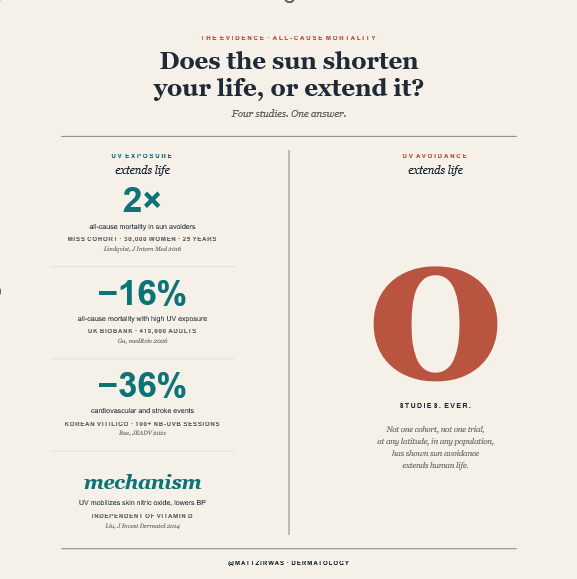
Dermatology is wrong about the sun.
And it's killing people.
I'm a dermatologist. 226 publications. I should know.
Avoiding the sun increases the risk of dying as much as being a smoker.
We can fix it.
For decades, dermatology's message has been simple: avoid the sun. Wear sunscreen. Seek shade. UV causes skin cancer. End of discussion.
That message is incomplete and outdated.
People are dying because of it. Lots of people.
The evidence has gotten strong enough that the field needs to update it.🧵
I really did not want to be writing this morning. But this issue is too important.
It’s been said that the last thing the weather person should do before going on the air is look out the window. The _day before_ @eringriffith profiled Medvi in @nytimes as the AI company of the future, the FDA approved Lilly’s new oral medication: orforglipron.
*Not tirzepatide.* In fact, it’s not even a peptide. It’s the first non-peptide, small-molecule oral GLP-1 receptor agonist. Lilly owns tirzepatide. They invented it. If you could put tirzepatide in a pill, Lilly would do it. They would desperately want to.
Instead, they spent millions and nearly eight years licensing a completely different kind of molecule, because oral tirzepatide is a biological impossibility. Tirzepatide is a 39-amino-acid, 4,813-dalton peptide. Your gut does not distinguish it from a piece of chicken.
SNAC, the absorption enhancer that barely gets oral semaglutide to 1% bioavailability, is compound-specific. It failed with liraglutide, another GLP-1 peptide, and has no demonstrated mechanism for tirzepatide. There is no published human study of oral tirzepatide. There is no plausible mechanism. Medvi sells it starting at $279 a month. A RICO class action against its supply chain partners has already called the product modern-day snake oil. Lilly’s own strategy is the best witness.
We can hear the lawyers now:
“So doctor, what was your assumption on why Lilly was not pursuing oral tirzepatide despite that in not doing so they would instead pursue an entire entirely different type of molecule and possibly create market confusion with their new entrant?”
The Times profile actually described an accountability architecture whose impact in part is that no single entity owns the patient and process. Medvi handles marketing. CareValidate provides the clinical workflow. OpenLoop provides prescribers and pharmacy fulfillment. The marketing layer can say the doctors make the decisions. The doctor platform can say the brand controls the messaging. The prescribers say the pharmacy fills what’s ordered. Everyone can point at everyone else.
That structure explains a lot of the financials. Medvi reported a 16.2% net margin. Hims, with 2,442 employees selling the same drug categories, reported 5.5%. The 10.7-point spread represents in part everything Medvi may not pay for: extensive clinical oversight, advanced adverse event monitoring, satisfactory regulatory compliance, sound quality systems.
The Times says they verified Medvi’s revenue. They did not seem to verify or note many other aspects. Six weeks before the profile ran, the FDA had issued Warning Letter #721455 for misbranding compounded GLP-1s. OpenLoop had disclosed a data breach: a threat actor claimed access to 1.6 million patient records, and multiple class actions were filed. The company’s ad network included fabricated physician personas, “Professor Albust Dongledore,” “Dr. Tuckr Carlzyn MD,” running over 5,000 Meta ads alongside a website disclaimer that these individuals “may be actors or AI portraying doctors.”
The Times told the story of a man who used AI to build a billion-dollar company alone.
The article was really a transcript of a Silicon Valley fever dream. A byproduct of regulatory lag and consumer desperation
A billion dollars in pharmaceutical transactions running through an organization with no one seeming to care if a product can survive contact with the human stomach better than a chicken nugget.
“A man should hear a little music, read a little poetry, and see a fine picture every day of his life, in order that worldly cares may not obliterate the sense of the beautiful which God has implanted in the human soul.”
-Johann Wolfgang von Goethe
I think peptides are popular because they give people a feeling of power and control.
One feels helpless when they can't sleep, stop scrolling, eat well or exercise consistently.
A few injections wrestles back a feeling of control. Evidence shows that injections amplify perceived agency (the ritual potency of administration).
This creates a dangerous situation where powerful compounds are being used less for biomarker improvement and more for psychological wellbeing.
This is what you want: closed loop.
> intervention (peptide)
> biological change
> measured biomarker
> adjustment
How most people are using peptides: open-loop.
> intervention (peptide)
> subjective feeling
> more intervention
The open-loop compounds over time. Without biomarker feedback, dose escalation is driven by subjective feelings which creates increased risk of doses with no clinical precedent.
I am pro peptide and pro experimentation. Some peptides such as GLP-1s and similar are among the most effective in the world.
Peptides (without clinical data) are among the most promising therapies available. They also need more clinical work so that we can characterize their effects, both good and bad.
Nothing is free in biology.
it hasn't sunk in for most people. we already live in a post-scarcity society. UBI is already here.
basic package: disability, medicaid, food stamps etc
bonus package: literally getting paid for staying at home and hanging out with your relatives
extra bonus: if you are willing to commit fraud, pretend your kids are autistic and get paid for that. get paid for watching your neighbor's kid. pretend you are taking care of your grandma. fake hospice clinic. fake rehab clinic. fake therapy clinic.
giga bonus: during a time of crisis take advantage of PPP or CARES and open a fake business and get paid for existing
people are shocked when they learn that defense is the FIFTH largest line item in the budget. ahead of defense: social security ($1.6T), interest on debt ($1.1T) medicare ($1T), medicaid + ACA ($1T), AND THEN defense ($0.9T)
complain about defense all you like, but healthcare fraud is a way bigger factor. hundreds of billions per year.
this is only going to get worse, because the fraud is a structural part of the system – payouts to client groups in exchange for votes (normally D).
in the US, only 47% of the population actually works (fully 14% of the population is working age and does not work). retirees are 18% and children 22%.
the system I described above subsidizes 50m non-working people absolute minimum, but really it's far more because people that are paid to stay home and take care of their relatives are considered "workers"
of that 47% of "actual workers" maybe one third does real work, the rest are shuffling papers around or doing fake email jobs. so you have, rough math, 50 million actual workers supporting 300 million dependents. that's the nature of the economy today. it will only accelerate. eventually you will have 10 million using AI tools to do all the work and 340 million dependents.
the reason no one roots out the fraud is because it's the system that keeps our extremely fragile polity intact. the fraud is the UBI. the purpose of the system is what it does.
of course, it's a deeply unfair system, because you are allowed to commit fraud if you are a politically protected client group of the democrats. DOGE was killed faster than any government program ever, because it attempted to root out the fraud. if you are honest and unwilling to commit fraud, you are a huge loser in this system. your neighbor will have their mortgage subsidized by some government program. they will get favorable SBA loans due to DEI. they will open a fake hospice or autism clinic. they will get paid for taking care of their neighbor's kid and vice versa. the primary skill in the labor market is learning how to extract money from state and federal government programs, not gaining skills or making yourself employable. if you are just trying to work an ordinary wagie job you are a huge sucker. you are paying 40-50% effective all in taxes to everyone else who is a net taker.
the sad part is because AI is such a substantial productivity boost, it will actually keep this system going for a while longer, and maybe in perpetuity. AI boosts the 15% of the population that is actually productive so much that the remaining 85% can coast by. no one in charge will change this because they can't think of anything else. the political costs of a real UBI program are too great and we don't have the money for it anyway. so we will keep this covert fraud-based UBI program running indefinitely. unfortunately, if you are an honest wagie, you lose.
There are currently no documented cases of BPC157 contributing to cancer anywhere in the literature. It doesn’t cause cancer. Per the current data it has no activity on normal tissue. It works as a repair coordinator and only shows increased angiogenesis activity in damaged tissues. Selectivity.
There is not much that can be done to the paranoid anxieties about theoretical mechanistic risk of contributing to cancer.
I’d humbly suggest if you have cancer you not use BPC157.
But there is probably 100,000-200,000 users of BPC157 on the regular and daily. And has been for arguably years at this point. IF it was going to be TURBOing cancer which you’d expect to show up (a cancer, any cancer) WITHOUT BPC157 at a rate of 2500-5000 per 100,000 over a 3-5 year period as a baseline cancer statistic … The user of BPC157 would be expected to be younger and healthier which should skew statistics lower than that BUT if it’s literally “turbo cancer” time (🙄) then we should be seeing numbers. Signal. A case report. But. We don’t.
No one makes it out of this current existence alive. We all understand the statistics of car crashes and we do, almost all leave our homes in cars every day.
There is a theoretical risk of an attack from an exotic wild animal loose from the local zoo. That risk can never be zero even if really low based on the available data of such things. Do we need huge and regular informed consent of hippopotamus attack outside of the home prior to leaving the home for a walk based on some wild theoretical speculation without much evidence for occurance in practical reality?
I’ll let reasonable people make up their minds about such things.
Had a parent-teacher conference this morning
My wife told me not to come
I came anyway
She said "please just listen and nod"
I said "I always listen"
She said "you listen like you're sitting in a boardroom looking for something to challenge"
That's how listening works
Nice classroom
Small chairs
I am 6'4" and was seated at a desk designed for someone who still believes in Santa Claus
My knees touched my chest
The teacher introduced herself
Shared her identified pronouns
I shared my identified adjectives
Smart and handsome
My wife closed her eyes
The teacher had a folder
Color-coded tabs
I respected the organization
She said our son is "a pleasure to have in class"
My wife smiled
I waited
That sentence is never the whole report
It's the executive summary before the risk section
She said "however"
There it is
She said he "asks a lot of questions"
I said "good"
She said "during quiet time"
I said "when is quiet time?"
She said "it's when students are expected to work independently and in silence"
I said "so he's the only one trying to get information and you've structured the environment to prevent it?"
My wife put her hand on my arm
I continued
The teacher said he recently told another student that "sharing pencils doesn't make sense if nobody brings their own"
I said "that's an accurate observation"
My wife squeezed harder
The teacher said she's concerned about his "resistance to group activities"
I said "he's not resistant. He just doesn't see the value of doing more work for the same grade."
The teacher said he also corrected her math on the whiteboard
I said "was he right?"
She paused
She said "that's not the point"
I said "it's a little bit the point"
My wife stood up
Sat back down
Compromise
The teacher pulled out an evaluation sheet
Categories like "works well with others" and "follows directions" and "respects classroom norms"
All subjective
Not a number on the page
I asked how these are graded
She said "based on observation"
I said "so one person's opinion with no second review?"
She said "it's professional judgment"
I said "my auditors say that too. Right before I disagree with them."
She looked at my wife
My wife said "I'm sorry about him"
I said "I'm sitting right here"
My wife said "I know"
The teacher said overall he's a bright kid and she just wants to make sure he learns to "collaborate"
I said "collaboration is important. But so is recognizing when you're the only one doing the work. He'll learn that again in college. And again in the real world. Might as well start now."
Nobody spoke
The teacher closed her folder
She said "I think we've covered everything"
I said "one more thing"
She braced herself
I said "his reading is above grade level. His math is strong. He asks hard questions and corrects mistakes when he sees them. I just want to make sure this school knows what it has."
The teacher looked at me differently
My wife looked at me differently
I said "that's all"
We left
In the car my wife was quiet
Then she said "he's turning into you"
I said "is that a good thing?"
She didn't answer
From the backseat he said "dad, why does the teacher count off for asking questions? Isn't that the whole point of school?"
I looked at my wife
She looked out the window
I said "yes. It is."
He said "I don't think she likes when I'm right"
I didn't say anything
Neither did my wife
Small chairs
Color-coded tabs
No follow-up items
But the kid's going to be fine
Sent from my iPhone