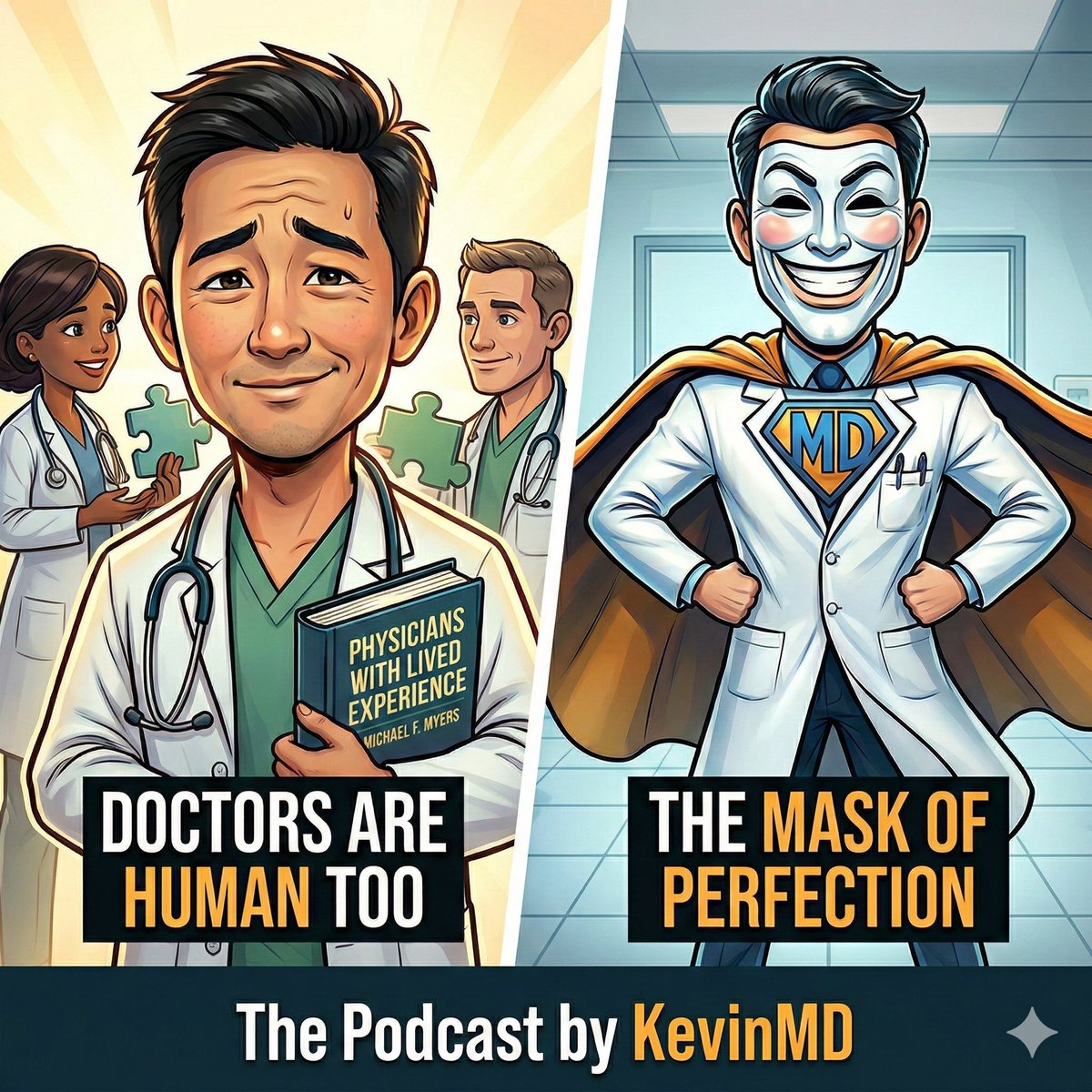
This space is where we can hear first hand the lived experiences and healthcare truths directly from physicians and scientists. Hoping if people jump ship there can be a similar meeting space. Physician burnout and Covid continue to be significant public health concerns.
Medicine has long demanded an illusion of perfection. But what happens when doctors openly share their own struggles with mental illness?
I interviewed Dr. Michael F. Myers, a professor of clinical psychiatry, about his book "Physicians With Lived Experience." We discussed the profound impact of medical professionals stepping forward to share their personal battles with psychiatric illnesses.
For decades, the culture of medicine taught doctors to hide their vulnerability. Admitting to depression or seeking therapy was often viewed as a professional risk. Today, a courageous group of physicians is breaking that silence, proving that doctors are human first.
During our conversation, Dr. Myers highlighted several reasons why physicians are choosing to go public with their mental health journeys:
Preventing tragedy: Many doctors are motivated to speak out after losing a colleague to suicide, realizing that silence is fatal.
Correcting misconceptions: Experiencing severe depression firsthand teaches doctors that it is a profound medical condition, fundamentally changing how they view the illness.
Strengthening connections: Showing vulnerability does not weaken a physician's authority. It enhances the therapeutic alliance, proving to patients that their doctors truly understand what it means to struggle.
We also discussed the powerful story of Dr. Chris Veal. As a Black, openly gay medical student, his severe depression was compounded by microaggressions, homophobic slurs, and the heavy burden of representation. By taking a step back to get help and eventually sharing his story, he became a beacon of hope for other marginalized students facing similar sociocultural pressures.
Dr. Myers leaves us with a simple but vital piece of advice. If a colleague shares their mental health journey, thank them. Your gratitude validates their courage and helps dismantle the stigma that keeps so many others suffering in silence.
🎙️ Listen to the full episode with Dr. Michael F. Myers on The Podcast by KevinMD.
📷 Search "The Podcast by KevinMD" on Apple or Spotify.
#KevinMD #PhysicianMentalHealth #EndTheStigma #MedicalEducation #MentalHealthAwareness #DiversityInMedicine
Doctors: we've accepted too many myths about Covid.
My presentation explains why - and gives you the science you're missing.
https://t.co/YxBxZwW18M
🧵 1/11
Haven’t posted in forever but this is worth it by @drjustincoleman Brilliant!
“Has lying become okay? (Asking for an American friend)” https://t.co/PznYfkAuIN #MedTwitter
Thank you @DoctorsOfBC for including in this morning Newsflash this excellent @CBC article based on the @CBCQuirks Q&A with @PutrinoLab
Can only hope that many MDs will read it or listen to the interview.
https://t.co/xy1qmvNVTe
A worthwhile listen for physicians:
The Doctor’s Crossing Carpe Diem Podcast: Episode Podcast: Healing the Heart and Mind: Breaking the Stigma of Physician Mental Health - A Cardiologist’s Story https://t.co/pY5hw60Rjn
Thank you to @CMAJ for publishing my essay on how it feels to be one of the few physicians still trying not to get Covid and trying to educate my patients about why they too should try not to get Covid. #saltingthevibes https://t.co/zMSWI9H6qU
Today's essential read for all physicians.
"When it comes to COVID-19, most public health officials seem more concerned with meeting people where they are and with keeping people calm than with informing and guiding people about risks to their health."
https://t.co/N7djPte0jz
Today's essential watch for all humans.
Infused with science, kindness, insightfulness, and wistfullness.
Do yourself a favour and take 35 minutes to listen to Ed Yong's wisdom.
https://t.co/ycTVVYnesQ
An excellent up to date look at the reality of #Covid - it has become so politicized and divisive that many people are unaware of the very real continued risks of getting infected with potentially irreversible symptoms.
@Protect_BC@PopAlberta@jvipondmd
To the 4th year med student staring down Match week…
Whether this week goes exactly how you want (or not)
… know that you are not defined by any single moment in your life
The best is yet to come
Keep your head up. It’s about the journey. Not the destination.
#medtwitter
How Many Docs Are Feeling Burned Out? Almost All of Them, Survey Finds
— More than half have considered taking a non-patient-facing job or leaving the field entirely
A thread
https://t.co/CQuzYFvAvD
We are seeking stories about "Uncertainty in Medicine" (from both clinicians and patients) for a new podcast series produced in partnership with @ArtsPractica and @ABIMFoundation. Contribute your voice here before March 24th: https://t.co/XdUCrg0iMC #medX#storytelling ☁️☁️☁️
Had the chance to speak on @ctvnews about the epidemic of burnout among health care workers. It is not surprising at all that this is happening. We all want to work hard to save lives, but hopeless work in a collapsing system is what leads to burnout.
Let me try to illustrate some of the challenges we face.
Recently I arrived to my evening shift; I saw 18 ambulances outside, with patients waiting to be offloaded into a department with few free beds. Our 'Infinity Hallway' is full again with stretchers lined up as far as the eye can see. I get inside, all of our acute resuscitation beds are occupied, our ICU is full, and another ambulance crew is taking a patient to another hospital's ICU. We get an alert from EMS that a person in their 40s has collapsed, is unresponsive, and is five minutes away. Just from that description, this person likely needs a ventilator and an urgent CT scan, but we had no beds.
Immediately we try to find a spot, checking just which other really sick patient we can shuffle somewhere else. Do we move the 50 year old on high flow oxygen for Covid? Or the heart attack patient waiting for the cath lab to free up, and it goes on. The strain of constantly weighing these lives, trying to eke out space from nothing, weighs heavily on all of us.
One exhausted nurse, who helped intubated 5 patients earlier in the day muttered under their breath that they're going to quit after this. I hope she's not serious, she's one of our best. We somehow manage to find space, the crew doing the patient transfer came early, and we used that bed. But what if 2-3 more came at the same time?
Most busy ERs looks like pandemonium to an outsider, but there's method to the madness that usually can process a huge number and variety of patients, treat them and occasionally accomplish miracles. But all of this is impossible if you completely burn out the highly trained staff on the ground.
When I finish medical school…
When I finish residency…
When I earn an attending physician paycheck…
When I buy the nice house or the nice car…
THAT is when I’ll be happy
This line of logic fall short in reality for most. It is called an Arrival Fallacy
#MedTwitter#MedX
Yes!!!
“Prioritizing the economy over health will sink both. We’ve learned a lot from the past four years. We have the tools to do so much better.”
@PopAlberta@Protect_BC@jvipondmd
The COVID-is-mild experiment, despite the wishing and the hoping, has been a tragic failure. Prioritizing the economy over health will sink both, by @jvipondmd@JuliaMWrightDal @danfurst https://t.co/lxqV1hKMrZ via @calgaryherald@DennisKendel#COVID19