An article was published in the Philosophy of Mathematics Education Journal No 41. It is argued that NCTM & sim. standards of math education for the youngest are deeply flawed and harmful to their math development,
1/3
#earlymath#tmwyk#learningthroughplay#froebel@NCTM@DREME
@NCTM Everything wrong. Simple child's arithmetic with manipulative objects has been replaced with written forms that are incomprehensible to child. Do you ever wonder why, despite so many decades of this approach, you are producing a mathematically uneducated and frustrated people?
@nerminskrbo1 Nažalost, duboka istina. Zato je pogrešno neke ljude nazivati zvijerima. Zvijeri su na neki način nevine, Nemaju zlo koje nose ti ljudi, da uživaju u patnji koju nanose drugom.
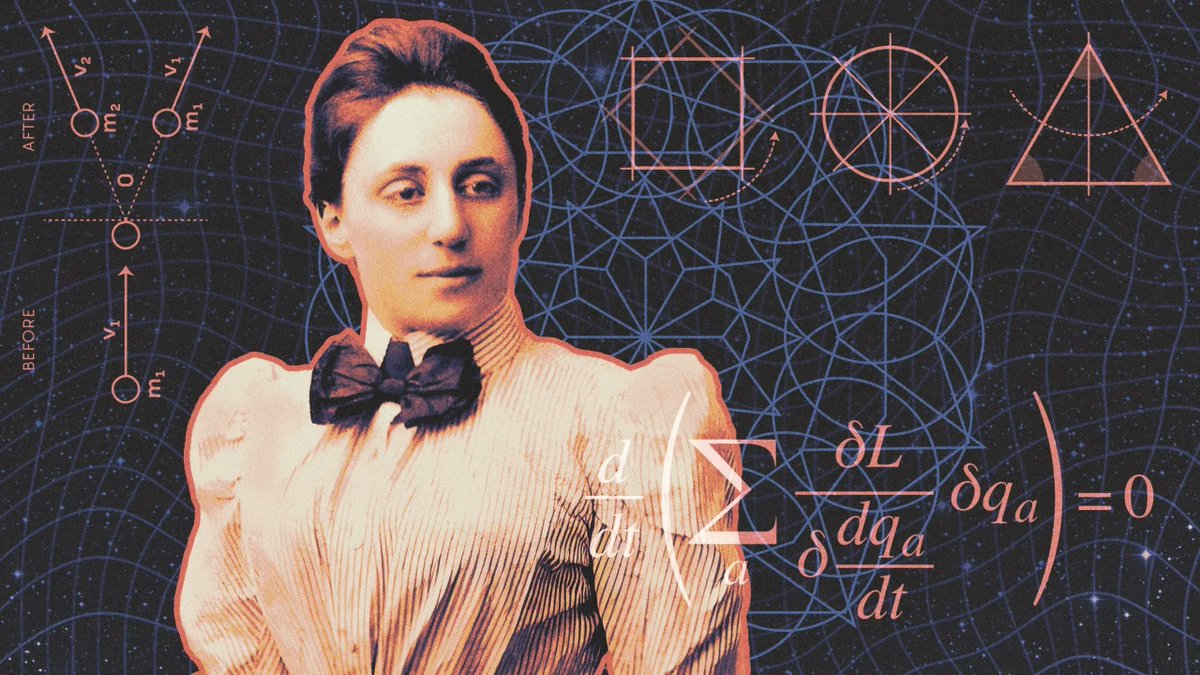
A German woman proved a single theorem in 1915 that quietly became the foundation of every law of physics on Earth. She taught for seven years without pay because the University of Göttingen refused to hire a woman. Then she fled the Nazis and died in Pennsylvania at 53.
I started reading about her and could not believe how much of modern physics traces back to one woman the world refused to pay for her work.
Her name was Emmy Noether. The theorem is called Noether's theorem.
Every law of physics ever discovered. Conservation of energy. Conservation of momentum. The Standard Model. General relativity. Quantum field theory. All of them are direct consequences of a single mathematical insight she proved 110 years ago. And most physics students will graduate without ever hearing her name once.
Emmy Noether was born in 1882 in Erlangen, Germany. Her father was a respected mathematician at the local university. The university would not allow women to enroll as students. So she audited classes from the back of the room and was not allowed to receive credit for anything she learned. She finished her PhD anyway in 1907.
Then she could not get a job.
For seven years she worked at the Mathematical Institute in Erlangen without a single paycheck. She supervised students. She published papers. She filled in for her aging father when he was too sick to teach. She did the work of a full professor and was paid nothing. There was no policy preventing her payment. There was simply no precedent for paying a woman.
In 1915 David Hilbert and Felix Klein invited her to Göttingen, the most important mathematics department in the world. Hilbert wanted her there because he was working on Einstein's new general relativity and there was a problem nobody could solve. The philosophy faculty blocked her hiring.
They argued returning soldiers should not learn from a woman. Hilbert stood up in the faculty meeting and said the line that has echoed for a century. He did not see how the sex of the candidate could be an argument against her admission, because the university senate was not a bathing establishment.
She still was not hired. So Hilbert listed her courses under his own name on the official schedule. She taught them under his title. This is how the most important mathematician of the 20th century was forced to operate for years inside one of the most prestigious universities in the world.
That same year she solved Hilbert and Einstein's problem.
The puzzle was technical. In general relativity, energy did not seem to be conserved the way classical physics required. Einstein could not figure out why. Hilbert could not figure out why. Noether figured out why in a few months. Then, instead of just solving their specific problem, she proved a much deeper theorem that solved every problem of that shape forever.
Her result was this. Every continuous symmetry in a physical system corresponds to a conservation law. If the laws of physics do not change over time, energy must be conserved. If they do not change with location, momentum must be conserved. The conservation laws were not separate facts. They were inevitable consequences of the symmetries underneath the universe.
This single theorem is the foundation of every law of physics ever discovered after her. The Standard Model is built on it. The Higgs boson Nobel Prize is built on it. Quantum field theory is built on it. Einstein read her paper and wrote to Hilbert that he was astonished. He had never met anyone with her capacity for abstract thought.
She finally got a paid teaching position in 1923. She was 41. She had been doing professor-level work for 16 years without compensation. While the German physicists kept getting credit for the consequences of her theorem, she quietly founded modern abstract algebra.
The structures we now call Noetherian rings are named after her. Modern algebraic geometry, the math that powers cryptography and parts of machine learning, runs on her foundations.
Then the Nazis came.
In 1933 she was fired for being Jewish. Bryn Mawr College in Pennsylvania offered her a position. She took it. She taught there for two years that were among the most productive of her life.
In April 1935 she went in for routine surgery to remove an ovarian cyst. Complications developed. She died four days later. She was 53.
Einstein wrote a public letter to the New York Times the day after her death. He said she was the most significant creative mathematical genius thus far produced since the higher education of women began. Almost nobody reading that letter knew her name.
She is buried in the courtyard of the library at Bryn Mawr College. The grave is small. Most students walk past it without noticing.
The woman who built the mathematical foundation of modern physics was paid almost nothing for almost all of it. The world she worked in told her every single day that she did not belong there.
She built it anyway.
Na linku možete naći prezentaciju (s linkovima na puno dobrog materijala) o problemima u matematičkom kao i cjelokupnom obrazovanju djece.
#vrtić#škola#djeca#roditelji#matematika#obrazovanje
https://t.co/2Nh0rZq5nu
Travnička nesretna ljubav... Priča o slomljenom cvijetu koji čeka vječno
U vrijeme kada je Travnik bio vezirski grad, kažu da je postojala jedna djevojka koja je hodala sokacima kao da nosi svjetlost u koraku. Svakog dana, u isto vrijeme, prolazila bi pored gradilišta džamije. Nije dolazila radi molitve, niti radi znatiželje. Dolazila je radi njega. On, mladi majstor, tih, vrijedan, uvijek s tragovima boje na rukama. Ona, kći uglednog trgovca, odgojena da hoda uspravno, da se smije tiho, da ne bira srcem. Nikada nisu razmijenili riječ. Samo pogled koji traje duže nego što bi smio. Samo tišina koja govori više nego što bi iko dopustio. Samo čekanje. Predanje kaže da je ona svake večeri, kad bi se majstori razišli, ostavljala mali cvijet uz zid koji je on tog dana oslikavao. A on, znajući da je to njen trag, u šare bi unosio skrivene poruke. List koji se savija kao njena kosa. Cvijet koji podsjeća na broš što ga je nosila. Boje koje šute, ali gore od čežnje.
Ljubav nikada nije bila izgovorena. Nije smjela biti.
Jednog jutra, više je nije bilo. Otac ju je odveo daleko, u drugi grad, u brak koji nije birala. I od tada, pričaju stariji, u jednoj od šara na zidu postoji motiv koji je drugačiji od svih ostalih. Neprimjetan, sitan, ali dovoljno uporan da preživi stoljeća. Simbol ljubavi koja nikada nije dobila glas. Kažu da je posljednje noći, kada je džamija bila gotovo završena, majstor ostao unutra sam. U tišini koja je odzvanjala kao njegova duša, oslikao je jedan mali cvijet. Usamljen. Tamniji od ostalih. Kao da je slomljen. Kao da još uvijek čeka nekoga... O tome se šuti. Niko to ne spominje naglas. Ali zidovi, kad ih obasjaju ramazanske noći, ponekad progovore. U njihovim bojama lebdi neka tanka, jedva čujna čežnja. Kao da u svakom potezu kista još uvijek stoji pitanje koje nikada nije dobilo odgovor. Možda zato, kad uđete unutra, ne osjetite samo mir. Osjetite i nešto drugo. Onu tihu, staru bol koja se ne liječi, ali se nosi dostojanstveno. Kao cvijet koji nikada nije uvenuo, samo je ostao čekati.
"Mi moramo da imamo svoj krumpir, jer jedino tako možemo zadržati slobodu i samostalnost. Ako nas bude drugi hranio, ode naša samostalnost."
https://t.co/Au3X35pReG
Čovika sa kraja ulice
u mome mistu
vole sva dica
ona mu blaže bol
A on in priča legende
dalekih mora
sa putovanja
na koja nije ni iša
Toma Bebić (Split, 6. studenog 1935. – Split, 4. veljače 1990.) 1/2
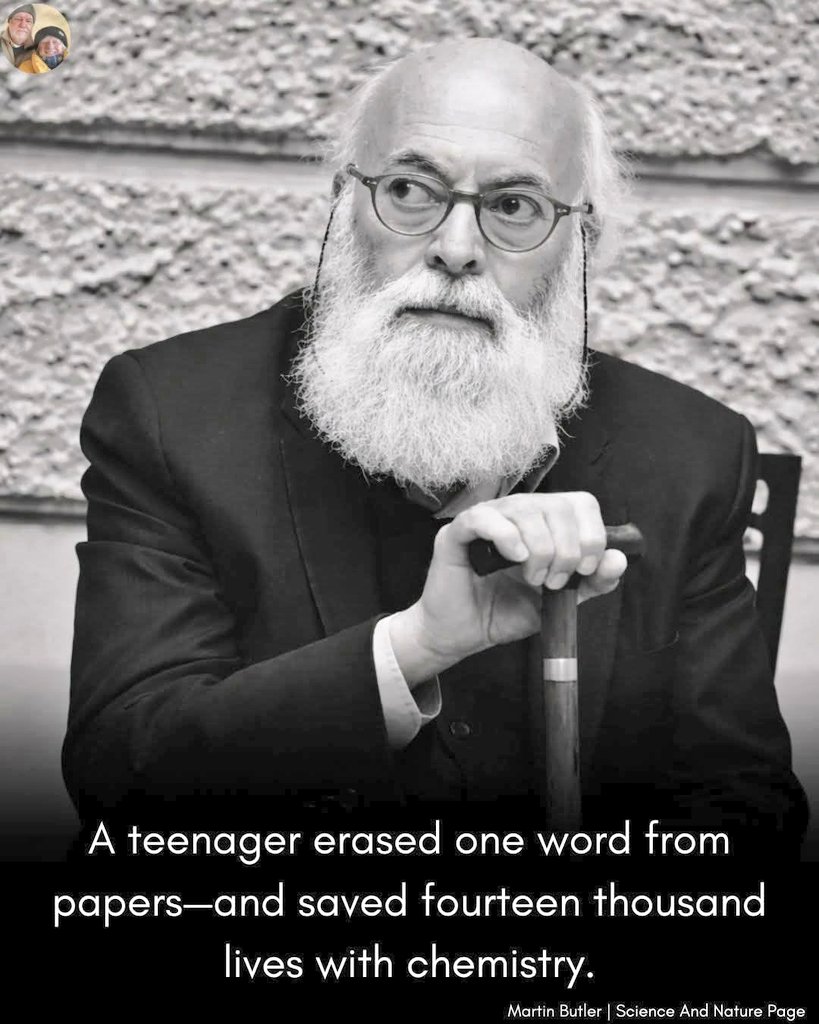
In 1943, in Nazi-occupied Paris, a teenager named Adolfo Kaminsky discovered that chemistry could be a weapon. He had learned the science of dyes in a small shop, studying how pigments bonded to paper and how solvents could break them apart. That knowledge became the difference between life and death.
The Nazis used paperwork as a weapon. On Jewish identity documents, the word JUIF was stamped in permanent blue ink. That single mark meant arrest, deportation, and death. The French Resistance asked Kaminsky if it could be erased. Most attempts ruined the paper. He remembered something else: lactic acid. It dissolved the dye without damaging the fibres. Under a single lamp, he watched the fatal word disappear.
But removing ink was only the beginning. He had to recreate entire identities birth certificates, ration cards, transit permits each detail perfect. A wrong shade of ink or a misaligned stamp could expose entire networks and send families to torture or execution. He worked in a hidden attic on the Left Bank, surrounded by chemical fumes that burned his eyes and stained his hands. Requests flooded in. Papers for children escaping to Switzerland. Ration cards for families in hiding. Transit passes for dangerous routes through Spain.
Then he made a calculation that would haunt him. Each document took about two minutes. In an hour, he could save thirty people. In an hour of sleep, thirty people could die. So he stopped sleeping.
When he learned that three hundred Jewish children in an orphanage were about to be raided, he locked himself in his lab and worked for two days without rest. His vision blurred. His hand cramped. He collapsed for an hour and woke in panic, furious at himself for the lives he imagined lost. He forced himself back to work. The children escaped.
It became a quiet war of precision. As Nazi security measures evolved, Kaminsky refined his methods. Success wasn’t measured in territory or headlines, but in families that survived and names that never appeared on transport lists. By the liberation of Paris in 1944, his forged documents had saved an estimated fourteen thousand people.
He never charged a cent. To him, putting a price on a life was unthinkable. After the war, he became a photographer and spoke little about what he had done. Even his children did not know for decades. The man who saved thousands disappeared back into ordinary life.
Only later did his story emerge, revealing a quieter truth about heroism. Courage does not always carry a weapon or wear a uniform. Sometimes it works under a dim bulb, with stained fingers and relentless focus, fighting an empire with knowledge and refusal to look away.
Adolfo Kaminsky died in 2023 at ninety-seven. His legacy is not in monuments or medals. It lives in the generations that exist because a teenager decided sleep could wait. #unknown #heroes #HistoryMakers
"Anarchists are simply people who believe human beings are capable of behaving in a reasonable fashion without having to be forced to. It is really a very simple notion. But it’s one that the rich and powerful have always found extremely dangerous."