Top Overnight News
For most of the war, Iran had an invaluable cushion: dozens of oil tankers holding millions of barrels of crude sitting safely in waters in Asia. Tehran steadily sold the oil to China, bringing in billions of much-needed cash. Now, that floating storage is gone. By mid-October, the reserves were fully depleted, according to analysts at Kpler, as a U.S. naval blockade prevented Iran from replacing the crude it normally sells to Chinese refineries. WSJ
The US ordered some diplomats and their families to leave Saudi Arabia because of the threat from Houthi militants, as the Iran-backed group carried out more strikes from Yemen; four people were killed in two attacks on an Aramco oil field and an airport in Saudi Arabia's Eastern Province. BBG
The US and Israel have drawn up plans for renewed strikes on Iran after the midterm elections, with targets likely to include Iran's energy infrastructure, nuclear facilities and missile and drone arsenals. NYT
Aramco told staff to leave its headquarters in Dhahran and work remotely. RTRS
Iran's IRGC threatened US bases in the region if Washington keeps escorting ships through what it calls an “illegal” Hormuz route. BBG
Saudi Arabia is in talks with foreign governments to give state-owned Aramco access to their strategic oil storage, as the kingdom seeks to make its supplies to customers more resilient during disruptions, Chief Executive Officer Amin Nasser said. BBG
The risk-off mood boosted havens, with Treasuries, the yen and Swiss franc gaining. The 30-year US yield touched its lowest since Sept. 23, but there was no relief for embattled French bonds which led a slide in European peers. BBG
France's 10-year bond risk premium over Germany widened as much as 18bps to 177bps, the widest since 2011. BBG
Over the past two weeks, HFs aggressively net sold global Info Tech stocks at the fastest pace in the past decade (-3.3 SDs), driven by long-and-short sales. Net allocation to Global AI stocks now sits in the 38th percentile while aggregate long/short ratio is in the 6th percentile vs. the past year. Goldman
Apple shares have become investors’ preferred Big Tech hedge against AI volatility as the company largely sits out the infrastructure spending boom. BBG
DeepSeek raised about $15 billion from investors including CATL and Tencent. BBG
JPM's HY AI credit basket is trading at all-time wides, 97bps wider than its widest level in July, with most of the move led by CoreWeave; Oracle has widened far more than the rest of the IG hyperscalers. JPM
Japan’s largest labor union group is seeking another year of wage increases big enough to anchor pay growth against persistent inflation. WSJ
Japanese monetary policy: the BOJ will keep rates unchanged at its meeting next week according to a report this morning in the Nikkei (this is consistent w/market expectations). Nikkei
The Philippine central bank surprised markets with a bigger-than-expected interest rate hike as it seeks to keep inflation in check during one of the worst energy crisis in decades and looming weather-driven shocks. WSJ
Turkey's central bank cut its one-week repo rate by 100bps to 36%, its first cut since the start of the Iran war, in line with estimates. BBG
The EU reached a provisional deal to overhaul securitization market rules that would unleash billions of euros to finance initiatives in key areas such as defense and climate resilience. BBG
Barclays said it’s cutting 5,000 jobs, or about 5% of total headcount, as part of a “technology-enabled” effort to reduce costs as it adopts artificial intelligence across the bank. BBG
The US signed a deal with Lockheed Martin for a minimum of 850 F-35 jets. BBG
A federal judge barred the DHS from knocking on doors to check on people’s immigration status in nine states through election day, saying the practice likely violates the Voting Rights Act. BBG
BofA Total Card Spending (week to October 17th) +4.9% Y/Y (prev. +5.1%); lower-income spending growth has consistently outpaced higher-income spending growth over the past several weeks. Newsquawk
Some US banks are reportedly detecting unauthorized AI agents operating within accounts: Axios. The report added that the banks affected include Morgan Stanley (MS), Bank of America (BAC), JPMorgan (JPM), Wells Fargo (WFC).
AI servers require millions of highly-precise glass cables to transmit colossal amounts of data at the speed of light—copper wires simply can't handle the load. An NVIDIA Hopper AI rack requires about 4,000 fibers, while the newer Blackwell architecture pushes that to 16,000.
The secret to these cables is the "preform"—a massive, crystal-clear glass cylinder baked with chemical vapors. Making your own preforms requires years of clean-room chemistry and captures up to 70% of the profit margin in the entire value chain.
Out of roughly 20 optical fiber makers in India, only two have the engineering capacity to build the high-density cables needed for AI.
But this massive boom comes with a geopolitical trap. Making the glass requires a critical mineral called germanium. China controls 91% of global germanium refining and has heavily restricted its export.
Caught between surging bare fiber prices and delivery wait times of up to a year, Indian cable makers are now walking a dangerous tightrope:
"They are locking in lucrative, multi-year contracts with American tech giants, but their own suppliers of glass preforms and Chinese germanium refuse to guarantee prices or volumes beyond a single year."
We look at the hyper-precise chemistry of fiber optics, the economics of preforms, and the ongoing geopolitical fight over germanium.
A TON OF THINGS HAPPENED IN THE STOCK MARKET TODAY.
Here's a full recap:
1. The Nasdaq $QQQ was down 2.60% on today, its worst session since June 5, while the Nasdaq 100 fell 2.90%, erasing nearly $1.2T in market value. The selloff was fueled by concerns over AI spending and profitability, with Meta $META dropping 7% despite beating revenue expectations, as investors questioned its massive AI investments and negative free cash flow. Semiconductors were hit hardest, with the Philadelphia Semiconductor Index falling 6.7%, led by AMD $AMD (-8%), Micron $MU (-6%), and NVIDIA $NVDA (-4%). AI and chip stocks accounted for roughly 90% of the Nasdaq 100's losses. However, broader market participation remained positive, with the Dow and Russell 2000 gaining. Meanwhile, Brent crude surged 4% toward $113 amid Middle East tensions. Despite the decline, the Nasdaq remains up 11.9% YTD, sitting 5.8% below its October 6 record high.
2. NVIDIA $NVDA CEO Jensen Huang pushed back against concerns surrounding neocloud financing, arguing that demand for AI computing infrastructure remains “off the charts” and that strong customer demand will ultimately help companies secure the capital needed to expand. Huang emphasized that “you can't solve the absence of demand,” but when demand is high, financing challenges can be addressed. He noted that neocloud providers already have excellent customers and significant demand, with their primary challenge being access to working capital to fund additional compute capacity. Huang expressed confidence that financing solutions will emerge, reinforcing his view that the industry's biggest challenge is not finding customers, but securing the capital and infrastructure needed to meet accelerating AI demand.
3. Bloom Energy $BE delivered a massive Q3 2026 earnings beat, with revenue surging 138% YoY to $1.24B, well above the $1.05B estimate, while adjusted EPS of $0.94 exceeded expectations of $0.68. Adjusted operating income reached $285.7M, beating the $214M estimate, while adjusted gross margins expanded 412 basis points to 34.5%, reflecting significant improvements in profitability. The company also raised its FY2026 revenue guidance to $4.4B–$4.6B, above the $4.1B consensus, and increased its adjusted EPS outlook to $3.10–$3.40, compared with $2.73 expected. Despite the strong results, operating cash flow was negative $27.1M during the quarter.
4. OpenAI is reportedly nearing a $30B funding round at a $1.25T valuation, with UAE investors and Coatue Management leading the financing, according to CNBC. The round is being positioned as a bridge ahead of a potential 2027 IPO, with OpenAI targeting investor signatures by the end of next week, although the final fundraising amount remains subject to change. Separately, OpenAI is negotiating an additional agreement to secure AI computing capacity from the UAE, highlighting the company's continued need for massive infrastructure investment as it scales its frontier AI models and expands its commercial operations. If completed at the proposed valuation, the financing would further cement OpenAI's position among the world's most valuable private technology companies.
5. SK Hynix has reportedly scrapped plans for a U.S. IPO of its Solidigm subsidiary and halted a related pre-IPO investment round following regulatory concerns and shareholder opposition, according to Bloomberg. South Korean regulators argued that separately listing the company's flash-memory business could constitute a “duplicate listing,” potentially diluting the economic interests of existing SK Hynix shareholders. The proposed IPO, which had Goldman Sachs $GS and Morgan Stanley $MS lined up as lead underwriters, was previously targeted for 2027. The decision represents a significant development in South Korea's efforts to strengthen minority shareholder protections and address the longstanding “Korea discount,” as regulators increasingly scrutinize corporate structures that could disadvantage existing public shareholders.
6. The top 10 most active options today by contracts traded were $NVDA with 3.5M contracts, $TSLA with 2.6M contracts, $SPCX with 1.7M contracts, $AAPL with 1.4M contracts, $MU with 1.2M contracts, $META with 1.2M contracts, $INTC with 1.2M contracts, $AMZN with 1.0M contracts, $NFLX with 967K contracts, and $CRWV with 941K contracts.
7. SpaceX $SPCX is reportedly seeking access to at least 80,000 cell tower sites across the United States as it accelerates plans to turn Starlink into a fourth nationwide wireless carrier, according to Bloomberg. The company is in discussions with major tower operators, including Crown Castle $CCI, over potential agreements that could be worth billions of dollars. The push follows SpaceX's recent acquisition agreement for nationwide low-band spectrum and FCC approval for a constellation of 15,000 direct-to-device satellites, giving Starlink the foundation to combine satellite connectivity with terrestrial cellular infrastructure. If successful, the expansion would position SpaceX to compete more directly with AT&T $T, Verizon $VZ, and T-Mobile $TMUS, potentially reshaping the U.S. wireless market.
8. China is continuing to accumulate significant amounts of gold, with Goldman Sachs estimating that Chinese purchases through the London OTC market reached 25 tonnes in August, approximately 25% above the 20 tonnes officially reported by China's central bank. The bank estimates China purchased 35 tonnes in July, 40 tonnes in June, and 48 tonnes in May, with estimated OTC purchases exceeding officially reported central bank purchases by 83 tonnes, or 128%, over the four-month period. Meanwhile, global central banks are estimated to have purchased 79 tonnes of gold in August, roughly 365% above the pre-2022 monthly average of 17 tonnes. The figures highlight exceptionally strong demand for gold amid ongoing geopolitical uncertainty, reserve diversification, and efforts by central banks to reduce reliance on traditional reserve assets, although estimated OTC purchases are not necessarily all central bank acquisitions.
9. NVIDIA $NVDA CEO Jensen Huang told CNBC that he believes a surplus of memory supply is unlikely by 2029, signaling continued confidence in long-term demand for DRAM, HBM, and other advanced memory technologies as AI infrastructure expands. Huang emphasized that “one of the things that’s really great about memory is that you can always use more of it,” highlighting how increasingly sophisticated AI models, larger context windows, and more demanding inference workloads continue to drive memory requirements higher.
10. SpaceX $SPCX is reportedly finalizing a $40B debt financing package at significantly higher borrowing costs than its previous financing, according to Semafor. The deal, led by Apollo and Goldman Sachs, is expected to include a lower-rated tranche carrying an interest rate of approximately 8.3%, while a more secure portion backed by AI chips could price around 7.75%. Even the chip-backed debt is expected to carry a yield more than 100 basis points above SpaceX's existing bonds, highlighting the rising cost of financing large-scale AI infrastructure. The transaction is expected to close next week and underscores the growing financial burden associated with SpaceX's aggressive expansion into AI computing and data centers.
11. Nebius $NBIS secured a $3.5B senior secured credit facility from Citi to finance its accelerating global AI data center expansion and GPU purchases. The facility carries a 364-day maturity, with borrowing costs starting at SOFR + 2.75% and potentially increasing to SOFR + 3.50%, giving Nebius additional access to capital as it scales its infrastructure. The company also highlighted more than $40B in long-term contracts with investment-grade customers, which could support further asset-backed financing as it expands AI computing capacity throughout 2027 and beyond. The agreement underscores how neocloud providers are increasingly leveraging contracted AI demand to secure billions in financing for next-generation data centers and GPU infrastructure.
12. The U.S. 10-year Treasury yield fell below 5.00% for the first time since September 23, as the selloff in technology and AI-related stocks intensified. The decline in yields suggests investors are rotating capital toward the relative safety of U.S. government bonds, pushing Treasury prices higher as risk appetite weakens. The move highlights a growing divergence between the bond and equity markets, with falling yields reflecting demand for defensive assets even as concerns over AI valuations, capital spending, and broader market volatility continue to pressure technology stocks.
WALL STREET IS THE GREATEST SHOW ON EARTH.
We are in a “stealth” bear market.
For the first time in history, nearly 60% of the S&P 500’s components are in a bear market, while the index trades 3% away from a record high.
We think this is a historic opportunity.
@TKL_Adam joins @cvpayne on Fox Business to discuss our view.
$MU $SNDK $SKHY $NBIS
Nomura’s memory team just put out a really interesting note on the AI scare, the numbers underneath are some of the strongest I’ve seen in this drawdown.
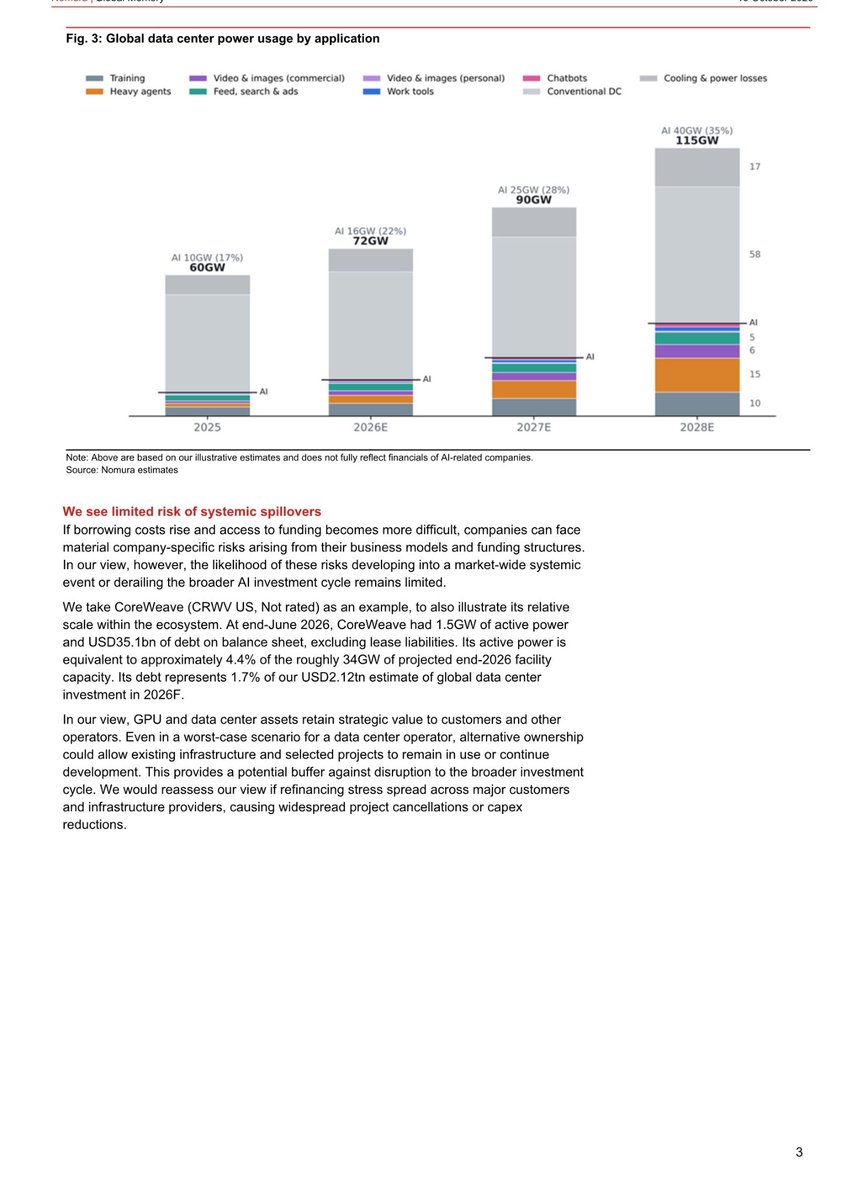
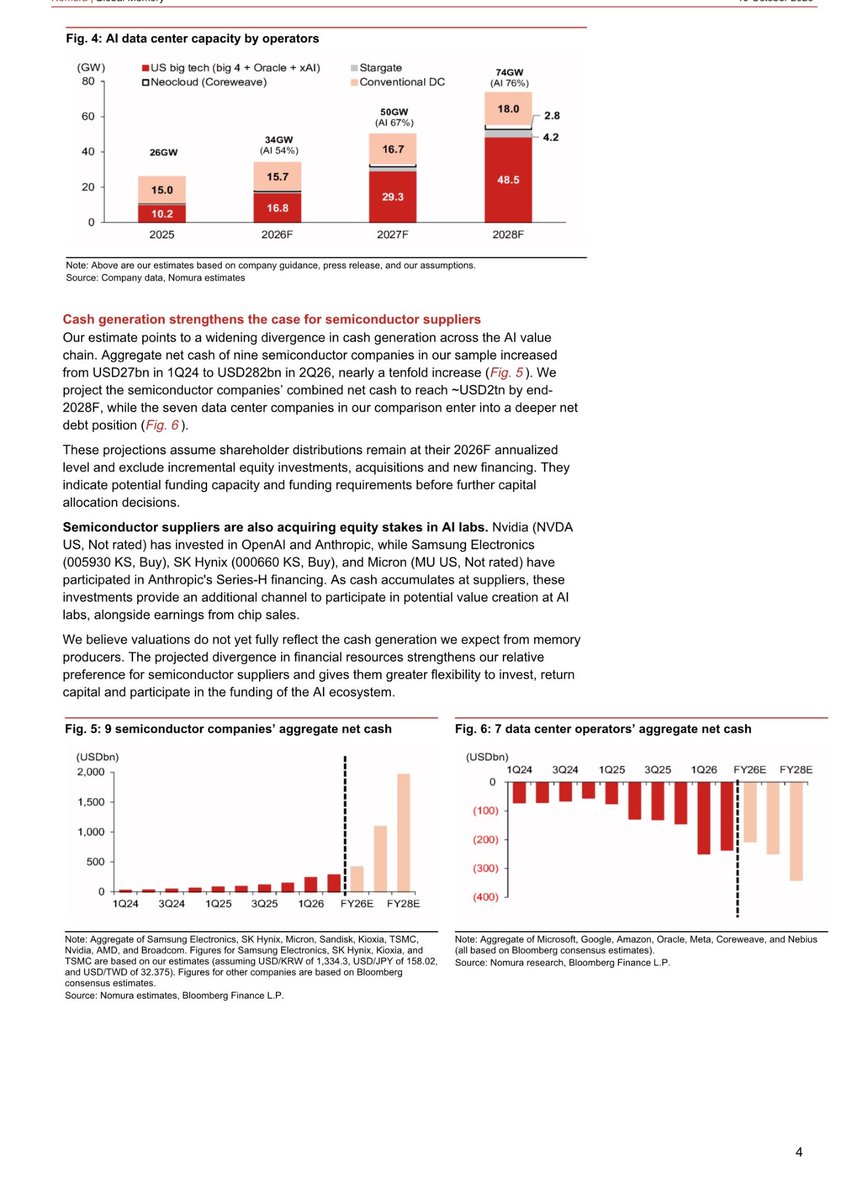
Nomura sees AI going from 10GW of data center power in 2025 to 40GW by 2028, taking it from 17% of all data center power to 35%.
The biggest slice of that 2028 number is heavy agents at 15GW, ahead of training at 10GW. In Nomura’s model, agents become the largest power user in AI within two years.
US big tech alone goes from 10.2GW of AI capacity to 48.5GW over the same stretch, Nomura’s memory team just put out a note on the AI scare, and once you get past the headline worry, the numbers underneath are some of the strongest I’ve seen in this drawdown.
Nomura sees AI going from 10GW of data center power in 2025 to 40GW by 2028, taking it from 17% of all data center power to 35%.
The biggest slice of that 2028 number is heavy agents at 15GW, ahead of training at 10GW. In Nomura’s model, agents become the largest power user in AI within two years.
US big tech alone goes from 10.2GW of AI capacity to 48.5GW over the same stretch, almost 5x.
The cash is piling up where the chips are made. Nine semiconductor companies (Samsung, Hynix, Micron, Sandisk, Kioxia, TSMC, Nvidia, AMD and Broadcom) went from $27B of net cash in 1Q24 to $282B in 2Q26, and Nomura projects ~$2T by end-2028.
The clouds buying all of it are printing too, with AWS at a 39% operating margin, Microsoft Intelligent Cloud at 41% and Google Cloud at 36%. Even Anthropic moved into adjusted operating profit in Q2, per Nomura.
Memory stays supply constrained through at least 2028. Nomura’s targets are 670,000 KRW for Samsung (+207%) and 4.7M KRW for SK Hynix (+268%).
Now the part the market sold on and I don't buy into:
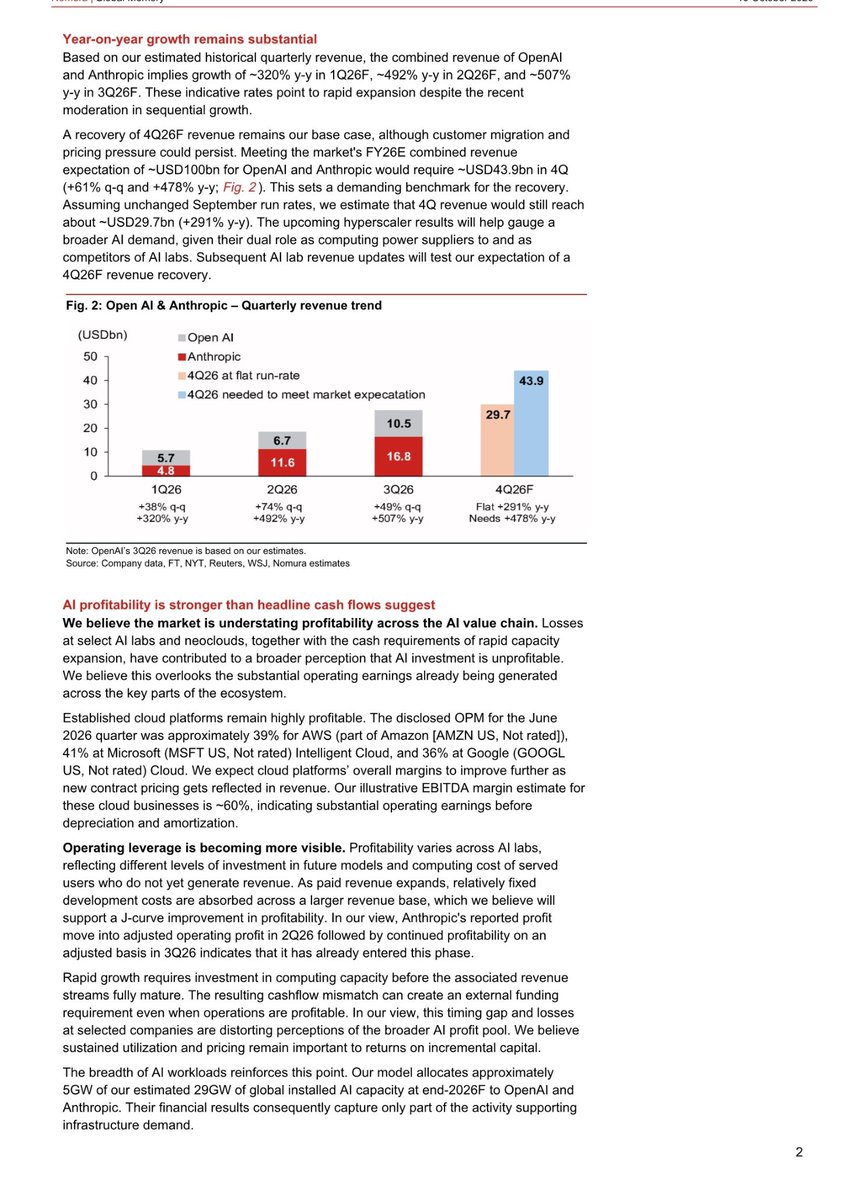
OpenAI and Anthropic’s combined revenue grew 49% q/q in Q3, down from 74% in Q2. At September’s run rate, Q4 lands at $29.7B and 2026 comes in short of the ~$100B the market expected.
That “slowdown” scenario is still +291% y/y.
Part of the dip is mechanical.
OpenAI’s run rate got reframed because of how partner revenue is booked, Anthropic cut off distillation (5-7% of revenue), and summer slowed usage-based billing.
Meta moving engineers off Claude Code onto its own tools sounds bad until you remember the tokens still get burned, just on Meta’s compute. OpenAI and Anthropic are only ~5GW of the ~29GW of AI capacity Nomura sees by end-2026.
The 7 big operators, CoreWeave and Nebius included, go deeper into net debt through 2028. That debt is the chipmakers’ revenue.
CoreWeave, the name everyone is scared of, is 4.4% of capacity and 1.7% of 2026 data center investment. Nomura sees limited systemic risk and calls the CXMT memory panic excessive.
Every bearish line in this note ends up as someone’s GPU, HBM or optics order.
So invest in the entire buildout and win either way.
Bullish ⚡️
To secure critical industrial raw materials like coking coal, copper, and lithium, India has launched a ₹34,300-crore National Critical Mineral Mission targeting 50 overseas mines by 2031.
However, recent disputes over Tata Chemicals' soda ash mine in Kenya and operational bottlenecks in Mozambique show that owning foreign mines acts primarily as a price hedge and output claim rather than guaranteeing discounted minerals.
Furthermore, mine ownership fails to overcome host-nation raw export bans or China's overwhelming dominance in global mineral refining.
"Owning a mine can buy a claim on output, a financial hedge, and some control over quality. It doesn't buy cheaper minerals, override market prices, or grant the final say."
Beyond raw extraction, refining remains the ultimate bottleneck. China controls ~71% of global lithium refining, over 75% of cobalt refining, and 91% of rare earths processing. Without domestic processing capacity, foreign ore alone doesn't grant supply chain security.
We look at India’s overseas mineral bets, host-country resource nationalism, and why owning a mine abroad isn't enough.
If you’re a memory investor and scared of this selloff, save this!
Goldman obliterates the bear case on $MU $SNDK $SKHY dropping could imply that the market may have underestimate the capacity ramp up. DRAM spot pricing which typically acts as an indicator is going up🔥
A TON OF THINGS HAPPENED IN THE STOCK MARKET TODAY.
Here's a full recap:
1. Amazon $AMZN posted its best trading day since August, supported by a bullish Morgan Stanley outlook and a major development in its custom AI chip strategy. Morgan Stanley named Amazon its top pick, setting a $350 price target that implies approximately 40% upside, while raising its AWS growth forecasts to 47% and 42% YoY for 2027 and 2028, respectively. Separately, Amazon unveiled TorchNeuron, a new software tool that allows developers to run existing PyTorch AI workloads on Trainium2 and Trainium3 chips with minimal code changes. The development could help reduce one of the biggest barriers to adopting Amazon's custom silicon and strengthen its competitive position against NVIDIA $NVDA, whose CUDA software ecosystem has historically been a major advantage in the AI infrastructure market.
2. ARK Invest updated its 2031 Tesla $TSLA valuation model, projecting a $4,400 base-case share price, representing approximately 12x upside from current levels. The firm expects robotaxis to account for roughly 80% of Tesla’s enterprise value by 2031, forecasting a fleet of 8.1M autonomous vehicles generating $753B in annual ride-hailing revenue, with operating costs potentially 40% below Waymo’s. ARK also sees Optimus humanoid robots emerging as Tesla’s second major growth engine, projecting approximately 1M robots sold externally and $212B in annual revenue by 2031, supported by an estimated $26T addressable robotics market. To support these ambitions, ARK expects Tesla to invest approximately $225B cumulatively in AI infrastructure through 2031, underscoring how heavily its valuation thesis depends on the successful commercialization and scaling of autonomous driving and robotics.
3. Microsoft $MSFT has reportedly withdrawn from a major UK data center agreement with British neocloud provider Nscale, according to The Telegraph, dealing a setback to the startup ahead of its planned $3B IPO. The proposed facility in Loughton, Essex, has faced repeated delays, with authorities reportedly not expecting sufficient power availability until the 2030s. Anthropic is also reportedly in talks to purchase $45B worth of AI computing capacity from Nscale, the NVIDIA-backed data center developer, according to Bloomberg.
4. A potential breakthrough agreement between the United States and Iran could be announced as early as this week, according to Al-Araby Al-Jadeed, citing sources familiar with ongoing mediation efforts. Negotiators are reportedly working to narrow remaining differences and secure mutual concessions aimed at preventing a renewed military escalation between Washington and Tehran. While the reported progress could represent a significant diplomatic development amid heightened tensions in the Middle East, no agreement has been officially confirmed, and negotiations remain ongoing.
5. Anthropic announced the creation of the Anthropic Public Benefit Fund, pledging an initial 5% of company equity to support charitable initiatives and address the broader societal impacts of AI, including its effects on employment. Subject to shareholder approval, the company’s board may contribute an additional 2% of shares for every 50% increase in valuation above an undisclosed baseline. Elon Musk also said that next year, he will give every American child one share of $SPCX, which would be worth $10.5B at today's prices. He says this will be the first of many times he gives shares to the public.
6. JPMorgan says the latest October selloff in Korean semiconductor and memory stocks looks materially different from the July correction, with several factors potentially limiting a rebound. Unlike July, retail investors have shown little appetite to buy the dip, while short interest across Korean equities, U.S. memory stocks, semiconductor ETFs such as $SMH, and broader indexes like $SPY remains relatively low. JPM also warned that leveraged ETF exposure has increased since late July, making the market more vulnerable to further selling pressure. Compounding the risks, a combined $40B share buyback program from South Korea's two largest memory manufacturers was accelerated to finish in mid-October, removing a significant source of buying support that helped stabilize the market in recent months.
7. Russian President Vladimir Putin has reportedly proposed a three-way meeting with President Donald Trump and Chinese President Xi Jinping to negotiate a potential end to the war in Ukraine, according to the Wall Street Journal. Putin reportedly raised the proposal during an October 9 phone call with Trump, with the meeting potentially taking place next month. The proposed summit would bring together the leaders of Russia, the United States, and China in an effort to explore a diplomatic resolution to the conflict, although no meeting or peace agreement has been confirmed.
8. South Korean AI infrastructure company Elice plunged approximately 30% on its stock market debut, despite raising $151M at a $750M valuation in an IPO that was reportedly 400x oversubscribed by retail investors. Elice specializes in GPU cloud rentals and the software infrastructure used to manage AI computing workloads, making its listing a notable test of investor appetite for AI infrastructure companies. The sharp decline came amid a broader selloff in South Korean equities, with the KOSPI falling 4.2% to below its July lows, while Samsung Electronics declined 3% and SK Hynix dropped 6%. If the decline holds through the close, Elice could record the worst IPO debut in South Korean market history, highlighting the growing disconnect between strong investor demand for AI-related offerings and increasingly volatile public market valuations.
9. S&P 500 $SPY put option trading volume surged to a record $3.3T in notional value on Friday, marking an extraordinary increase in downside positioning and hedging activity. The dollar value of S&P 500 puts traded was approximately 330% above the 2024 daily average, compared with typical daily volumes of just $100B–$500B before the 2020 pandemic. Meanwhile, total CBOE put option volume reached 9.6M contracts, the fourth-highest daily reading since 2015. The surge highlights an unprecedented level of activity in downside protection as investors navigate elevated market uncertainty, although record put volume does not necessarily indicate outright bearish positioning, since options are also used for hedging and complex trading strategies.
10. Morgan Stanley strategist Michael Wilson believes the three-month U.S. equity correction may be approaching its final stages, urging investors to prepare for potential buying opportunities rather than assume the broader bull market is ending. Since mid-August, high-quality stocks have gained roughly 6%, while the equal-weight S&P 500 has declined nearly 4% and cyclical stocks have fallen almost 10%, highlighting the growing divergence beneath the index. He believes the correction reflects a transition toward a more selective, mid-cycle market rather than the end of the economic expansion, with investors potentially getting an opportunity to buy the dip as the adjustment concludes.
11. The top 10 most active options today by contracts traded were $NVDA with 3.3M contracts, $TSLA with 2.8M contracts, $AMZN with 1.5M contracts, $AAPL with 1.5M contracts, $MU with 1.4M contracts, $SPCX with 1.0M contracts, $INTC with 816K contracts, $CRWV with 778K contracts, $META with 754K contracts, and $AMD with 743K contracts.
12. JPMorgan significantly raised its AI data center capital expenditure forecasts, now expecting spending to grow 85% YoY in 2026, up from 80%, and 70% in 2027, up from its previous 50% estimate. The firm projects more than $270B in incremental data center spending in 2026 and another record increase of $400B+ in 2027, with total spending across major U.S. hyperscalers and other operators approaching $800B in 2026 and $1.5T in 2027. JPM highlighted Credo $CRDO, Lumentum $LITE, Coherent $COHR, Amphenol $APH, Arista $ANET, Celestica $CLS, Ciena $CIEN, Corning $GLW, and Fabrinet $FN as key beneficiaries of the accelerating infrastructure buildout.
WALL STREET IS THE GREATEST SHOW ON EARTH.
if you're wondering why the 10-year is down today even though CPI had a horrible print...which should be causing yields to go up because that means we have a higher chance of a rate hike due to more inflation...
i *think* it's because the bond market wants to see the stock market go down.
and not just stocks, but AI/semi/capex stocks in particular.
the theory i've had over the past couple of weeks is that as we see more issuance of corporate debt in order to fuel capex...that is obviously competing with the long end of the curve for US treasuries
i mean, one can even argue that bond yields we're going to go up regardless of the oil issues because those yields simply couldn't stay at 4% if meta/google/amzn/msft were offering 6-7% on their corporate debt
so the obvious answer now could be for there to be LESS competition with the US 10-year...but the only way for that to happen is for their to be lower-yielding debt from the hyperscalers that are issuing bonds to fuel their capex spend
well...the only way that happens is if the capex stops, slows down, or the cost to build these datacenters drop so that the borrowing costs drop
which is why we have seen yields RISE every day over the past few weeks when semis go up and we are seeing them go down when semis go down...it's like the credit market is saying "we will only buy bonds if you guys stop buying semis"
this doesn't mean that stocks writ-large have to go down, but it does mean that the credit markets are asking for something to break in the equity markets and its like they want semis to be the main culprit. if semis keep going to the moon, cool, but then so will yields and then maybe a 6% 10-year is what breaks everything?
not sure if this theory is right but the objectively true part is the competition between US corp debt and treasuries, if all that corp debt is going to buy semis then when semis go down, it makes sense for treasuries to go up
the easiest way to get SOME relief here is for Trump to end the war so gas/energy comes down and puts relief on inflation...but today's CPI showed the opposite and yields STILL went down because semis got hit
it's a very, very weird time to understand how the bond market is navigating the AI trade
🛢️Oil Is Not Just Fuel
About 14% of world oil demand goes into chemicals, not engines.
The IEA expects petrochemicals to drive much of future oil demand growth.
It starts with feedstocks like naphtha, ethane and propane.
Crackers turn them into basic building blocks: ethylene, propylene, butadiene and aromatics.
Methanol is made mostly from natural gas.
Those become ⬇️
• Plastics
• Synthetic rubber
• Resins and foams
• Solvents and industrial chemicals
And then the things we use every day:
📦 Packaging
🚗 Car parts and tyres
📱 Electronics
🏗 Pipes, insulation and paint
💊 Medicines and medical supplies
When oil supply breaks, the shock reaches factories long before it reaches the pump.
One thing the RBI did on Friday was to tell banks: You need to keep 99% of your CRR requirements at all times.
A quick decode. If a bank has Rs. 100 of deposits, it needs to keep about 3% of it with the RBI as zero interest earning cash. That's the CRR. Every bank has an account with the RBI (like you have a savings account with your bank - your bank has an account with the RBI). That account should have this CRR every day. It's like a minimum balance.
A CRR is calculated on deposits that were, roughly, 15 days ago, and RBI says listen, just keep 3% of that number interest free for the next fortnight.
If a bank has a lot of money in their RBI account, they will take the "excess" (whatever's beyond CRR limits) and give it to the RBI as reverse repo, or SDF - basically like a very short term fixed deposit on which they earn interest.
But banks often see cash move around. You do UPI at midnight, and some money moves from your bank's account with the RBI to some other bank's account with the RBI. Your bank is like hello, I had this money and this uncle did UPI so i'm now short of money?
Now RBI knows this, so they say fine, listen, we will ask you that your AVERAGE balance over a fortnight should be 3%. But that doesn't mean you keep ZERO today and 6% tomorrow - that is a little too much. So banks get only a little headroom. They need a minimum of 90% of the CRR in their account every single day, and whatever they do, they should ensure the balances average to the full CRR averaged over the fortnight. That leeway of 10% allows a few of these midnight UPI uncles without CRR violations.
Now that I've confused you enough, here's more: What the RBI has done is that they've changed the 90% to 99%.
Banks, therefore, can't ever see less than 99% of their CRR needs in RBI at any time. Currently, as the screenshot shows, banks have about 96% parked as CRR (784K cr versus the requirement of 817K cr). Starting friday, they need to bump this up to 99%.
What does this do? Banks will probably keep more than 100% all the time because who knows which UPI uncle will transfer how much at midnight, boss. So banks earn interest on lesser money (CRR earns no interest for them)
Why has RBI done this? To reduce the overall liquidity in the system - banks are FLUSH with deposits after the FCNR scheme, and RBI is keen to ensure this doesn't cause the system to go overboard on lending. It controls the bank lending growth a little.
It will take out about 30,000 cr. in liquidity out of the system, and is likely to be a temporary measure while banks slowly grow into the liquidity overload. The impact is lower interest revenue for banks (marginally), but otherwise the measure should not meaningfully impact anything you and I see in daily life.
Long story for what isn't a big deal, I know, but I'm like that.
Remember when JP Morgan came out 2 weeks ago claiming Hormuz flows were near pre-war highs?
Well, they have a new oil report and it's not looking good.
"October is beginning to look like April".
Why?
The cost of shipping crude is skyrocketing and it's not changing soon.
JPMorgan just called Brazil the "anti-AI market" and told clients to own more Brazilian stocks than the index holds.
In plain words, the bank sees Brazilian stocks as protection for a portfolio if AI stocks fall.
I wrote in June that Brazil wins in both cases, and the reason is 150 years old.
Every tech craze follows the same path: a real invention shows up, the stock price runs far ahead of what the invention can earn, and the price breaks while the invention keeps working.
In 1873, railroad debt sank Jay Cooke's bank and shut the New York Stock Exchange for ten days, and the tracks still carried the next forty years of American trade.
RCA, the hot radio stock of the 1920s, fell 98% from 1929 to 1932, while the share of American homes with a radio more than doubled, from about 40% in 1930 to about 83% in 1940.
The Nasdaq fell 78% after March 2000, and the fiber cable laid during the bubble became the floor the internet was built on.
Each time, the money that lasted ended up with whoever owned the power, the metal, the land and the food the machine needed.
AI is the most physical machine ever built.
Data centers used about 1.5% of the world's electricity in 2024, and the International Energy Agency expects that to more than double by 2030, to roughly what all of Japan uses today.
Brazil makes about 85% of its electric capacity from renewable sources and holds the second-largest known reserves of both graphite and rare earths on Earth.
So while AI keeps building, Brazil supplies the power and the minerals it runs on, and if the AI stock story breaks, JPMorgan already counts Brazil as the hedge.
JPMorgan's own report also says Brazilian profits are still under pressure, so the gain it sees comes from investors paying a higher price for the same profits, up from 8.9 times expected earnings today.
The bank calls Brazil a hedge against AI, and 150 years of manias say Brazil is also the ground AI stands on.
Read my full article from June on "When the AI Bubble Bursts: The Case for Brazilian Hard Assets"...
https://t.co/eN1k0IavEl
If you have the appetite to watch just 1 video on the economy, FPI situation, Indian Rupee, market valuation, and the interest rate, then do check this. @ananthng sir does an excellent job of breaking this down for us 🙏
Link below 👇
If you’re a trader, do check these out:
After Market Report: https://t.co/6BNdv8Yigd
A daily newsletter covering what happened in the markets, delivered to your inbox every evening after the market closes.
In The Money: https://t.co/af7GCUYMXd
Published twice a week, with deeper pieces on trading, markets, behaviour, and the ideas that matter to traders.
PB Fintech lost ₹25,000 crore in a single day.
SBI Life didn't drop a single rupee.
One proposal from IRDAI changed the whole industry structure.
The breakdown in 1 minute.🧵
Last year I put together a short guide with a few practical heuristics for reading an income statement.
Re-sharing it below, as I think more investors could benefit from it.
It covers things like suspicious revenue growth, margin trends, SG&A discipline, recurring “one-time” adjustments, and whether earnings are actually converting into cash.
Nothing fancy. Just useful pattern recognition.
🚨 JP MORGAN ADMITS THEY’RE CLUELESS: This Oil Shock Could Send 10-Year Yields to 7% and Wipe Out Bond Portfolios
“WE DON’T KNOW HOW TO MODEL THE ENDGAME.”
Wall Street’s biggest oil desk just admitted they’re flying blind. For the first time since the Iran conflict started, JPMorgan has NO baseline forecast. Oil is already over $100 (Brent recently hit $106 vs their $90 “fair value”), gasoline is $4.37, and diesel just printed an all-time high of $6.31 heading into winter with inventories at record lows. The 10-year Treasury already has a 5-handle.
Here’s what history actually did when oil exploded like this:
1973 embargo: Oil jumped from ~$3 to $12 (quadrupled). Inflation hit 12%. 10-year yields started around 6.8% and climbed toward 8.5% over the following year.
1979 Iran shock: Oil went from ~$15 to nearly $40. Inflation peaked at 13.5%. The bond market got crushed, 10-year yields ripped from about 9% to over 13% (Fed funds hit 17-20%).
Fast-forward to now: oil and Treasury yields are moving together more tightly than they have in years. Every extra $10 in oil is starting to add basis points to the 10-year. If the disruption lasts (Houthis, pipelines, more refinery hits), we get another wave of inflation that the Fed can’t just “look through.”
That means higher yields = lower bond prices (your existing Treasuries lose value), more expensive mortgages and corporate debt, and slower growth.
The dollar risk isn’t immediate collapse, it’s slower debasement. High oil + sticky inflation + massive deficits = your dollars buy less gasoline, food, and everything else, just like the 1970s.
JPM even said the market is already pricing extra disruption risk. If that risk materializes instead of fading, the “dry powder” they mentioned runs out. Bonds get hit, yields grind higher, and the quiet inflation tax on cash and fixed-income portfolios gets a lot louder.
This could very well be the decade for GOLD.