@Jeffdeehan Actually, I forgot to tell you this but I did run into him once at Cantoro Market in Plymouth of all places. I was very impressed that he remembered me after well over a year. Such a solid gentleman, and great tribute from you.
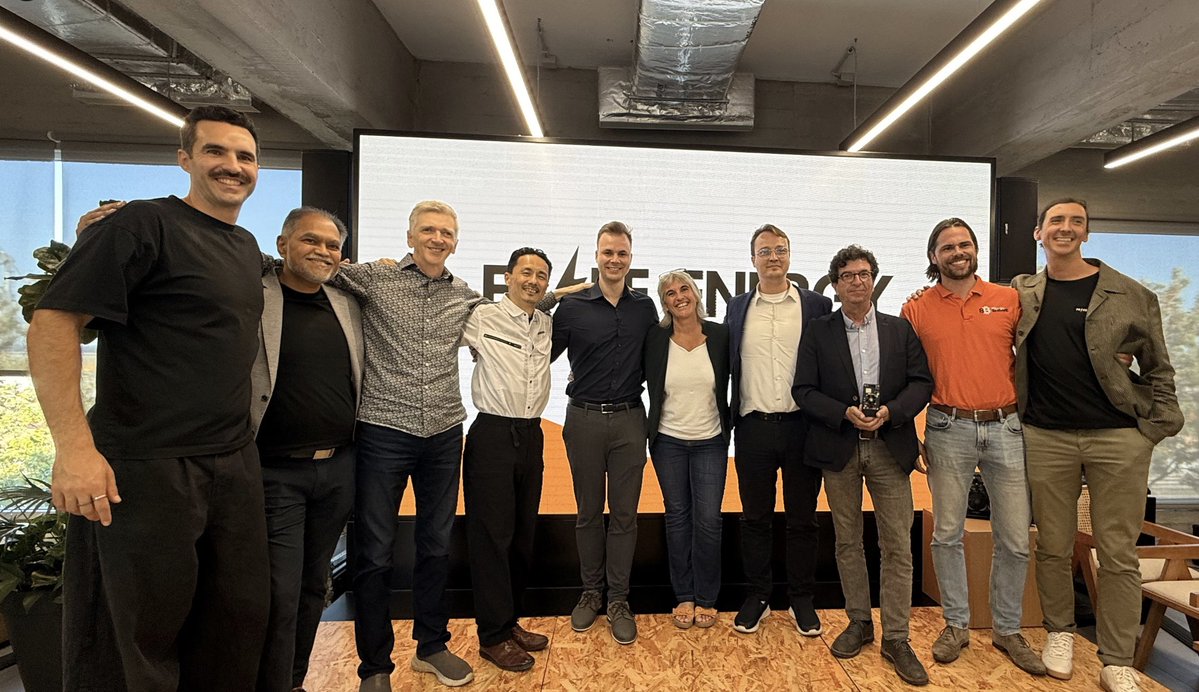
I just got back from the Bitcoin Energy Summit in Lisbon and I have a question that won't leave me alone.
First some context: Bitcoin mining is now stabilizing the grids of 7 nations, 4 agencies (including the Spanish Govt and the World's largest energy policy association) just called for more flexible demand being critical to the resilience of the grids of the future - and Bitcoin mining is the world's most flexible load resource by an order of magnitude.
So in light of this my question is this: why is 95% of the Bitcoin adoption conversation about Bitcoin-as-money when Bitcoin-as-energy is already deployed on grids across 3 continents?
Is it possible that energy is the Bitcoin usecase that paves the road for mainstream acceptance of Bitcoin in the West?
I've been in this space for four years now. When I started, the conversation was "bitcoin mining wastes energy." A group of Bitcoiners including @thetrocro, @jyn_urso and others changed that. Then it became "ok maybe it doesn't waste energy, but it's not useful." @gladstein, @jack and others changed that too.
But here's what I noticed in Lisbon. Three separate European organisations - the European Bitcoin Energy Association, Free Madeira, and the Institut National de Bitcoin in France - are all independently converging on the same conclusion.
@geyer_rachel, Chair of EBEA said energy is what will move the needle for Bitcoin in Europe. @andreloja at @FREEMadeiraOrg said energy is the most topical issue in Europe right now. Bastien Desteuque (@Proxy18387764), directeur général at @BitcoinPolicyFr said they're focusing on mining because France has spare nuclear capacity and that's where the biggest opportunity is.
Three organisations. Same conclusion.
And that's before you get to what's actually being built. In Sweden, a man I coach runs ASIC hardware that earns almost two-thirds of its revenue from frequency regulation - keeping the lights on, responding in seconds to the need of the grid operator, and helping to stabilize the grid an incredible 11,247 times last year alone. (Yes, you read that sentence right).
In Lisbon, I watched Kenji Tateiwa present a circular economy where bitcoin mining heat grows tropical fish and the CO2 gets converted to charcoal and micro diamonds. Bastian outlined how France's surplus nuclear energy could be absorbed by bitcoin mining by 2027.
And outside the West, from stabilizing the economy of Bhutan post-covid to helping save Virunga National Park in Africa - Bitcoin mining was behind both events and many more. This phenomenon is a global one.
The conversation has quietly moved from "does bitcoin mining help grids?" to "how many services can one machine provide?"
We've been thinking about this like monoculture - one machine, one function.
What I saw in Lisbon is permaculture. The same hardware doing frequency regulation, heat capture, Sats-minting ... and potentially in the near future - voltage regulation (something that would have prevented the 28 April 2025 Iberian Peninsular Blackout).
I talked to Bitcoin founders after the keynote who told me the energy thesis had opened their eyes. These are people who worked to advance Bitcoin payment infrastructure, and they hadn't fully grasped this.
Bitcoin solves a monetary problem the world is only beginning to understand. I'm more convinced of that than ever.
And ... as we wait for that revolution to be fully grasped, the energy revolution is already here - deployed, generating revenue, stabilizing grids. It might just be the thing that opens the door for everything else. What other Bitcoin use case is this far along ... at least in the West?
At the end of 2023 I met the person who ran GreenpeaceUSA's campaign against Bitcoin. I expected it to be tense.
But it wasn't.
He told me he'd read almost all of my responses to the posts they'd made on Twitter.
"I wish we'd engaged with you and people like you from the outset," he said.
Two months later he left Greenpeace.
A few months after that they ended the campaign entirely.
It was the most well-funded, yet the worst result in their history. I keep coming back to that phrase.
"People like you." Not me, but a whole group: Troy Cross, Margot Paez, Elliot David, Susie Violet Ward and many others.
We were working independently, with no budget and no coordination.
We just shared data and conviction. It is a great story of a decentralized response beating a multi-million dollar centralized campaign, by a combination of having the truth behind us, and expressing that truth in such a way that reasonable people could see.
That recipe has two parts, and it's like giving a glass of water to someone dying of thirst.
The first part is truth, there must be water in the glass.
The second part is the container, how you hold and deliver that truth matters just as much.
You can have perfect data and still lose people if the glass doesn't reach them, or if the energy behind it makes them flinch instead of drink.
We won because the data was right AND because enough people delivered it with the kind of energy that made opponents think rather than react.
And this recipe, we can use again and again throughout Bitcoin's adoption journey, and each time a Bitcoiner builds a new Bitcoin project that involves outreach to non-Bitcoiners.
"We're about to see the explosion of analog."
@garyvee wants to open a restaurant that makes you check your phone in at the door and seats you at communal tables.
"Extreme AI is creating extreme analog. I think it's a barbell."
"I could not be more interested in physical retail, event-driven businesses, in concerts and venues."
"There are a lot of interesting non-digital realities that are coming as a countermove to the insanity of AI advancements."
"We're literally within a half decade of not believing a single video that's on the internet. In 5 years, if we're having this interview, most of the audience is trying to figure out if we're real or not."
"That is very real, and has substantial counter-opportunities."
"Any real entrepreneur, they're not crying about AI killing them. They're curious about how AI at scale is going to create opportunity for them."
This is close to what I've been doing for a couple weeks, but I took it a step further and abandoned Obsidian. Don't need it when my lead agent can make the database, my librarian can index everything, my dev can make a better interface, and I can just talk to all of it.
LLM Knowledge Bases
Something I'm finding very useful recently: using LLMs to build personal knowledge bases for various topics of research interest. In this way, a large fraction of my recent token throughput is going less into manipulating code, and more into manipulating knowledge (stored as markdown and images). The latest LLMs are quite good at it. So:
Data ingest:
I index source documents (articles, papers, repos, datasets, images, etc.) into a raw/ directory, then I use an LLM to incrementally "compile" a wiki, which is just a collection of .md files in a directory structure. The wiki includes summaries of all the data in raw/, backlinks, and then it categorizes data into concepts, writes articles for them, and links them all. To convert web articles into .md files I like to use the Obsidian Web Clipper extension, and then I also use a hotkey to download all the related images to local so that my LLM can easily reference them.
IDE:
I use Obsidian as the IDE "frontend" where I can view the raw data, the the compiled wiki, and the derived visualizations. Important to note that the LLM writes and maintains all of the data of the wiki, I rarely touch it directly. I've played with a few Obsidian plugins to render and view data in other ways (e.g. Marp for slides).
Q&A:
Where things get interesting is that once your wiki is big enough (e.g. mine on some recent research is ~100 articles and ~400K words), you can ask your LLM agent all kinds of complex questions against the wiki, and it will go off, research the answers, etc. I thought I had to reach for fancy RAG, but the LLM has been pretty good about auto-maintaining index files and brief summaries of all the documents and it reads all the important related data fairly easily at this ~small scale.
Output:
Instead of getting answers in text/terminal, I like to have it render markdown files for me, or slide shows (Marp format), or matplotlib images, all of which I then view again in Obsidian. You can imagine many other visual output formats depending on the query. Often, I end up "filing" the outputs back into the wiki to enhance it for further queries. So my own explorations and queries always "add up" in the knowledge base.
Linting:
I've run some LLM "health checks" over the wiki to e.g. find inconsistent data, impute missing data (with web searchers), find interesting connections for new article candidates, etc., to incrementally clean up the wiki and enhance its overall data integrity. The LLMs are quite good at suggesting further questions to ask and look into.
Extra tools:
I find myself developing additional tools to process the data, e.g. I vibe coded a small and naive search engine over the wiki, which I both use directly (in a web ui), but more often I want to hand it off to an LLM via CLI as a tool for larger queries.
Further explorations:
As the repo grows, the natural desire is to also think about synthetic data generation + finetuning to have your LLM "know" the data in its weights instead of just context windows.
TLDR: raw data from a given number of sources is collected, then compiled by an LLM into a .md wiki, then operated on by various CLIs by the LLM to do Q&A and to incrementally enhance the wiki, and all of it viewable in Obsidian. You rarely ever write or edit the wiki manually, it's the domain of the LLM. I think there is room here for an incredible new product instead of a hacky collection of scripts.
Keystone, Bain, Deloitte, Boston Consulting. All cooked by one week of Claude updates. Nuked by future ones. Those people are probably not going to be happy with their UBI. Better start building.