Ladies, you need to be babymaxxxxing...especially later in life.
Women who had a child after the age of 40 were FOUR TIMES more likely to live to 100.
Pregnancies massively increase progesterone, the most healing female hormone.
The average student graduates after 12 years of schooling and still cannot answer the most important questions in life.
What is a good man?
What is justice?
What is worth sacrificing for?
What is beauty?
What is truth?
What is the purpose of life?
Classical education begins with the assumption that any education failing to address these questions is not really education at all.
Deep inner suffering inevitably arises when the human person is reduced to performance, consumption, or a statistical datum. Many young people today live under the yoke of expectations to perform, immersed in an exasperated competitiveness that generates anxiety, fear of not measuring up, and disorientation.
Artificial intelligences do not undergo experiences, do not possess a body, do not feel joy or pain, do not mature through relationships, and do not know from within what love, work, friendship or responsibility mean. Nor do they have a moral conscience, since they do not judge good and evil, grasp the ultimate meaning of situations, or bear responsibility for consequences. They may imitate or even simulate, but they do not understand what they produce, for they lack the affective, relational, and spiritual perspective through which human beings grow in wisdom. #MagnificaHumanitas
@JerryDi73428624@RepublicReviver@GigaBasedDad And what’s the ceiling?
I see that, but tells me growth not overpopulated
“Parisian Density: If humanity lived at the same population density as metropolitan Paris, everyone on Earth would fit into an area smaller than France”
@654_nosneb@SkyVirginSon Can you expand where they come from?
“Evangelical Christianity is a movement within Protestant Christianity, which itself emerged from the 16th-century Reformation that broke from the Roman Catholic Church.”
Today, among the goods that are universally intended for everyone, we must also include new forms of property, such as patents, algorithms, digital platforms, technological infrastructure and data. In a context where the wealth of nations depends increasingly on knowledge and technology, when these goods remain concentrated in the hands of a few, without adequate forms of sharing and access, a new imbalance is created that contradicts the universal destination of goods. In turn, it widens the gap between the included and the excluded, between those who can participate in the digital revolution and those who remain on the margins. #MagnificaHumanitas
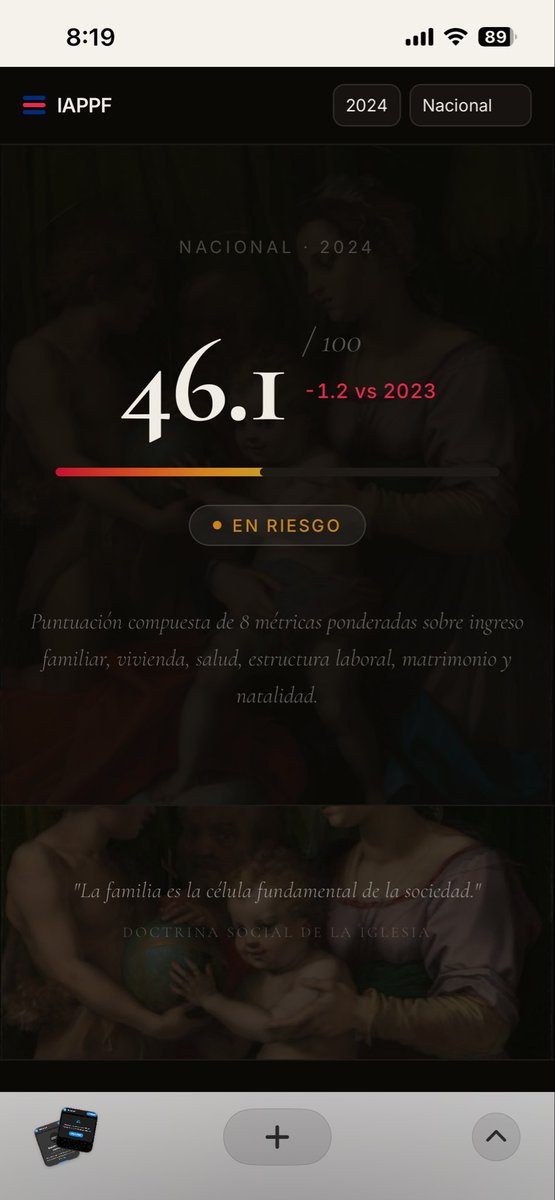
A nations’ wealth shall be measured by the well-being of the families that compose it
Inspired by this post I’m starting an effort to measure indicators like:
- health cost %
- education cost %
- …
Make sure to check it out!
Note: currently mocked date
https://t.co/MIw7sbbhk5
A nations’ wealth shall be measured by the well-being of the families that compose it
Inspired by this post I’m starting an effort to measure indicators like:
- health cost %
- education cost %
- …
Make sure to check it out!
Note: currently mocked date
https://t.co/MIw7sbbhk5
Thoughts inspired by the Church’s Social Doctrine, and Pope Leo’s latest encyclical (where he proposed better measures than just GDP for evaluating the health of our societies and economies):
What if instead of GDP, we had a “Family Formation and Prosperity Index” by which to gauge the health of our economy?
Our reading on that “FFPI” measure would improve based on things like:
—The ability of families to provide for themselves with one stream of income (yes, prioritizing men as the primary earners, and empowering wives to be mothers), including the ability to completely refrain from work at least one day per week (for worship, rest, etc.)
—The ability of families to purchase homes of modest and sufficient size for raising children (and also to own them outright, not subject to ongoing “leasing” from the government via property tax)
—The ability of families to afford healthcare costs, particularly as they have more children
—The ratio between the average pay of CEOs and workers (thus making it possible to evaluate individual corporations for the “FFPI”).
—The ability of families to find employment opportunities as close to their own extended families as possible (prioritizing the ability to build long-term in particular places)
—The marriage rate + birthrate
—The longevity of marriages once established (less divorce, adjusted for situations like death, which “artificially” bring marriages to an end)
Etc.
These are just some of the ideas I’ve had for how we should TRULY evaluate our society and economy.
🇻🇦Lo que está ocurriendo con “Magnifica Humanitas” es histórico y muchos todavía no entienden la magnitud.
Estoy leyendo la encíclica llevo varias horas y: Mientras Silicon Valley promete eficiencia, automatización y reemplazo humano, León XIV pone el problema real sobre la mesa: la IA no solo amenaza empleos, amenaza la propia concepción del hombre. Y eso cambia completamente el debate.
La encíclica no es tecnofobia. Es una declaración de guerra moral contra la deshumanización disfrazada de progreso. Por eso incomoda tanto a ciertas élites tecnocráticas que quieren reducir al ser humano a datos, productividad y algoritmos.
“No machine can ever replace” no es una frase poética. Es un límite civilizatorio.
Después de décadas donde muchos pensaban que la Iglesia había llegado tarde al debate tecnológico, el Vaticano acaba de entrar al centro de la guerra espiritual más importante del siglo XXI.
Y lo hizo defendiendo algo que el mundo moderno ya casi olvidó: el alma humana.
No la he terminado me falta mucho, más de 42.000 palabras, les recomiendo encarecidamente que la lean y no se dejen manipular por titulares de pasquines digitales ni de influencers anti-católicos. 👇🏻
✝️ Viva Cristo Rey
THE CHURCH FATHER WHO WROTE THIS IN 107 AD AND IT SILENCES EVERY PROTESTANT ARGUMENT
St. Ignatius of Antioch was a student of the Apostle John. He was arrested and sent to Rome to be eaten by lions.
On the way, he wrote seven letters. In 107 AD, within living memory of the Apostles, he wrote:
“Where the bishop is, there let the multitude of believers be; even as where Jesus is, there is the Catholic Church.” (Letter to the Smyrnaeans, 8:2)
This is the first recorded use of the term “Catholic Church” and it comes from a man who personally knew the Apostle who leaned on Jesus’ chest at the Last Supper.
He also wrote:
“Take note of those who hold heterodox opinions… They abstain from the Eucharist and from prayer, because they do not confess that the Eucharist is the flesh of our Savior Jesus Christ.”
Real Presence of Christ in the Eucharist. The Catholic Church by name. Obedience to bishops in apostolic succession.
107 AD. Not the Council of Trent. Not the Middle Ages.
The next time someone tells you the Catholic Church invented these doctrines centuries later, show them Ignatius.
He wrote this on the way to die for it.
Who will share this?