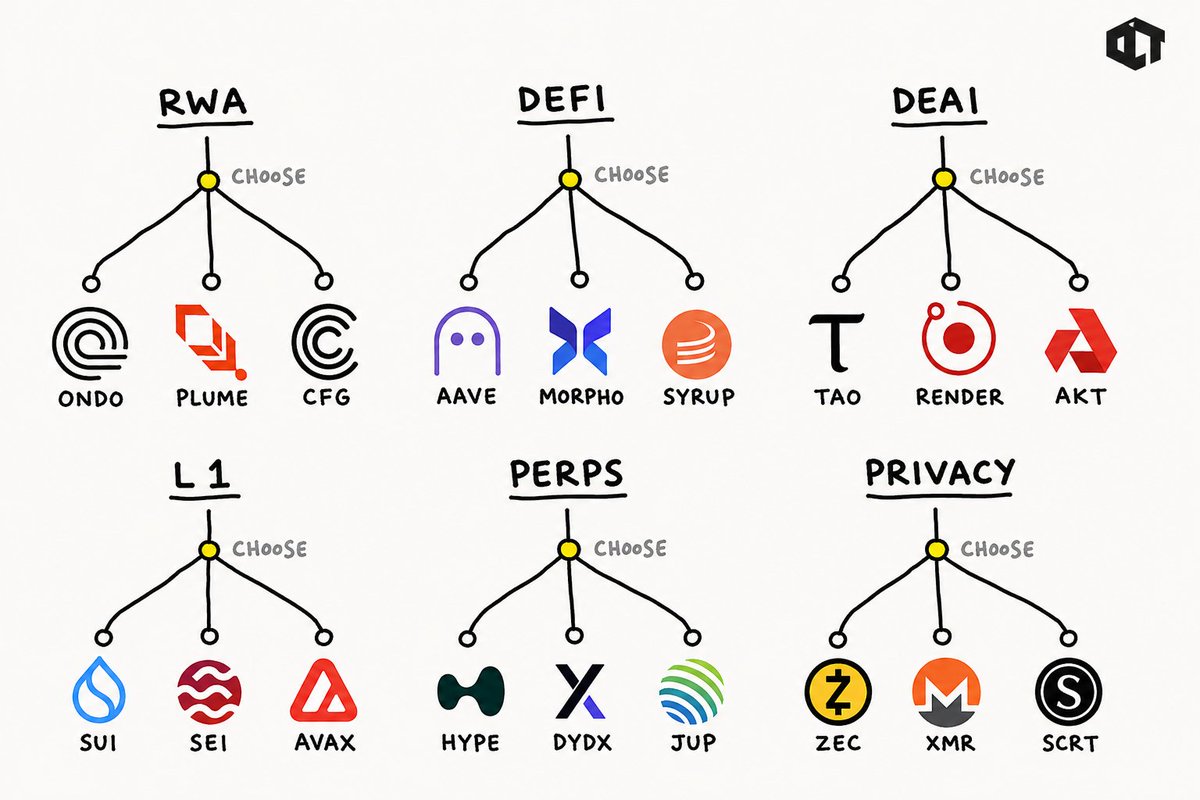
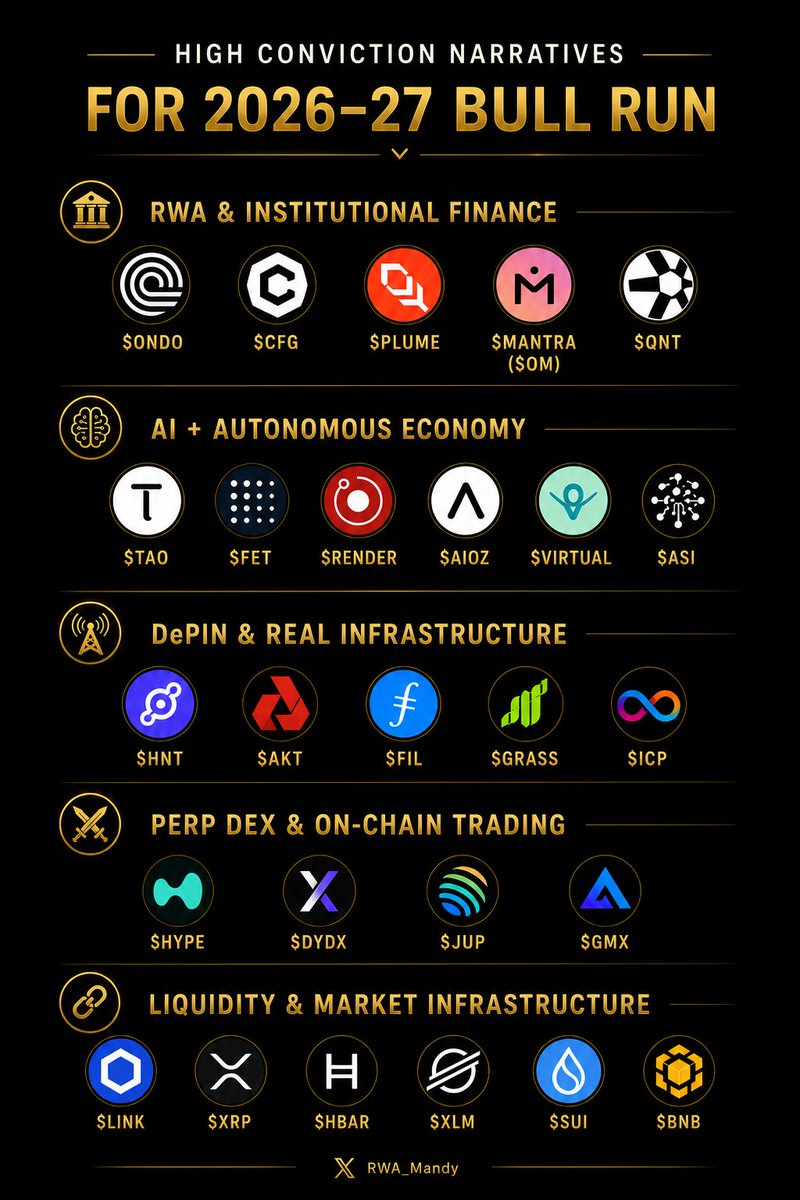
Pick one from each narrative.
RWA: $ONDO / $PLUME / $CFG
DeFi: $AAVE / $MORPHO / $SYRUP
DeAI: $TAO / $RENDER / $AKT
L1: $SUI / $SEI / $AVAX
Perps: $HYPE / $DYDX / $JUP
Privacy: $ZEC / $XMR / $SCRT
Not on the list? Name yours and say why.
We'll tally every reply and publish the results next Sunday!
In my honest opinion, if you have no more cash to invest then it is better to book loss on 80% positions and convert to USDT and keep holding 20%.
Use this USDT to buy non-privacy coins like $FET, $INJ, $VET, $SOL, $ACH, $TEL in July when $BTC reaches 39k.
Feels like 2026 just started and we're already staring at H2. AI still got a seat in basically every portfolio.
TradFi is still throwing stupid money at AI infra. So crypto continues to have a lot of room to grow, but where does crypto have a real wedge instead of just borrowing Nvidia’s narrative?
I only focus on real tech coins with catalysts heading into H2 2026.
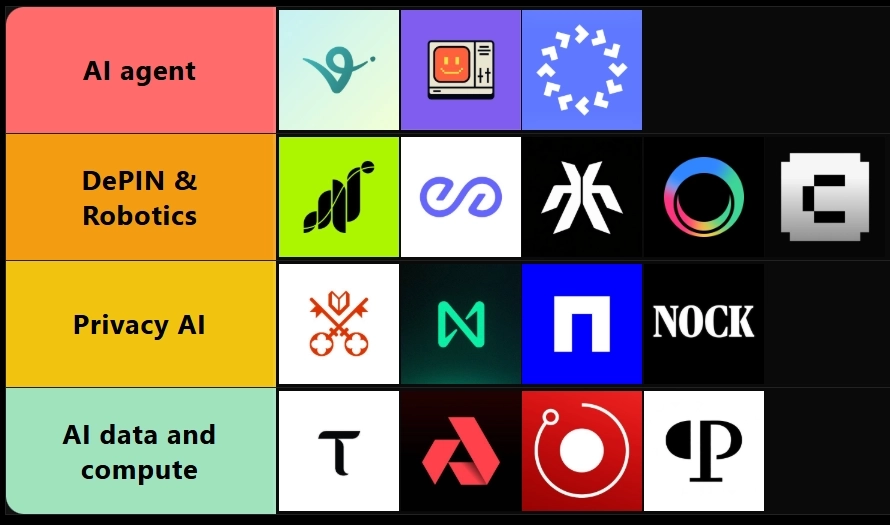
1/ AI agent utility ramp
Agents are the easiest narrative for CT to understand because they already look like onchain behavior.
The froth died, and now the surviving names need to prove real agent payments, real launchpad revenue, real trading flow, and real wallet usage.
$VIRTUAL: ACP v2, ERC-8183, Revenue Network, and still the index bet on agent commerce and tokenized AI workers.
$BNKR: already doing more launchpad volume than Virtuals and controlling 67% market share on Base. Every AI launch on Base routes value to $BNKR.
$SERV : building full-stack agent startup rails with BRAID, no-code tools, SDKs, staking, launch payments, and buyback/burn mechanics, while already pointing at UAE government usage.
2/ DePIN supply explosion from consumer hardware and robotics
The next AI bottleneck is real-world data, robot data, bandwidth, machine identity, and eventually robots paying each other for skills, maps, energy, and maintenance.
Tesla wants 50,000 Optimus units by the end of 2026, Figure is already inside BMW, 1X is shipping NEO, and Unitree keeps pushing cheap robots into the market.
$GRASS: turning idle bandwidth into AI fuel with 2.5M+ active nodes and $33M verified revenue. Season 2 is the big H2 event with a 170M GRASS distribution.
$PEAQ: machine economy L1 with 3M+ machines, 60+ DePIN apps, 20+ industries, and 1.7B+ PEAQ staked.
$DEUS: the most direct retail wrapper for private robotics exposure, with treasury exposure to Apptronik, Figure AI, 1X, Agility, Neura, and Robotico.
$ROBO: building identity, coordination, and payment rails for robots through OM1 and crypto wallets for machines.
$CODEC: operator execution rails for robotics and AI agents. Just shipped SimArena to train robots directly in the browser.
3/ Privacy AI
Nobody serious wants their agent leaking prompts, customer data, trading logic, or source code into some random model endpoint forever.
$VVV: 2M+ users, 1M+ API calls/day, and 50k–150k DAU. People will continue staking $VVV for inference capacity. DIEM turns compute into a weird perpetual API credit.
$NEAR: NEAR AI Cloud, Private Chat, IronClaw, Confidential Intents, chain abstraction, and Intents all stack together. $19B cumulative Intents volume, $32M fees, and $68M shielded volume.
$NIL: privacy compute underdog with nilDB, nilAI, and nilCC, plus 130M+ privacy-preserved data points processed.
$NOCK: ZK proof-of-work L1 where miners generate STARK proofs over NockVM, and the cuPoW thesis lets MatMul work connect directly to AI workloads.
4/ AI data and compute
Hyperscalers are fighting for power, HBM, CoWoS, data centers, and GPU clusters. Half of the US data centers planned for 2026 are facing delays from land, energy, and permitting constraints.
Real decentralized compute, model, inference, and data marketplaces look like shadow supply.
$TAO: still the main play on decentralized intelligence with 128 active subnets, ~70% of supply staked, and the $TAO ETF narrative coming.
$PRL: trying to turn AI computation itself into network security through Proof of Useful Work. Generates zk proofs through Plonky2 and secures the chain while producing compute that can be reused for inference.
$RENDER: GPU coordination at scale. 63M+ rendered frames and thousands of active GPU nodes. Started with rendering but increasingly sits inside the broader AI workload conversation.
$AKT: decentralized cloud markets. Record $5M Q1 compute spend, 120B tokens processed in April, and growing AI demand looking for cheaper alternatives to hyperscalers.
Not every AI headline will need a ticker. The market probably rewards the ones with revenue, tech, and utility rather than vapor.
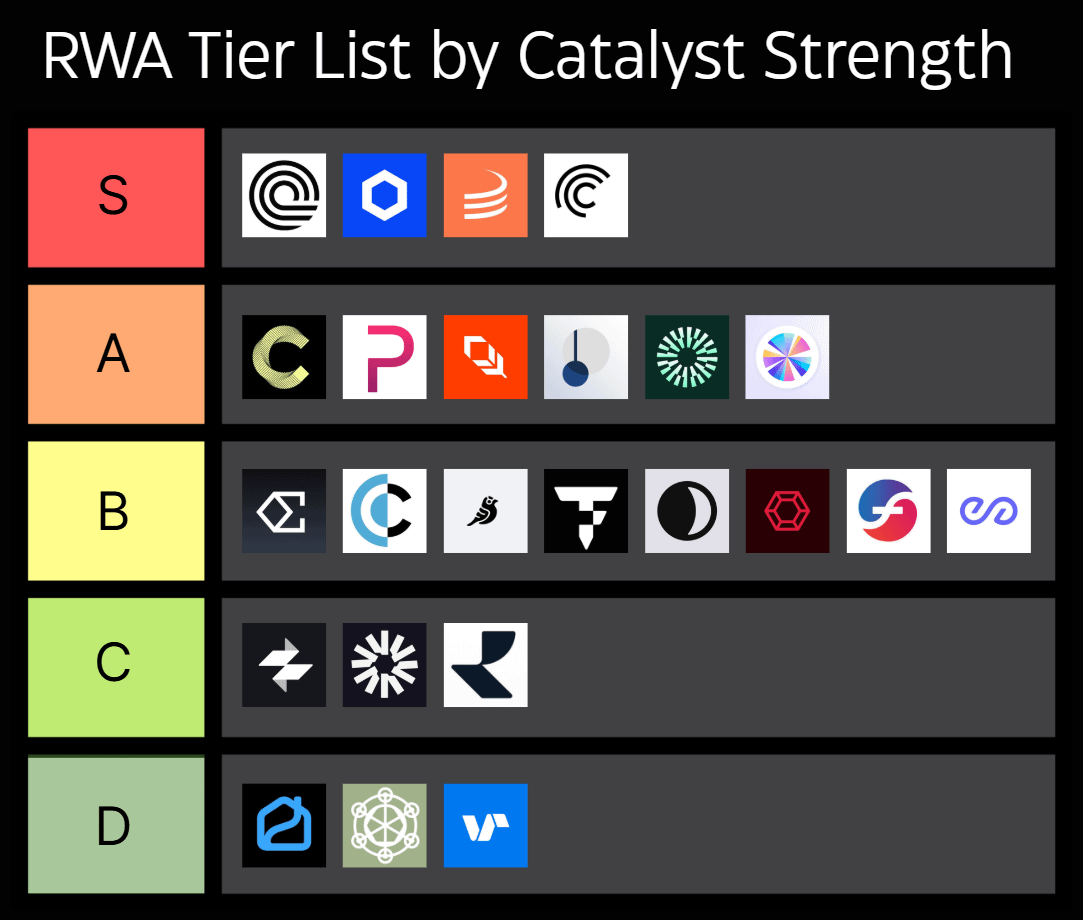
RWA Tier List by Catalyst Strength
S — strongest RWA beta
Projects with the clearest market position, real usage, institutional relevance, and catalysts that can directly affect the token.
@OndoFinance, @chainlink, @MapleFinance, @centrifuge
A — strong catalyst setup
Projects with serious infrastructure, distribution, yield, or ecosystem exposure, but slightly less direct RWA beta than S tier.
@CantonNetwork, @PolymeshNetwork, @plumenetwork, @Pendle_Fi, @Mantle_Official, @SkyEcosystem
B — high-beta RWA plays
Projects with a real RWA angle, but more execution risk, weaker token linkage, or less institutional visibility.
@ethena, @ClearpoolFin, @goldfinch_fi, @tokenfi, @DuskFoundation, @redstone_defi, @protocol_fx, @peaq
C — niche / early but relevant
Projects that fit the RWA theme, but are still more narrow, less liquid, or waiting for clearer market validation.
@IxsFinance, @KAIO_xyz, @realio_network
D — asymmetric long shots
Smaller or less visible RWA plays where current traction is limited, but the risk/reward can still be interesting if the right catalyst appears.
@PropyInc, @ChintaiNexus, @SwarmMarkets
Only narratives that I can see for this next stretch:
RWA: more institutional announcements/Trump administration good/etc. $ONDO, $OM
Trading Projects that actually make $: $JUP, $RAY, $HYPE
DeFi: WLFI bags + return to value $AAVE $LINK $ENA
Obv all dependent on healthy $BTC
I guess the coins I like the most going into the new cycle are these:
1. $HYPE (perps, L1)
2. $TAO (AI, L1)
3. $NEAR (AI, L1, privacy)
4. $LIT (perps, the best bet on perps after HYPE)
5. $PUMP (memecoins, speculation)
6. $ZEC (L1, privacy)
7. $MON (new L1)
8. $MEGA (new L2)
New coins good, old coins bad. HYPE, LIT, PUMP, MON, MEGA has never been in a bull. Well, you could argue HYPE launched at the tail of the bull, but not a full cycle. TAO and NEAR are clear tokens in the AI narrative. ZEC is the "VC-privacy coin".
But tokens are not stocks, they have no value. Yes, and no. I think this is one of the hardest "dilemmas" of the new cycle. Betting on tokens in 2023 felt like a no-brainer. We all had hopes that our coins would make a comeback at some point. Now, in 2026, with an infinite number of tokens, it's harder than ever to pick something. There is a huge difference between a good product and a good token, and since most tokens are governance tokens, do we really need them? Maybe not, but it remains the main vehicle for speculation.
What about BTC, SOL, ETH? BTC should always be a part of a core portfolio, maybe SOL and ETH also, but I think the ones above will outperform compared to them.
Anyway, my gut feeling says that there will be something else that takes the spotlight, and that "the new thing" will outperform all of the 8 I listed. These are my thoughts today. Next week or next month I could already have changed my mind, so NFA and do your own research.
Assets Under Consideration Update: Learn about the diverse digital assets we’re considering for future investment products and explore those already part of our offerings. Are we missing anything? 🤔
Read the full list and article: https://t.co/Tr5lU1CSSQ
Pay attention to projects that keep building during the down stages
$ONDO Global Markets now multi-chain
$RENDER more integrations like C4D &
$AERO recently locked 2.4M more AERO
$HBAR FedEx joins Governance Council
$NEAR Intents all-time TXs at $13 Bil
$LINK selected to Bank of England testing
$PLUME RWA Alliance with WisdomTree
$INJ ranked #2 in code commits over past year
These are the teams that are building real-world products regardless of where the market is
And when the market returns?
Most of retail wonders what the hype about these projects are.
But those who have been around will see the continued persistance and development.
JUNE 2028.
The S&P is down 38% from its highs. Unemployment just printed 10.2%. Private credit is unraveling. Prime mortgages are cracking. AI didn’t disappoint. It exceeded every expectation.
What happened?
https://t.co/JzzwCrbJgS
@rockyadi1 Exit all other non-privacy coins and cut the losses. Spread your money in $XVG, $ROSE, $SCRT, $ZEN, $DCR and $DASH. Keep 25% USDT on the sides.
✨ The Market Always Finds the Weak Point
There’s a clear common thread here: one we’ve seen repeatedly across multiple market cycles.
What Garrett, Tom Lee, Do Kwon, and Sam Bankman-Fried had in common was not fraud from day one, nor necessarily bad intentions.
It was absolute conviction combined with structural weakness. And the market always tests that.
--------------------------------------------------------
The Market Tests Where the Weakness Is.
In every cycle, the same mechanism appears. One party becomes so dominant that they:
- continuously buy
- provide liquidity
- push price higher
Eventually, the market notices.
The moment that flow weakens, the test begins.
If a system depends on constant buying pressure, a negative spiral is inevitable.
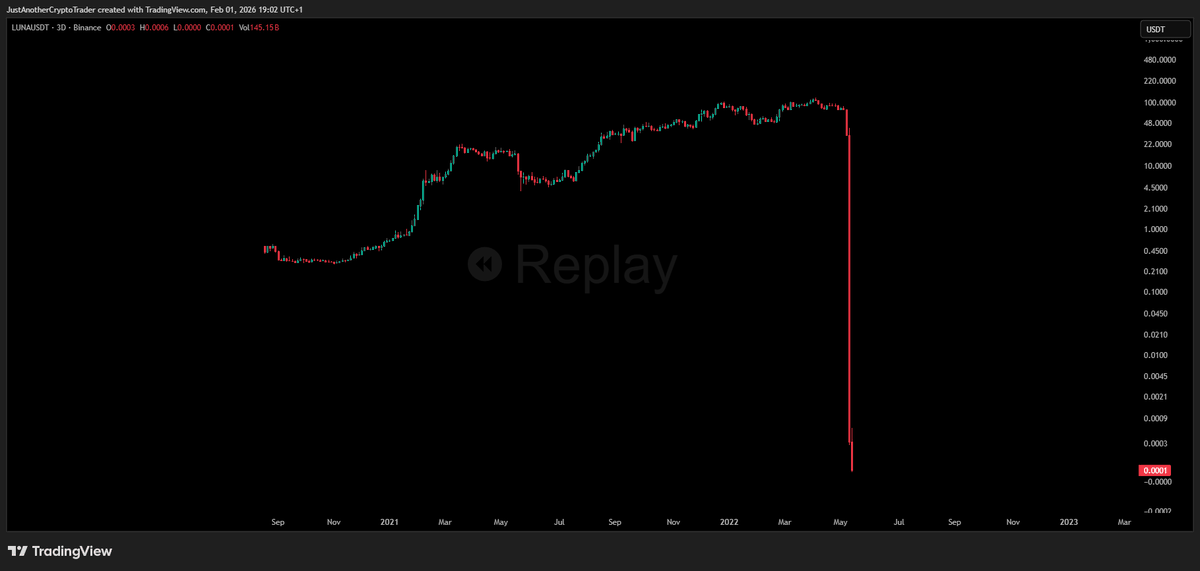
That happened with Terra/LUNA.
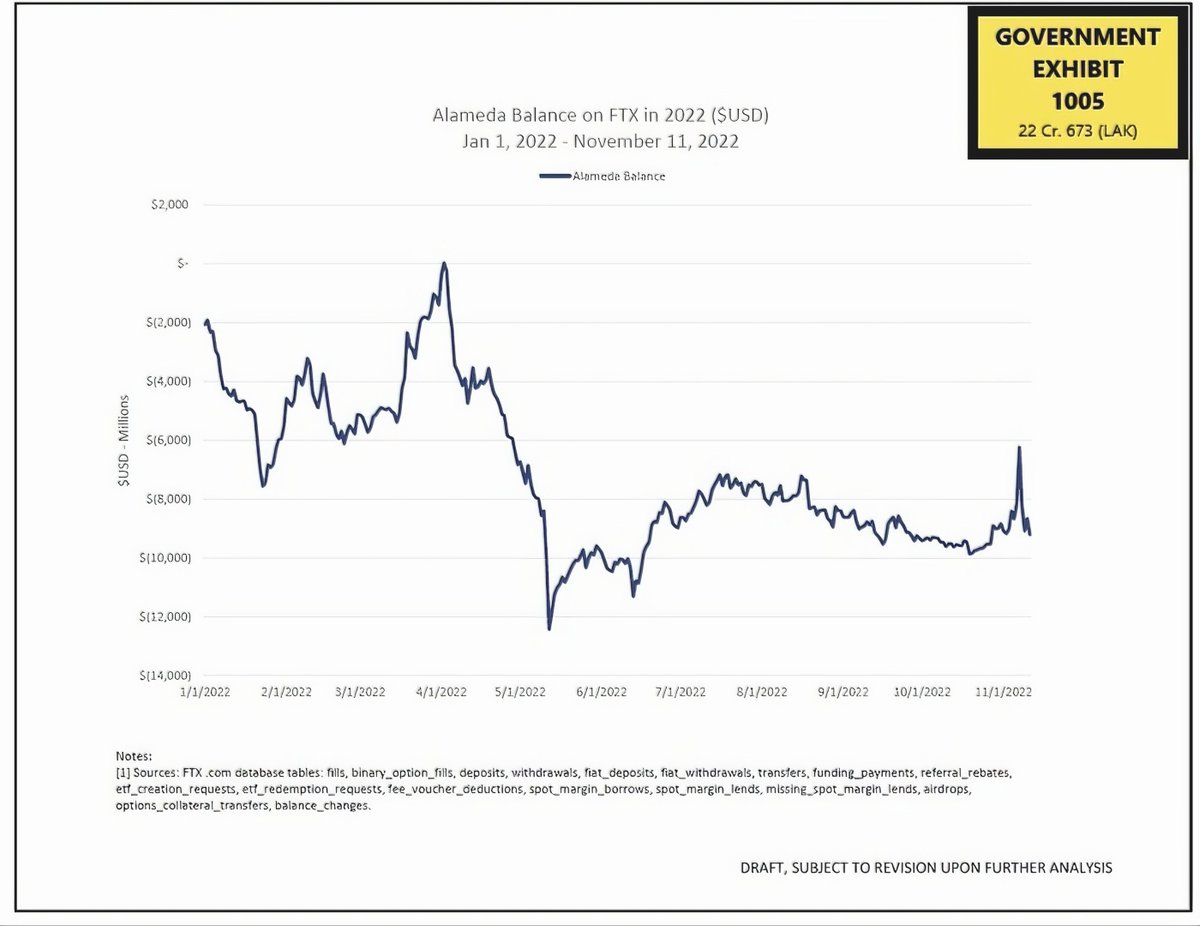
That happened with FTX / Alameda.
It happened with Tom Lee’s ETH exposure.
And yesterday, we saw it happen with Garrett.
--------------------------------------------------------
Terra/LUNA: The Illusion of an Unbreakable Spiral
With Do Kwon, the narrative was simple and persuasive:
- UST was “backed”
- LUNA absorbed volatility
- More collateral could fix every dip
When UST broke below $1, the response was always the same:
- buy more LUNA
- deploy BTC reserves
- add more collateral
But the system only worked as long as confidence and buying pressure remained intact.
Once the market realized that:
- stability depended on infinite capital
- not on real demand
the spiral reversed.
Over $40+ billion evaporated in days.
--------------------------------------------------------
FTX: Same Test, Different Form
With FTX, the prevailing belief was:
"They’ll always have liquidity.”
Until:
- withdrawals accelerated
- Alameda was forced to unwind
- FTT lost credibility as collateral
The moment the market tested “do they really have enough?” everything turned against them.
Not because anyone wanted it to fail, but because trust combined with leverage must never be tested.
--------------------------------------------------------
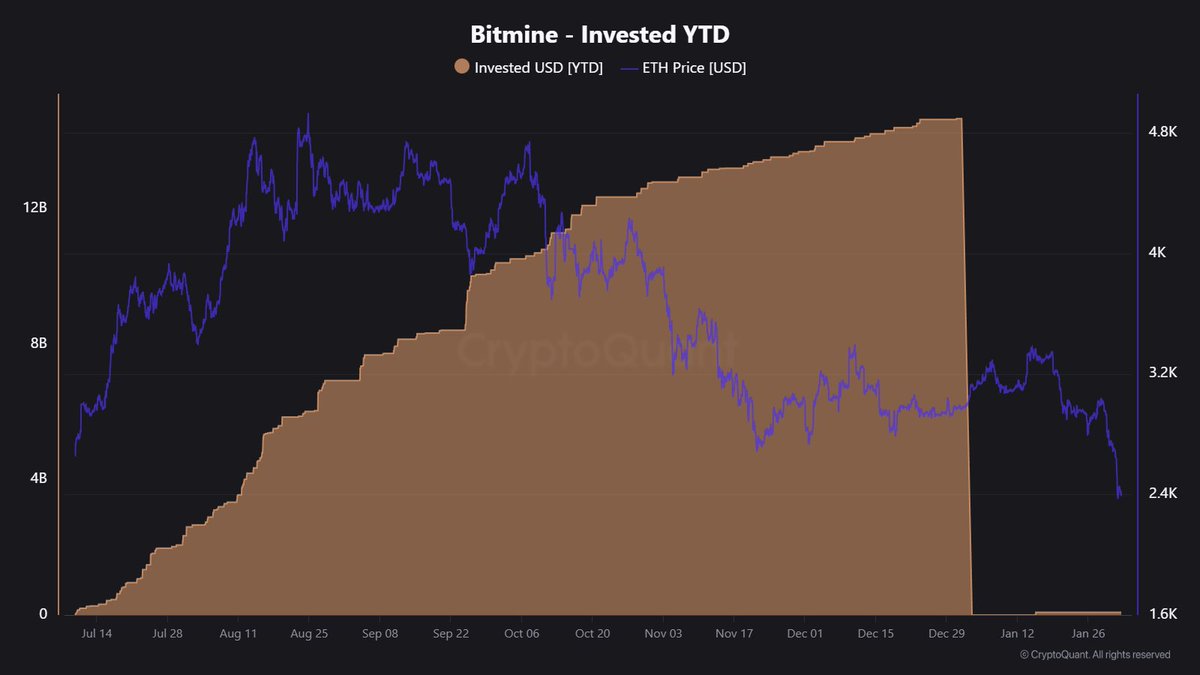
Tom Lee: When ETH Became a Money Machine
Tom Lee was extremely bullish on ETH for months — and rightly so, up to a point.
What later became clear was this:
- he was one of the largest buyers
- he kept adding on dips
- billions were deployed in additional exposure
As long as ETH was rising, the machine worked flawlessly.
But once:
- ETH went underwater
- more capital was required
- that buying power disappeared
the price structure collapsed.
The market revealed a critical truth:
buying pressure was dangerously concentrated.
--------------------------------------------------------
Garrett: The Same Mistake, Playing Out in Real Time
And now, Garrett.
- publicly extremely confident
- strong, unequivocal statements
- helt a ~$550M ETH long on Hyperliquid
This wasn’t a “normal trade.”
This was market structure.
The market could clearly see:
- the liquidation level
- where forced selling would begin
- where the weakness sat
From that moment on, everything moved against him.
Not personal.
Not emotional.
Mechanical.
-------------------------------------------------------
The Lesson (It’s Always the Same)
This isn’t about comparing people.
And it’s not about predicting who fails next.
The point is structural, not personal.
Markets consistently test:
- Conviction
- Position size
- Concentration
- Structural dependence
When price action becomes dependent on:
- one participant staying active,
- continuous capital deployment,
- or a single position absorbing pressure,
that participant stops being a source of strength in the system.
They become a reference point.
And reference points get tested.
Not because markets are malicious,
but because price discovery naturally moves toward levels where outcomes are forced.
This process repeats every cycle.
Across assets.
Across narratives.
Not occasionally.
Systematically.