@saad__1992 Not necessary.
n8n is great when the job is a fixed workflow: trigger, steps, output.
A skill-specific agent needs a tight scope, the right tools, and a clear picture of what done looks like.
What skill are you thinking of?
30 memory products for agents, and the hard question is when a fact changes.
Saving memories is easy.
Knowing that "the client prefers blue" stopped being true in March is the product.
Memory without forgetting is just a growing pile of stale context.
A review of 30 memory products for AI agents: what each one saves, how it gets memory back into the prompt, what happens when a fact changes, and what it really costs once you count the extraction tokens the price page leaves out.
Which one do you use? https://t.co/D1kNwi2NOG
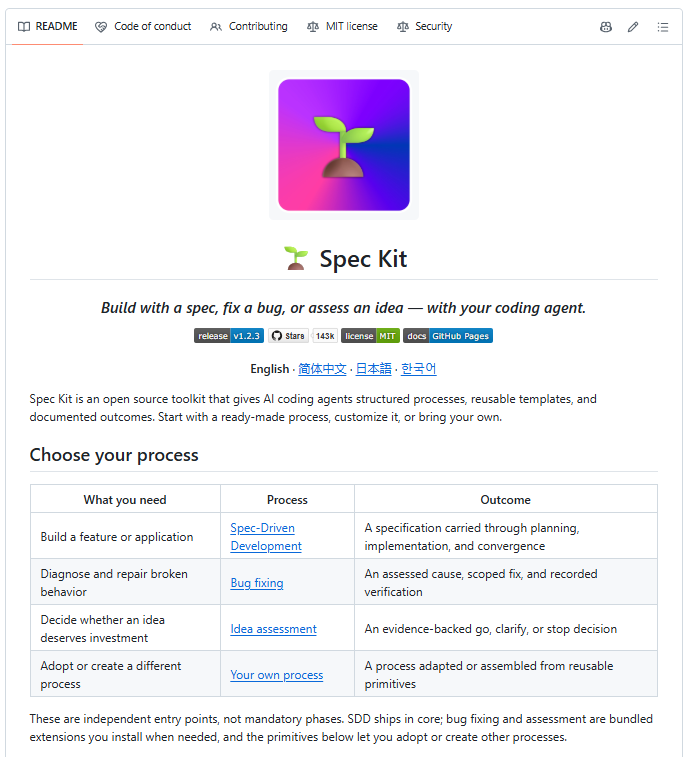
GitHub's Spec Kit has 5 commands, and the first one isn't about code.
/speckit.constitution is where you write the project's principles.
That's the file most vibe-coded apps never had.
Agents follow specs well. They follow values only if someone wrote them down.
VIBE CODING IS CHANGING.
2025–2026 might be remembered as the era of building software by throwing prompts at AI.
GitHub released Spec Kit, a toolkit that takes a different approach.
Instead of asking your coding agent to build things on the fly, you define the specification first. Then the agent follows a structured process to implement it.
The workflow has 5 commands:
→ `/speckit.constitution` → Define your project's principles.
→ `/speckit.specify` → Describe what you want to build.
→ `/speckit.plan` → Decide the tech stack and architecture.
→ `/speckit.tasks` → Break the work into actionable tasks.
→ `/speckit.implement` → Let the agent build it.
Spec Kit supports 30+ AI coding agents, including GitHub Copilot, Claude Code, Codex, and Cursor.
The idea is simple:
Stop improvising with prompts. Start giving AI a clear plan to execute.
The future of AI coding isn't just about writing better prompts. It's about giving agents better specifications.
GitHub repo in the comments. 👇
One ChatGPT chat, one new algorithm, one climate crisis solved.
The model agreed with everything, so the pitch deck does too.
Before an investor sees it, ask the same model to tear the idea apart.
Turns out it's great at that part too 🙃
I don't think people realize how many pitches investors get today from people who "invented a new algorithm" or "solved the climate crisis" because of one conversation with ChatGPT.
@johnnynelai fork --last is the one I'd use most.
Let the agent try the risky approach in a copy and keep the original thread clean.
Does the fork carry the working files too, or just the chat?
The 5th question on that list is the one most agents fail.
Seeing the logs and reading the diff is plumbing.
Knowing when to stop and say "I'm not sure, check this" is judgment.
An agent that never asks for help isn't confident. It's unmonitored.
We've been running a few agents to monitor production systems for a few weeks now.
Agents working 24/7, looking at failures, suggesting potential causes, and recommending fixes.
We're not only saving a ton of money, but we are also doing things we couldn't before.
But to set this up, you need to trust these agents. Here are a few questions you need to answer:
• Do your agents understand how your systems work?
• Can they see what actually happened?
• Do they have access to the code that changed recently?
• Can you verify the evidence behind the agent's recommendations?
• Do these agents recognize when they need help?
You can't automate production monitoring without all of this.
Here is what you want to do next:
@rileybrown Same with coding agents.
If you can't tell good output from bad, every result looks fine to you.
Do it by hand first, then automate what you understand.
@Prathkum "Most agents" sounds like the old lines-of-code metric.
I'd bet on whoever writes the clearest specs and catches bad output fastest.
Agent count is easy to inflate.
@MengTo@Viggle_PINOC@ViggleAI One image per world is the unlock.
The cost of 3D on the web was mostly making the assets.
If the input is a single picture, the bottleneck moves to art direction.
@Replit Designers shipping code with engineers approving is the interesting part.
Where's the bottleneck now: reading the diff, or agreeing on what the design was supposed to do?
@yulikay@axiommathai The proof work had Lean, a checker that says a hard yes or no.
Most codebases have nothing that strict.
Agents can only verify their work as well as our tests define "done".
@figma Bigger deal than it sounds.
With generated work, the source is the prompt and the params, not the pixels.
Rolling back the recipe is what makes it safe to experiment.
@DannPetty Clickable changes the feedback, not just the deck.
Once a client can arrow through it, they stop judging colors and start asking what happens after this screen.
Every archetype in Andrew Chen's list hits the same wall: customers.
AI removed the code bottleneck for the doctor, the creator and the kid.
It didn't remove the conversations that tell you what to build.
The new founder edge is listening, not shipping.
New essay:
https://t.co/Tm7eYpIXxs
NEW FOUNDER ARCHETYPES IN THE AI AGE
Solo founders
- Why: Solo founders can do 100x with AI, so they can ship a v1 when previously they couldn’t have before
- Why not: Maybe a team of cofounders still makes more progress. Maybe you can agentically code but someone still needs to do a million meetings with customers. Maybe coding was never the main bottleneck for startups in the first place?
Non-technical founders
- Why: There’s elite talent that comes from areas like finance, consulting, who can’t code but are passionate about business. There’s also folks in creative industries who create all day but just not in code. Now they can build
- Why not: Why not: Maybe AI makes it easier to build a prototype, but there’s still a big gap between a demo and a reliable product that can scale. If everyone can build the first version, maybe technical judgment becomes more important in deciding what to build, what’s actually possible, and how to stay ahead as the product gets more complex. (especially true for product categories like dev tools/etc)
Domain experts
- Why: A doctor who works at a hospital understands all the problems they face each day. A real estate broker really gets the subtleties of their markets, their clients. Same with a soldier, teacher, etc. What if they could use software to solve their own problems and build business along the way?
- Why not: Hoteliers didn’t create Airbnb and the finance industry didn’t create Kalshi. Sometimes you just need an outsider’s view in order to reinvent an industry, versus building incremental improvements
Kids, high schoolers, college students
- Why: Young people have already been building products early on. Start with a Minecraft mod, a Roblox game, a Discord bot, and suddenly you’ve learned how to make something that thousands of other people use. Now add AI, and a kid with an idea can build way more, way earlier
- Why not: Building something your friends love is very different from building a company. You still have to hire, raise money, manage people, and figure out how to make money. And maybe young founders have an advantage in consumer products because they understand their peers, but much less of one when it comes to enterprise software, healthcare, or other industries where experience and relationships really matter. Sometimes you just need domain expertise
Content creators
- Why: They’re already creating. So instead of creating videos, maybe the same skills can go into creating software. Plus, they have distribution. They know what their followers care about, how to get their attention, and how to reach them without paying for ads. In the past, turning that audience into a software product meant finding a technical cofounder or hiring a team. Now a creator could build and launch something themselves, and immediately put it in front of millions of potential users.
- Why not: Having followers helps with a spike of distribution, but building a sustainable growth engine is something else. The most valuable products aren’t memes - they are long-running, long-growing products that need to be endlessly tweaked and iterated on. Does the DNA work?
Ramp's coding agent writes 74% of merged PRs, up from ~30% in January.
3 takeaways:
The input is a screenshot in Slack, not a spec.
99% of eng, design and product used it, so the users aren't only engineers.
The output is a tested PR, so review stays the gate.
wow @tryramp back at it again + just turned its internal coding agent into a product, Inspect
Inspect lets anyone on the team tag it in Slack, GitHub or Linear w/ a task (even just a screenshot + "@ inspect fix this") and get back a tested PR ready for review
some stats from inside Ramp:
> writes 74% of merged PRs, up from ~30% in Jan
> used by 99% of eng, design + product in the last month
> builders ship 3.4x as many PRs per person vs a year ago
first model routing (Router), then AI workspace / OS (Glass), now coding agent (Inspect) --> every day looking more like an AI lab than a fintech
https://t.co/tGzhhuOzlK
$5000 to $4 is the headline. The brief is the real story.
The first video already answered what the product should look like on screen.
The $4 refresh got to start from that answer.
Pay for taste once, then let the cheap tool iterate 😅
Synthetic users are the most supportive users you'll ever have.
They love the onboarding, never rage-quit, and always find the sign up button.
Which is exactly why you can't ship based on them 🙃
100 releases a day, and Kent still keeps PRs. That's the tell.
A PR was never just a gate for humans.
It's the one place where review, preview, CI and the why live together.
Skip it and agents don't get faster. They just lose the record of why.
I've done over 100 releases a day several times as a solo maintainer and I could do this without PRs, but I would have to build out what my PRs do for me to get that level of confidence so why would I?
- AI Review
- Preview deploys
- CI
- Historical records of decisions
One agent plus skills beating a team of subagents is an org chart lesson.
Most multi-agent setups copy how teams are drawn, not how work flows.
Every arrow between boxes is a handoff, and every handoff is a summary.
Draw the agent around the task and most boxes disappear.
Anthropic just flipped the AI agent playbook.
ONE agent + skills can beat a team of subagents.
Better quality. Lower cost. Less latency.
One customer's loop ran ~2x faster.
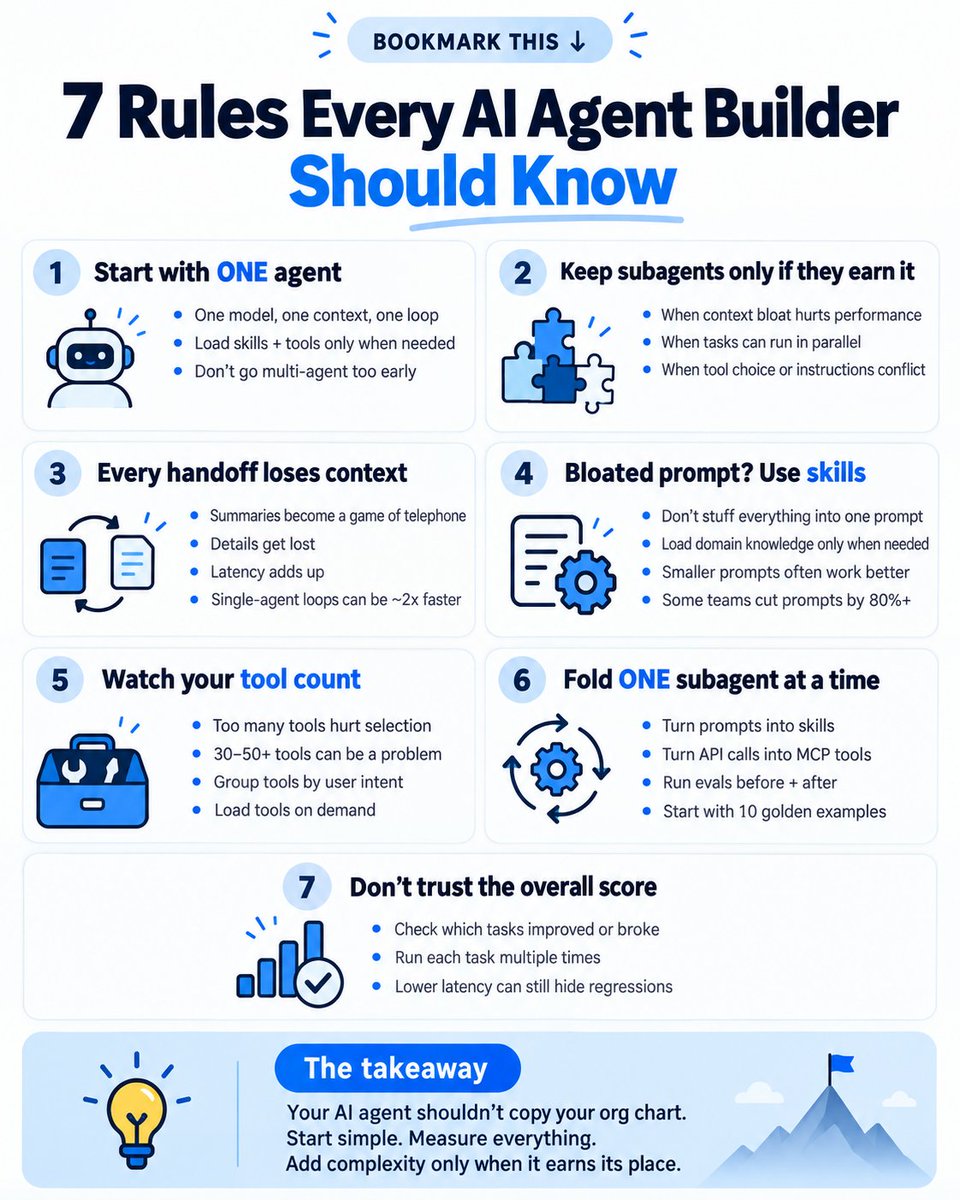
7 rules every AI agent builder should know.
Bookmark this ↓
1. Start with ONE agent
One model. One context window. One loop.
Load skills + tools only when needed.
Don't build a multi-agent system before you've proven you need one.
2. Keep subagents only when they earn their place
Three good reasons:
• Context bloat measurably hurts performance
• Tasks can run in parallel with fresh, disposable context
• One agent struggles to select tools or handle conflicting instructions
Otherwise, simplify.
3. Every handoff loses context
Multiple agents passing summaries back and forth create a game of telephone.
Details get lost. Latency adds up.
One customer saw ~2x faster runtime after moving to a single-agent loop.
4. Bloated prompt? Use skills, not more agents
Stop stuffing every instruction into one giant system prompt.
Load domain knowledge only when needed.
Anthropic says it cut Claude Code's system prompt by over 80% for newer models, partly through this approach.
5. Watch your tool count
Anthropic found that tool selection tends to degrade beyond 30–50 tool definitions in the system prompt.
Group tools by user intent.
Use on-demand tool loading instead of exposing everything at once.
6. Fold ONE subagent at a time
The migration process:
• Turn prompts into skills
• Turn API calls into MCP tools
• Run evals before + after
• Keep only changes that improve results
Just 10 golden examples are enough to start evaluating.
7. Don't trust the overall score
Check which specific tasks improved or broke.
In Anthropic's own test, folding a subagent reduced latency but broke a previously working process.
Run each task multiple times.
The takeaway:
Your AI agent shouldn't be a copy of your org chart.
Start simple. Measure everything. Add complexity only when it earns its place.
Genie 4 turns the first question of game design into a prompt.
The hard part of a world was never rendering it.
It was deciding what happens when someone walks in.
A world that reacts in real time moves that decision from code to taste.
This is Genie 4, our most realistic and interactive world model yet. 🌐
Explore dynamic environments in real time to see how the scene responds, sounds, and how the people in it move, react, and speak.