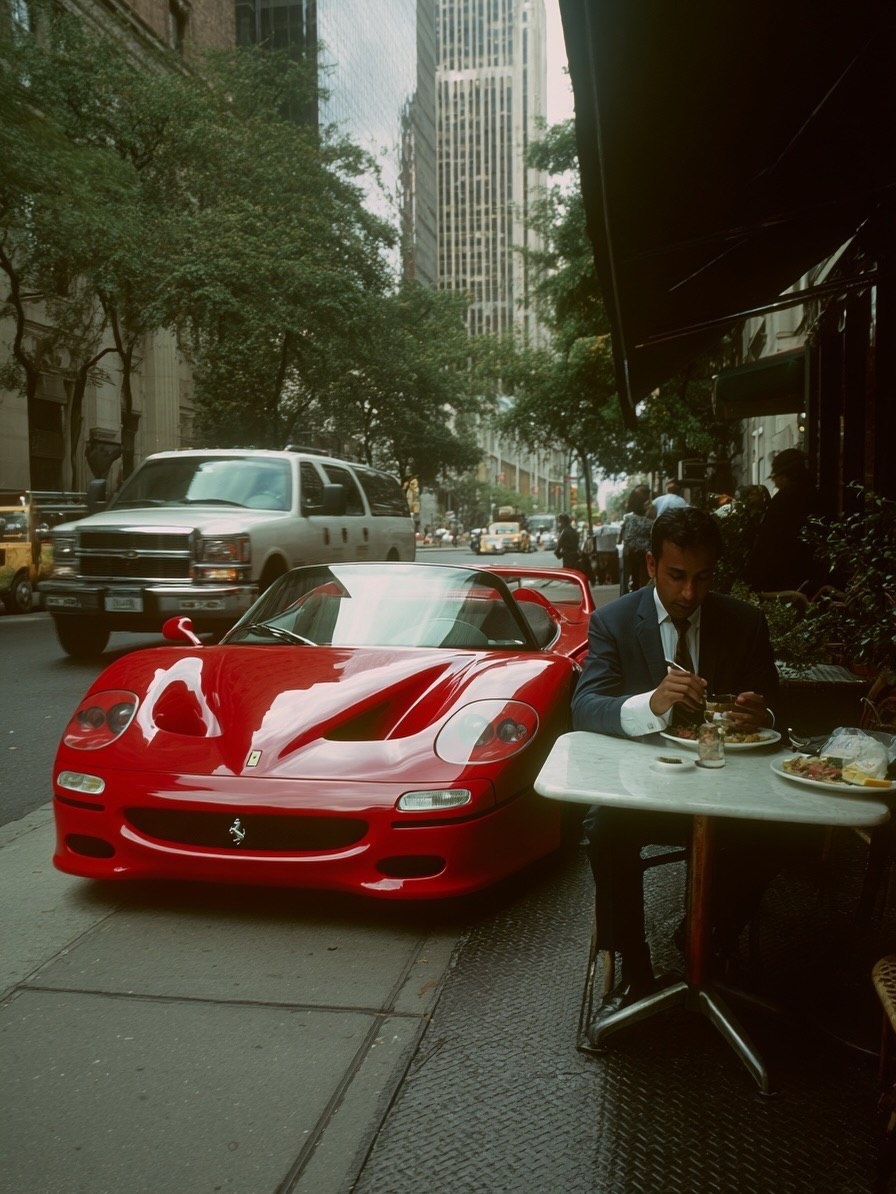
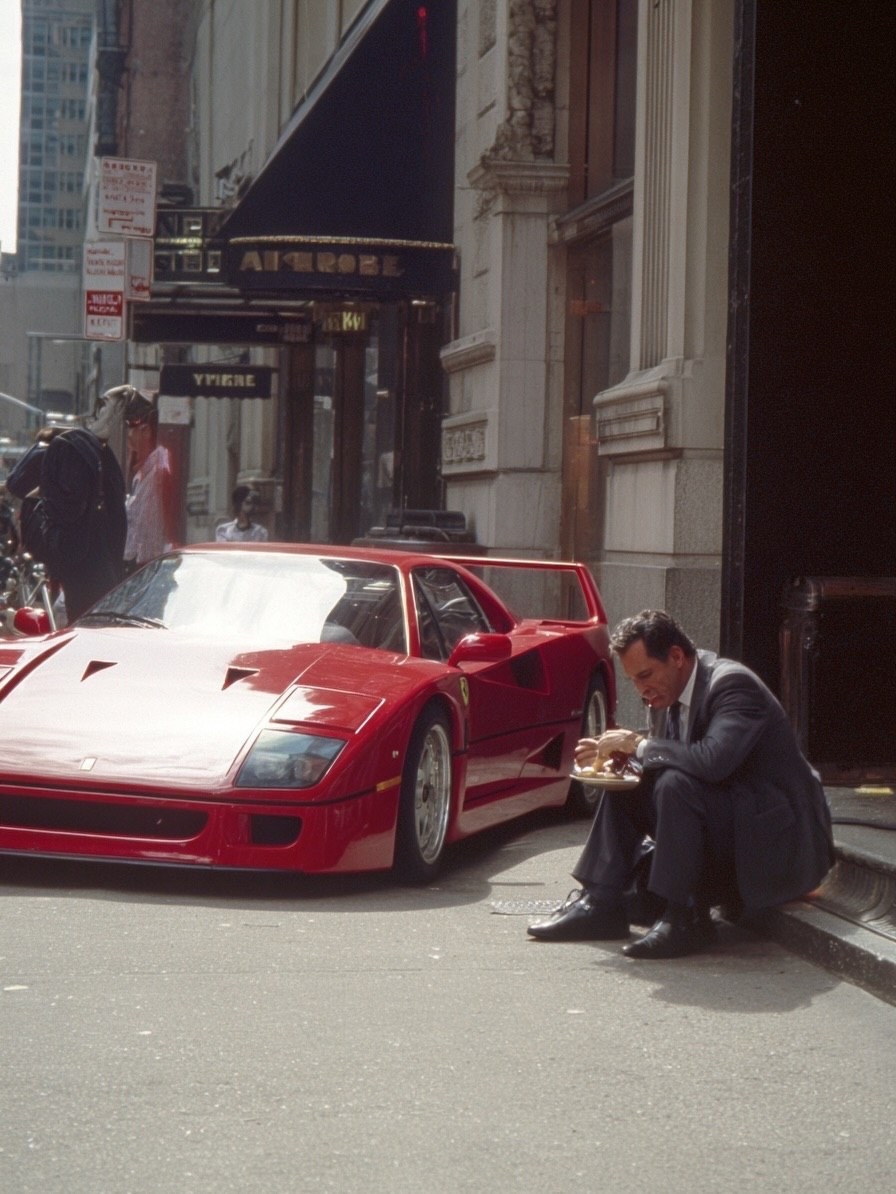
In the 1990s, it was quite common in major financial centers to see businessmen and bankers eating in or around their supercars. A man in a tailored suit might sit on the hood of his Ferrari, finishing a quick lunch, while another leans against his Lamborghini, talking on a large mobile phone. Outside cafés and restaurants, it wasn't unusual for someone to choose a terrace table just to keep their Porsche in clear view.
At that time, the culture around success was becoming more visible and expressive. The financial boom and rapid growth of global markets created a new kind of professional who was driven, ambitious, and often proud of what they had achieved. For many, these cars were not just a way to get around but a symbol of long hours, risk taking, and reward.
Practical reasons also played a role. Their schedules were tight and time was valuable. Grabbing food quickly while staying close to the car made it easier to move between meetings without delay. There was also less concern about appearances compared to today, so eating casually next to an expensive car felt natural in that fast paced environment.
At the same time, there was a sense of enjoyment.
Sitting near the car, even on a pavement or café terrace, gave a moment to pause and appreciate the lifestyle. It was a simple mix of convenience, pride, and the spirit of the decade, where business, image, and personal success were closely connected.
Live in Exclusives. Live in Exclusives. A Vagabondage II, FP Journe's first wristwatch to have a fully digital, jumping time display. Debuting in 2010, the Vagabondage II uses three indepedent discs and a remontoir d'égalité to deliver exact digital time. The project required over 10 years in development, first percolated in 1995 when a Parisian client asked François-Paul for a wandering hours wristwatch. The idea continued to develop when Cartier expressed interest in the project (partially inspiring the 38mm tortue case), finally culminating in three prototypes for the ICM Foundation charity auction. Demand proved so large that FP Journe continued developing the idea. The first Journe fully digital display, seen here in the Vagabondage II, arrived within one year of the Zeitwerk. Both had been developed independently and arrived at the 'time bridge' dial. The Vagabondage II was made in 68 pink gold examples as seen here, one of the most audacious and technically interesting works FP Journe has conquered. https://t.co/7H7p1hULiC
This designer still makes all shoes by hand 🪡
Marcos Hjorn was founded by shoemakers Marcos and Aina, who construct all pairs made-to-order from their Barcelona studio.
Lamborghini Polo Storico unveils its latest 1972 Miura SV restoration at the Anantara Concorso Roma. Pure magic, elevated by the first super sports car in history.