We are slowly removing coincidence out of our lives. We don't pick a restaurant before even checking the ratings. We don't hear music before the algorithm ever predicts we'll like it. We don't even take a route before maps removes the wrong turn. Barely meet someone even before checking their profile. And none of that is necessarily bad. But that's what makes it interesting because every tool nowadays removes every tiny bit of uncertainty, but uncertainty is where a lot of your favorite memories came from. The place you found by accident, the friend you met because the plans changed. The street you weren't supposed to be on that ended up having the best restaurant you've ever been to. We've optimized our life so well to the point where nothing unexpected ever has room to even happen and a life with no accidents is easier to manage, but it's just harder to remember.
Playing Super Mario 64 for 30 minutes a day for two months physically grew the brains of the people who played it. A 2014 study in Molecular Psychiatry scanned participants before and after two months of daily play and found increases in grey matter in three regions involved in memory, planning, and fine motor control.
The study was led by Simone Kuhn at the Max Planck Institute in Berlin. She gave 23 adults a Nintendo DS and told them to play Super Mario 64 for at least 30 minutes a day for two months. A control group played nothing. MRI scans taken before and after showed that the Mario group had measurable increases in grey matter in the right hippocampus, the right prefrontal cortex, and the cerebellum, and the increases were not found in the control group.
The hippocampus is where the brain stores spatial maps. Super Mario 64 is a game built entirely around navigating three-dimensional space, jumping between platforms, remembering which doors lead where, and building a mental model of a world that does not exist. The brain treats a virtual world the same way it treats a real one: it maps it, stores it, and grows to accommodate it.
The prefrontal cortex handles planning and strategy, which the game demands constantly. The cerebellum handles timing and coordination, which every jump requires. The brain was not just entertained. It was being trained, and the tissue responded the same way muscle responds to a weight: it got bigger.
Kuhn said the results suggest that video game training could be used as a therapy for conditions where these brain regions are reduced, including post-traumatic stress disorder, schizophrenia, and age-related brain shrinkage. The prescription is a plumber in a red hat, 30 minutes a day. https://t.co/8hKZMvh8VN
Being in your 40s is wild. One friend is a grandma, one has a newborn, one is celebrating 20 years married, and another is dating a 25-year-old. Half of us look 28, the other half pulled a muscle sleeping. 😂 No timeline, just vibes. 😭
Reminder to go touch grass
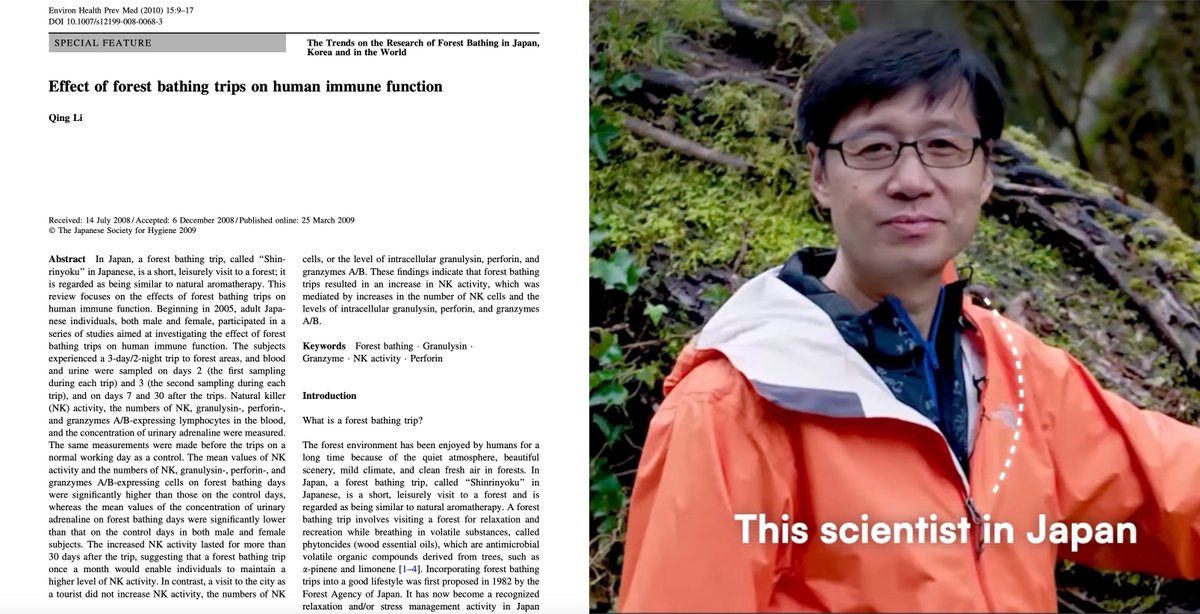
A scientist in Japan demonstrated that the air inside a forest strengthens your immune system for a full month
The study is incredibly fascinating:
Qing Li, an immunologist at Nippon Medical School in Tokyo, took 12 men on a 3-day forest trip. These were slow walks with no breathing exercises and no set route.
Then he tested their blood and found a surge in natural killer cells -- the immune cells your body uses to fight cancer and virus-infected cells.
Remarkably, the effect didn't fade when they went home, it was still measurable 30 days later.
A control group that walked the same distance through a city showed no change at all.
Pine, cedar, and cypress trees release compounds called phytoncides to defend themselves from insects and bacteria. You breathe them in, and Li believes they switch your immune cells into high gear.
He estimates one forest walk a month may be enough to keep those cells elevated all year.
The best medicine might not even need a prescription -- just a walk among the trees.
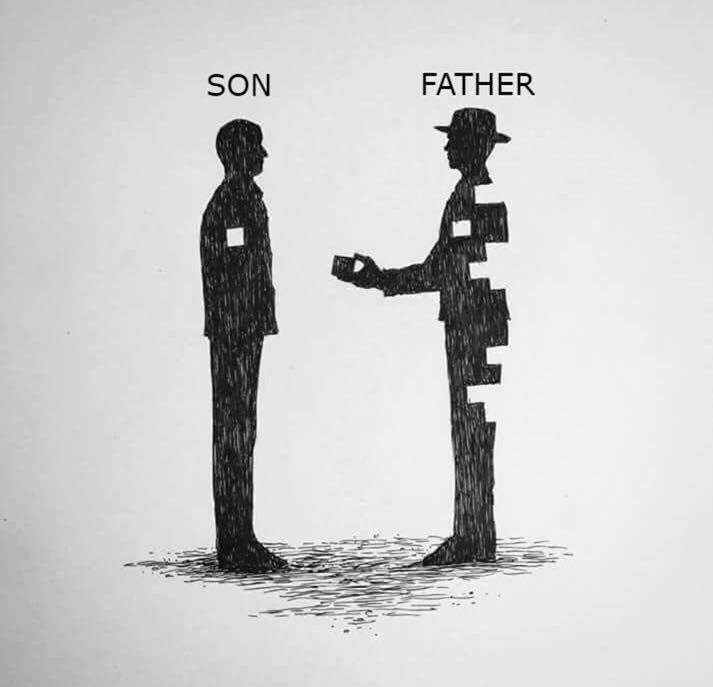
RULES FOR SONS:
1. Never shake a man’s hand sitting down.
2. Don’t enter a pool by the stairs.
3. The man at the BBQ Grill is the closest thing to a king.
4. In a negotiation, never make the first offer.
5. Request the late check-out.
6. When entrusted with a secret, keep it.
7. Hold your heroes to a higher standard.
8. Return a borrowed car with a full tank of gas.
9. Play with passion or not at all…
10. When shaking hands, grip firmly and look them in the eye.
11. Don’t let a wishbone grow where a backbone should be.
12. If you need music on the beach, you’re missing the point.
13. Carry two handkerchiefs. The one in your back pocket is for you. The one in your breast pocket is for her.
14. You marry the girl, you marry her family.
15. Be like a duck. Remain calm on the surface and paddle like crazy underneath.
16. Experience the serenity of traveling alone.
17. Never be afraid to ask out the best looking girl in the room.
18. Never turn down a breath mint.
19. A sport coat is worth 1000 words.
20. Try writing your own eulogy. Never stop revising.
21. Thank a veteran. Then make it up to him.
22. Eat lunch with the new kid.
23. After writing an angry email, read it carefully. Then delete it.
24. Ask your mom to play. She won’t let you win.
25. Manners maketh the man.
26. Give credit. Take the blame.
27. Stand up to Bullies. Protect those bullied.
28. Write down your dreams.
29. Always protect your siblings (and teammates).
30. Be confident and humble at the same time.
31. Call and visit your parents often. They miss you.
32. The healthiest relationships are those where you’re a team; where you respect, protect, and stand up for each other.
Morty: Capitalism gives everyone a chance to get rich if they just work hard enough.
Rick: Oh my god, Morty! Capitalism doesn't work if everyone wins. It needs poverty to function. Someone has to take the low-paying jobs so the profits keep flowing upward. If everyone had real financial security, no one would take those positions and the system would collapse.
Morty: But Rick, that's just how the market works. Some people earn more because they provide more value.
Rick: Tell that to the kid assembling your iPhone overseas for pennies while some CEO makes millions off it. Capitalism doesn't reward work, it rewards ownership. You don't climb the ladder by working hard, you climb it by owning the ladder. The workers collectively produce infinitely more value than some shareholder living in the Bahamas.
Morty: Okay, but isn't it about freedom People can still move up if they make good choices. Look at people who came from nothing and became successful, like entrepreneurs or celebrities.
Rick: Those are exceptions, idiot. That's why they're on TV. For every one person who makes it out, millions stay stuck because they never had the same luck, connections, or safety nets. The system needs those stories so people believe it's fair.
Fred Rogers met with a child psychologist every week for 22 years to build his show. She shaped everything: every script, prop, and song. The whole point was to give a child's nervous system time to slow down. In 1984, a single regulatory decision ended all of it.
The psychologist was Dr. Margaret McFarland, who co-founded the Arsenal Family and Children's Center alongside Benjamin Spock and Erik Erikson. She and Rogers understood that the prefrontal cortex in children, the part of the brain that controls impulse, emotion, and attention, takes decades to fully develop. At the start of every episode, Rogers tied his sneakers and changed his sweater while children settled in. Those pauses were intentional, designed to help a child's nervous system shift into a calmer, more focused state.
What ended it had nothing to do with child development science. In 1984, Reagan's FCC chairman Mark Fowler abolished the advertising limits that had protected children's programming from commercial pressure. Toy companies moved within months. Between 1984 and 1985, cartoons tied to toy lines increased by 300%, from a handful of shows to more than 40 animated series. In almost every case, the toy was designed first. The cartoon was built to sell it.
Researchers later put numbers to what parents were already noticing. A 2011 study in Pediatrics from the University of Virginia tested 60 four-year-olds across three groups: one watching SpongeBob, which cuts scene every 11 seconds; one watching a slow PBS show, which cuts scene every 34 seconds; and one drawing. Nine minutes later, all three took tests on attention, impulse control, short-term memory, and problem-solving. The SpongeBob group scored significantly worse across every measure.
In the 1970s, children began watching television around age 4. Research from pediatrician Dimitri Christakis found that by 2009, the average age of first screen exposure had dropped to 4 months, as the content got faster and the audience got younger. Researchers separately found that each additional hour of daily screen time at ages 1 or 3 raised the risk of attention problems at age 7 by 9%.
😱😱😱 And just like that, it’s completely VANISHED from the media.
A sitting congressman, Ted Lieu, said on the record the Epstein files are being blocked because they show Trump raped and threatened to kill children.
Lets make this viral again 👇
I'm finally reading Dune. This quote, which is in the first few pages, hits hard:
"Once men turned their thinking over to machines in the hope that this would set them free. But that only permitted other men with machines to enslave them."
This the quintessential story of how sports reflects the state of the world. Thousands of fans have waited for Game 3 their whole lives and now they’re priced out of entering the game and can’t even celebrate outside because one billionaire gets to attend the game for free.