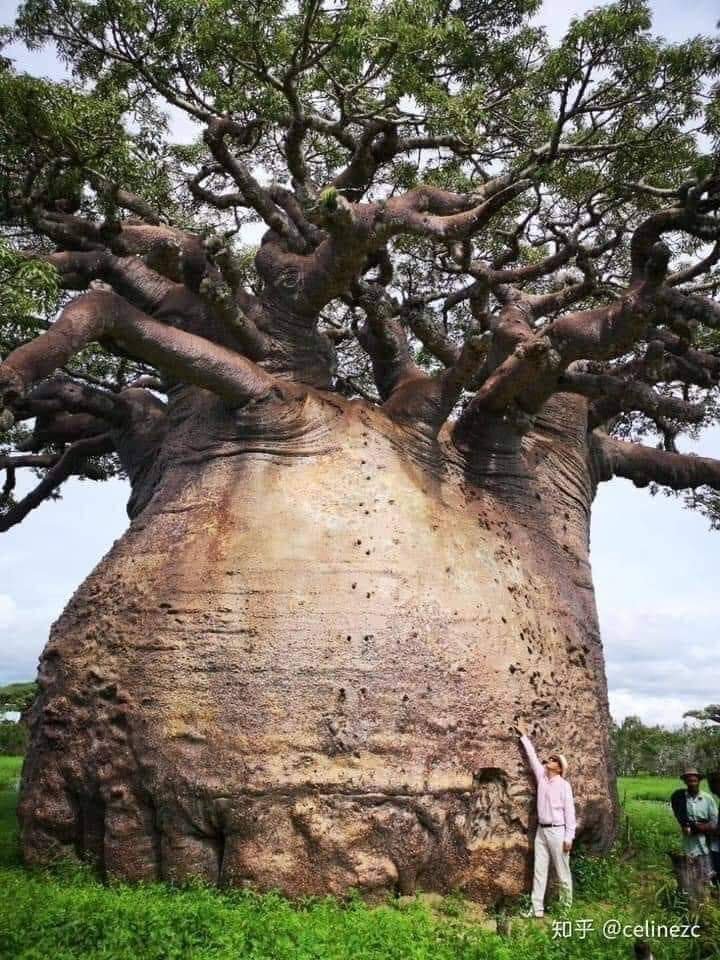
The sacred Tsitakakantsa, a massive and ancient Grandidier's baobab (Adansonia grandidieri) located near Andombiry in Madagascar 🇲🇬.... This giant specimen is estimated to be around 1200 years old and has a massive trunk circumference of nearly 29m. Known locally as the "mother of the forest" or "mother of all trees," it is considered a sacred and protected landmark....
Baobab, a prehistoric species which predates both mankind and splitting of continents over 200 million years ago. Baobabs (Adansonia) are distinctive trees with incredibly large trunks. They can store tremendous amounts of water, as their trunks noticeably swell during the rainy season.
Tree is native to African savannah, where climate is extremely dry and arid, it is a symbol of life and positivity in a landscape where little else can thrive. African baobab (A. digitata) has a vast range throughout the arid parts of Africa; six additional species are native to the Indian Ocean island of Madagascar, off south-east Africa; and an eighth species is native to north-west Australia. The largest known living baobab is the Sagole Big Tree, a specimen of A. digitata located in Masisi, Vhembe, South Africa, near the border with Zimbabwe. Based on its most recent measurements, Sagole has an extremely large base that covers 60.6m², a height of 19.8m and a total wood and bark volume of 414m³. Its aboveground dry mass is estimated to be 54 tonnes.
Baobab trees grow in 32 African countries. Tree known for its longevity and some specimens in Africa have been dated to between 1100-2500 years old and reach up to 30m high and up to an enormous 50m in circumference. Baobab trees can provide shelter, food and water for animals and humans, many savannah communities made their homes near Baobab trees. Baobab also looms among ancient mounds and remains scattered around them are invariably early medieval or Portuguese.
Until 2018, the largest living baobab was sacred Tsitakakoike Baobab, a specimen of the endangered species Adansonia grandidieri, which grew near Andombiro in the Ambiky Forest of south-west Madagascar. The incredibly stout and compact tree had a cylindrical trunk with a base that covered 59.6m², a height of 14.6m and a total volume of 455m³ - 380m³ of which was trunk and 75m³ of which was canopy. It partially broke and collapsed in February 2018 leaving about 40% of the tree still standing, but this was expected to also collapse soon after.
An even larger African baobab tree (A. digitata) alive during 21st Century was the Platland/Sunland Tree of Modjadjiskloof, South Africa, with a base of 67.9m², height of 18.9m and a total wood and bark volume of 448m³. Unfortunately, a large portion of the Platland Tree collapsed and died in 2016, leaving the Sagole Big Tree to claim the top spot.
Baobabs have among the lightest wood for any tree. Balsa wood is well known to model aeroplane makers as one of the lightest and softest woods with a wood density that averages around 0.15g/cm³, yet baobab wood is even lighter, averaging 0.13 g/cm³. As a result, the aboveground dry mass of the Platland baobab was estimated at only 58 tonnes and about 59 tonnes for Tsitakakoike. In terms of mass, giant gum trees (Eucalyptus) of Australia are the largest hardwood trees.
The Sagole Big Tree has been carbon-dated to 800 years old, the Platland Tree to 1100 years and Tsitakakoike to 1270 years.
#archaeohistories
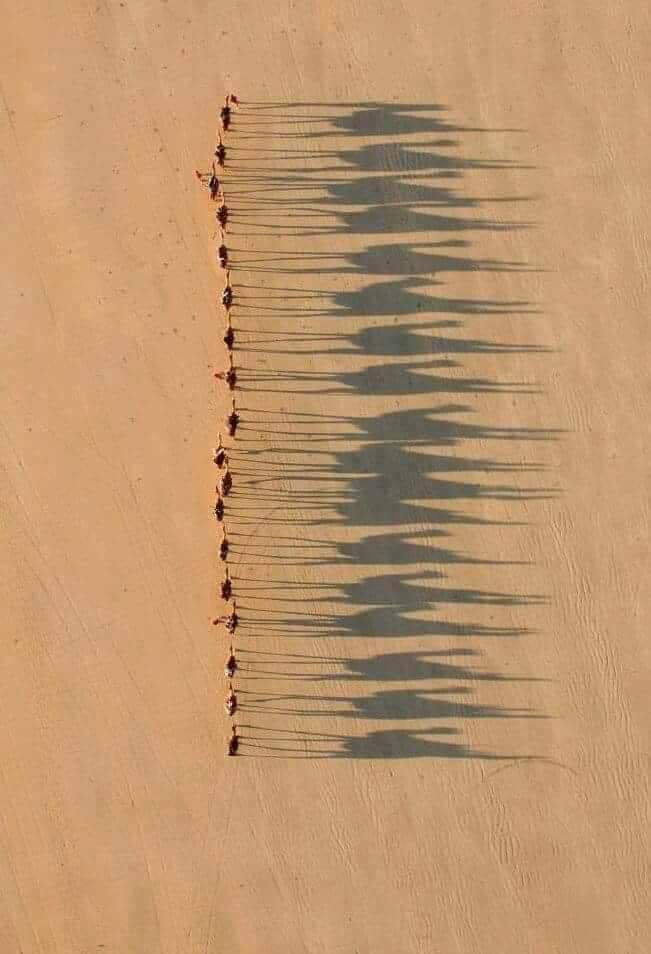
The iconic National Geographic photograph captures a line of camels walking across golden Sahara sand, their elongated shadows stretching dramatically in the late afternoon sun...
The camel caravans which crossed the great dunes of the Sahara desert began in antiquity but reached their golden period from 9th Century CE onwards. In their heyday caravans consisted of thousands of camels travelling from North Africa, across the desert to the savannah region in the south and back again, in a hazardous journey that could take several months. Stopping along the way at vital oases, the caravans were largely controlled by the Berbers who acted as middlemen in the exchange of such desired commodities as salt, gold, copper, hides, horses, slaves, and luxury goods. The trans-Saharan trade brought with it ideas in art, architecture and religion, transforming many aspects of daily life in the towns and cities of a hitherto isolated part of Africa.
Long before the great trans-Saharan caravans of the medieval period, there was a more localised trade between nomadic desert peoples and the tribes of the savannah region south of the Sahara, often called the Sudan region. Rock salt from the Sahara itself, which was badly needed in the salt-impoverished savannah, was exchanged for cereals (e.g. rice, sorghum, and millet), which could not be grown in the desert.
Greek historian Herodotus, writing in 5th Century BC (Histories, Bk 4. 181-5), noted a camel caravan route which went from Thebes in Egypt to Niger (although Memphis is more likely to have been the starting point). Roman writer Pliny the Elder (23-79 CE) noted in his Natural History (5.35-8) that the caravans were managed by the Garamantes, probably ancient Berbers, who lived south of Libya. The Garamantes, in control of the date-palmed oases at Fezzan, acted as middlemen between the peoples of North Africa and sub-Saharan Africa. This arrangement would continue throughout the history of trans-Saharan commerce because those who controlled the desert, who knew the secrets of meeting its formidable challenges, also controlled the trade.
Roman Tripolitania (modern Libya) was supplied with gold, ivory, ebony, cedarwood, and exotic beasts destined for the circuses, while olive oil and luxury goods like fine ceramics, glassware, and cloth were sent south in the exchange. Further east, there were also camel caravans linking Darfur in northwest Sudan to Assiut on Nile at least from 1st Century CE. Known as the Darb al-Arbein ('Road of 40 Days') it brought ivory and elephants from Africa's interior and thrived into Late Antiquity.
Salt was the major commodity going south which was exchanged for gold, ivory, hides, and slaves (acquired from African tribes conquered by the sub-Saharan empires). Goods were gathered up from across the entire West African region and channelled along the Niger and Senegal Rivers to trading 'ports' like Timbuktu. As the Sudan region saw new and richer empires rise like the Mali Empire (1240-1645 CE) and Songhai Empire, so a wealthy elite sought evermore exotic and expensive goods from North Africa and the wider Mediterranean.
Besides salt, caravans transported southwards glazed pottery (luxury vases, cups, oil lamps, and incense burners), precious and semi-precious stones (especially garnet and amazonite), cowrie shells and copper wire to be used as currencies, copper ingots, horses, manufactured goods, fine cloth, beads, coral, dates, raisins, and glassware (cups, goblets, and perfume bottles). As Sudan empires spread their influence and new powers rose such as Hausaland, so this brought in new goods to the trans-Saharan trade like kola nuts (a mild stimulant), ostrich feathers, perfumes, and tobacco.
#archaeohistories
Presley Gerber, Cindy Crawford's Son, Dead At 27: Dr. Drew on His Ibogaine Addiction Treatment w/ Ben Bergquam & AJ Rice – Ask Dr. Drew https://t.co/jdWOlf8YRN
The greatest inheritance may be the ability to build your own.
Jackie Chan has said he doesn’t intend to simply hand his fortune to his son.
His philosophy: if his son is capable, he should make his own money.
I agree with the principle.
Money can provide comfort, but struggle builds resilience, discipline and independence.
The best inheritance isn’t necessarily a bank account.
It’s values, education, opportunity and the confidence to create your own success.
Give your children a head start, not the finish line.
Senators just voted to stop paying themselves during government shutdowns, but the rule will not take effect until after the next election.
In May 2026 the U.S. Senate unanimously passed Sen. John Kennedy’s resolution to withhold senators’ salaries whenever the government shuts down. Because of the 27th Amendment, any pay withheld before the November 2026 election would be placed in escrow and released only after the congressional session ends. After the election the rule would fully take effect, meaning senators would no longer receive pay during a shutdown.
Kennedy’s argument was simple. If federal workers can miss paychecks because Congress fails to keep the government open, lawmakers should not keep collecting theirs.
The measure passed 99 to 0, a rare show of bipartisan agreement, after the country endured a combined 119 days of government shutdowns between October 2025 and May 2026.
Melania Trump: "My husband would like to have a country where all of the people can walk down the street and not be harassed or murdered or women raped"
🚨Al-Nassr are now considering promoting Cristiano Ronaldo Junior to the 𝐅𝐈𝐑𝐒𝐓 team.
There is a real possibility that the father & son duo could play alongside each other. 🤯