Excited to share the preprint of our work on structuring A&P sections in clinical notes!
In it we provide a dataset and build ML models to identify problems, their assessments and plan action items.
https://t.co/aUES5XEoG7
@GoogleAI@GoogleHealth#MedTwitter
Oran Lang innovates at Google, advancing medical explainability with Generative AI and now with Gemini. His project, StylEx, uses StyleGAN to visualize decision-making. This breakthrough aids understanding and detects biases, opening new research avenues. Explore Oran's impactful work at Google Research. → https://t.co/N4VvC8CW3m
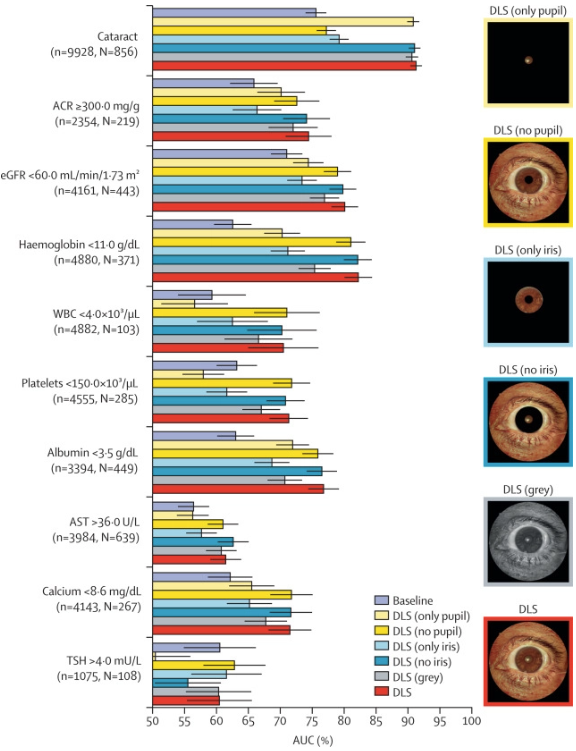
NEW Research: A #DeepLearning model for novel systemic #biomarkers in photographs of the external eye. @GoogleHealth
Read it here: https://t.co/IjF3YOPl0h
The accompanying dataset, containing annotations of almost 580 notes and over 30K annotations over physician notes from the MIMIC-III dataset, is available at Zenodo: https://t.co/0XfVeUeCSy
Our code is available on GitHub: https://t.co/EiGeP9YHZt
Excited to share the preprint of our work on structuring A&P sections in clinical notes!
In it we provide a dataset and build ML models to identify problems, their assessments and plan action items.
https://t.co/aUES5XEoG7
@GoogleAI@GoogleHealth#MedTwitter
We show that in this task, incorporating domain knowledge in the form of weak supervision on heuristics and data augmentation improves performance with fewer labels and generalization across departments.
Excited to share the release of my first paper @GoogleAI with Johannes Ballé, @MatharyCharles and Jakub Konečný! https://t.co/432aHGqnqY
We leverage rate-distortion theory to achieve competitive accuracy at a fraction of the communication cost in federated learning.
Our paper on peptide-protein docking with @AlphaFold2 was published today in @NatureComms 🥳🥳🥳 Now it also includes calibration of the method and further analysis of the results!
Have a look at: https://t.co/DZbhY26xVF
We published a new supervised functional prediction method based on integrating clade-specific co-evolution signals. Led by @doronst1, with Elad Sharon and Idit Bloch, all from @YTabach lab, and with @marinkazitnik
https://t.co/DXnKTLek7q
@Caroline_Bartma I think WikiGenes (https://t.co/4cpRfbL9bH) and WikiPathways (https://t.co/fhGSxfHv1z) have this aim in mind, I find both to be quite useful
Our new paper is out today. We used CRISPR to uncover some really striking findings with several drugs and drug targets in clinical trials. Also, we accidentally found the first-ever inhibitor of the cyclin-dependent kinase CDK11. https://t.co/Rthvr67cyk
Come see my poster (K-31) at #ISMBECCB and talk about functional interaction prediction using machine learning and phylogenetic profiling! #evolcompgen
A really mind blowing talk by Olivier Lichtarge about modeling evolutionary fitness with Calculus. Interesting to see how powerful these basic principles are in modeling evolution. #ISMBECCB
Great talk from Wei Wang at #ISMBECCB about extracting clinical knowledge from case reports using deep learning. Turning case reports into graphs @bio_kare
Timothy Lu's group presents SPECS for screening and identify #synbio synthetic promoters with cell-state specificity
Out now @NatureComms
https://t.co/qLp0XhyyjY
Excited for my first co-author paper! Published today @NatureComms
https://t.co/3zKbob3gqm
A high-throughput screening and computation platform for identifying synthetic promoters with enhanced cell-state specificity (SPECS)
#phdchat#mdphd#Science#scitwitter#rstats