🚨GIVEAWAY ALERT🚨
RETWEET THIS and FOLLOW US
for a chance to get this autographed
Xavier Worthy mini helmet and
official football COMBO! 🏎️💨
#NFLRivals🏈 #ChiefsKingdom
Inflation... boon or bane for Polkadot? 🤔
Join the Great Debate: Polkadot’s Inflation. Learn about key proposals aimed at adjusting/reducing inflation, and explore their potential impact on the ecosystem 💡
Live on 𝕏, YouTube & LinkedIn
🗓️ Tomorrow July 31st, 11:00am UTC
The Simplified Guide to Understanding Polkadot Asynchronous Backing
Asynchronous backing is just released feature in #Polkadot, specifically designed to enhance how parachain blocks (para blocks) are managed and integrated into the Relay Chain.
Let's simplify this concept to understand how it functions and its benefits.
First, let's explain what is a parachain.
Parachains in @Polkadot function similarly to Ethereum's rollups in that they both process transactions off the main chain. However, parachains are like highly customizable rollups that scale transactions and offer varied and unique blockchain functionalities. They rely on the Relay Chain for overarching security and consensus, akin to how rollups rely on #Ethereum for security and data availability.
While rollups primarily focus on scaling transactions and smart contracts, parachains offer broader functionalities, including but not limited to data storage, complex financial applications, identity management solutions, supply chain management, cross-chain interoperability, or smart contracts within the Polkadot ecosystem.
In the Polkadot network, a parachain is a blockchain that runs parallel to the Relay Chain. Parachains handle their transactions and data but rely on the Relay Chain for security and consensus. Let's now check how those parachain blocks are added to the Relay Chain.
Traditionally, in synchronous backing, adding new parablocks to the Relay Chain is tightly linked to the timing of the Relay Chain itself. Here’s how it worked:
▫️ Timing: A new parablock could only be created and added every 12 seconds.
▫️ Dependency: Before it could be processed, each new parablock had to wait for the previous one to be included.
▫️ Execution Speed: Execution for each parablock had to be very fast (about 0.5 seconds), limiting the complexity or the amount of data each block could handle.
Now, let's shift to the Asynchronous Backing.
Asynchronous backing changes this rigid structure, offering a more flexible and efficient approach:
🟣Faster Block Creation:
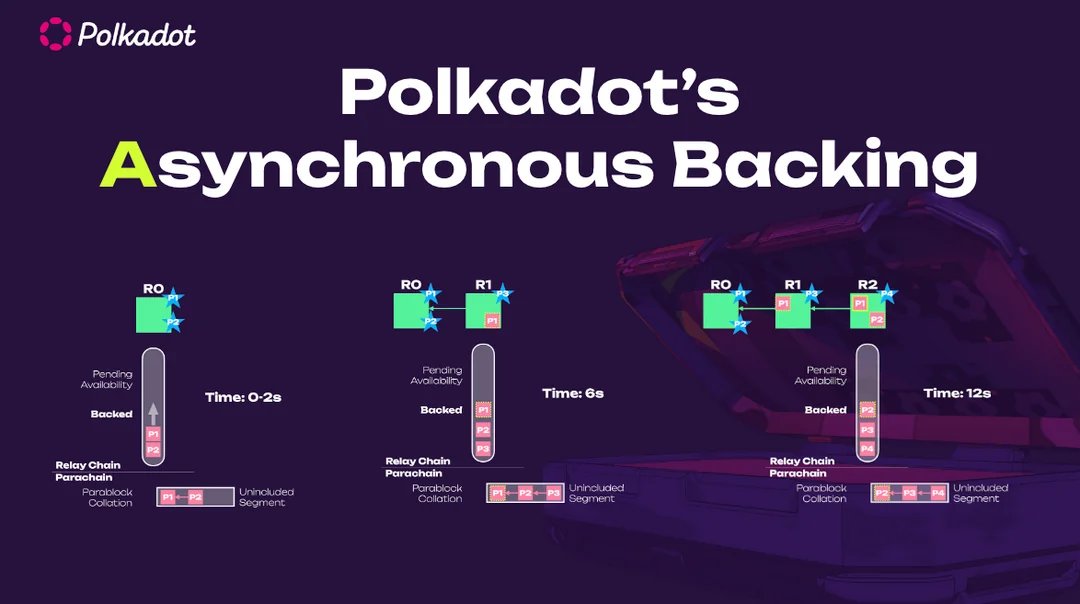
Parablocks can be added every 6 seconds, doubling the speed of block creation.
🟣Increased Block Capacity:
With a maximum execution time of 2 seconds (compared to 0.5 seconds), parablocks can contain four times more data or transactions.
🟣Less Dependency:
Creating a new parablock does not depend strictly on the immediate inclusion of the previous one. Parablocks can be prepared and proposed based on older blocks in the Relay Chain, not just the most recent ones.
https://t.co/FxB4lSfk8A
Ok. But You probably ask Yourself, "What are the benefits of Asynchronous Backing"?
1. Higher Throughput
Due to the reduced interval between block inclusions, the system can handle twice as many transactions in the same amount of time. Parablocks can be added every 6 seconds, doubling the speed of block creation, and with a maximum execution time of 2 seconds (compared to 0.5 seconds), parablocks can contain four times more data or transactions.
2. Greater Flexibility
Collators (the entities that produce parablocks) can build blocks in advance, using older blocks as a foundation. This helps maintain a continuous flow of block production even if there are temporary delays or network issues. Asynchronous backing is a feature that introduces pipelining to the parachain block generation, backing, and inclusion. Pipelining aims to increase the throughput of the entire network by completing the backing and inclusion steps for different blocks simultaneously.
3. Efficiency and Scalability:
The system reduces the risk of discarding potentially helpful block data by allowing multiple unincluded parablocks to exist in the pipeline simultaneously. In traditional synchronous systems, if a block fails to get included immediately, it is often discarded, leading to wasted computational effort and resources.
Asynchronous backing’s approach minimizes this waste, as blocks can be re-proposed and included in subsequent opportunities. It supports the network’s ability to grow and handle increased demand without a corresponding increase in resource waste or inefficiency.
To summarize and better understand what we discussed, Imagine a relay race where each runner is ready to go as soon as the baton reaches them. Still, they can also start running slightly before they get the baton, based on the predicted timing of the baton's arrival. This flexibility means the team can adjust their speeds and strategies, potentially running a faster race.
Asynchronous backing in Polkadot works similarly, where parablocks are prepared and ready to be slotted into the Relay Chain more fluidly, adapting to network conditions without strict dependencies on the exact timing of previous blocks.
A New Era for Blockchain with Asynchronous Backing
Asynchronous Backing isn't just an upgrade but a transformative leap that defines Polkadot 2.0.
By enabling greater flexibility in how blocks are prepared, backed, and included, Polkadot stands ready to handle a larger volume of transactions, accommodate more data, and offer a robust infrastructure that empowers innovative decentralized applications. This is how Polkadot evolves to meet the demands of tomorrow's blockchain economy, setting new benchmarks for scalability, efficiency, and security.
As businesses and developers look to build decentralized applications that can scale securely and efficiently, Polkadot’s robust infrastructure stands ready to support these innovations, secured by the most advanced cryptographic assurances in blockchain technology.
Great article by @stakenode_dev about business opportunities on #Polkadot
Is this possible to make business with Web3 communities and projects?
What value Polkadot brings to business and various industries?
Is this secure way of doing business in a fast paced environment?
Anyone else as excited as I am that @Polkadot will be the #1 gaming chain in terms of wallets, txns AND sales volume in the next couple of months. Mythos is coming very soon! @EnterTheMythos@mythicalgames The future of gaming looks pink!
You want to see Leo Messi and Luis Suarez wearing Polkadot?
Dive into this mind-blowing marketing opportunity for #Polkadot being main sponsor for the @InterMiamiCF
https://t.co/NRyVkMCBxN
@WeAreMessi@Polkadot