Most teams building their first cross-border payment product assume that picking a provider now is a reversible decision.
If the FX desk underperforms, swap them. If the ramp gets expensive, change it. If the KYC vendor frustrates the ops team, find another.
By the time you want to swap, you're not swapping a provider. You're rewriting your payment core. The first corridor is usually built around one set of choices: one FX partner, one payout provider, one ledger setup, one KYC vendor, one ramp.
The decisions feel local - pick what fits the first market - and the integration is direct, because there's no reason yet to abstract anything. That shape works fine until the second market. Then the third. Then the corridor that needs a different liquidity provider, or the regulator that requires a different KYC partner, or the FX desk that quotes 80 bps tighter on the same pair. The cost surfaces when you try to add or replace one of those. Provider-specific assumptions are wired into status handling, retry logic, the reconciliation layer, the ledger schema, the way exceptions get classified.
The "swap" is not a swap. It's a partial rewrite of the payout core, with every other corridor exposed to regression risk during the change. The mistake compounds...
In conventional software, a bad early dependency is annoying. In a payment system booking real money against a ledger, every uncontrolled rewrite is a reconciliation incident waiting to happen. The migration window has to coexist with live settlement, and the team writing the migration is the same team running production.
By the time you realize the first provider became your architecture, the cost to undo it is no longer the cost of an integration. It's the cost of a refactor while the system is live, multiplied by the number of corridors built on the same assumption.
The decision worth making early is not which provider. It's where the seam between your payment core and any specific provider lives, whether ledger, FX, custody, ramp and KYC sit behind interfaces that treat each provider as a swappable implementation, or whether they're wired directly into the workflow.
What is your bet on the orchestation framework?
@OrlandoG85 lmao🤣 you are pathetic and it’s you who is actually paid by treasury to talk all this nonsense
Throughout 6 years of contributions I haven’t took a penny from treasury, apart of the flight cost reimbursement when I was flying Miami to check the foundation for IIM deal.
No one cares about Nakamoto numbers if one entity can single-handedly change the whole protocol rules, tokenomics, freeze the funds, or spend all the treasury with governance proposal and votes.
One way to measure decentralization and why you should care.
A Nakamoto coefficient of 178 means it would take 178 independent validators to collude to disrupt consensus. For comparison, many chains sit in low or single digits.
Decentralization isn't something a network can just claim. It's something you can measure and demand proof of.
@josi25120 Throughout 6 years of contributions I haven’t took a penny from treasury, apart of the flight cost reimbursement when I was flying Miami to check the foundation for Inter Miami deal.
@Juliuszk Piękna historia.
A gdyby zaczynał Pan przygodę z giełdą dziś, jakie 5 pozycji trafiło by do portfela? Jakie 3 rady / wskazówki mając obecne doświadczenie miałby Pan dla początkujących inwestorów?
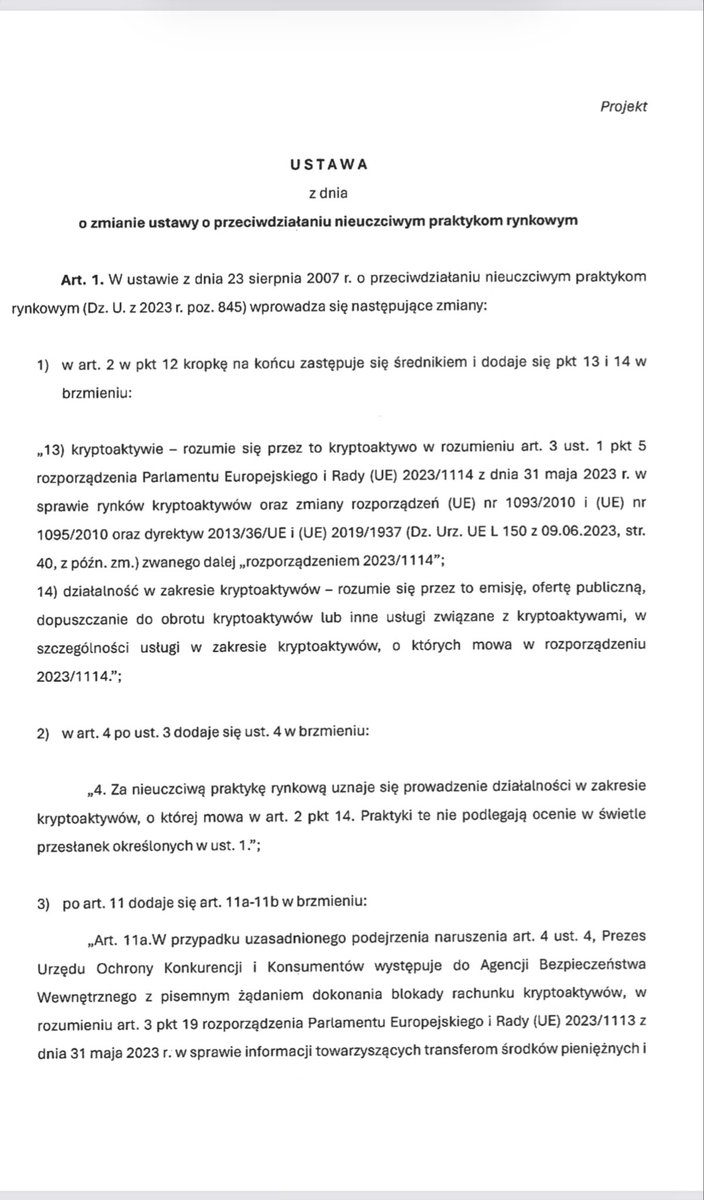
W Dubaju można płacić krypto za usługi rządowe a u nas składają propozycje całkowitego zakazu kryptowalut…
Świat pędzi do przodu a my jesteśmy w dupie. A najgorsze jest to że powoli zaczynamy się w tej dupie urządzać…
#krypto do płatności rządowych i podatków? No kto to widział :) 🇦🇪 👇
Crypto .com otrzymało pierwszą licencję na prowadzenie systemu przedpłaconych środków (SVF) od Banku Centralnego Zjednoczonych Emiratów Arabskich.
Dzięki temu stała się pierwszą platformą kryptowalutową uprawnioną do obsługi płatności rządowych w tym kraju.
Oznacza to wejście w życie protokołu ustaleń (MoU) podpisanego w maju 2025 r. między Departamentem Finansów Dubaju (DOF) a Crypto .com.
Mieszkańcy i firmy mogą teraz płacić za usługi rządowe (np. media, parkingi, podatki, licencje, zezwolenia i inne usługi publiczne) za pomocą kryptowalut, takich jak Bitcoin, Ethereum i innych aktywów o dużej kapitalizacji, korzystając z portfeli cyfrowych.
Jak to działa?
Płatności kryptowalutowe są automatycznie przeliczane na dirhamy Zjednoczonych Emiratów Arabskich (AED) lub zatwierdzone stablecoiny oparte na dirhamie przed rozliczeniem z rządem. Chroni to rząd przed zmiennością kursów.
Jest to część strategii bezgotówkowej Dubaju oraz szerszych wysiłków Zjednoczonych Emiratów Arabskich, aby stać się globalnym centrum fintechu i aktywów cyfrowych.
W Dubaju można płacić krypto za usługi rządowe a u nas składają propozycje całkowitego zakazu kryptowalut…
Świat pędzi do przodu a my jesteśmy w dupie. A najgorsze jest to że powoli zaczynamy się w tej dupie urządzać…
#krypto do płatności rządowych i podatków? No kto to widział :) 🇦🇪 👇
Crypto .com otrzymało pierwszą licencję na prowadzenie systemu przedpłaconych środków (SVF) od Banku Centralnego Zjednoczonych Emiratów Arabskich.
Dzięki temu stała się pierwszą platformą kryptowalutową uprawnioną do obsługi płatności rządowych w tym kraju.
Oznacza to wejście w życie protokołu ustaleń (MoU) podpisanego w maju 2025 r. między Departamentem Finansów Dubaju (DOF) a Crypto .com.
Mieszkańcy i firmy mogą teraz płacić za usługi rządowe (np. media, parkingi, podatki, licencje, zezwolenia i inne usługi publiczne) za pomocą kryptowalut, takich jak Bitcoin, Ethereum i innych aktywów o dużej kapitalizacji, korzystając z portfeli cyfrowych.
Jak to działa?
Płatności kryptowalutowe są automatycznie przeliczane na dirhamy Zjednoczonych Emiratów Arabskich (AED) lub zatwierdzone stablecoiny oparte na dirhamie przed rozliczeniem z rządem. Chroni to rząd przed zmiennością kursów.
Jest to część strategii bezgotówkowej Dubaju oraz szerszych wysiłków Zjednoczonych Emiratów Arabskich, aby stać się globalnym centrum fintechu i aktywów cyfrowych.
Coinbase has made a strategic investment in Centrifuge and selected Centrifuge as a Preferred Tokenization Infrastructure.
Centrifuge brings deep institutional tokenization expertise.
@coinbase brings consumer access, institutional relationships, and developer reach.
Together, we’re bringing differentiated assets to @base.