@dzhng Directionally this feels right but I’d stop short of throwing out react or vue.js. Depending on the ui one wants, either of these actually makes the JavaScript code easier to follow and much shorter.
This is funny and spot on at the same time. And honestly I suspect there is a list of hard software engineering problems for which this is true, still.
In software development it clearly is a time to rethink everything from first principles given the massive improvements we’ve seen in AI coding this year. No one knows if it will make sense for humans to be writing code in a year.
But COBOL and RPG are still a thing. Hmm.
There's some senior engineers on here who, in the face of AI changing the very structures this industry is built on, present themselves as Stewards of the Craft of Programming.
Bugs the hell out for me.
They keep alluding to the virtue of doing things by hand, the value of Good Code and of craftsmanship, saying that yes, AI might change some things, but hey it won't ever change the value of something done with proper care, by hand, just like in the olden days of 2024. Most everything that was Good back then is still Good now: deep knowledge of languages and systems, good code, great architecture. You know the sermon.
And, yes, some of that *is* true. At least I think so. But we don't know, because no one truly knows what will be important in the future.
We're going through times of great change and I think the best advice to give to young people and others who want to have a job and provide value is: keep your eyes open, rethink from first principles, derive from what businesses value what you can provide; the digital world is more malleable than ever, you should rethink how you can help shape it.
All this pounding on the Bible of Good Code seems to me to be doing the opposite: it lets people feel comfortable -- what I've valued all my life is still valuable, I can rest easy -- in times when one shouldn't feel comfortable. This is a bumpy, exciting, strange ride. If you lean back you might fall off the waggon.
Let's not delude ourselves and others that we can keep doing what we've been doing. Rethink it all.
And, like I said, it bugs the hell out of me seeing senior engineers (that are secure in their career) talking as if there's nothing *really* to change, because the Fundamentals will still be valued. They might!
But it's the wrong advice to not rethink everything right now.
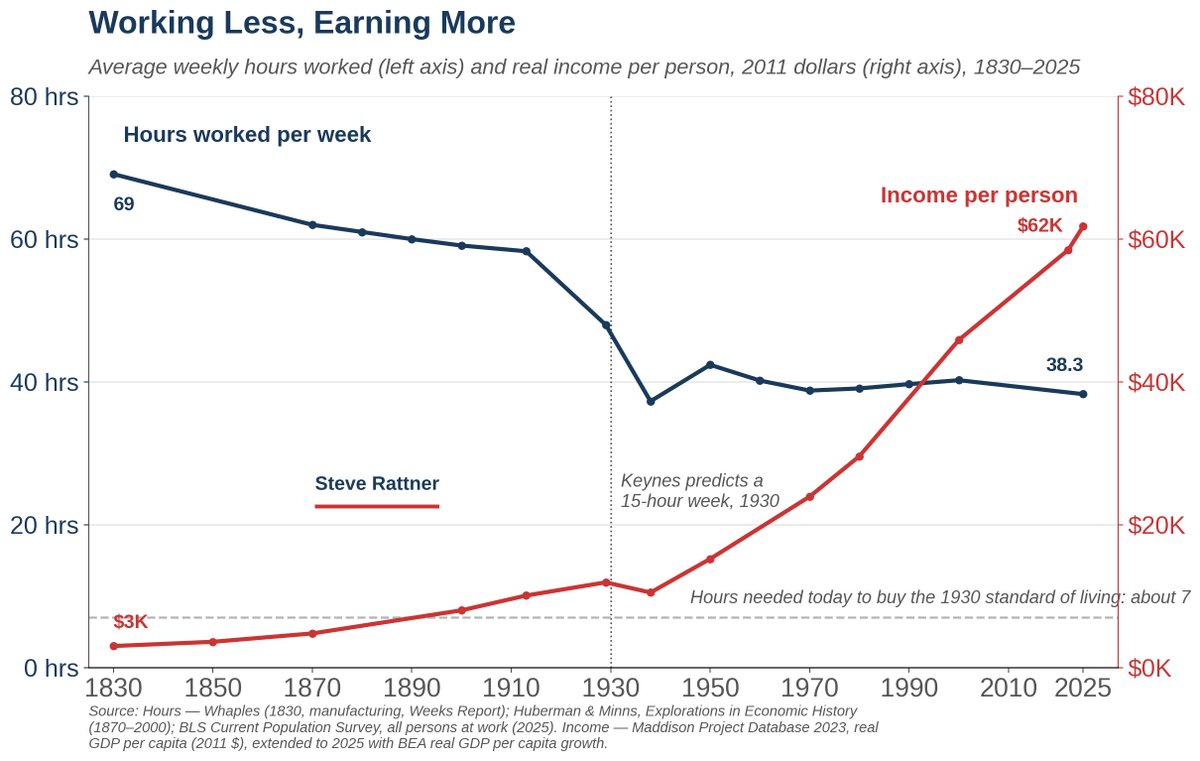
Since 1830, technology has cut the American workweek from 69 hours to 38 while raising real income per person roughly 20-fold.
Properly managed, A.I. can do the same.
My @nytopinion Chart: https://t.co/3WCBRg3gMx
I'm learning that using Codex well is less about “prompt engineering” and more about software leadership: setting scope, giving context, creating checkpoints, reviewing output, and correcting direction early.
It's pencils down, people. Writing code by hand is no longer an economically viable skill for most programmers at most companies. But the future of making software has never been brighter. Don't you dare black pill this beautiful moment! https://t.co/qaCgfmkW0u
I think a lot about the quote "A computer can never be held accountable, therefore a computer must never make a management decision" these days
Except I think it applies to any 'decision', not just management.
It's your code, not the AI's code
https://t.co/aPL2NRaVm5 Core ranks among the top web frameworks for performance. In TechEmpower Round 23 it led popular ones in Fortunes with ~610k RPS, beating Go Fiber (~338k), Rust Actix (~320k), Java Spring (~244k), and Node Express (~78k). Current HttpArena shows minimal APIs strong vs Fastify/Gin/Spring. Multi-threaded Kestrel handles high concurrency well; tuned low-level options can edge it in pure throughput.
Here is a good "high-level" on the OpenAI/Hugging Face incident. Well worth reading. @dwarkesh_sp does a really good job. Devs, this should cause us all to sit up and take notice. https://t.co/eFkprBsW5d
A cake made with 50 premium ingredients isn't necessarily the best cake.
AI is making the ingredients abundant. What's scarce is judgment: knowing what to use, what to leave out, and when you're done.
A lesson from @steipete, nicely captured in an article from Taiwan's bnext.
Garry Tan (CEO of Y-Combinator): "when someone asks how I 'prompt' my AI, the answer is: I don't. the skills are the prompts."
[if I had 7 days to master skills and how to use them to automate workflows:]
→ read the Skillify 11-item checklist (SKILL.md in gbrain)
→ watch Murag + Barry Zhang: "Don't Build Agents. Build Skills Instead."
→ Read "Designing, Refining, and Maintaining Agent Skills at Perplexity"
→ do one workflow. type /skillify. watch it become permanent.
that's the whole day.
here is how to set it up:
1. clone GBrain (his open-source second brain, Postgres-backed memory + 30 skills)
2. add GStack (23 battle-tested slash-command skills, drops right in)
3. do anything once → type /skillify → it's a skill forever
prompting is dead. skillifying is next.
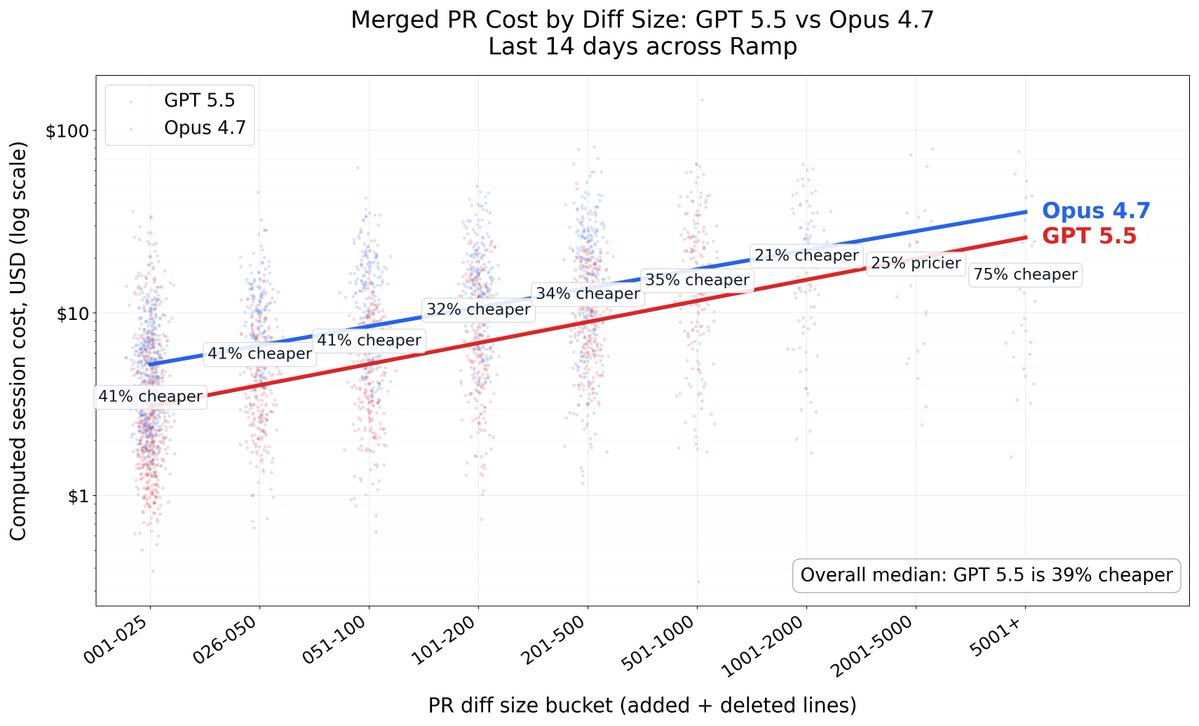
GPT-5.5 is ~39% cheaper than Opus 4.7, across merged PRs bucketed by diff size in Inspect
despite the higher output token cost, 5.5 is cheaper for input tokens (cache writes are free), more token efficient, and tokenizes the same text to fewer tokens
Prediction:
The next 12-24 months, "UX-pilled" builders will be in massive demand.
Who can create intuitive interfaces, web+mobile+desktop apps that "feel good," natural, fast, and far better than the competition.
THIS will be the difference vs those building "just" with AI.
Feeling like it's time to jump into AI enabled software development? Microsoft just launched a free GitHub Copilot CLI course.
There has never been a better time to be a software engineer.
We just launched a free, open-source course on GitHub Copilot CLI.
Learn how to ship faster with AI powered command line workflows—context, custom agents, skills, MCP servers, and more.
Hands on. Practical. Built for devs.
Check it out: https://t.co/gFBNFUcwfG