Introducing SWE-1.7, the most capable model we’ve trained yet.
It scores within a few points of the strongest frontier models at a fraction of the cost, and is now available at 1000 tok/s.
RL is not hitting its limit: after refining our recipe, we keep seeing gains as we scale
new open (apache 2.0!) model from @TencentHunyuan, Hy3 is only 295B total 21B active and competitive with MUCH bigger model on benchmarks
https://t.co/GOgtLPLfBR
“Agentic kernel optimization is the future of on-device inference”
@xenovacom used Fable 5 to write kernels that pushed Gemma 4 to a massive 255 tok/s on WebGPU with M4. He shared the demo, so you can try in your browser!!
We wanted to make long-horizon video generation accessible beyond massive compute clusters. With Quant VideoGen, you can now deploy HYWorldPlay locally on an RTX 5090. By exploiting spatiotemporal redundancy, we’ve slashed memory usage by 7× with almost no overhead. Congratulations to the team!
🎮🤖 Introducing MultiWorld: Scalable Multi-Agent Multi-View Video World Models!
Current video world models are mostly single-agent, but the real world is multi-agent. We present MultiWorld for action-controllable, multi-view-consistent video world modeling on multi-agent video games and multi-robot collaboration scenarios.
Fully open-source — code, models & data!
📄 Paper: https://t.co/goGMtXKEmp
💻 Code: https://t.co/3KnqsEn1Yf
🌐 Project: https://t.co/ktcF91Vmev
🤗 Checkpoint: https://t.co/B2ZzaWlCTO
📚 Data: https://t.co/3QY7PadGfP
🎮🤖 Introducing MultiWorld: Scalable Multi-Agent Multi-View Video World Models!
Current video world models are mostly single-agent, but the real world is multi-agent. We present MultiWorld for action-controllable, multi-view-consistent video world modeling on multi-agent video games and multi-robot collaboration scenarios.
Fully open-source — code, models & data!
📄 Paper: https://t.co/goGMtXKEmp
💻 Code: https://t.co/3KnqsEn1Yf
🌐 Project: https://t.co/ktcF91Vmev
🤗 Checkpoint: https://t.co/B2ZzaWlCTO
📚 Data: https://t.co/3QY7PadGfP
Introducing Claude Opus 4.7, our most capable Opus model yet.
It handles long-running tasks with more rigor, follows instructions more precisely, and verifies its own outputs before reporting back.
You can hand off your hardest work with less supervision.
Nice milestone for our research effort: SWE-1.6 (early preview) is a meaningful step up from 1.5 without sacrificing speed (950 tok/s). Strong SWE-Bench Pro results, and this is just the beginning!
In an era in which everything becomes exponentially faster, intelligence increasingly means predicting the future state of the world better than others
We just reimagined GitHub from code as a primitive to features spec based and won 3rd place at YC MCP hackathon.
We built a collaboration tool integrated with any platform (chatgpt, claude code, etc) for people discuss and iterate over the feature spec, once agreed push to build in a click.
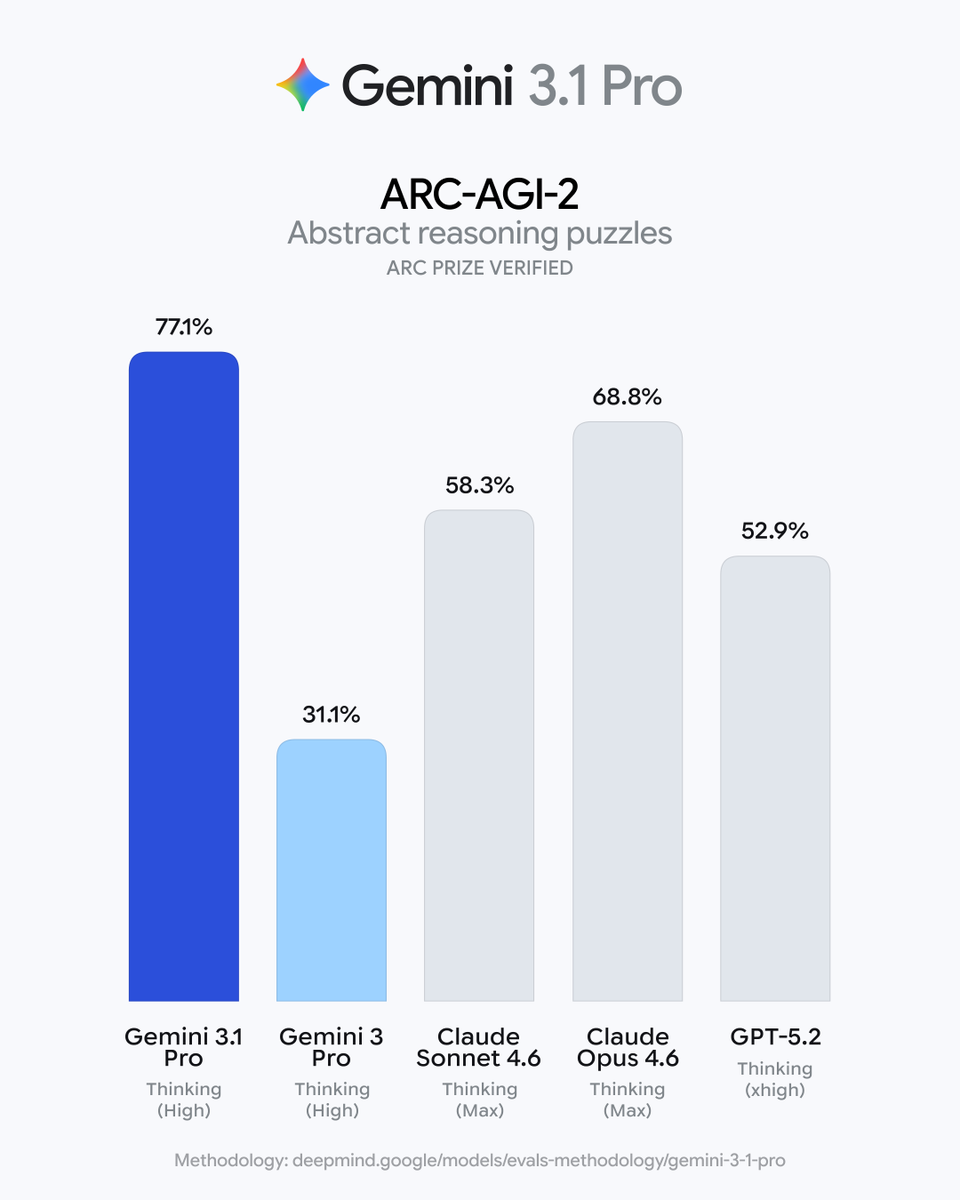
The model is a step forward in reasoning, designed for workflows where a simple answer isn’t enough.
On ARC-AGI-2 – which tests for novel logic patterns – it more than doubles 3 Pro’s score.
This means it can help you visualize complex topics, organize scattered data, and bring creative projects to life.