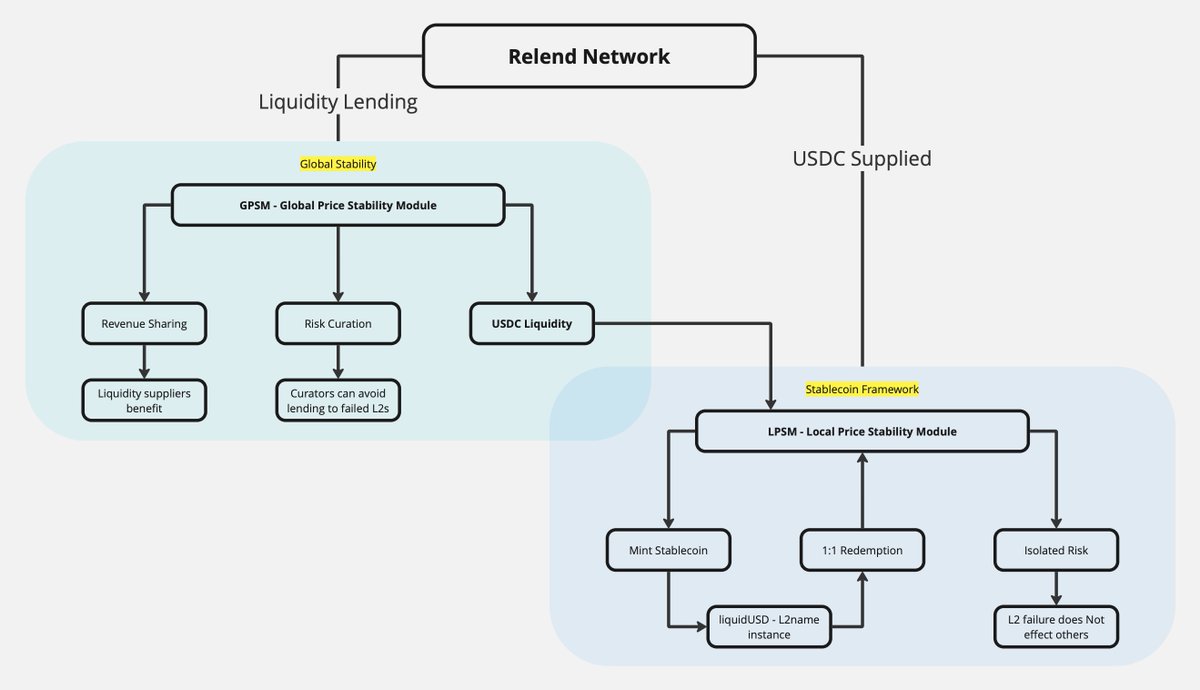
💡 Relend Network is revolutionizing CDP-based stablecoins for a multi-L2 world!
Stablecoins are the backbone of DeFi, but deploying them across multiple Ethereum L2s presents unique challenges—liquidity fragmentation, risk contagion, and inefficiencies in cross-chain stability.
Relend introduces a hybrid CDP-based stablecoin model combining risk isolation with shared stability. Each L2 gets its own liquidUSD-L2name stablecoin, backed by lending market collateral and USDC.
🔹 Risk Isolation: If one L2 fails, the rest remain unaffected—no systemic contagion.
🔹 Composability: Strong L2 instances reinforce the ecosystem rather than compete with it.
🔹 Efficient Liquidity: Users can mint & redeem stablecoins seamlessly with 1:1 USDC redemptions.
🔹 Scalable Credit: Native stablecoin minting on each L2 enables efficient capital deployment.
📢 How it works:
Relend features two key stability modules:
⚡ Local Price Stability Module (LPSM): A USDC-backed vault ensures that each L2’s stablecoin maintains a 1:1 peg with USDC.
🌍 Global Price Stability Module (GPSM): A Morpho Vault that supports liquidity when LPSMs need reinforcement. If one L2 suffers, risk curators can stop lending to it—keeping the rest of the system secure.
Unlike MakerDAO (DAI), which shares risk across all chains, and Liquity V2 (BOLD), which isolates instances without shared benefits, Relend combines the best of both.
🔗 The future of stablecoins is here. Secure, scalable, and interoperable across all Ethereum L2s.
👉 Read the full details: https://t.co/Mrn2aE9Wb4
#DeFi #Ethereum #Stablecoins #L2
The holiday season brings joy and…a massive surge in energy consumption. Let’s break down the impact of festive lights, cooking, and heating on our energy grid—and what it means for the environment. 🧵
The DEPIN category has seen some winners this cycle. @daylightenergy is a prime example of what can happen when really smart people leverage crypto’s openness to try to solve important problems.
If you want to learn more about this brilliant company, here’s a full interview from @tokenwarrant with @jasonbadeaux
For founders, you’ll hear great insights about navigating a bear market and fundraising for your company.
https://t.co/JuD0sWOWZV
You’ll enjoy it! 💯
This week, #DePIN descends on the Big Apple 🍎
Join DIMO & @coinfund on Wednesday at 5:30pm EST for delicious drinks and DePIN discussion. 💬 🥂
There will also be a handful of demos from @helium, @daylightenergy, @iotex_io, and more!
https://t.co/8B2AUfQty7
🪙 Relend Gold $XAUm Vault Launched on @MorphoLabs- in partnership with @Matrixdock
If BTC can generate yield, so can Gold 👀
💰Gold has always been the ultimate store of value—now it’s on-chain and works for you. With Relend Gold $XAUm on Morpho, you’re not just holding gold; you’re unlocking its power to fuel liquidity, earn rewards, and redefine what’s possible in goldlending.
⏲️ Time to put your digital treasure to work:
Relend Gold $XAUm - https://t.co/bgrzoGLpss
🌀Relend Network, provides a 10x in capital efficiency through banking architecture. We integrate reserve bridges to support economic activity on L1s and L2s—every $1 bridged turns into $10 in ecosystem liquidity.
💡Matrixdock pioneers a new era of finance where traditional and digital assets seamlessly blend, supporting permissioned and permissionless assets in a unified ecosystem.
🔏Vault Info:
Supply cap: $5m
LTV: 77%
Liquidity: $1m $XAUm
MORPHO token incentives: 6%
Collateral: @CurveFinance crvUSD - more markets coming soon.
Relend Gold $XAUm has been added to the Relend Stone Age Season, providing depositors with additional incentives and access to Relend Network.
Supply $XAUm - Earn lending APY, MORPHO tokens and RELEND units.
Borrow $XAUm ~2% interest
We are excited to bring the first active Gold Vault onto Morpho and look forward to bringing on more RWAs soon 🔗
1/ 🚀 The Cambrian explosion of Layer 2s (L2s) is thrilling, but success is hard. Liquidity and TVL are key to bootstrapping growth, yet scarce for early-stage ecosystems. Relend Network steps in as The Bank of L2s, solving these challenges with a fractional reserve bridgeinnovative tech. Here's how: 🧵
https://t.co/S4wgFiuLpi
The crypto ecosystem is experiencing sluggish expansion, and it's more than just technical challenges at play.
The market suffers from inefficient and scarce credit options.
However, a possible remedy may be on the horizon.
Let's explore in detail 🧵
...
— 📌 The Current Crypto Landscape
Traditional finance employs relending and fractional reserves to greatly enhance credit availability, stretching well beyond the initial capital pool.
This has led to a substantial chunk of financial assets being linked to credit, leverage, and debt—estimated between $300-$350 trillion—out of a total $469 trillion in global assets.
On the other hand, the crypto market does not currently leverages fractional reserves. Only an estimated $30 billion of the $2.5 trillion in cryptocurrency holdings are used for lending purposes.
Blockchain is well designed to support a fractional reserve banking system. With liquid assets and a transparent ledger risks are significantly mitigated.
However, @relend_network aimed to shift this dynamic.
...
— 📌 Relend - Lend. Relend. Repeat.
In essence, Relend Network seeks to boost credit availability by implementing a relending strategy that leverages the fractional reserve token standard known as ERC-7770.
By using ERC-7770 or reTokens, token holders automatically become lenders, and borrowers generate new tokens when they borrow. Interest is allocated among holders through rebasing. Additionally, with ERC-7770, any ERC20 token can be borrowed by default.
This approach produces a money multiplier effect similar to that of fractional reserve banking.
For illustration:
▶️ A user deposits $1000 into Relend Network
▶️ Multiplier set to 10x, making available amount to loan $10,000
▶️ Borrower interest rate is 3%
▶️ Interest split 50/50
For this scenario, let's see how it affect lenders and borrowers:
▶️ By starting with a $1000 deposit, the lender can enjoy a 15% APY from credit utilization.
▶️ Borrowers pay a 1.5% interest rate on their borrowed funds, reflecting part of the interest accrued
▶️ Should borrowers choose to trade their interest-earning USD for different assets, they must cover the entire 3% interest charge.
Relend Network achieves this by keeping all credit within its system, unlike traditional systems which require multiple lending cycles to achieve a similar outcome.
...
— 📌 Relend - Solving Liquidity Fragmentation
Relend Network offers a unique bridging feature through a developer-implemented contract, enabling the transfer of fractional reserve assets from Relend Network to various L2s by creating equivalent L2 tokens.
The backbone is its canonical lending market—a structure of collateral/debt pairings. Borrowers offer collateral to obtain debt tokens and must repay them to retrieve their collateral.
Differing from conventional models, this setup doesn't rely on direct lender liquidity. Instead, debt is generated on-demand and is removed from circulation when repaid.
All loans require over-collateralization, and the platform initially targets blue-chip assets with riskier assets listed via credit delegation.
By design, this system prevents the liquidity fragmentation common in single-collateral/single-debt markets, while allowing the collateral to accrue yield.
...
— 📌 Relend Pre-Deposit Campaign
Looking to dive in now?
Relend Network collaborates with @bprotocoleth and @BlockAnalitica to bring you RELEND Units through @MorphoLabs vaults.
Here's why it's worth considering:
▶️ Pre-depositing in these vaults allows you to accumulate RELEND Units, with multipliers that vary by vault.
▶️ Once launched, pre-depositors can start relending, potentially enjoying up to 30% APY in returns.
▶️ RELEND Units might put you in line for potential future airdrops.
You can also farming RELEND Units via Telegram (link shared after this post), though keep in mind that Telegram points don't match the unit tally from the pre-deposit vaults.
Relending ELI5
📜There is a village with a Chief, 10 villagers and 1 Village Bank.
🏦The Village Bank holds $1000 in cash.
The Chief owns all the houses.
👩🌾Villager 1 borrows $1000 and buys a house from the Chief, Chief deposits the money back into Village Bank.
👨🌾Villager 2 borrows $1000 and buys a house from the Chief, Chief deposits the money back into Village Bank.
Repeat with all 10 villagers.
The Chiefs bank balance now reflects $10 000.
Each of the villagers now owns a house🤯.
Village Bank holds fractional reserves of $1000
Village Bank is owed $1000 by 10 villagers,
total of $10 000 in credit.
Village Bank holds 10 houses as collateral.
Village Bank AUM: $21 000
🌀This is relending. We are bringing this to DeFi.
#relending