Thanks @tomkeene. So why did Rockefeller stop vertically integrating at the gas pump and never build the car? I knew you would come back on this...
Rockefeller followed one rule: never put a dollar where you're a price-taker. Only own the bottleneck where you set the price. It's the same rule the hyperscalers are breaking.
He stopped integrating beyond the pump, as owning Detroit would have meant pouring capital into a competitive, capital-intensive, price-taking manufacturing business. Gasoline and cars are complements, not substitutes, and you want your complement industry fragmented and competitive. Cheap, abundant cars from Ford and GM meant more fuel sold at higher margin.
The artificial muscle (AM) revolution was ultimately about oil, not the cars planes and trucks that did the heavy lifting. Decades ago, Buffet called them the worst kinds of businesses: ones that grow fast, devour capital and earn little on it. He said if he would have been at Kitty Hawk he would have shot Orville down because "Karl Marx couldn't have done as much damage to capitalists as Orville did." This is exactly the charge now being levelled at the hyperscalers: rapid growth, insatiable demand for capital, and returns that don't clear the cost of it.
But the key here is that Rockefeller wanted the cheap abundant trains, planes and automobiles as he controlled the choke point. The ability to turn crude into gasoline, diesel and aviation fuels.
Similarly, the AI revolution will likely be about atoms, not bits, as that’s where the choke point ultimately is. Chips, turbines, transformers – hence critical minerals. In the new AI race the actual chokepoint has moved off bits entirely, onto atoms: silicon, where Nvidia sets the price, and the commodity complex underneath it: copper, steel, gas, uranium, the metals and molecules.
With the exception Google’s TPU, they own very little of this. Think of Google with its TPU as the Gulf Oil/Mellons that became Chevron.
So who is the Standard Oil of the AI story: Its Nvidia. Both with c.85% market share. I am sure Jensen keeps a copy of Dan Yergin's The Prize for nighttime reading as he has played it to the tee.
But unlike Standard Oil, Nvidia doesn’t control its crude supply. It has TSMC and ASML to contend with. So what does the AM revolution tell you about what could happen to Nvidia, TSMC and ASML in the AI revolution?
@housing_alex@TheStalwart This looks like there is a solid case for taxing equity wealth (as we do housing) to pay for public goods, and maybe reduce taxation of labor income as a share of total tax receipts
Every single midterm year since 1974.
Same pattern.
1974 Ford: −35%
1978 Carter: −15%
1982 Reagan: −17%
1986 Reagan: −10%
1990 Bush: −20%
1994 Clinton: −8%
1998 Clinton: −22%
2002 Bush: −34%
2006 Bush: −8%
2010 Obama: −17%
2014 Obama: −10%
2018 Trump: −20%
2022 Biden: −27%
2026 Trump: ???
Every single one had a significant drawdown.
Every single one recovered.
The long-term chart kept going up.
The question for 2026 is not if it recovers.
The question is whether you will still be invested when it does.
@TheStalwart@alexolegimas One possibility is those structures were often built by soldiers of defeated enemies - who became slaves - to occupy their time.
@TheStalwart@Frances_Coppola The distribution of wealth & income is so different now vs. the 80s & 90s it would be odd if the correlations between measured consumer confidence & the stock mkt or economic activity. Consumers being depressed now is the flip side of record profit margins
Lotta people love to play with Hormuz offset balance math—and boy, oh boy, the numbers I've seen bouncing around...
But let's keep it dead simple and focus on pure output:
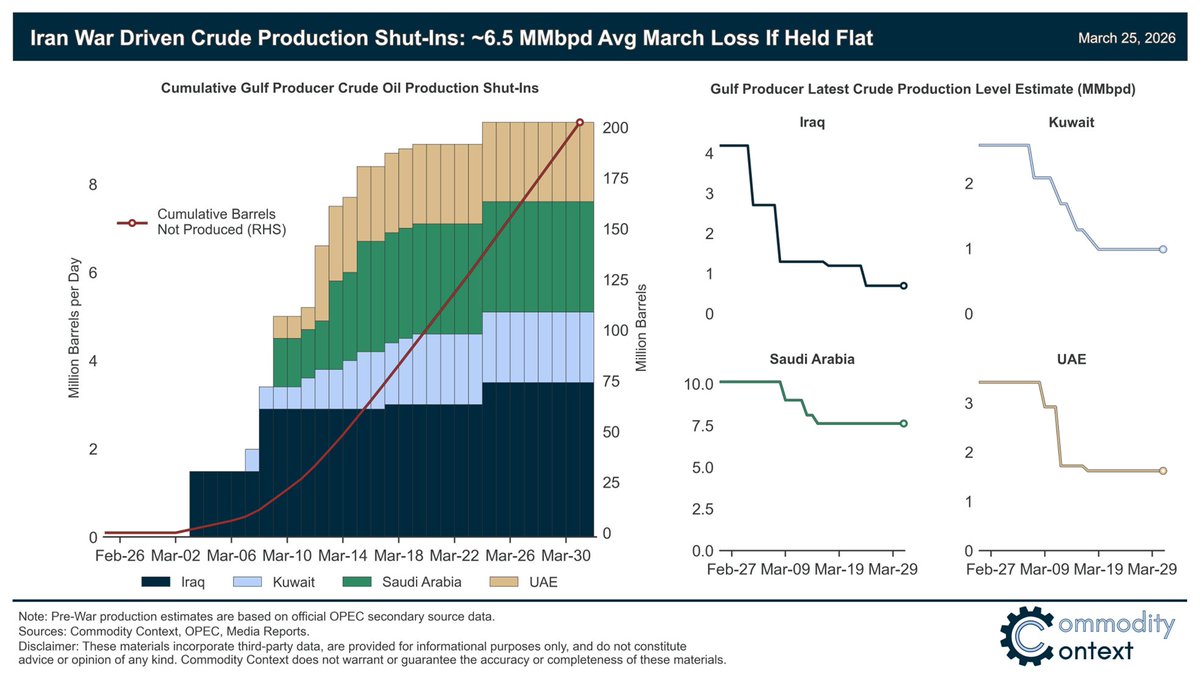
There's now ~10 MMbpd of crude oil production shut-ins confirmed across the Gulf. NGLs/condensate on top of that. 200 million barrels not produced in March already that should have been produced.
That alone is already the largest supply shock in history. And it continues to get worse the longer Hormuz remains shut.
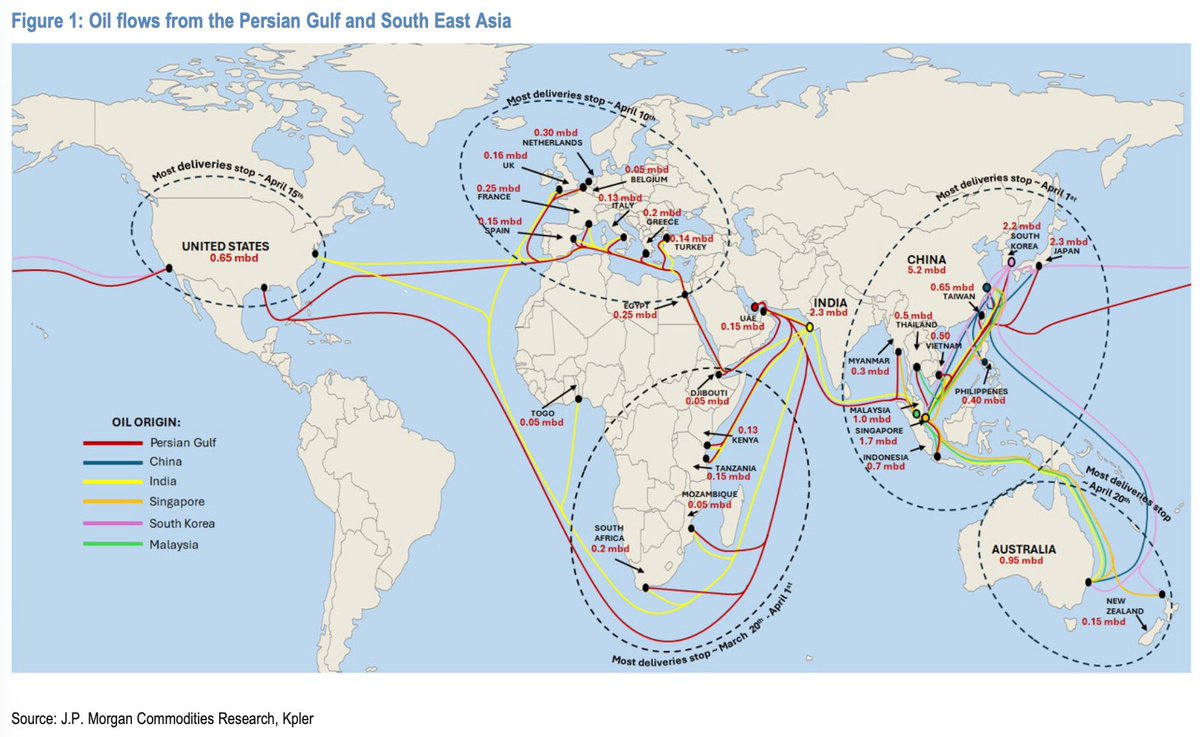
I’ve been describing the supply loss from the closure of the Strait of Hormuz as an “air pocket” moving through the normal flow of oil out of the Gulf
Helpful map from JPM highlighting when that air pocket will “land” in different major consuming regions:
- East Africa last week
- East Asia this week
- Europe next week
- North America two more weeks