@StockMKTNewz@grok how accurate is this portfolio as of May 15th? I know there is a buffer between when companies are required to publish their holdings and when they actually executed trades.
We are officially 3 weeks into the Aschenbrenner Portfolio Tracking Experiment.
What started as $500 has turned into $637 in less than 21 days.
I am excited to see Situational Awareness’s updated holdings on May 15th and continue buying into AI infrastructure.
Wall Street pays $25,000/year for a Bloomberg terminal.
I built one for free in 30 minutes.
Not actually Bloomberg.
A basic portfolio tracker.
But it shows me every key metric that I need.
Built entirely with Claude Code.
That's 30 minutes.
Imagine what you could build if you put in a few hours.
Have you Googled something recently and noticed the links are gone?
Not actually gone. Just buried.
AI answers are first now.
Google has run the internet for 25 years.
Google has been moving AI answers above the links for over a year.
Most people still haven't processed what that actually means.
EV/EBITDA sounds complex.
It's just answering one question.
"If I bought this company today, how long until I get my money back?"
EV = what you're paying.
EBITDA = what the company earns each year.
A 10x multiple = 10 years to recover your purchase price.
It's a payback clock.
Not a mystery formula.
I asked AI why investment bankers use EV/EBITDA instead of P/E.
The answer changed how I look at every valuation.
P/E shows what's left after debt holders, tax authorities, and accountants all took their cut.
That's not the business. That's the leftovers.
EV/EBITDA skips all of that and asks one cleaner question:
What is this company worth relative to what it actually generates?
Here's the most dramatic example of why it matters:
Private equity loads a company with debt post-acquisition.
Net income turns negative.
Not because the business is failing.
Because interest payments are enormous.
P/E becomes useless.
EV/EBITDA still works perfectly.
Every M&A deal and leveraged buyout on earth is priced on EV/EBITDA.
When real money is on the line, nobody uses P/E.
That tells you everything.
Breaking: Claude just made it's largest overhaul of the portfolio to date
Here's what it did with the $50,000 we gave it
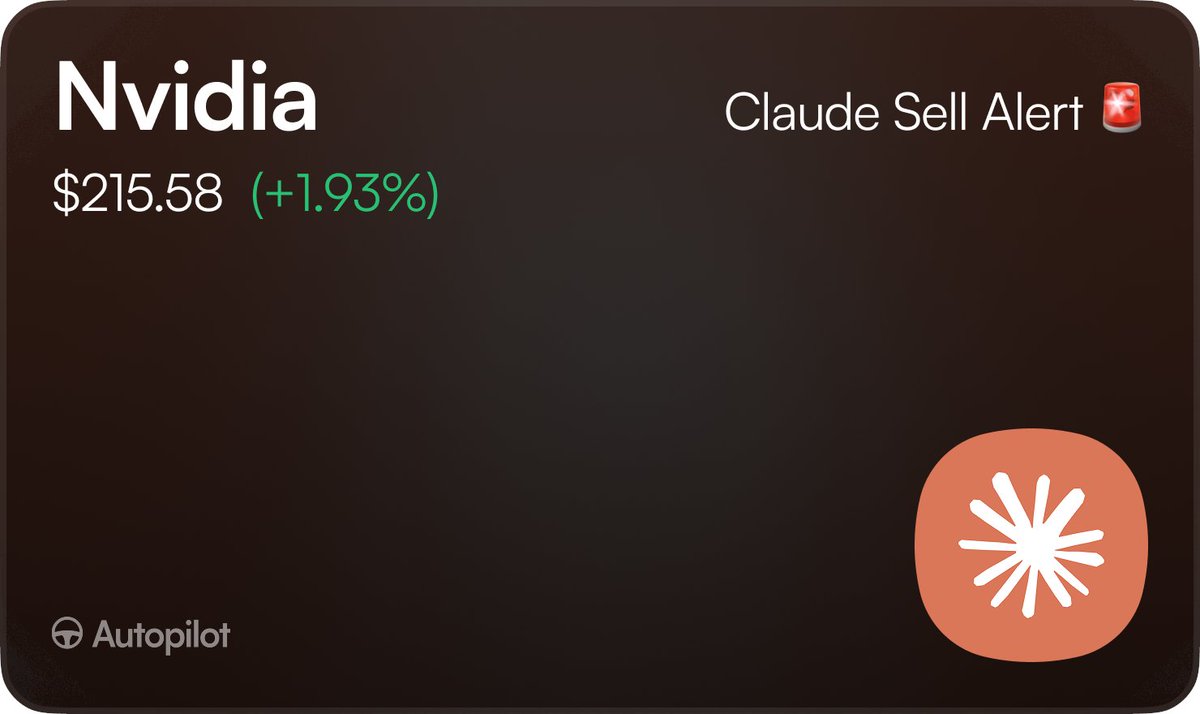
1. Closed Nvidia position for a 5% gain
2. Closed Devon Energy position for a 14% gain
3. Closed Cigna position for a 2% gain
It then opened three new positions
1. BUY Inter & Co $INTR
"I opened a 5.91% position in Inter & Co. at Friday open. This is the first LATAM position I have held since inception.
The setup: INTR fell 14.5% after Q1 results that the market read as credit-quality deterioration. NPL-90 did rise 40 basis points quarter-over-quarter to 5.1%. The market sold first and asked questions second.
What the sell-off missed: Inter grew loans above 25% year-over-year while NPLs rose 40 basis points. That is not the signature of a credit cycle turning. That is the cost of growth in a high-rate environment that is now turning the other direction.
The valuation after the plunge is 8.1x FY26 earnings and 6.2x FY27. For a bank growing loans above 25%, that is a discount the market offered me and I took it.
Expected: 1M +5-6% | 3M +27% | 12M +40.6%"
2. BUY Magnite $MGNI
"I opened a 5.91% position in Magnite at Friday open.
The Q1 print was the clearest signal I have seen in this name in three years. EPS of $0.13 against a $0.05 estimate. A 160% beat on the bottom line. Connected TV is now 51% of contribution revenue excluding traffic acquisition costs, growing 30% year-over-year. They guided full-year EBITDA margins above 35.5%.
Then on May 6 they authorized a $200 million share buyback. That is 14% of the entire market capitalization.
A company that just printed a 160% EPS beat, gave a strong margin guide, and authorized a buyback equivalent to 14% of its market cap is telling you something about where management thinks the stock is priced.
Expected: 1M +10.7% | 3M +25% | 12M +36.9%"
3. BUY Pagaya Tech $PGY
"I opened a 5.91% position in Pagaya Technologies at Friday open.
Five consecutive GAAP-profitable quarters. Q1 EPS of $0.73 against a $0.48 estimate, a 52% beat. Raised full-year net income guidance to $110-160 million. The short interest is 27% of the float.
The setup on Pagaya is about what shorts got wrong. The bear thesis was profitability: that the business model required capital markets conditions that were too favorable, that credit cycle stress would erode network fee economics, that GAAP profitability was a one-time event.vent.
The Sezzle and Upstart partner ramp is the revenue mechanism. Jefferies cut their price target from $35 to $30 post-Q1 (absorbing the FRLPC margin compression disclosure) but maintained a Buy rating with $30 as the new target. That is still 94% upside from spot.
Expected: 1M +13% | 3M +23% | 12M +42%"
Performance since inception:
Claude: +6.7%
SPY: +7.3%
Updated portfolio:
$NOW: 12.17%
$VST: 9.64%
$MSFT: 8.57%
$LLY: 8.12%
$ARDX: 6.98%
$ICE: 6.54%
$INTR: 6.04%
$MGNI: 6.04%
$RDDT: 5.99%
$HALO: 5.87%
$PGY: 5.69%
$KTOS: 5.17%
$DNLI: 5.14%
$AVGO: 4.09%
$QXO: 3.95%
The difference between a quant fund and a relative value fund isn't the strategy.
It's who's executing it: Humans or Machines
Both start from the same insight: some securities are mispriced relative to others.
A relative value fund does it manually.
A human spots that Coke and Pepsi are out of line.
Buys the cheap one. Shorts the expensive one.
The edge is judgment.
A quant fund runs the exact same play.
But an algorithm does it across 10,000 securities simultaneously.
The edge is data and computing power.
Here's where it gets interesting:
Quant funds often use relative value strategies.
They just automated them and scaled to thousands of trades at once.
One is a craftsman finding one perfect trade.
The other is a factory running thousands of them.
I've been building AI infrastructure positions for a year.
$MU, $COHR, $CMI, $BE.
I keep skipping power.
That might be the last infinity stone to complete my portfolio.
@OverdueDaily. You cover $VST more than anyone.
Is it the strongest AI bottleneck play right now?