🚀 Daily, we marvel at #AI progress, yet one human ability stands unchallenged: immediate adaptation.
💡 Today, we're closing that gap! Introducing 💀 To Adapt or Not to Adapt? Real-Time Adaptation for Semantic Segmentation. An AI that shifts gears as swiftly as we do! #ICCV2023
Liner is partnering with @spoticlr at #ICLR2026 — supporting Best Paper and Travel Awards for LLM research.
And to celebrate, we're giving away:
✈️ Round-trip flights + hotel to #ICML2026 in Seoul
🎁 $300 Liner Credits
Follow @search_liner + repost to enter by 4/27.
Liner is built for research workflows. Find papers, verify sources, and write with citations in one place.
See you in 🇧🇷 and 🇰🇷!
@iclr_conf@icmlconf
From stereo vision to LiDAR fusion, and the edge cases that break them.
Join the next AMD AI Research Club session where Pier Luigi Dovesi, Robotics and Autonomous Systems Lead, AMD Silo AI, explores the evolving landscape of depth foundation models with Luca Bartolomei.
📅 April 16, 2026
⏰ 4 PM CET | 10 AM CT
We’ll unpack:
• Virtual pattern projection
• Cross-domain depth generalization
• Geometry-aware perception in complex environments
Built for developers, researchers, and engineers pushing the boundaries of AI perception.
👉 Register here: https://t.co/JWkWQvkO8p
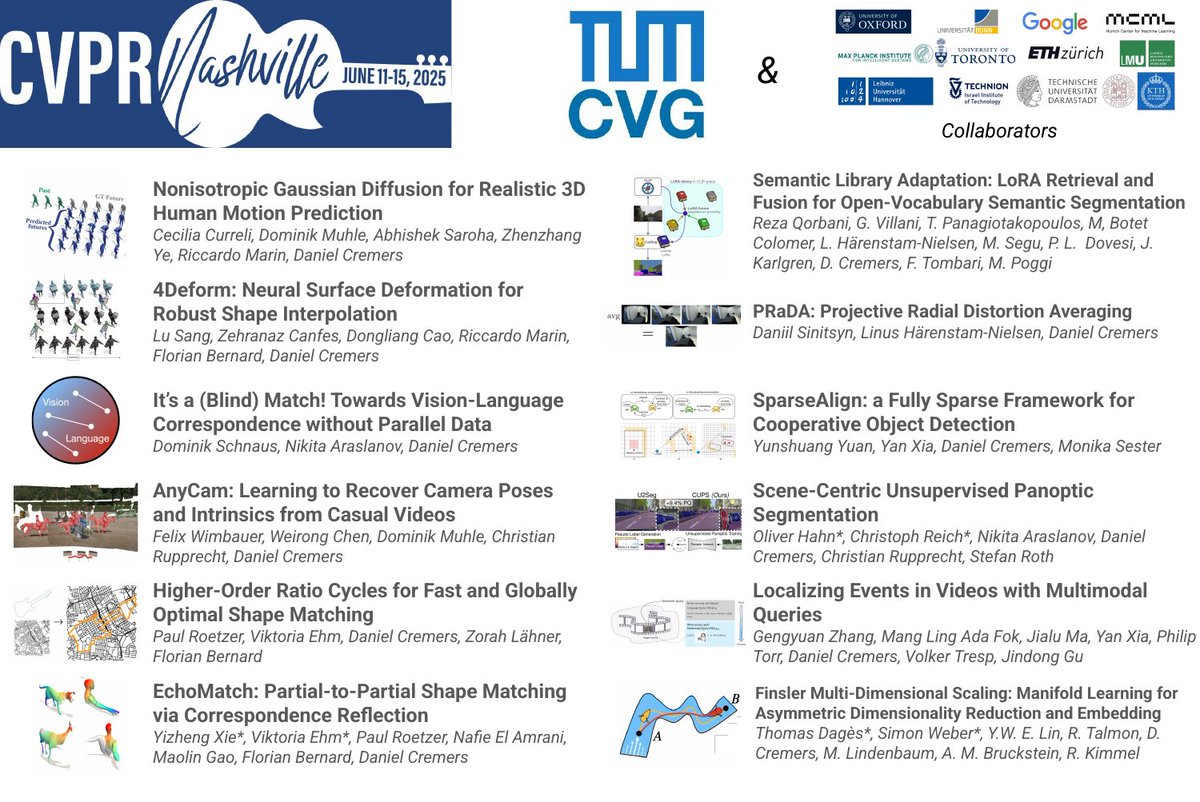
We are thrilled that our group has twelve papers accepted at #CVPR2025! 🚀
Congratulations to all of our students for this great achievement! 🎉
For more details, check out: https://t.co/pTTuMlMUdp
We are presenting DiffCD tomorrow morning at #ECCV2024!
Come by poster 214 to discuss how to fit neural SDFs to point clouds, from a geometric perspective
🍸🍸The TRICKY 24 challenge on "Monocular Depth from Images of Specular and Transparent SurfacesHR Depth from Images of Specular and Transparent Surfaces" is live! 🍸🍸
More details about the challenge: https://t.co/6F6SoQe337
and the TRICKY workshop: https://t.co/cOmyFO5cED
Era questione di ore. La notizia è arrivata. Se sei ferito senza che i soccorsi siano consentiti, questo è il tuo destino. Come è destino che l’ennesima morte di un reporter ucciso mentre faceva il suo lavoro, non muterà il corso delle cose.
Noi, oggi, piangiamo un collega
#Gaza
CEASEFIRE NOW!
CEASEFIRE NOW!
CEASEFIRE NOW!
CEASEFIRE NOW!
In the face of unfettered devastation and suffering, humanity must prevail. Demand a ceasefire by all parties to end civilian suffering.
Act now ⬇️
https://t.co/66L4Pe7D8I
To Adapt or Not to Adapt? Real-Time Adaptation for Semantic Segmentation
paper page: https://t.co/qWaVPMlvK7
The goal of Online Domain Adaptation for semantic segmentation is to handle unforeseeable domain changes that occur during deployment, like sudden weather events. However, the high computational costs associated with brute-force adaptation make this paradigm unfeasible for real-world applications. In this paper we propose HAMLET, a Hardware-Aware Modular Least Expensive Training framework for real-time domain adaptation. Our approach includes a hardware-aware back-propagation orchestration agent (HAMT) and a dedicated domain-shift detector that enables active control over when and how the model is adapted (LT). Thanks to these advancements, our approach is capable of performing semantic segmentation while simultaneously adapting at more than 29FPS on a single consumer-grade GPU. Our framework's encouraging accuracy and speed trade-off is demonstrated on OnDA and SHIFT benchmarks through experimental results.
ICCV org on @huggingface crossed 100 team members and 149 papers have been claimed by authors
ICCV page: https://t.co/RWQ7tcyJoN
org: https://t.co/QVrqc86PV1
demo: https://t.co/1CJ0AdeBrX
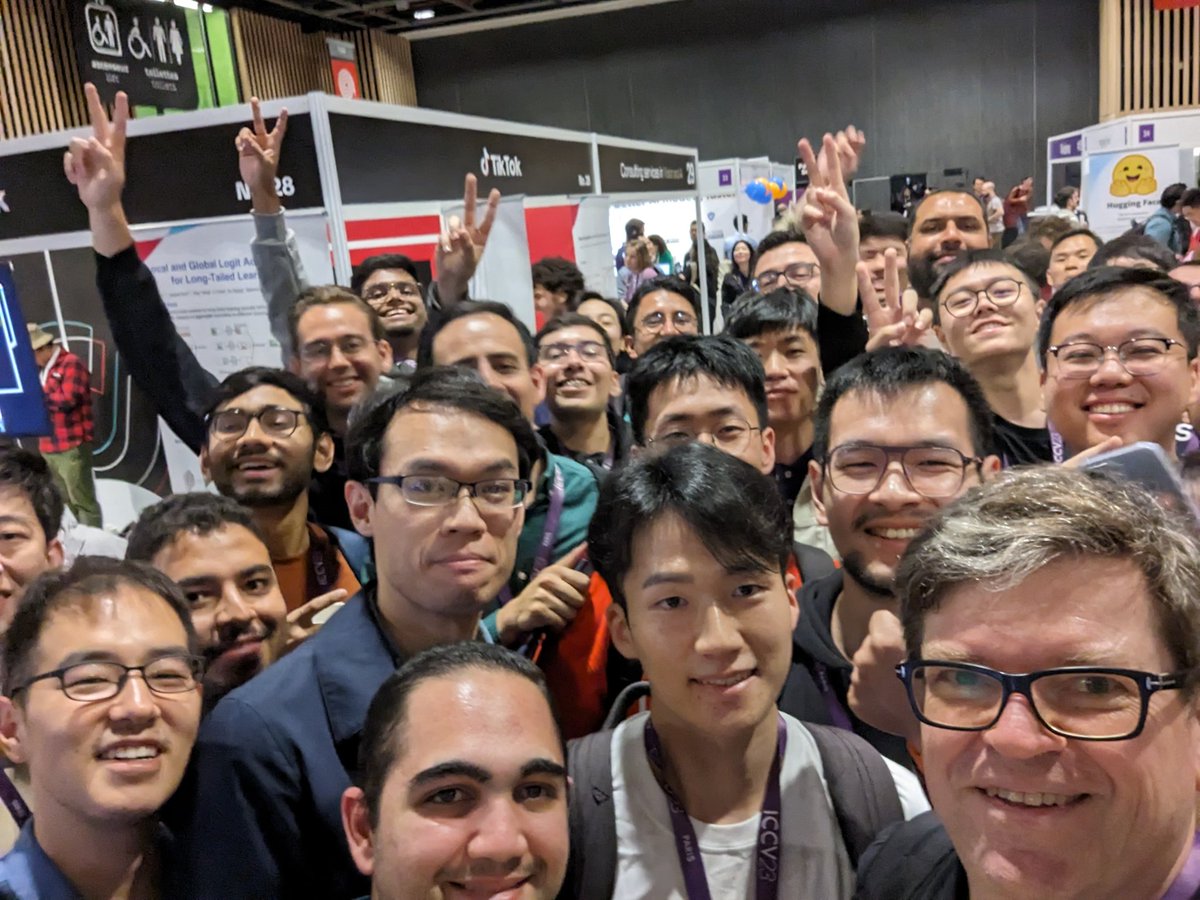
We are happy to announce that 4 papers were accepted to #ICCV2023! Here is a short overview of all the amazing work our team and collaborators have done over the last months. See you at #ICCV2023 in Paris in October !🇫🇷✈️ 1/n
Hardware-Aware Modular Least Expensive Training (HAMLET) is a real-time domain adaptation framework for semantic segmentation.
✅ 34% less back-propagation FLOPS
✅ 29FPS on consumer-grade GPUs
9/n
To Adapt or Not to Adapt? Real-Time Adaptation for Semantic Segmentation
paper page: https://t.co/qWaVPMlvK7
The goal of Online Domain Adaptation for semantic segmentation is to handle unforeseeable domain changes that occur during deployment, like sudden weather events. However, the high computational costs associated with brute-force adaptation make this paradigm unfeasible for real-world applications. In this paper we propose HAMLET, a Hardware-Aware Modular Least Expensive Training framework for real-time domain adaptation. Our approach includes a hardware-aware back-propagation orchestration agent (HAMT) and a dedicated domain-shift detector that enables active control over when and how the model is adapted (LT). Thanks to these advancements, our approach is capable of performing semantic segmentation while simultaneously adapting at more than 29FPS on a single consumer-grade GPU. Our framework's encouraging accuracy and speed trade-off is demonstrated on OnDA and SHIFT benchmarks through experimental results.
🌱 This work is a collaboration between Marc Botet Colomer*, myself*, Theodor Panagiotakopoulos, João Frederico Carvalho, @LinusHNielsen, @HosseinAzizpour, Hedvig Kjellström, Daniel Cremers, and @mattpoggi .
🚀 Daily, we marvel at #AI progress, yet one human ability stands unchallenged: immediate adaptation.
💡 Today, we're closing that gap! Introducing 💀 To Adapt or Not to Adapt? Real-Time Adaptation for Semantic Segmentation. An AI that shifts gears as swiftly as we do! #ICCV2023