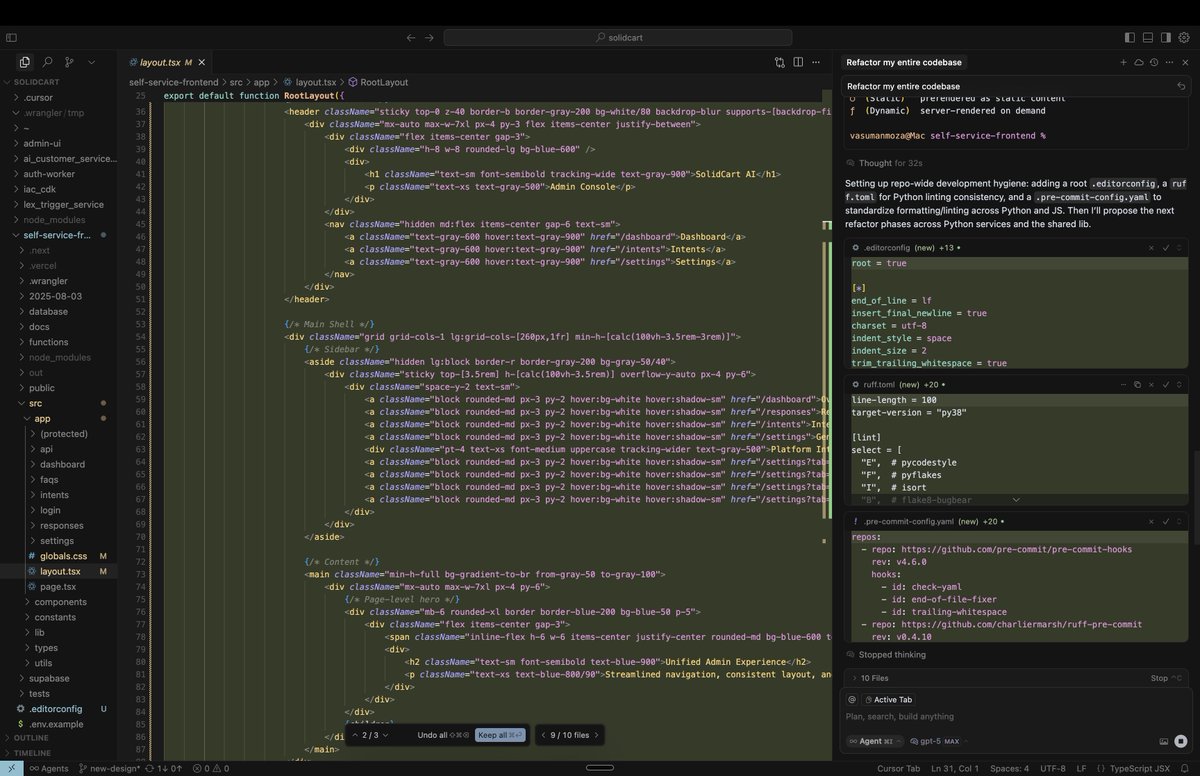
GPT-5 just refactored my entire codebase in one call.
25 tool invocations. 3,000+ new lines. 12 brand new files.
It modularized everything. Broke up monoliths. Cleaned up spaghetti.
None of it worked.
But boy was it beautiful.
If more developers ran Linux on their desktop, maybe they wouldn't be so petrified of running a server by themselves. We are unlearning the basics of the Internet at an alarming rate.
WEKO-Entscheid: Sieg im #Glasfaserstreit! 💪
Swisscom darf Glasfasernetz nicht monopolisieren.
Mehr Infos in unserer Medienmitteilung: https://t.co/SV6oZ389BG
There are only 2 types of good software.
1. Software made by a company with a clear direction and enough investment to hire great people (Tailscale, Vercel, Linear).
2. Software made by 1 person in 1995 that looks like ass but runs instantly and does exactly what you need.
@Microsoft downplaying novel SMTP Smuggeling attack by @timolongin, @Cisco calling it a feature #verygoodsecurity Fix postfix and don't open legit looking mails in the next few days, especially when Microsoft or Cisco is involved. https://t.co/mGssT1whnX
S24 Zug - ZH HB 5min verspätet, S2 trottet der verspäteten S24 in ZH Enge mit 5min Verspätung hinterher. In Oerlikon wartet die neue S24 Wipkingen - Kemptthal dann aber aber nicht auf den Anschluss der S2. Wunderbar gelöst diese Viaduktsanierung #fail#zvv
One: They're not spying on "Apple & Google," they're spying on 𝐲𝐨𝐮.
Two: It's not just the DOJ, or even the US. Foreign countries are also demanding your info.
Now ask yourself: why haven't Apple/Google begun blinding themselves to this data? This is privacy-hostile design.
WHAT THE EFFING F!!! I don't understand anything about networks.
As you know, Google shook the beehive that is infosec by providing a .zip domain. The community has exploded in outrage over the fact that this makes a lot of phishing-style attacks easier.
This excellent post shows the dangers with a GitHub URL. This would confuse even experts.
https://t.co/mq7CRa8CBV
The problem is less .zip and more the fact we allow URLs of the form http://username:[email protected]. This has long been used to confuse people, the .zip domain only makes this slightly easier.
But this really has no valid functionality. A password inside a URL is not a password. It's almost entirely used for hacker attacks.
Not only should Google Chrome remove the feature, so should we write an RFC explicitly deprecating the functionality.
So I went back to re-read the RFC 1738 that standardizes the format of URLs. What I find is that while username:password is specified for things like FTP, it's not allowed for HTTP.
Let me repeat: THE USERNAME:PASSWORD FEATURE IS ALREADY A VIOLATION OF THE STANDARD.
We don't need to write an RFC deprecating the feature. We need to write an RFC clarifying that we really mean it -- that doing so is bad, and that everyone should really change their products to be compliant with RFC 1738.
I feel as a so-called "expert" in such things I should already have known this.
@FreeMindedCH @NZZ@Swisscom Der Preis-Unterschied zwischen «billig» (#P2MP) und «Luxus» (#P2P) beträgt ca. 2 Franken (in Worten: zwei) pro Jahr und Anschluss, bezogen auf eine Lebensdauer von 30 Jahren. Das könnte man schon sagen, @haberli_stefan@NZZ, nicht wahr?! #Glasfaserstreit#P2PvsP2MP
Happy to announce the @httpie public beta launch! It's a huge milestone. Check this out and post in the reply all your thoughts: 👉 https://t.co/DUo0djDha0 👈
Undoubtedly, it's the best project I've ever worked on. And here is why 🧶
I refuse to bookmark a website. I will simply use the far more logical system of keeping 400 tabs open on 32 browser windows until my computer crashes and I can finally be free.
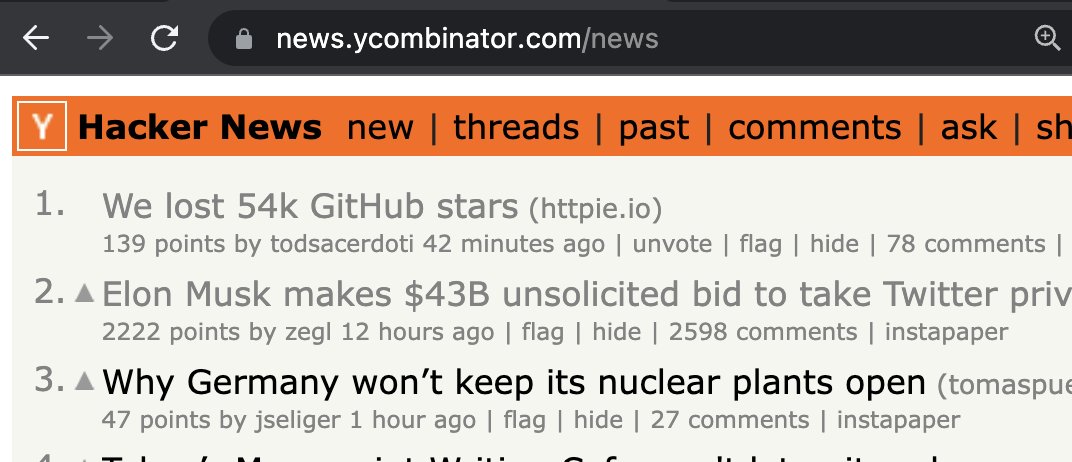
#1 on HN for the wrong reason (and beating @elonmusk!) 🥹😃 Here’s a tale of how I accidentally deleted @httpie’s 54k @github stars by making the repo private for a moment: https://t.co/qizV8TVA4Y